More Alleged SIM Swappers Face Justice

Prosecutors in Northern California have charged two men with using unauthorized SIM swaps to steal and extort money from victims. One of the individuals charged allegedly used a hacker nickname belonging to a key figure in the underground who’s built a solid reputation hijacking mobile phone numbers for profit.

According to indictments unsealed this week, Tucson, Ariz. resident Ahmad Wagaafe Hared and Matthew Gene Ditman of Las Vegas were part of a group that specialized in tricking or bribing representatives at the major wireless providers into giving them control over phone numbers belonging to people they later targeted for extortion and theft.

Investigators allege that between October 2016 and May 2018, Hared and Ditman grew proficient at SIM swapping, a complex form of mobile phone fraud that is often used to steal large amounts of cryptocurrencies and other items of value from victims.

The Justice Department says Hared was better known to his co-conspirators as “winblo.” That nickname corresponds to an extremely active and at one time revered member of the forum ogusers[.]com, a marketplace for people who wish to sell highly prized social media account names — including short usernames at Twitter, Instagram and other sites that can fetch thousands of dollars apiece.
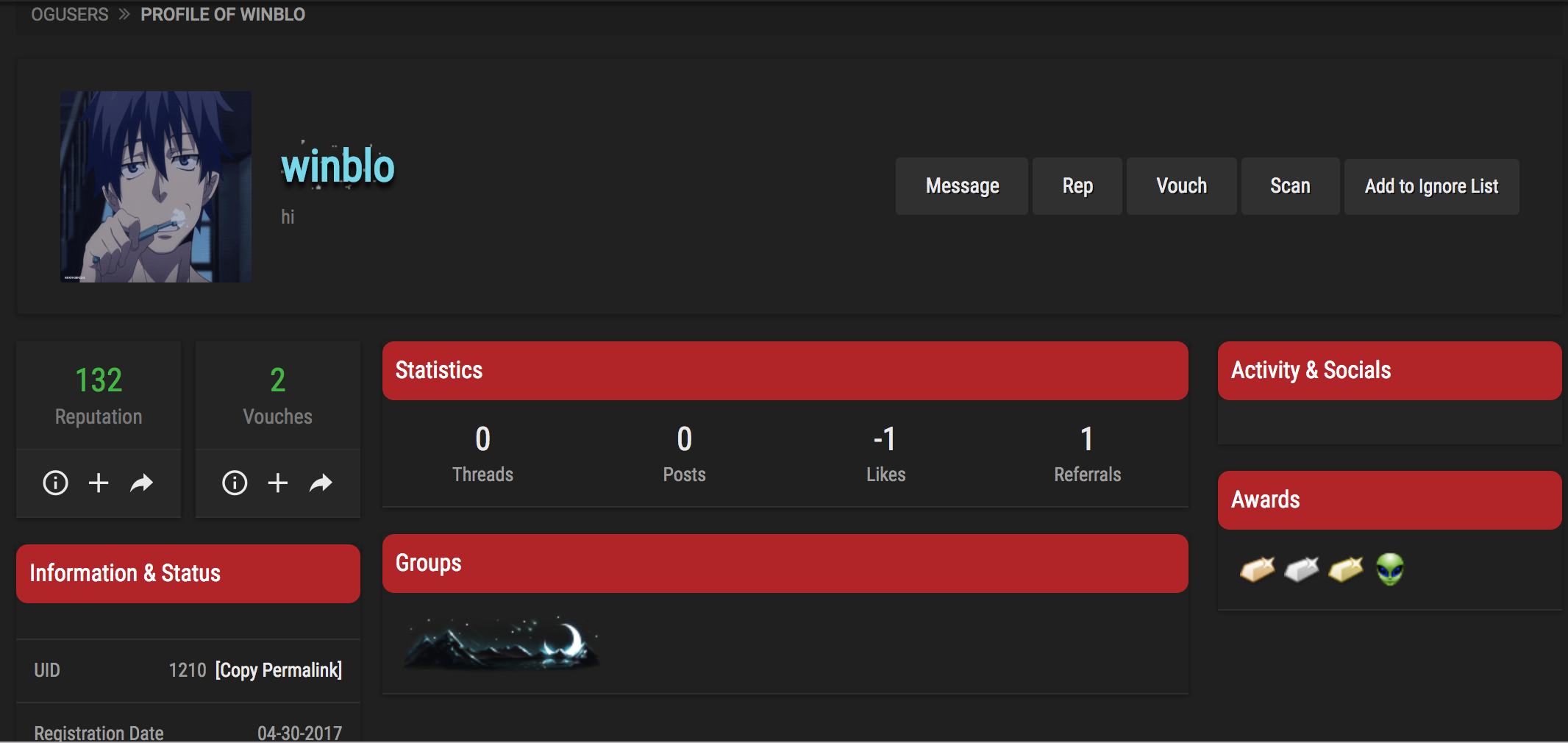
Winblo’s account on ogusers[.]com

Winblo was an associate and business partner of another top Oguser member, a serial SIM swapper known to Oguser members as “Xzavyer.” In August 2018, authorities in California arrested a hacker by the same name — whose real name is Xzavyer Clemente Narvaez — charging him with identity theft, grand theft, and computer intrusion.

Prosecutors allege Narvaez used the proceeds of his crimes (estimated at > $1 million in virtual currencies) to purchase luxury items, including a McLaren — a $200,000 high-performance sports car.

According to the indictments against Hared and Ditman, one of the men (the indictment doesn’t specify which) allegedly used his ill-gotten gains to purchase a BMW i8, an automobile that sells for about $150,000.

Investigators also say the two men stole approximately 40 bitcoins from their SIM swapping victims. That’s roughly $136,000 in today’s conversion, but it would have been substantially more in 2017 when the price of a single bitcoin reached nearly $20,000.

Interestingly, KrebsOnSecurity was contacted in 2018 by a California man who said he was SIM swapped by Winblo and several associates. That victim, who asked not to be identified for fear of reprisals, said his Verizon mobile number was SIM hijacked by Winblo and others who used that access to take over his Twitter and PayPal accounts and then demand payment for the return of the accounts.

A computer specialist by trade, the victim said he was targeted because he’d invested in a cryptocurrency startup, and that the hackers found his contact information from a list of investors they’d somehow obtained. As luck would have it, he didn’t have much of value to steal in his accounts.

The victim said he learned more about his tormentors and exactly how they’d taken over his mobile number after they invited him to an online chat to negotiate a price for the return of his accounts.

“They told me they had called a Verizon employee line [posing as a Verizon employee] and managed to get my Verizon account ID number,” said my victim source. “Once they had that, they called Verizon customer service and had them reset the password. They literally just called and pretended to be me, and were able to get my account tied to another SIM card.”

The victim said his attackers even called his mom because the mobile account was in her name. Soon after that, his phone went dead.

“The funny thing was, after I got my account back the next day, there was a voicemail from a Verizon customer service agent who said something like, ‘Hey [omitted], heard you were having trouble with your line, hope the new SIM card is working okay, give us a call if not, have a nice day.’”

RECKONING

The indictments against Hared and Ditman come amid a series of arrests, charges and sentences targeting admitted and suspected SIM swappers. Last week, Joel Ortiz — a 20-year-old college student valedictorian accused of stealing more than $5 million in cryptocurrency in a slew of SIM hijacking attacks — became the first to be convicted for the crime, accepting a plea deal for a 10-year prison term.

Many of the people being arrested and charged with SIM swapping were part of a tight circle of individuals who spent money almost as quickly as they stole it. The video below was posted to the Instagram account “O,” a username that was hijacked by Ortiz. The video shows a birthday party celebration for Xzavyer Narvarez at the Hyde Sunset club in Los Angeles. Notice the Twitter bird symbols at the bottom of each card brought out by the club’s female attendants.


Another video posted by Ortiz — to a hijacked, highly sought Instagram account “T” — shows members of this group dumping out $200 bottles of glow-in-the-dark Dom Perignon champagne onto designer watches that cost thousands of dollars each.


Also last week, 20-year-old Dawson Bakies pleaded not guilty in Manhattan Supreme Court to 52 counts of identity theft, grand larceny, and computer trespass tied to alleged SIM swapping activity. According to the New York Post, Bakies, who lives with his mom in Columbus, Ohio, allegedly called customer-service representatives posing as his victims and was able to port their phone numbers to a device he controlled.

In November 2018, authorities in New York arrested 21-year-old Manhattan resident Nicholas Truglia on suspicion of using SIM swaps to steal approximately $1 million worth of cryptocurrencies from a Silicon Valley executive. Truglia also is being sued by cryptocurrency angel investor Michael Terpin, who alleges that Truglia used a SIM swap against AT&T to steal $24 million in cryptocurrencies from him.

WHAT CAN YOU DO?

SIM swappers tend to target people with plenty of funds in the bank or in cryptocurrency exchanges, but as my victim source’s story shows, they often also SIM swap individuals who only appear to be high rollers. In the process, they may also rifle through your personal email and try to extort victims in exchange for turning over access to hijacked accounts.

There are several steps that readers can take to insulate themselves from SIM swapping attacks. First and foremost, do not re-use passwords to important accounts anywhere else. Also, take full advantage of the most robust form of multi-factor authentication available for the accounts you care about.

The web site twofactorauth.org breaks down online service providers by the types of secondary authentication offered (SMS, call, app-based one-time codes, security keys). Take a moment soon to review this important resource and harden your security posture wherever possible.

If the only two-factor authentication offered by a company you use is based on sending a one-time code via SMS or automated phone call, this is still better than relying on simply a password alone. But one-time codes generated by a mobile phone app such as Authy or Google Authenticator are more secure than SMS-based options because they are not directly vulnerable to SIM-swapping attacks. If available, physical security keys are an even better option.

Further reading:

Hanging Up on Mobile in the Name of Security

Busting SIM Swappers and SIM Swap Myths

from Krebs on Security http://bit.ly/2GfOiyS
via IFTTT

Crooks Continue to Exploit GoDaddy Hole

Godaddy.com, the world’s largest domain name registrar, recently addressed an authentication weakness that cybercriminals were using to blast out spam through legitimate, dormant domains. But several more recent malware spam campaigns suggest GoDaddy’s fix hasn’t gone far enough, and that scammers likely still have a sizable arsenal of hijacked GoDaddy domains at their disposal.

On January 22, KrebsOnSecurity published research showing that crooks behind a series of massive sextortion and bomb threat spam campaigns throughout 2018 — an adversary that’s been dubbed “Spammy Bear” —  achieved an unusual amount of inbox delivery by exploiting a weakness at GoDaddy which allowed anyone to add a domain to their GoDaddy account without validating that they actually owned the domain.

Spammy Bear targeted dormant but otherwise legitimate domains that had one thing in common: They all at one time used GoDaddy’s hosted Domain Name System (DNS) service. Researcher Ron Guilmette discovered that Spammy Bear was able to hijack thousands of these dormant domains for spam simply by registering free accounts at GoDaddy and telling the company’s automated DNS service to allow the sending of email with those domains from an Internet address controlled by the spammers.

Very soon after that story ran, GoDaddy said it had put in place a fix for the problem, and had scrubbed more than 4,000 domain names used in the spam campaigns that were identified in my Jan. 22 story. But on or around February 1, a new spam campaign that leveraged similarly hijacked domains at GoDaddy began distributing Gand Crab, a potent strain of ransomware.

As noted in a post last week at the blog MyOnlineSecurity, the Gand Crab campaign used a variety of lures, including fake DHL shipping notices and phony AT&T e-fax alerts. The domains documented by MyOnlineSecurity all had their DNS records altered between Jan. 31 and Feb. 1 to allow the sending of email from Internet addresses tied to two ISPs identified in my original Jan. 22 report on the GoDaddy weakness.

“What makes these malware laden emails much more likely to be delivered is the fact that the sending domains all have a good reputation,” MyOnlineSecurity observed. “There are dozens, if not hundreds of domains involved in this particular campaign. Almost all the domains have been registered for many years, some for more than 10 years.”

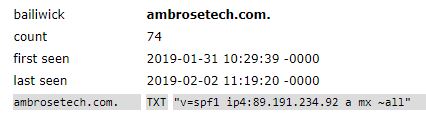
A “passive DNS” lookup shows the DNS changes made by the spammers on Jan. 31 for one of the domains used in the Gand Crab spam campaign documented by MyOnlineSecurity. Image: Farsight Security.

In a statement provided to KrebsOnSecurity, GoDaddy said the company was confident the steps it took to address the problem were working as intended, and that GoDaddy had simply overlooked the domains abused in the recent GandCrab spam campaign.

“The domains used in the Gand Crab campaign were modified before then, but we missed them in our initial sweep,” GoDaddy spokesperson Dan Race said. “While we are otherwise confident of the mitigation steps we took to prevent the dangling DNS issue, we are working to identify any other domains that need to be fixed.”

“We do not believe it is possible for a person to hijack the DNS of one or more domains using the same tactics as used in the Spammy Bear and Gand Crab campaigns,” Race continued. “However, we are assessing if there are other methods that may be used to achieve the same results, and we continue our normal monitoring for account takeover. We have also set up a reporting alias at dns-spam-concerns@godaddy.com to make it easier to report any suspicious activity or any details that might help our efforts to stop this kind of abuse.”

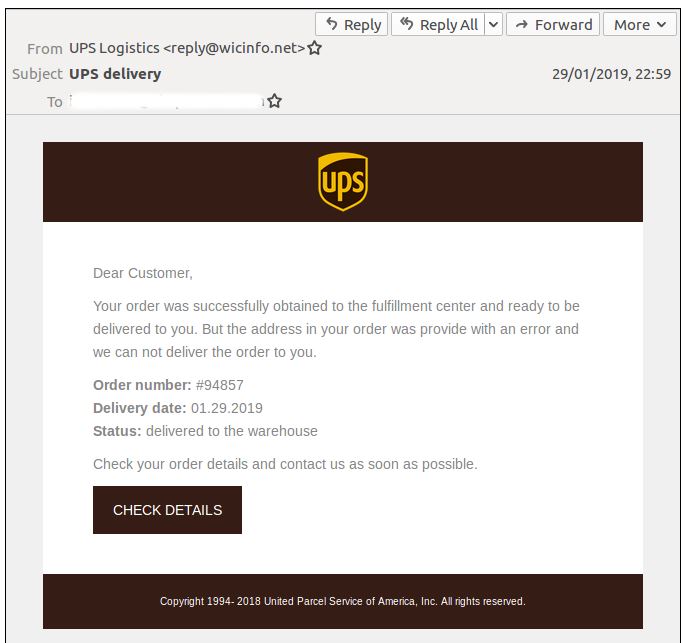
That email address is likely to receive quite a few tips in the short run. Virusbulletin editor Martijn Grooten this week published his analysis on a January 29 malware email campaign that came disguised as a shipping notice from UPS. Grooten said the spam intercepted from that campaign included links to an Internet address that was previously used to distribute GandCrab, and that virtually all of the domains seen sending the fake UPS notices used one of two pairs of DNS servers managed by GoDaddy.

“The majority of domains, which we think had probably had their DNS compromised, still point to the same IP address though,” Grooten wrote. That IP address is currently home to a Web site that sells stolen credit card data.

The fake UPS message used in a Jan. 29 Gand Crab malware spam campaign. Source: Virusbulletin.

Grooten told KrebsOnSecurity he suspects criminals may have succeeded at actually compromising several of GoDaddy’s hosted DNS servers. For one thing, he said, the same pair (sometimes two pairs) of name servers keep appearing in the same campaign.

“In quite a few campaigns we saw domains used that were alphabetically close, [and] there are other domains used that had moved away from GoDaddy before these campaigns, yet were still used,” Grooten said. “It’s also interesting to note that hundreds — and perhaps thousands — of domains had their DNS changed within a short period of time. Such a thing is hard to do if you have to log into individual accounts.”

GoDaddy did not respond to requests for comment about the possibility of a breach explaining the continuing abuse of its DNS services.

First emerging in early 2018, Gand Crab has been dubbed “the most popular multi-million dollar ransomware of the year.” Last week, KrebsOnSecurity was contacted by a company hit with Gand Crab in late January after an employee was taken in by what appears to be the same campaign detailed by Virusbulletin.

Charlene Price is co-owner of A.S. Price Mechanical, a small metal fabrication business in Gilbert, South Carolina. Price said an employee was tricked into infecting one of their hard drives with Gand Crab, which encrypted the drive and demanded $2,000 in bitcoin for a key needed to unlock the files.

While Price and her husband consulted with tech experts and debated what to do next, the extortionists doubled the ransom demand to $4,000.

Sites like nomoreransom.org distribute free tools and tutorials that can help some ransomware victims recover their files without paying a ransom demand, but those tools often only work with specific versions of a particular ransomware strain. Price said the tool nomoreransom.org made available for Gand Crab infections was unable to decrypt the files on her scrambled hard drive.

“It’s not fair or right and this is unjust,” Price said. “We have accepted the fact, for now, that we are just locked out our company’s information. We know nothing about this type of issue other than we have to pay it or just start again.”

from Krebs on Security http://bit.ly/2D6zxui
via IFTTT

250 Webstresser Users to Face Legal Action

More than 250 customers of a popular and powerful online attack-for-hire service that was dismantled by authorities in 2018 are expected to face legal action for the damage they caused, according to Europol, the European Union’s law enforcement agency.

In April 2018, investigators in the U.S., U.K. and the Netherlands took down attack-for-hire service WebStresser[.]org and arrested its alleged administrators. Prior to the takedown, the service had more than 151,000 registered users and was responsible for launching some four million attacks over three years. Now, those same authorities are targeting people who paid the service to conduct attacks.

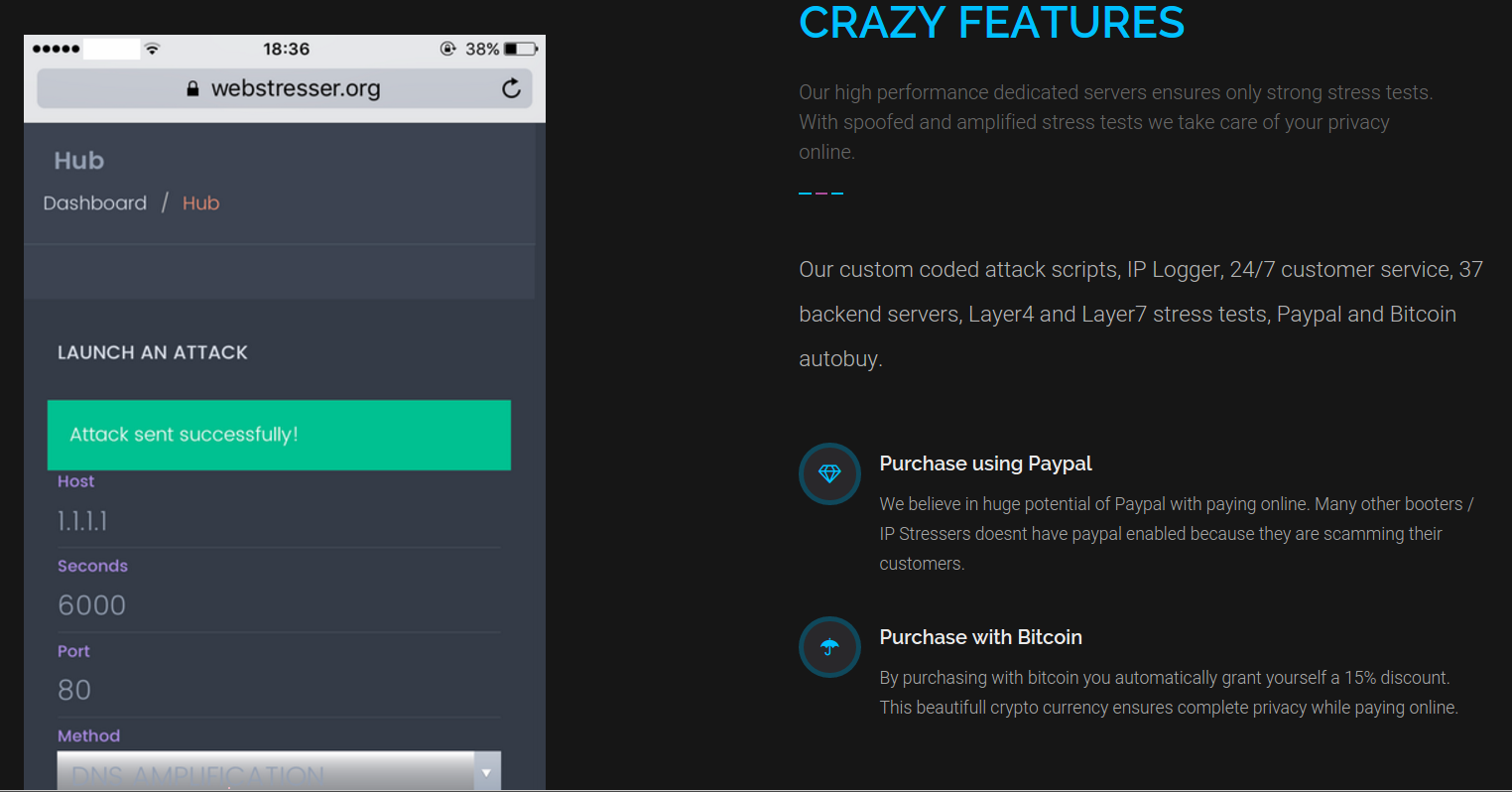
Webstresser.org (formerly Webstresser.co), as it appeared in 2017.

In the United Kingdom, police have seized more than 60 personal electronic devices from a number of Webstresser users, and some 250 customers of the service will soon face legal action, Europol said in a statement released this week.

“Size does not matter – all levels of users are under the radar of law enforcement, be it a gamer booting out the competition out of a game, or a high-level hacker carrying out DDoS attacks against commercial targets for financial gain,” Europol officials warned.

The focus on Webstresser’s customers is the latest phase of “Operation Power Off,” which targeted one of the most active services for launching point-and-click distributed denial-of-service (DDoS) attacks. WebStresser was one of many so-called “booter” or “stresser” services — virtual hired muscle that even completely unskilled users can rent to knock nearly any website or Internet user offline.

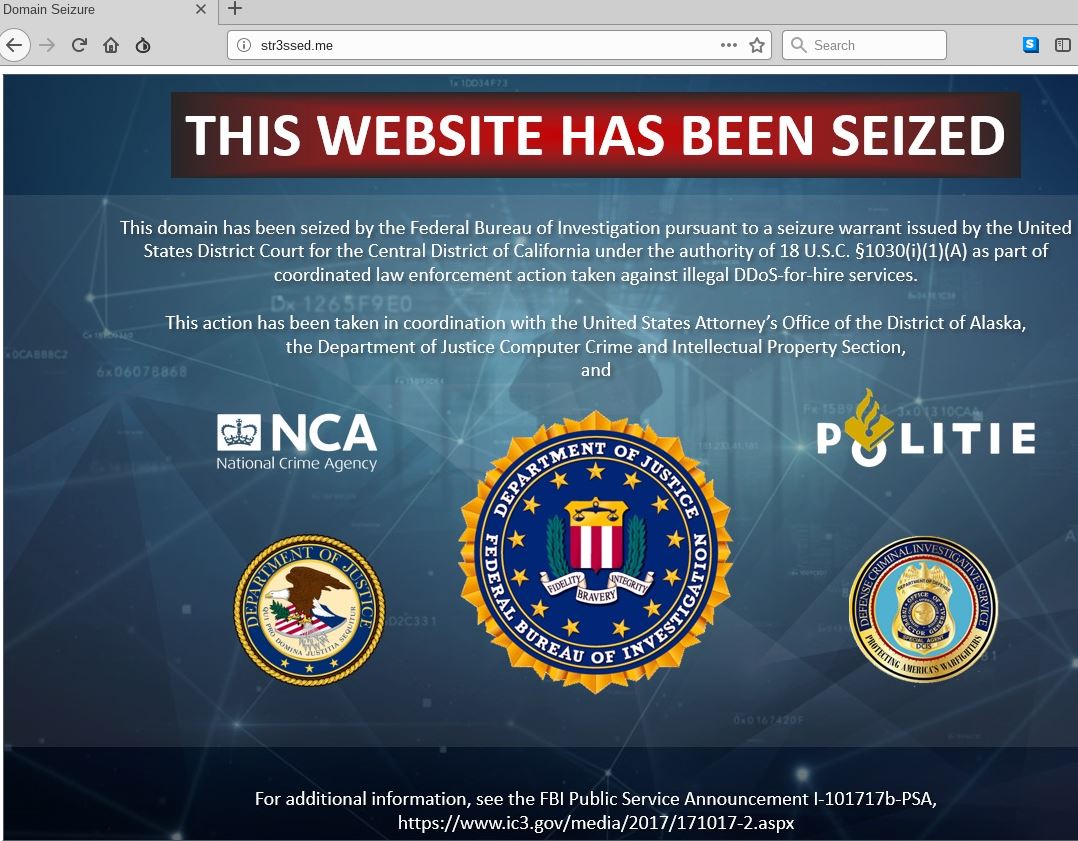
Operation Power Off is part of a broader law enforcement effort to disrupt the burgeoning booter service industry and to weaken demand for such services. In December, authorities in the United States filed criminal charges against three men accused of running booter services, and orchestrated a coordinated takedown of 15 different booter sites.

This seizure notice appeared on the homepage of more than a dozen popular “booter” or “stresser” DDoS-for-hire Web sites in December 2018.

The takedowns come as courts in the United States and Europe are beginning to hand down serious punishment for booter service operators, their customers, and for those convicted of launching large-scale DDoS attacks. Last month, a 34-year-old Connecticut man received a 10-year prison sentence for carrying out DDoS attacks a number of hospitals in 2014. Also last month, a 30-year-old in the United Kingdom was sentenced to 32 months in jail for using an army of hacked devices to crash large portions of Liberia’s Internet access in 2016.

In December 2018, the ringleader of an online crime group that launched DDoS attacks against Web sites — including several against KrebsOnSecurity — was sentenced to three years in a U.K. prison. And in 2017, a 20-year-old from Britain was sentenced to two years in jail for renting out Titanium Stresser, a booter service that earned him $300,000 over several years it was in operation.

Many in the hacker community have criticized authorities for targeting booter service administrators and users and for not pursuing what they perceive as more serious cybercriminals, noting that the vast majority of both groups are young men under the age of 21 and are using booter services to settle petty disputes over online games.

But not all countries involved in Operation Power Off are taking such a punitive approach. In the Netherlands, the police and the prosecutor’s office have deployed new legal intervention called “Hack_Right,” a diversion program intended for first-time cyber offenders. Europol says at least one user of Webstresser has already received this alternative sanction.

“Skills in coding, gaming, computer programming, cyber security or anything IT-related are in high demand and there are many careers and opportunities available to use these wisely,” Europol said.

According to U.S. federal prosecutors, the use of booter and stresser services to conduct attacks is punishable under both wire fraud laws and the Computer Fraud and Abuse Act (18 U.S.C. § 1030), and may result in arrest and prosecution, the seizure of computers or other electronics, as well as prison sentences and a penalty or fine.

from Krebs on Security http://bit.ly/2Da6ZjJ
via IFTTT

Three Charged for Working With Serial Swatter

The U.S. Justice Department has filed criminal charges against three U.S. men accused of swatting, or making hoax reports of bomb threats or murders in a bid to trigger a heavily armed police response to a target’s address. Investigators say the men, aged 19 to 23, all carried out the attacks with the help of Tyler Barriss, a convicted serial swatter whose last stunt in late 2018 cost an Oklahoma man his life.

Image: FBI.gov

FBI agents on Wednesday arrested Neal Patel, 23, of Des Plaines, Ill. and Tyler Stewart, 19 of Gulf Breeze, Fla. The third defendant, Logan Patten, 19, of Greenwood, Mo., agreed to turn himself in. The men are charged in three separate indictments with conspiracy and conveying false information about the use of explosive devices.

Investigators say Patten, who used the Twitter handle “@spared,” hired Barriss in December 2017 to swat individuals and a high school in Less’s Summit, Mo.

Around the same time, Stewart, a.k.a. “@tragic” on Twitter, allegedly worked with Barriss to make two phony bomb threats to evacuate a high school in Gurnee, Ill. In that incident, Barriss admitted telling police in Gurnee he had left explosives in a classroom and was high on methamphetamine and was thinking about shooting teachers and students.

Also in December 2017, Patel allegedly worked with Barriss to plan a bomb threat targeting a video game convention in Dallas, Texas. Patel is also accused of using stolen credit cards to buy items of clothing for Barriss.

The Justice Department’s media release on the indictments doesn’t specify which convention Barriss and Patel allegedly swatted, but a Wired story from last year tied Barriss to a similarly timed bomb threat that caused the evacuation of a major Call of Duty tournament at the Dallas Convention Center.

“When the social media star SoaR Ashtronova tweeted about the confusion she felt as she fled the event beneath the whir of police helicopters, Barriss taunted her from one of his Twitter accounts: ‘It got ran, baby girl. Thats what happens,” Wired reported.

Interestingly, it was a dispute over a $1.50 grudge match in a Call of Duty game that would ultimately lead to Barriss’s final — and fatal — swatting a year later. On Dec. 28, 2018, Barriss phoned police in Wichita, Kan. from his location in California, telling them he was a local man who’d just shot his father and was holding other family members hostage.

Prosecutors say Barriss did so after getting in the middle of a dispute between two Call of Duty gamers, 18-year-old Casey Viner from Ohio and Shane Gaskill, 20, from Wichita. Viner allegedly asked Barriss to swat Gaskill. But when Gaskill noticed Barriss’ Twitter account suddenly following him online, he tried to deflect the attack. Barriss says Gaskill allegedly dared him to go ahead with the swat, but then gave Barriss an old home address — which was then being occupied by someone else.

When Wichita police responded to the address given by Barriss, they shot and killed 28-year-old Andrew Finch, a father of two who had no party to the dispute and did not know any of the three men.

Both Viner and Gaskill have been charged with wire fraud, conspiracy and obstruction of justice. Barriss pleaded guilty in Nov. 2018 to a total of 51 charges brought by federal prosecutors in Los Angeles, Kansas and Washington, D.C. He has agreed to serve a sentence of between 20 to 25 years in prison. Barrris is slated to be sentenced on March 1, 2019.

Stewart’s attorney declined to comment. Lawyers assigned to Patel and Patten could not be reached for comment.

As the victim of a swatting attack in 2013 and several other unsuccessful attempts, I am pleased to see federal authorities continue to take this crime seriously. According to the FBI, each swatting incident costs emergency responders approximately $10,000. Each hoax also unnecessarily endangers the lives of the responders and the public, and draws important resources away from actual emergencies.

from Krebs on Security http://bit.ly/2WjGZuT
via IFTTT

How the U.S. Govt. Shutdown Harms Security

The ongoing partial U.S. federal government shutdown is having a tangible, negative impact on cybercrime investigations, according to interviews with federal law enforcement investigators and a report issued this week by a group representing the interests of FBI agents. Even if lawmakers move forward on new proposals to reopen the government, sources say the standoff is likely to have serious repercussions for federal law enforcement agencies for years to come.

One federal agent with more than 20 years on the job told KrebsOnSecurity the shutdown “is crushing our ability to take the fight to cyber criminals.”

“The talent drain after this is finally resolved will cost us five years,” said the source, who asked to remain anonymous because he was not authorized to speak to the news media. “Literally everyone I know who is able to retire or can find work in the private sector is actively looking, and the smart private companies are aware and actively recruiting. As a nation, we are much less safe from a cyber security posture than we were a month ago.”

The source said his agency can’t even get agents and analysts the higher clearances needed for sensitive cases because everyone who does the clearance processing is furloughed.

“Investigators who are eligible to retire or who simply wish to walk away from their job aren’t retiring or quitting now because they can’t even be processed out due to furlough of the organization’s human resources people,” the source said. “These are criminal investigations involving national security. It’s also a giant distraction and people aren’t as focused.”

The source’s comments echoed some of the points made in a 72-page report (PDF) released this week by the FBI Agents Association, a group that advocates on behalf of active and retired FBI special agents.

“Today we have no funds for making Confidential Human Source payments,” reads a quote from the FBIAA report, attributed to an agent in the FBI’s northeast region. “In my situation, I have two sources that support our national security cyber mission that no longer have funding. They are critical sources providing tripwires and intelligence that protect the United States against our foreign adversaries. The loss in productivity and pertinent intelligence is immeasurable.”

My federal law enforcement source mentioned his agency also was unable to pay confidential informants for their help with ongoing investigations.

“We are having the same problems like not being able to pay informants, no travel, critical case coordination meetings postponed, and no procurements to further the mission,” the source said.

The extended shutdown directly affects more than 800,000 workers, many of them furloughed or required to work without pay. Some federal employees, now missing at least two back-to-back paychecks, are having trouble keeping food on the table. CNN reports that FBI field offices across the country are opening food banks to help support special agents and staff struggling without pay.

An extended lack of pay is forcing many agents to seek side hustles and jobs, despite rules that seek to restrict such activity, according to media reports. Missing multiple paychecks also can force investigators to take on additional debt. This is potentially troublesome because excess debt down the road can lead to problems keeping one’s security clearances.

Excessive debt is a threat to clearances because it can make people more susceptible to being drawn into illegal activities or taking bribes for money, which in turn may leave them vulnerable to extortion. Indeed, this story from Clearancejobs.com observes that the shutdown may be inadvertently creating new recruiting opportunities for foreign intelligence operatives.

“If you are a hostile intelligence service human intelligence (HUMINT) targeting officer you are hoping this situation lasts a long time and has a multitude of unintended consequences affecting the cleared government employee population,” writes Christopher Burgess.

The shutdown may impact government and civilian cybersecurity efforts in other ways. As Brian Fung reported last week at The Washington Post, a rising number of federal Web sites are falling into disrepair, making it harder for Americans to access online services.

“In the past week, the number of outdated Web security certificates held by U.S. government agencies has exploded from about 80 to more than 130, according to Netcraft, an Internet security firm based in Britain,” Fung wrote.

Alex Stamos, former chief security officer at Facebook, said this creates problems for people trying to access key documents at government Web sites because the world’s dominant browser — Google Chrome — heavily discourages users from even visiting sites with expired security certificates.

But Stamos says he’s far more concerned about who’s maintaining, monitoring and safeguarding the countless Internet servers and other government online assets during the shutdown.

“What worries me more is what this indicates for the fact that there’s not standard maintenance going on,” Stamos said in this week’s episode of security journalist Patrick Gray‘s “Risky Business” podcast. “We’ve gone through a Patch Tuesday since the government shut down. Who is actually maintaining the systems, who is sitting in the SOCs [security operations centers], who’s looking at the logs? Even if you have critical cybersecurity people at NSA or Cyber Command working, there’s a lot of importance in having people show up for their jobs.”

U.S. Senate leaders are now planning to hold competing votes on Thursday in a bid to end the shutdown, but a story Wednesday in The New York Times reckons that neither measure is expected to draw the 60 votes required to advance.

“You hear [New England Patriots football coach Bill] Belichick and other coaches constantly preaching about leaving distractions outside the locker room,” said the federal law enforcement source who spoke with this author. “Can’t think of many bigger distractions like not getting paid, damaging credit scores, not being able to pay bills, and losing supplemental insurance. We just wish our national leaders would listen to another Belichick gem: ‘Do Your Job.’”

from Krebs on Security http://bit.ly/2U5QDPQ
via IFTTT

Bomb Threat, Sextortion Spammers Abused Weakness at GoDaddy.com

Two of the most disruptive and widely-received spam email campaigns over the past few months — including an ongoing sextortion email scam and a bomb threat hoax that shut down dozens of schools, businesses and government buildings late last year — were made possible thanks to an authentication weakness at GoDaddy.com, the world’s largest domain name registrar, KrebsOnSecurity has learned.

Perhaps more worryingly, experts warn this same weakness that let spammers hijack domains registered through GoDaddy also affects a great many other major Internet service providers, and is actively being abused to launch phishing and malware attacks which leverage dormant Web site names currently owned and controlled by some of the world’s most trusted corporate names and brands.

In July 2018, email users around the world began complaining of receiving spam which began with a password the recipient used at some point in the past and threatened to release embarrassing videos of the recipient unless a bitcoin ransom was paid. On December 13, 2018, a similarly large spam campaign was blasted out, threatening that someone had planted bombs within the recipient’s building that would be detonated unless a hefty bitcoin ransom was paid by the end of the business day.

Experts at Cisco Talos and other security firms quickly drew parallels between the two mass spam campaigns, pointing to a significant overlap in Russia-based Internet addresses used to send the junk emails. Yet one aspect of these seemingly related campaigns that has been largely overlooked is the degree to which each achieved an unusually high rate of delivery to recipients.

Large-scale spam campaigns often are conducted using newly-registered or hacked email addresses, and/or throwaway domains. The trouble is, spam sent from these assets is trivial to block because anti-spam and security systems tend to discard or mark as spam any messages that appear to come from addresses which have no known history or reputation attached to them.

However, in both the sextortion and bomb threat spam campaigns, the vast majority of the email was being sent through Web site names that had already existed for some time, and indeed even had a trusted reputation. Not only that, new research shows many of these domains were registered long ago and are still owned by dozens of Fortune 500 and Fortune 1000 companies. 

That’s according to Ron Guilmette, a dogged anti-spam researcher who has made a living suing spammers and helping law enforcement officials apprehend online scammers. Researching the history and reputation of more than 5,000 Web site names used in each of the extortionist spam campaigns, Guilmette made a startling discovery: Virtually all of them had at one time been registered via GoDaddy.com, a Scottsdale, Ariz. based domain name registrar and hosting provider.

Guilmette told KrebsOnSecurity he initially considered the possibility that GoDaddy had been hacked, or that thousands of the registrar’s customers perhaps had their GoDaddy usernames and passwords stolen.

But as he began digging deeper, Guilmette came to the conclusion that the spammers were exploiting an obscure — albeit widespread — weakness among hosting companies, cloud providers and domain registrars that was first publicly detailed in 2016.

EARLY WARNING SIGNS

In August 2016, security researcher Matthew Bryant wrote about spammers hijacking some 20,000 established domain names to blast out junk email. A few months later, Bryant documented the same technique being used to take over more than 120,000 trusted domains for spam campaigns. And Guilmette says he now believes the attack method detailed by Bryant also explains what’s going on in the more recent sextortion and bomb threat spams.

Grasping the true breadth of Bryant’s prescient discovery requires a brief and simplified primer on how Web sites work. Your Web browser knows how to find a Web site name like example.com thanks to the global Domain Name System (DNS), which serves as a kind of phone book for the Internet by translating human-friendly Web site names (example.com) into numeric Internet address that are easier for computers to manage.

When someone wants to register a domain at a registrar like GoDaddy, the registrar will typically provide two sets of DNS records that the customer then needs to assign to his domain. Those records are crucial because they allow Web browsers to figure out the Internet address of the hosting provider that’s serving that Web site domain. Like many other registrars, GoDaddy lets new customers use their managed DNS services for free for a period of time (in GoDaddy’s case it’s 30 days), after which time customers must pay for the service.

The crux of Bryant’s discovery was that the spammers in those 2016 campaigns learned that countless hosting firms and registrars would allow anyone to add a domain to their account without ever validating that the person requesting the change actually owned the domain. Here’s what Bryant wrote about the threat back in 2016:

“In addition to the hijacked domains often having past history and a long age, they also have WHOIS information which points to real people unrelated to the person carrying out the attack. Now if an attacker launches a malware campaign using these domains, it will be harder to pinpoint who/what is carrying out the attack since the domains would all appear to be just regular domains with no observable pattern other than the fact that they all use cloud DNS. It’s an attacker’s dream, troublesome attribution and an endless number of names to use for malicious campaigns.”

SAY WHAT?

For a more concrete example of what’s going on here, we’ll look at just one of the 5,000+ domains that Guilmette found were used in the Dec. 13, 2018 bomb threat hoax. Virtualfirefox.com is a domain registered via GoDaddy in 2013 and currently owned by The Mozilla Corporation, a wholly owned subsidiary of the Mozilla Foundation — the makers of the popular Firefox Web browser.

The domain’s registration has been renewed each year since its inception, but the domain itself has sat dormant for some time. When it was initially set up, it took advantage of two managed DNS servers assigned to it by GoDaddy — ns17.domaincontrol.com, and ns18.domaincontrol.com.

GoDaddy is a massive hosting provider, and it has more than 100 such DNS servers to serve the needs of its clients. To hijack this domain, the attackers in the December 2018 spam campaign needed only to have created a free account at GoDaddy that was assigned the exact same DNS servers handed out to Virtualfirefox.com (ns17.domaincontrol.com and ns18.domaincontrol.com). After that, the attackers simply claim ownership over the domain, and tell GoDaddy to route all traffic for that domain to an Internet address they control.

Mozilla spokesperson Ellen Canale said Mozilla took ownership of virtualfirefox.com in September 2017 after a trademark dispute, but that the DNS nameserver for the record was not reset until January of 2019.

“This oversight created a state where the DNS pointed to a server controlled by a third party, leaving it vulnerable to misuse,” Canale said. “We’ve reviewed the configuration of both our registrar and nameservers and have found no indication of misuse. In addition to addressing the immediate problem, we have reviewed the entire catalog of properties we own to ensure they are properly configured.”

According to both Guilmette and Bryant, this type of hijack is possible because GoDaddy — like many other managed DNS providers — does little to check whether someone with an existing account (free or otherwise) who is claiming ownership over a given domain actually controls that domain name.

“During this entire time, and continuing to the present moment, the same bad actor(s) who were responsible for the massive wave of bomb threat bitcoin extortion spams that were emailed to five countries on December 13th, 2018 have been in a position to add, delete, or modify any DNS record associated with any domain name that uses the GoDaddy DNS service,” Guilmette said.

Contacted by KrebsOnSecurity, GoDaddy acknowledged the authentication weakness documented by Guilmette.

“After investigating the matter, our team confirmed that a threat actor(s) abused our DNS setup process,” the company said in an emailed statement.

“We’ve identified a fix and are taking corrective action immediately,” the statement continued. “While those responsible were able to create DNS entries on dormant domains, at no time did account ownership change nor was customer information exposed.”

SPAMMY BEAR

Guilmette has dubbed the criminals responsible as “Spammy Bear” because the majority of the hijacked domains used in the spam campaigns traced back to Internet addresses in Russia.

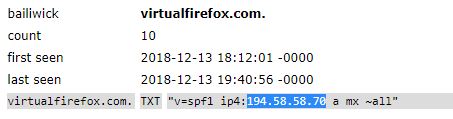
In the case of Mozilla’s Virtualfirefox.com domain, historic DNS records archived by Farsight Security show that indeed on Dec. 13, 2018 — the very same day that spammers began blasting out their bomb threat demands — the Internet address in the domain’s DNS records at GoDaddy were changed to 194.58.58[.]70, a server in the Russian Federation owned by a hosting company there called Reg.ru.

The record above, indexed by Farsight Security, shows that the Internet address for virtualfirefox.com was changed to an ISP in Russia on Dec. 13, 2018, the same day spammers used this domain and more than 5,000 others for a mass emailed bomb threat.

In fact, Guilmette found that that at least 3,500 of the commandeered domains traced back to Reg.ru and to a handful of other hosting firms in Russia. The next largest collection of fraudulently altered Internet addresses were assigned to hosting providers in the United States (456), although some of those providers (e.g. Webzilla/WZ Communications) have strong ties to Russia. The full list of Internet addresses is available here.

Guilmette’s sleuthing on the 5,000+ domains abused in both 2018 spam campaigns, combined with data from Farsight, suggest the spammers hijacked domains belonging to a staggering number of recognizable corporations who registered domains at GoDaddy, including but not limited to:

Abbott Laboratories; Ancestry.com; AutodeskCapital One; CVS Pharmacy; SSL provider Digicert; Dow Chemical; credit card processors Elavon and Electronic Merchant Systems; Fair Isaac Corp.; Facebook; Gap (Apparel) Inc; Fifth Third Bancorp; Hearst CommunicationsHilton InterntionalING Bank; the Massachusetts Institute of Technology (MIT); McDonalds Corp.NBC Universal MediaNRG Energy; Oath, Inc (a.k.a Yahoo + AOL); OracleTesla Motors; Time WarnerUS Bank; US Steel Corp.; National Association; Viacom International; and Walgreens.

In an interview with KrebsOnSecurity, Bryant said the domain hijacking technique can be a powerful tool in the hands of spammers and scammers, who can use domains associated with these companies not only to get their missives past junk and malware filters, but also to make phishing and malware lures far more believable and effective.

“This is extremely advantageous to attackers because they don’t have to pay any money to set it all up, and there’s a strong reputation attached to the domain they’re sending from,” Bryant said. “A lot of services will flag email from unknown domains as high risk, but the domains being hijacked by these guys have a good history and reputation behind them. This method also probably greatly complicates any sort of investigatory efforts after the spam campaign is over.”

WHAT CAN BE DONE?

Guilmette said managed DNS providers can add an extra layer of validation to DNS change requests, checking to see if a given domain already has internal DNS servers assigned to the domain before processing the request. Providers could nullify the threat by simply choosing a different pair of DNS servers to assign to the request. The same validation process would work similarly at other managed DNS providers.

“As long as they’re different, that ruins this attack for the spammers,” Guilmette said. “The spammers want the DNS servers to be the same ones that were already there when the domain was first set up, because without that they can’t pull of this hack. All GoDaddy has to do is see if this particularly odd set of circumstances apply in each request.”

Bryant said after he published his initial research in 2016, a number of managed DNS providers mentioned in his blog posts said they’d taken steps to blunt the threat, including Amazon Web Services (AWS), hosting provider Digital Ocean, and Google Cloud. But he suspects this is still a “fairly common” weakness and hosting providers and registrars, and many providers simply aren’t convinced of the need to add this extra precaution.

“A lot of the providers are of the opinion that it’s down to a user mistake and not a vulnerability they should have to fix,” he said. “But it’s clearly still a big problem.”

from Krebs on Security http://bit.ly/2R7wt60
via IFTTT

773M Password ‘Megabreach’ is Years Old

My inbox and Twitter messages positively lit up today with people forwarding stories from Wired and other publications about a supposedly new trove of nearly 773 million unique email addresses and 21 million unique passwords that were posted to a hacking forum. A story in The Guardian breathlessly dubbed it “the largest collection ever of breached data found.” But in an interview with the apparent seller, KrebsOnSecurity learned that it is not even close to the largest gathering of stolen data, and that it is at least two to three years old.

The dump, labeled “Collection #1” and approximately 87GB in size, was first detailed earlier today by Troy Hunt, who operates the HaveIBeenPwned breach notification service. Hunt said the data cache was likely “made up of many different individual data breaches from literally thousands of different sources.”

KrebsOnSecurity sought perspective on this discovery from Alex Holden, CTO of Hold Security, a company that specializes in trawling underground spaces for intelligence about malicious actors and their stolen data dumps. Holden said the data appears to have first been posted to underground forums in October 2018, and that it is just a subset of a much larger tranche of passwords being peddled by a shadowy seller online.

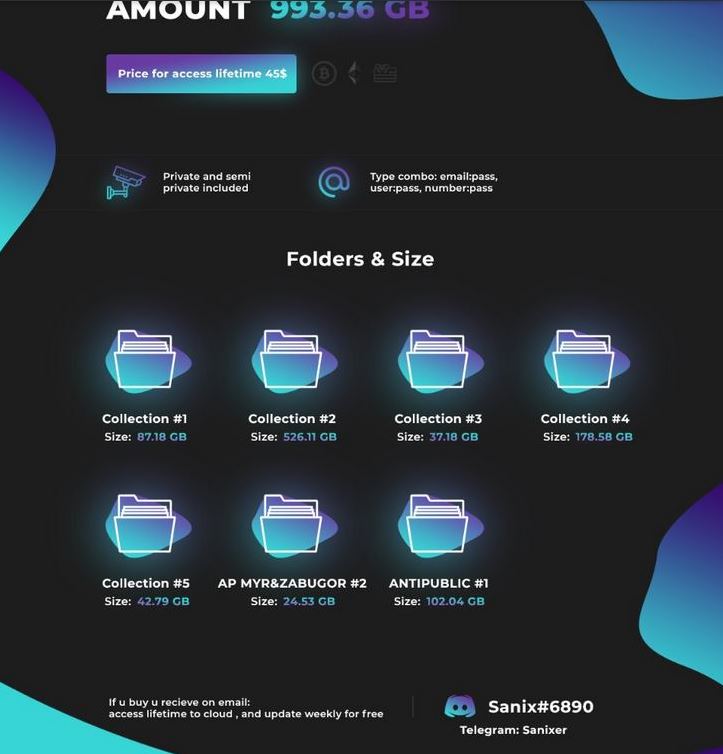
Here’s a screenshot of a subset of that seller’s current offerings, which total almost 1 Terabyte of stolen and hacked passwords:

The 87GB “Collection1” archive is one of but many similar tranches of stolen passwords being sold by a particularly prolific ne’er-do-well in the underground.

As we can see above, Collection #1 offered by this seller is indeed 87GB in size. He also advertises a Telegram username where he can be reached — “Sanixer.” So, naturally, KrebsOnSecurity contacted Sanixer via Telegram to find out more about the origins of Collection #1, which he is presently selling for the bargain price of just $45.

Sanixer said Collection#1 consists of data pulled from a huge number of hacked sites, and was not exactly his “freshest” offering. Rather, he sort of steered me away from that archive, suggested that — unlike most of his other wares — Collection #1 was at least 2-3 years old. His other password packages, which he said are not all pictured in the above screen shot and total more than 4 terabytes in size, are less than a year old, Sanixer explained.

By way of explaining the provenance of Collection #1, Sanixer said it was a mix of “dumps and leaked bases,” and then he offered an interesting screen shot of his additional collections. Click on the image below and notice the open Web browser tab behind his purloined password trove (which is apparently stored at Mega.nz): Troy Hunt’s published research on this 773 million Collection #1.

Sanixer says Collection #1 was from a mix of sources. A description of those sources can be seen in the directory tree on the left side of this screenshot.

Holden said the habit of collecting large amounts of credentials and posting it online is not new at all, and that the data is far more useful for things like phishing, blackmail and other indirect attacks — as opposed to plundering inboxes. Holden added that his company had already derived 99 percent of the data in Collection #1 from other sources.

“It was popularized several years ago by Russian hackers on various Dark Web forums,” he said. “Because the data is gathered from a number of breaches, typically older data, it does not present a direct danger to the general user community. Its sheer volume is impressive, yet, by account of many hackers the data is not greatly useful.”

A core reason so many accounts get compromised is that far too many people have the nasty habit(s) of choosing poor passwords, re-using passwords and email addresses across multiple sites, and not taking advantage of multi-factor authentication options when they are available.

If this Collection #1 has you spooked, changing your password(s) certainly can’t hurt — unless of course you’re in the habit of re-using passwords. Please don’t do that. As we can see from the offering above, your password is probably worth way more to you than it is to cybercriminals (in the case of Collection #1, just .000002 cents per password).

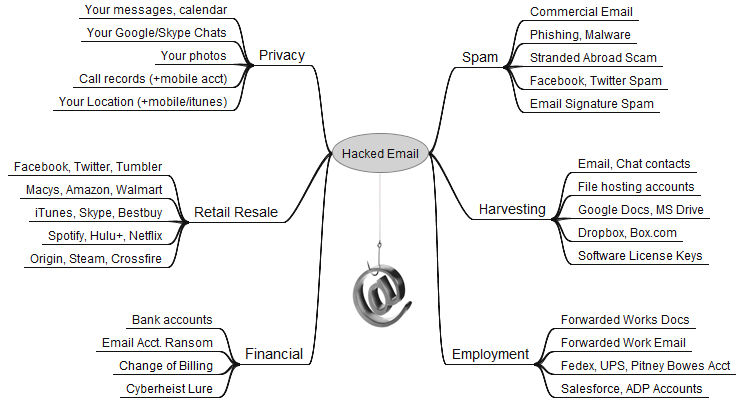
For most of us, by far the most important passwords are those protecting our email inbox(es). That’s because in nearly all cases, the person who is in control of that email address can reset the password of any services or accounts tied to that email address – merely by requesting a password reset link via email. For more on this dynamic, please see The Value of a Hacked Email Account.

Your email account may be worth far more than you imagine.

And instead of thinking about passwords, consider using unique, lengthy passphrases — collections of words in an order you can remember — when a site allows it. In general, a long, unique passphrase takes for more effort to crack than a short, complex one. Unfortunately, many sites do not let users choose passwords or passphrases that exceed a small number of characters, or they will otherwise allow long passphrases but ignore anything entered after the character limit is reached.

If you are the type of person who likes to re-use passwords, then you definitely need to be using a password manager, which helps you pick and remember strong and unique passwords/passphrases and essentially lets you use the same strong master password/passphrase across all Web sites.

Finally, if you haven’t done so lately, mosey on over to twofactorauth.org and see if you are taking full advantage of multi-factor authentication at sites you trust with your data. The beauty of multi-factor is that even if thieves manage to guess or steal your password just because they hacked some Web site, that password will be useless to them unless they can also compromise that second factor — be it your mobile device or security key.

from Krebs on Security http://bit.ly/2RBbtd6
via IFTTT

“Stole $24 Million But Still Can’t Keep a Friend”

Unsettling new claims have emerged about Nicholas Truglia, a 21-year-old Manhattan resident accused of hijacking cell phone accounts to steal tens of millions of dollars in cryptocurrencies from victims. The lurid details, made public in a civil lawsuit filed this week by one of his alleged victims, paints a chilling picture of a man addicted to thievery and all its trappings. The documents suggest that Truglia stole from his father and even a dead man — all the while lamenting that his fabulous new wealth brought him nothing but misery.

The unflattering profile was laid out in a series of documents tied to a lawsuit lodged by Michael Terpin, a cryptocurrency investor who co-founded the first angel investor group for bitcoin enthusiasts in 2013. Terpin alleges that crooks stole almost $24 million worth of cryptocurrency after fraudulently executing a “SIM swap” on his mobile phone account at AT&T in early 2018. Terpin also is pursuing a $200 million civil lawsuit against AT&T in connection with the theft.

Authorities arrested Truglia on November 14, 2018 on suspicion of using SIM swaps to steal approximately $1 million worth of cryptocurrencies from a different Silicon Valley executive. But Terpin’s civil lawsuit (PDF) maintains that evidence was revealed at Truglia’s bail hearing that he had texted his father and multiple friends to brag about the $24 million hack on the day of Terpin’s theft, allegedly offering to take friends to the Super Bowl with “porn star escorts.”

Terpin’s lawsuit includes a large number of supporting documents, including an affidavit filed by Chris David, a 25-year-old New York City resident who claims to have been an acquaintance of Truglia’s until he began to unravel the source of his new friend’s overnight riches.

In his affidavit (PDF), David describes himself as a self-employed private jet broker who met Truglia in a fitness center attached to Truglia’s luxury apartment building. Truglia allegedly struck up a conversation about booking private jets with his cryptocurrency. When the two met again a few days later, David says Truglia showed him accounts on his mobile phone and computer indicating he had over $7 million in cash in a JP Morgan account and more than $12 million in various cryptocurrencies.

“At the same time, Nick showed me two thumb drives (Trezors),” David recounted. “One had over $40 million in cash value of various cryptos, and the other one had over $20 million cash value of various cryptos.”

David said Truglia initially explained his wealth by saying he’d made the money by mining cryptocurrencies, but that Truglia later would admit he stole the funds.

“Over the next few months, Nick and I socialized at nightclubs, local bars, the gym, and in his apartment playing video games,” David recounted. “Gradually, I got to know Nick. He does not have a job or visible means of support. His typical day is to get up late, go to the gym, eat at the deli across the street, play video games late into the night and he had no friends. Nick was an egotistical braggart about his life and wealth. For example, once at a crowded lounge, he said: ‘Chris, I have more money than all of the people here tonight.’”

David started documenting Truglia’s activities after he and several of his friends were arrested for allegedly stealing Truglia’s laptop, mobile phone and Trezor drive. That incident, recounted in this New York Post story  and in David’s own testimony, indicates that Truglia later recanted the accusation and chalked it up to confusion resulting from a heavy night of drinking.

According to David, when Truglia wasn’t bragging about his wealth he was displaying it openly: He lived in a $6,000 per month apartment, wore a Rolex watch which he claimed cost $100,000, and boasted he was going to purchase a $250,000 McLaren sports car. David also said he recorded conversations with Truglia in which the latter admitted to stealing $24 million from Terpin.

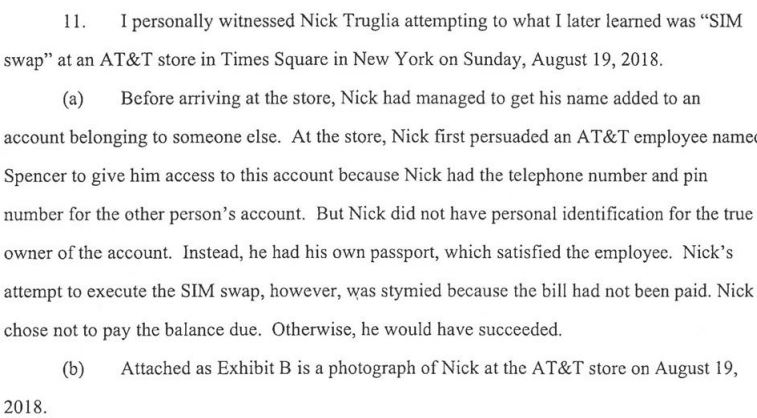
David said he even witnessed Truglia attempting a SIM swap at a Times Square AT&T store in August 2018. Here’s David’s account of that hijack effort, which allegedly failed when Truglia declined to pay the target’s overdue phone bill:

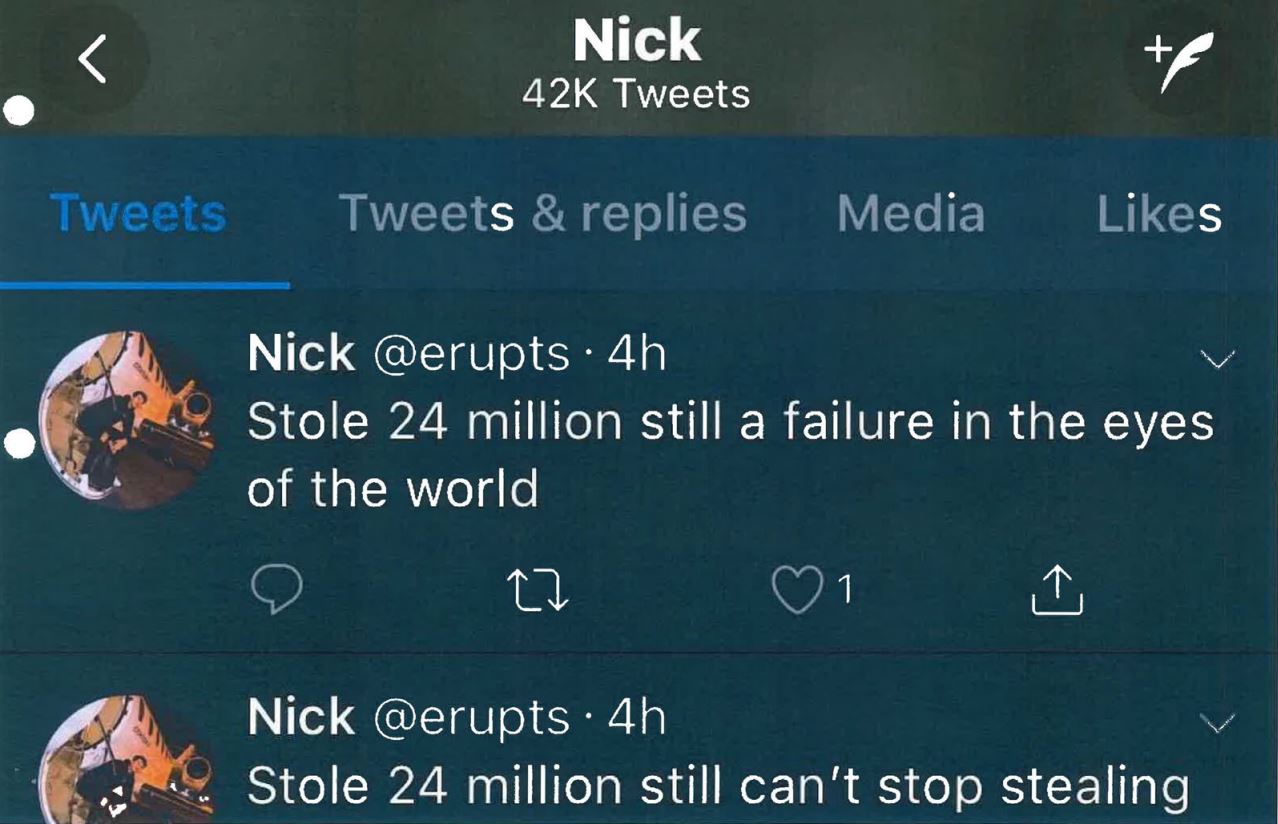
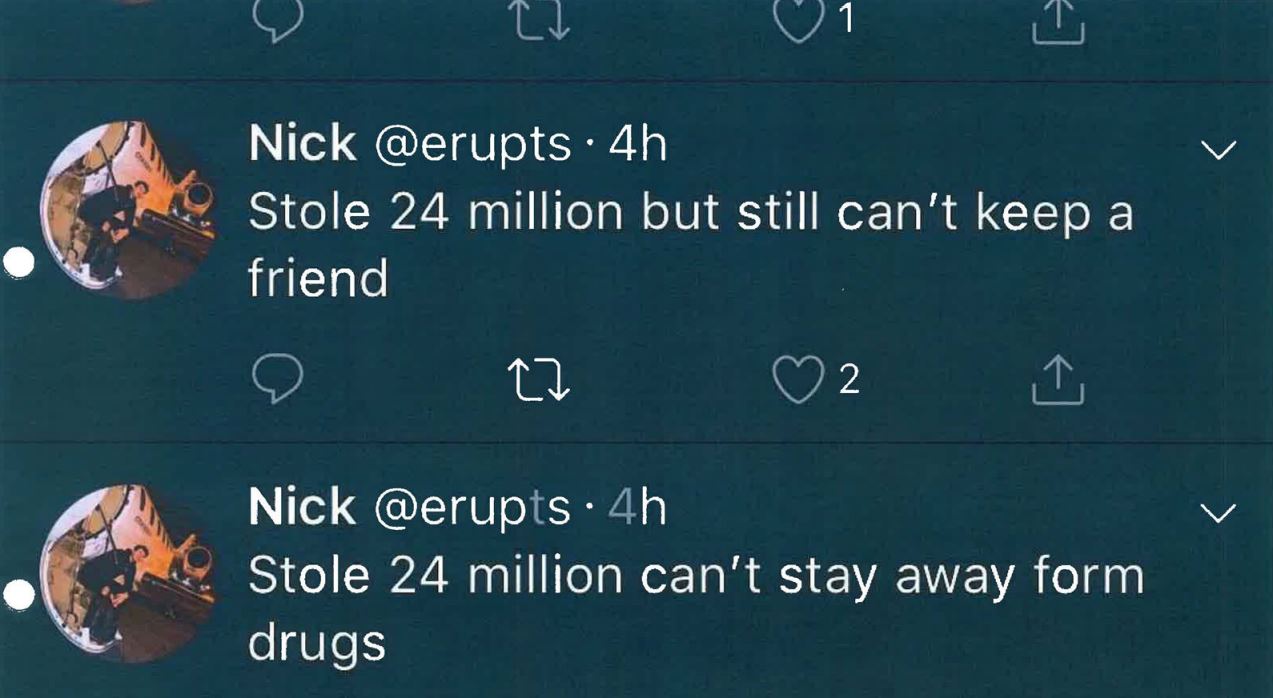
The affidavit states that later in the month David took screen shots of a now-defunct Twitter account that Truglia allegedly used (@erupts), which included six different messages about what the theft of $24 million had wrought.

Tweets from the account @erupts, allegedly penned by Nicholas Truglia.

“Stole 24 million but still can’t keep a friend,” reads another tweet allegedly tied to Truglia’s account:

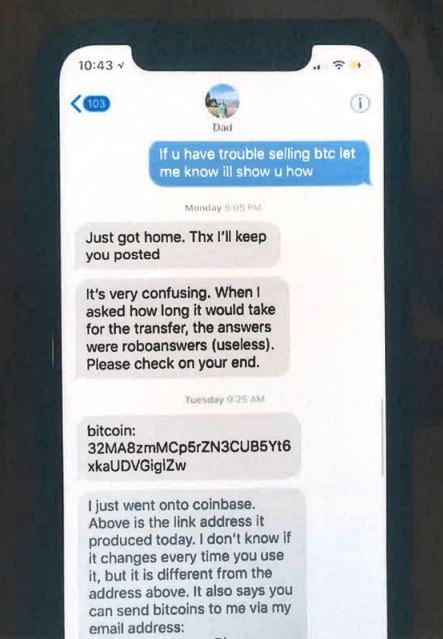
David says Truglia even acknowledged stealing $15,000 after hacking into his own father’s accounts. According to David, Truglia’s dad asked to be repaid, and that his son agreed to return the money — but in bitcoin. In the image below — which David claims was a screenshot he took of a mobile phone chat conversation between Truglia and his father — the elder expresses mystification and frustration about how to complete the transaction.

A screen shot David says he took of an alleged chat conversation between Truglia and his father regarding repayment of $15,000.

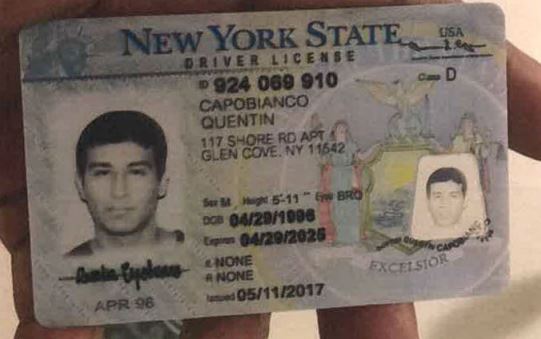
In the affidavit, David also testifies that he saw Truglia in possession of a fake New York State driver’s license which had the name and identifying information of a deceased man named Quentin Capobianco, but with Truglia’s photo on the license.

A copy of this phony drivers’ license was documented by investigators with the Regional Enforcement Allied Computer Team, or REACT — a task force in Santa Clara, Calif. that is almost singularly focused on tracking down criminals who use unauthorized SIM swaps to steal virtual currencies (for a deep dive into the workings of the REACT Task Force, see my November 2018 story, Busting SIM Swappers and SIM Swap Myths).

David said he took this photograph of a license Truglia had in his possession; the license includes Truglia’s photograph but the information of a dead man that Truglia allegedly SIM swapped.

That REACT Task Force investigation report (PDF) was included in Terpin’s lawsuit, and it lays out how detectives tied Truglia to SIM swaps that allegedly gave him access to Capobianco’s accounts at Coinbase, a virtual currency trading and purchasing platform.

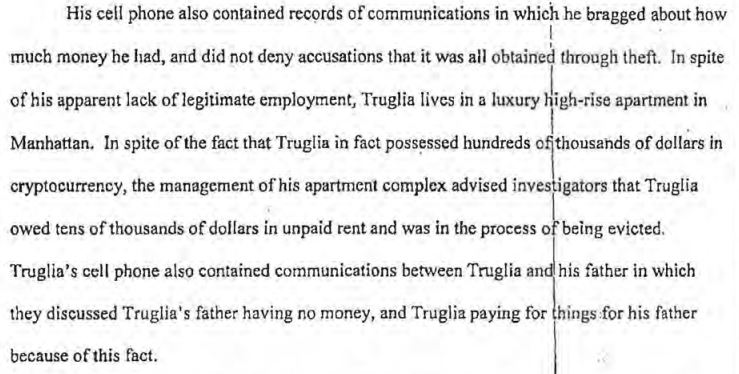
David testified that despite Truglia’s ill-gotten riches, he was constantly borrowing small amounts of cash and was otherwise tight with his money. Much like David’s testimony, a related memo (PDF) filed by REACT Detective Caleb Tuttle suggests that Truglia was in the process of being evicted from his pricey Manhattan apartment because he refused to pay his rent.

A snippet from a memo filed about Truglia by REACT Task Force Detective Caleb Tuttle.

Truglia is currently being held by Santa Clara authorities on a $1.4 million bond. His next court date is April 10. Neither Truglia nor his attorney could be immediately reached for comment. Members of the REACT Task Force declined to comment for this story.

A SIM card is the tiny, removable chip in a mobile device that allows it to connect to the provider’s network. Customers can legitimately request a SIM swap when their existing SIM card has been damaged, or when they are switching to a different phone that requires a SIM card of another size.

But SIM swaps are frequently abused by scam artists who trick mobile providers into tying a target’s service to a new SIM card and mobile phone that the attackers control. Unauthorized SIM swaps often are perpetrated by fraudsters who have already stolen or phished a target’s password, as many banks and online services rely on text messages to send users a one-time code that needs to be entered in addition to a password for online authentication. However, many online services let customers reset their password merely by using their mobile phones.

All four major wireless carriers — AT&T, SprintT-Mobile and Verizon — let customers add security against SIM swaps and related schemes by setting a PIN that needs to be provided over the phone or in person at a store before account changes should be made. But these security features can be bypassed by incompetent or corrupt mobile store employees.

For more on ways to minimize your chances of becoming the next SIM swapping victim, check out the “What Can You Do?” section at the conclusion of this story.

from Krebs on Security http://bit.ly/2suBqfy
via IFTTT

Courts Hand Down Hard Jail Time for DDoS

Seldom do people responsible for launching crippling cyberattacks face justice, but increasingly courts around the world are making examples of the few who do get busted for such crimes. On Friday, a 34-year-old Connecticut man received a whopping 10-year prison sentence for carrying out distributed denial-of-service (DDoS) attacks against a number of hospitals in 2014. Also last week, a 30-year-old in the United Kingdom was sentenced to 32 months in jail for using an army of hacked devices to crash large portions of Liberia’s Internet access in 2016.

Daniel Kaye. Photo: National Crime Agency

Daniel Kaye, an Israel-U.K. dual citizen, admitted attacking an African phone company in 2016, and to inadvertently knocking out Internet access for much of the country in the process. Kaye launched the attack using a botnet powered by Mirai, a malware strain that enslaves hacked Internet of Things (IoT) devices like poorly-secured Internet routers and Web-based cameras for use in large-scale cyberattacks.

According to court testimony, Kaye was hired in 2015 to attack Lonestar, Liberia’s top mobile phone and Internet provider. Kaye pocketed $10,000 for the attack, which was alleged to have been paid for by an individual working for Cellcom, Lonestar’s competitor in the region. As reported by Israeli news outlet Haaretz, Kaye testified that the attack was ordered by the CEO of Cellcom Liberia.

In February 2017, authorities in the United Kingdom arrested Kaye an extradited him to Germany to face charges of knocking more than 900,000 Germans offline in a Mirai attack in November 2016. Prosecutors withheld Kaye’s full name throughout the trial in Germany, but in July 2017 KrebsOnSecurity published findings that named Kaye as the likely culprit. Kaye ultimately received a suspended sentence for the attack in Germany, and was sent back to the U.K. to face charges there.

The July 2017 KrebsOnSecurity investigation also linked Kaye to the development and sale of a sophisticated piece of spyware named GovRAT, which is documented to have been used in numerous cyber espionage campaigns against governments, financial institutions, defense contractors and more than 100 corporations.

The U.K.’s National Crime Agency called Kaye perhaps the most significant cyber criminal yet caught in Britain. A report on the trial from the BBC says Kaye wept as he was taken away to jail.

Here across the pond, 34-year-old Martin Gottesfeld was sentenced to 10 years in prison and ordered to pay $443,000 in restitution for damages caused by a series of DDoS attacks he launched against several Boston-area hospitals in 2014. Like Kaye, Gottesfeld was identified thanks to clue he left behind on the Internet: Prosecutors reportedly linked him to a video he uploaded to Youtube about the attack campaign.

The Boston Globe reports that Gottesfeld and his wife in 2016 tried to flee to Cuba in a rented boat, but the trip didn’t go as planned. It seems the high seas had their own denial-of-service in store for the Gottesfelds: They were rescued from the Gulf of Mexico by a Disney ship that answered Martin’s SOS distress call and brought them back to the United States.

Ten years may seem like a stiff sentence for DDoS and fleeing from justice, but as the recipient of hundreds of DDoS attacks over the years I can’t say it bothers me one bit — especially considering how few of the anonymous cowards responsible for DDoS attacks are ever held accountable.

Cue the usual comments here about how these guys deserved jobs and not jail, but I for one am glad the courts are starting to recognize that these are real and costly crimes that deserve equally real consequences. Remember: Don’t do the crime if you can’t do the time.

from Krebs on Security http://bit.ly/2Cmkqwt
via IFTTT

Secret Service: Theft Rings Turn to Fuze Cards

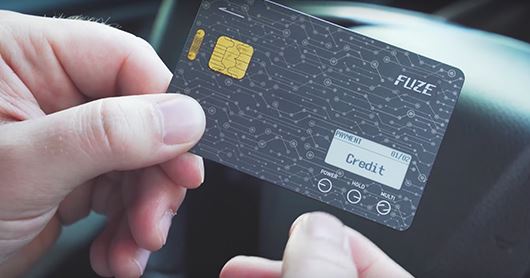
Street thieves who specialize in cashing out stolen credit and debit cards increasingly are hedging their chances of getting caught carrying multiple counterfeit cards by relying on Fuze Cards, a smartcard technology that allows users to store dozens of cards on a single device, the U.S. Secret Service warns.

A Fuze card can store up to 30 credit/debit cards. Image: Fuzecard.com

Launched in May 2017, the Fuze Card is a data storage device that looks like a regular credit card but can hold account data for up to 30 credit cards. The Fuze Card displays no credit card number on either side, instead relying on a small display screen on the front that cardholders can use to change which stored card is to be used to complete a transaction.

After the user chooses the card data to be used, the card data is made available in the dynamic magnetic stripe on the back of the card or via the embedded smart chip. Fuze cards also can be used at ATMs to withdraw funds.

An internal memo the U.S. Secret Service shared with financial industry partners states that Secret Service field offices in New York and St. Louis are currently working criminal investigations where Fuze Cards have been used by fraud rings.

The memo, a copy of which was obtained by KrebsOnSecurity, states that card theft rings are using Fuze Cards to avoid raising suspicions that may arise when shuffling through multiple counterfeit cards at the register.

“The transaction may also appear as a declined transaction but the fraudster, with the push of a button, is changing the card numbers being used,” the memo notes.

Fraud rings often will purchase data on thousands of credit and debit cards stolen from hacked point-of-sale devices or obtained via physical card skimmers. The data can be encoded onto any card with a magnetic stripe, and then used to buy high-priced items at retail outlets — or to withdrawn funds from ATMs (if the fraudsters also have the cardholder’s PIN).

But getting caught holding dozens of counterfeit or stolen cards is tough to explain to authorities. Hence, the allure of the Fuze Card, which may appear to the casual observer to be just another credit card in one’s wallet.

“While this smart card technology makes up a small portion of fraudulent credit cards currently, investigators should be aware of the potential for significant increases in fraud loss amounts with the emergence of this smart card technology,” the Secret Service memo concludes.

Fuze Card did not respond to requests for comment.

In many ways, it is unsurprising that thieves are turning to this new technology to perpetrate credit card fraud, which is something of a constant cat-and-mouse game that employs ever-changing techniques. For evidence of this, one need only look to the constant innovations that fraudsters come up with to deploy physical card skimmers at ATMs and retail checkout lanes.

No doubt, fraudsters engaged in money laundering via virtual currencies like bitcoin will be doubly interested in Fuze Cards in the coming months. Fuze Card says that later this year it plans to launch FuzeX, which contains the same amenities of the Fuze Card and will allow users to conduct purchases using virtual currencies.

from Krebs on Security http://bit.ly/2REoOk8
via IFTTT