A Tough Week for IP Address Scammers

In the early days of the Internet, there was a period when Internet Protocol version 4 (IPv4) addresses (e.g. 4.4.4.4) were given out like cotton candy to anyone who asked. But these days companies are queuing up to obtain new IP space from the various regional registries that periodically dole out the prized digits. With the value of a single IP hovering between $15-$25, those registries are now fighting a wave of shady brokers who specialize in securing new IP address blocks under false pretenses and then reselling to spammers. Here’s the story of one broker who fought back in the courts, and lost spectacularly.
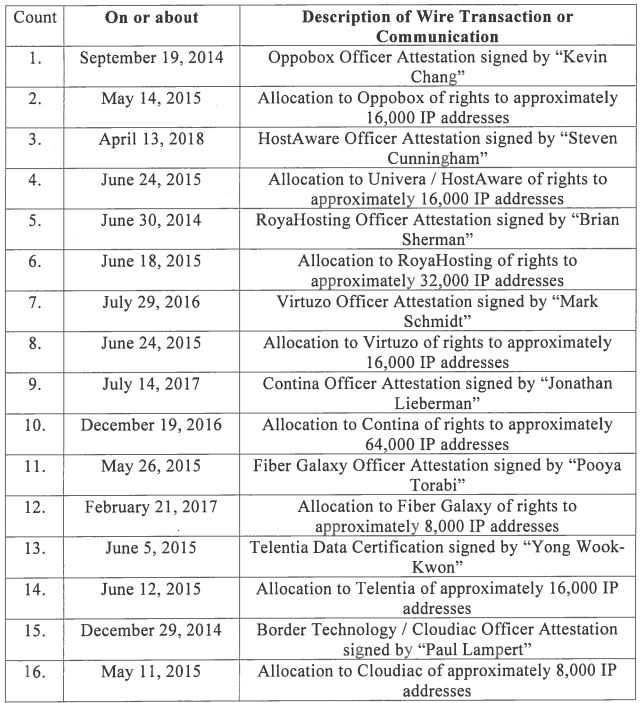
On May 14, South Carolina U.S. Attorney Sherri Lydon filed criminal wire fraud charges against Amir Golestan, alleging he and his Charleston, S.C. based company Micfo LLC orchestrated an elaborate network of phony companies and aliases to secure more than 735,000 IPs from the American Registry for Internet Numbers (ARIN), a nonprofit which oversees IP addresses assigned to entities in the U.S., Canada, and parts of the Caribbean.

Interestingly, Micfo itself set this process in motion late last year when it sued ARIN. In December 2018, Micfo’s attorneys asked a federal court in Virginia to issue a temporary restraining order against ARIN, which had already told the company about its discovery of the phony front companies and was threatening to revoke some 735,000 IP addresses. That is, unless Micfo agreed to provide more information about its operations and customers.

At the time, many of the IP address blocks assigned to Micfo had been freshly resold to spammers. Micfo ultimately declined to provide ARIN the requested information, and as a result the court denied Micfo’s request (the transcript of that hearing is instructive and amusing).

But by virtue of the contract Micfo signed with ARIN, any further dispute had to be settled via arbitration. On May 13, that arbitration panel ordered Micfo to pay $350,000 for ARIN’s legal fees and to cough up any of those 735,000 IPs the company hadn’t already sold.

According to the criminal indictment in South Carolina, in 2017 and 2018 Golestan sold IP addresses using a third party broker:

“Golestan sold 65,536 IPv4 addresses for $13 each, for a total of $851,896,” the indictment alleges. “Golestan also organized a second transaction for another 65,536 IP addresses, for another approximately $1 million. During this same time period, Golestan had a contract to sell 327,680 IP addresses at $19 per address, for a total of $6.22 million” [this last transaction would be blocked.]
The various front companies alleged to have been run by Micfo and Amir Golestan.

Mr. Golestan could not be immediately reached for comment. Golestan’s attorney in Micfo’s lawsuit against ARIN declined to comment on either the criminal charges or the arbitration outcome. Calls to nearly a dozen of the front companies named in the dispute mostly just rang and rang with no answer, or went to voicemail boxes that were full.

Stephen Ryan is a Washington, D.C.-based attorney who represented ARIN in the dispute filed by Micfo. Ryan said this was the first time ARIN’s decision to revoke IP address space resulted in a court battle — let alone arbitration.

“We have revoked addresses for fraud before, but that hasn’t previously resulted in litigation,” Ryan said. “The interesting thing here is that they litigated this for five months.”

According to a press release by ARIN, “Micfo obtained and utilized 11 shelf companies across the United States, and intentionally created false aliases purporting to be officers of those companies, to induce ARIN into issuing the fraudulently sought IPv4 resources and approving related transfers and reassignments of these addresses. The defrauding party was monetizing the assets obtained in the transfer market, and obtained resources under ARIN’s waiting list process.”

“This was an elaborate operation,” said Ryan, a former federal prosecutor. “All eleven of these front companies for Micfo are still up on the Web, where you see all these wonderful people who allegedly work there. And meanwhile we were receiving notarized affidavits in the names of people that were false. It made it much more interesting to do this case because it created 11 states where they’d violated the law.”

The criminal complaint against Golestan and Micfo (PDF) includes 20 counts of wire fraud associated with the phony companies allegedly set up by Micfo.

John Levine, author of The Internet for Dummies and a member of the security and stability advisory committee at ICANN, said ARIN does not exactly have a strong reputation for going after the myriad IP address scammers allegedly operating in a similar fashion as Micfo.

“It is definitely the case that for a long time ARIN has not been very aggressive about checking the validity of IP address applications and transfers, and now it seems they are somewhat better than they used to be,” Levine said. “A lot of people have been frustrated that ARIN doesn’t act more like a regulator in this space. Given how increasingly valuable IPv4 space is, ARIN has to be more vigilant because the incentive for crooks to do this kind of thing is very high.”

Asked if ARIN would have the stomach and budget to continue the fight if other IP address scammers fight back in a similar way, Ryan said ARIN would not back down from the challenge.

“If we find a scheme or artifice to defraud and it’s a substantial number of addresses and its egregious fraud, then yes, we have a reserve set aside for litigation and we can and will use it for cases like this,” Ryan said, adding that he’d welcome anyone with evidence of similar schemes to come forward. “But a better strategy is not to issue it and never have to go back and revoke it, and we’re good at that now.”

from Krebs on Security http://bit.ly/2YyxLLl
via IFTTT

Microsoft Patches ‘Wormable’ Flaw in Windows XP, 7 and Windows 2003

Microsoft today is taking the unusual step of releasing security updates for unsupported but still widely-used Windows operating systems like XP and Windows 2003, citing the discovery of a “wormable” flaw that the company says could be used to fuel a fast-moving malware threat like the WannaCry ransomware attacks of 2017.

The vulnerability (CVE-2019-0709) resides in the “remote desktop services” component built into supported versions of Windows, including Windows 7, Windows Server 2008 R2, and Windows Server 2008. It also is present in computers powered by Windows XP and Windows 2003, operating systems for which Microsoft long ago stopped shipping security updates.

Microsoft said the company has not yet observed any evidence of attacks against the dangerous security flaw, but that it is trying to head off a serious and imminent threat.

“While we have observed no exploitation of this vulnerability, it is highly likely that malicious actors will write an exploit for this vulnerability and incorporate it into their malware,” wrote Simon Pope, director of incident response for the Microsoft Security Response Center.

“This vulnerability is pre-authentication and requires no user interaction,” Pope said. “In other words, the vulnerability is ‘wormable,’ meaning that any future malware that exploits this vulnerability could propagate from vulnerable computer to vulnerable computer in a similar way as the WannaCry malware spread across the globe in 2017. It is important that affected systems are patched as quickly as possible to prevent such a scenario from happening.”

The WannaCry ransomware threat spread quickly across the world in May 2017 using a vulnerability that was particularly prevalent among systems running Windows XP and older versions of Windows. Microsoft had already released a patch for the flaw, but many older and vulnerable OSes were never updated. Europol estimated at the time that WannaCry spread to some 200,000 computers across 150 countries.

CVE-2019-0709 does not affect Microsoft’s latest operating systems — Windows 10, Windows 8.1, Windows 8, Windows Server 2019, Windows Server 2016, Windows Server 2012 R2, or Windows Server 2012.

More information on how to download and deploy the update for CVE-2019-0709 is here.

This post will be updated throughout the day as more information about the rest of today’s Patch Tuesday updates becomes available.

from Krebs on Security http://bit.ly/2YwFABr
via IFTTT

Nine Charged in Alleged SIM Swapping Ring

Eight Americans and an Irishman have been charged with wire fraud this week for allegedly hijacking mobile phones through SIM-swapping, a form of fraud in which scammers bribe or trick employees at mobile phone stores into seizing control of the target’s phone number and diverting all texts and phone calls to the attacker’s mobile device. From there, the attackers simply start requesting password reset links via text message for a variety of accounts tied to the hijacked phone number.

All told, the government said this gang — allegedly known to its members as “The Community” — made more than $2.4 million stealing cryptocurrencies and extorting people for restoring access to social media accounts that were hijacked after a successful SIM-swap.

Six of those charged this week in Michigan federal court were alleged to have been members of The Community of serial SIM swappers. They face a fifteen count indictment, including charges of wire fraud, conspiracy and aggravated identity theft (a charge that carries a mandatory two-year sentence). A separate criminal complaint unsealed this week charges three former employees of mobile phone providers accused of collaborating with The Community’s members.

Several of those charged have been mentioned by this blog previously. In August 2018, KrebsOnSecurity broke the news that police in Florida arrested 25-year-old Pasco County, Fla. city employee Ricky Joseph Handschumacher, charging him with grand theft and money laundering. As I reported in that story, “investigators allege Handschumacher was part of a group of at least nine individuals scattered across multiple states who for the past two years have drained bank accounts via an increasingly common scheme involving mobile phone “’SIM swaps.’”

This blog also has featured several stories about the escapades of Ryan Stevenson, a 26-year-old West Haven, Conn. man who goes by the hacker name “Phobia.” Most recently, I wrote about how Mr. Stevenson earned a decent number of bug bounty rewards and public recognition from top telecom companies for finding and reporting security holes in their Web sites — all the while secretly operating a service that leveraged these same flaws to sell their customers’ personal data to people who were active in the SIM swapping community.

One of the six men charged in the conspiracy — Colton Jurisic, 20 of, Dubuque, Iowa — has been more well known under his hacker alias “Forza,” and “ForazaTheGod.” In December 2016, KrebsOnSecurity heard from a woman who had her Gmail, Instagram, Facebook and LinkedIn accounts hijacked after a group of individuals led by Forza taunted her on Twitter as they took over her phone account.

“They failed to get [her three-letter Twitter account name, redacted] because I had two-factor authentication turned on for twitter, combined with a new phone number of which they were unaware,” the source said in an email to KrebsOnSecurity in 2016. “@forzathegod had the audacity to even tweet me to say I was about to be hacked.”

Also part of the alleged Community of SIM swappers is Conor Freeman, 20, of Dublin, Ireland; Reyad Gafar Abbas, 19, of Rochester, New York; Garrett Endicott, 21, of Warrensburg, Missouri.

The three men criminally accused of working with the six through their employment at mobile phone stores are Fendley Joseph, 28, of Murrietta, Calif.; Jarratt White, 22, and Robert Jack, 22, both from Tucson, Ariz.

If convicted on the charge of conspiracy to commit wire fraud, each defendant faces a statutory maximum penalty of 20 years in prison.  The charges of wire fraud each carry a statutory maximum penalty of 20 years in prison.

Last month, 20-year-old college student and valedictorian Joel Ortiz became the first person ever to be sentenced for SIM swapping — pleading guilty to a ten year stint in prison for stealing more than $5 million in cryptocurrencies from victims and then spending it lavishly at elaborate club parties in Las Vegas and Los Angeles.

A copy of the indictment against the six men is here (PDF).

from Krebs on Security http://bit.ly/2VaNkHj
via IFTTT

What’s Behind the Wolters Kluwer Tax Outage?

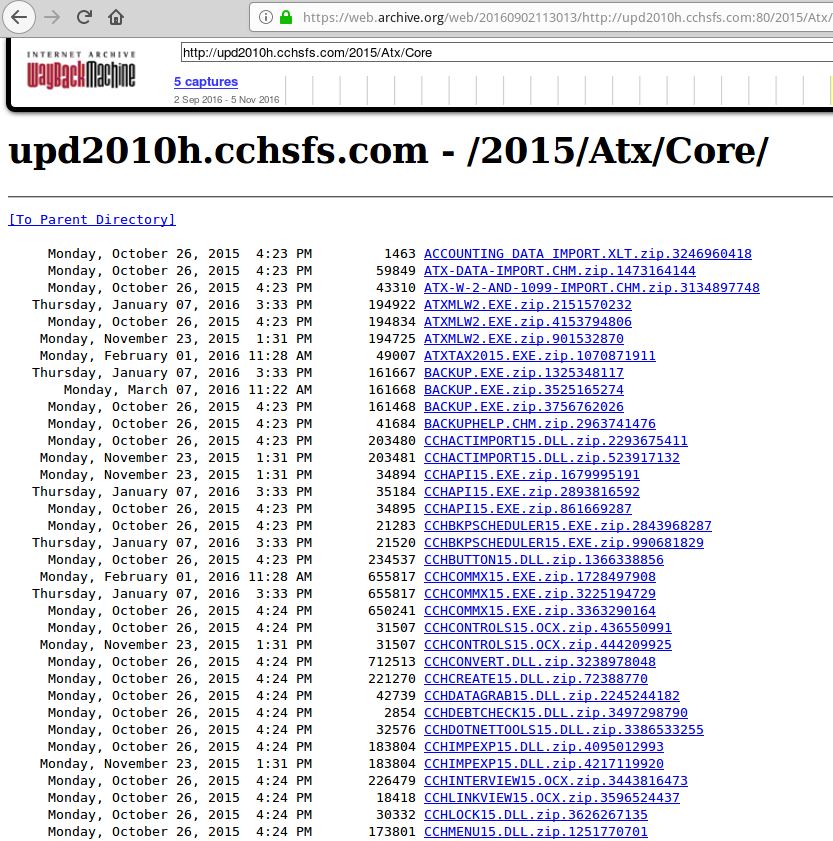
Early in the afternoon on Friday, May, 3, I asked a friend to relay a message to his security contact at CCH, the cloud-based tax division of the global information services firm Wolters Kluwer in the Netherlands. The message was that the same file directories containing new versions of CCH’s software were open and writable by any anonymous user, and that there were suspicious files in those directories indicating some user(s) abused that access.

Shortly after that report, the CCH file directory for tax software downloads was taken offline. As of this publication, several readers have reported outages affecting multiple CCH Web sites. These same readers reported being unable to access their clients’ tax data in CCH’s cloud because of the ongoing outages. A Reddit thread is full of theories.

One of the many open and writable directories on CCH’s site before my report on Friday.

I do not have any information on whether my report about the world-writable file server had anything to do with the outages going on now at CCH. Nor did I see any evidence that any client data was exposed on the site.

What I did see in those CCH directories were a few odd PHP and text files, including one that seemed to be promoting two different and unrelated Russian language discussion forums.

I sent Wolters Kluwer an email asking how long the file server had been so promiscuous (allowing anyone to upload files to the server), and what the company was doing to validate the integrity of the software made available for download by CCH tax customers.

Marisa Westcott, vice president of marketing and communications at Wolters Kluwer, told KrebsOnSecurity on Friday that she would “check with the team to see if we can get some answers to your questions.”

But subsequent emails and phone calls have gone unreturned. Calls to the company’s main support number (800-739-9998) generate the voice message, “We are currently experiencing technical difficulties. Please try your call again later.”

This morning, Wolters Kluwer released an update on the extensive outage this morning on Twitter, saying:

“Since yesterday, May 6, we are experiencing network and service interruptions after certain Wolters Kluwer platforms and applications. Out of an abundance of caution, we proactively took offline a number of other applications and we immediately began our investigation and remediation efforts. The secure use of our products and services is our top priority. we have ben able to restore network and services for a number – but not all — of our systems.”

Accounting Today reports today that a PR representative from Wolters Kluwer Tax & Accounting, which makes the CCH products, confirmed the outage was the result of a malware attack:

“On Monday May 6, we started seeing technical anomalies in a number of our platforms and applications,” the statement given to Accounting Today reads. “We immediately started investigating and discovered the installation of malware. As a precaution, in parallel, we decided to take a broader range of platforms and applications offline. With this action, we aimed to quickly limit the impact this malware could have had, giving us the opportunity to investigate the issue with assistance from third-party forensics consultants and work on a solution. Unfortunately, this impacted our communication channels and limited our ability to share updates. On May 7, we were able to restore service to a number of applications and platforms.”

Accounting Today says the limited ability to share updates angered CCH users, many of whom took to social media to air their grievances against a cloud partner they perceive to be ill-prepared for maintaining ongoing service and proper security online.

“Despite CCH stating that a number of applications and platforms were up and running today, May 7, several users on a Reddit thread on the topic have stated that as of this morning in Florida, Maine, Texas, Pittsburgh and South Carolina, their CCH systems are still down,” Accounting Today wrote.

Special thanks to Alex Holden of Hold Security for help in notifying CCH.

from Krebs on Security http://bit.ly/2vJbrCr
via IFTTT

Feds Bust Up Dark Web Hub Wall Street Market

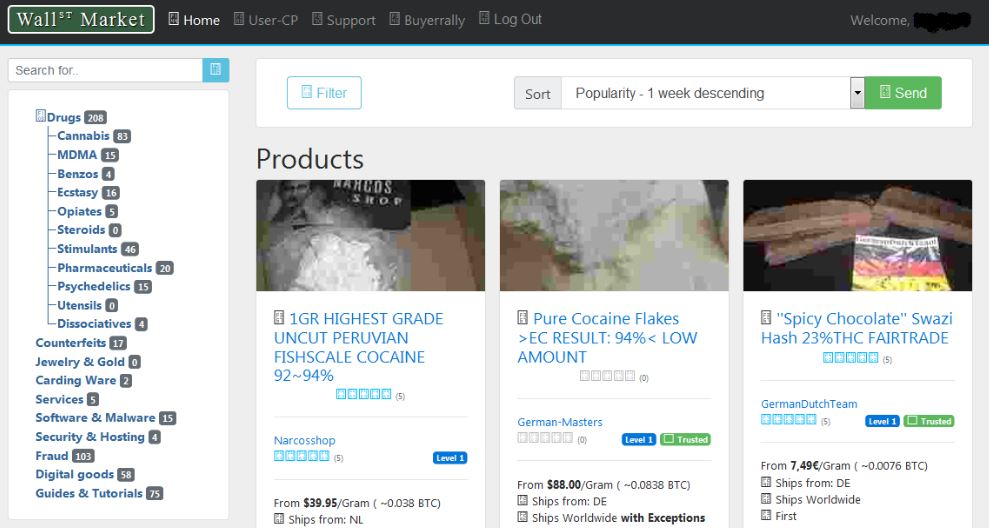
Federal investigators in the United States, Germany and the Netherlands announced today the arrest and charging of three German nationals and a Brazilian man as the alleged masterminds behind the Wall Street Market (WSM), one of the world’s largest dark web bazaars that allowed vendors to sell illegal drugs, counterfeit goods and malware. Now, at least one former WSM administrator is reportedly trying to extort money from WSM vendors and buyers (supposedly including Yours Truly) — in exchange for not publishing details of the transactions.

The now-defunct Wall Street Market (WSM). Image: Dark Web Reviews.

A complaint filed Wednesday in Los Angeles alleges that the three defendants, who currently are in custody in Germany, were the administrators of WSM, a sophisticated online marketplace available in six languages that allowed approximately 5,400 vendors to sell illegal goods to about 1.15 million customers around the world.

“Like other dark web marketplaces previously shut down by authorities – Silk Road and AlphaBay, for example – WSM functioned like a conventional e-commerce website, but it was a hidden service located beyond the reach of traditional internet browsers, accessible only through the use of networks designed to conceal user identities, such as the Tor network,” reads a Justice Department release issued Friday morning.

The complaint alleges that for nearly three years, WSM was operated on the dark web by three men who engineered an “exit scam” last month, absconding with all of the virtual currency held in marketplace escrow and user accounts. Prosecutors say they believe approximately $11 million worth of virtual currencies was then diverted into the three men’s own accounts.

The defendants charged in the United States and arrested Germany on April 23 and 24 include 23-year-old resident of Kleve, Germany; a 31-year-old resident of Wurzburg, Germany; and a 29-year-old resident of Stuttgart, Germany. The complaint charges the men with two felony counts – conspiracy to launder monetary instruments, and distribution and conspiracy to distribute controlled substances. These three defendants also face charges in Germany.

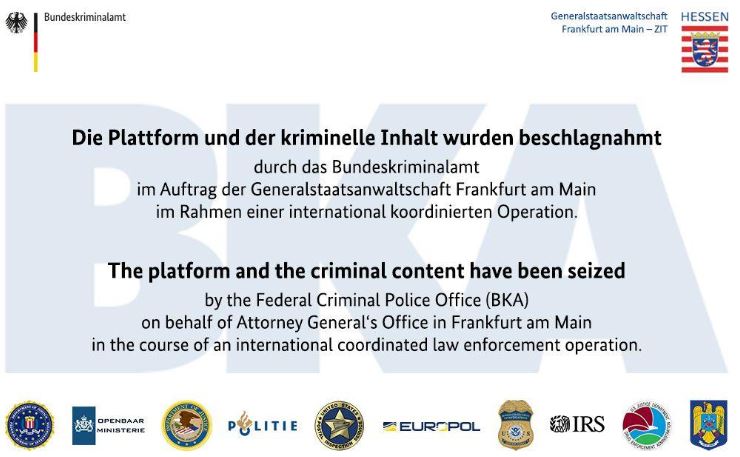
Signs of the dark market seizure first appeared Thursday when WSM’s site was replaced by a banner saying it had been seized by the German Federal Criminal Police Office (BKA).

The seizure message that replaced the homepage of the Wall Street Market on on May 2.

Writing for ZDNet’s Zero Day blog, Catalin Cimpanu noted that “in this midst of all of this, one of the site’s moderators –named Med3l1n— began blackmailing WSM vendors and buyers, asking for 0.05 Bitcoin (~$280), and threatening to disclose to law enforcement the details of WSM vendors and buyers who made the mistake of sharing various details in support requests in an unencrypted form.

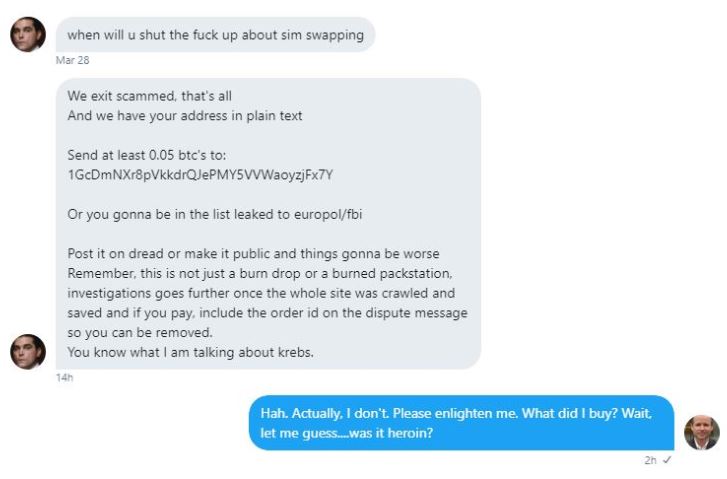
In a direct message sent to my Twitter account this morning, a Twitter user named @FerucciFrances who claimed to be part of the exit scam demanded 0.05 bitcoin (~$286) to keep quiet about a transaction or transactions allegedly made in my name on the dark web market.

“Make it public and things gonna be worse,” the message warned. “Investigations goes further once the whole site was crawled and saved and if you pay, include the order id on the dispute message so you can be removed. You know what I am talking about krebs.”

A direct message from someone trying to extort money from me.

I did have at least one user account on WSM, although I don’t recall ever communicating on the forum with any other users, and I certainly never purchased or sold anything there. Like most other accounts on dark web shops and forums, it was created merely for lurking. I asked @FerucciFrances to supply more evidence of my alleged wrongdoing, but he has not yet responded.

The Justice Department said the MED3LIN moniker belongs to a fourth defendant linked to Wall Street Market — Marcos Paulo De Oliveira-Annibale, 29, of Sao Paulo, Brazil — who was charged Thursday in a criminal complaint filed in the U.S. District Court in Sacramento, California.

Oliviera-Annibale also faces federal drug distribution and money laundering charges for allegedly acting as a moderator on WSM, who, according to the charges, mediated disputes between vendors and their customers, and acted as a public relations representative for WSM by promoting it on various sites.

Prosecutors say they connected MED3LIN to his offline identity thanks to photos and other clues he left behind online years ago, suggesting once again that many alleged cybercriminals are not terribly good at airgapping their online and offline selves.

“We are on the hunt for even the tiniest of breadcrumbs to identify criminals on the dark web,” said McGregor W. Scott, United States Attorney for the Eastern District of California. “The prosecution of these defendants shows that even the smallest mistake will allow us to figure out a cybercriminal’s true identity. As with defendant Marcos Annibale, forum posts and pictures of him online from years ago allowed us to connect the dots between him and his online persona ‘Med3l1n.’ No matter where they live, we will investigative and prosecute criminals who create, maintain, and promote dark web marketplaces to sell illegal drugs and other contraband.”

A copy of the Justice Department’s criminal complaint in the case is here (PDF).

from Krebs on Security http://bit.ly/2H1V0Yr
via IFTTT

Credit Union Sues Fintech Giant Fiserv Over Security Claims

A Pennsylvania credit union is suing financial industry technology giant Fiserv, alleging that “baffling” security vulnerabilities in the company’s software are “wreaking havoc” on its customers. The credit union said the investigation that fueled the lawsuit was prompted by a 2018 KrebsOnSecurity report about glaring security weaknesses in a Fiserv platform that exposed personal and financial details of customers across hundreds of bank Web sites.

Brookfield, Wisc.-based Fiserv [NASDAQ:FISV] is a Fortune 500 company with 24,000 employees and $5.8 billion in earnings last year. Its account and transaction processing systems power the Web sites for hundreds of financial institutions — mostly small community banks and credit unions.

In August 2018, in response to inquiries by KrebsOnSecurity, Fiserv fixed a pervasive security and privacy hole in its online banking platform. The authentication weakness allowed bank customers to view account data for other customers, including account number, balance, phone numbers and email addresses.

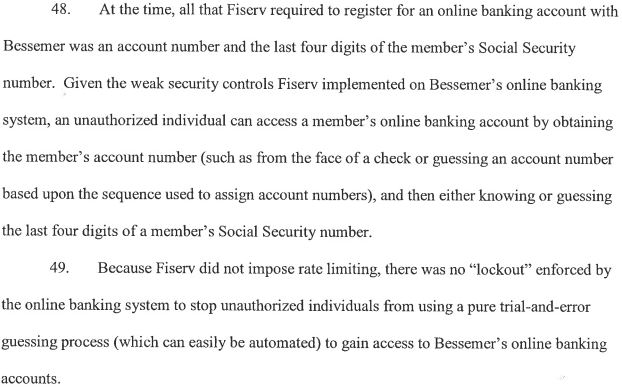
In late April 2019, Fiserv was sued by Bessemer System Federal Credit Union, a comparatively tiny financial institution with just $38 million in assets. Bessemer said it was moved by that story to launch its own investigation into Fiserv’s systems, and it found a startlingly similar flaw: Firsev’s platform would let anyone reset the online banking password for a customer just by knowing their account number and the last four digits of their Social Security number.

Bessemer claims Fiserv’s systems let anyone reset a customer’s online banking password just by knowing their SSN and account number.

Recall that in my Aug 2018 report, Fiserv’s systems were exposing online banking account numbers for its customers. Thus, an attacker would only need to know a target’s SSN to reset that customer’s password, according to Bessemer. And that information is for sale in multiple places online and in the cybercrime underground for a few bucks per person.

Bessemer further alleges Fiserv’s systems had no checks in place to prevent automated attacks that might let thieves rapidly guess the last four digits of the customer’s SSN — such as limiting the number of times a user can submit a login request, or imposing a waiting period after a certain number of failed login attempts.

The lawsuit says the fix Fiserv scrambled to put in place after Bessemer complained was “pitifully deficient and ineffective:”

“Fiserv attempted to fortify Bessemer’s online banking website by requiring users registering for an account to supply a member’s house number. This was ineffective because residential street addresses can be readily found on the internet and through other public sources. Moreover, this information can be guessed through a trial-and-error process. Most alarmingly, this security control was purely illusory. Because some servers were not enforcing this security check, it could be readily bypassed.”

Bessemer says instead of fixing these security problems and providing the requested assurances that information was being adequately safeguarded, Fiserv issued it a “notice of claims,” alleging the credit union’s security review of its own online banking system gave rise to civil and criminal claims.

The credit union says Fiserv demanded it not disclose information relating to the security review to any third parties, “including Fiserv’s other clients (who presumably were affected with the same security problems at their financial institutions) as well as media sources.”

Fiserv did not immediately respond to requests for comment. But Fiserv spokesperson Ann Cave was quoted in several publications saying, “We believe the allegations have no merit and will respond to the claims as part of the legal process.”

Charles Nerko, the attorney representing Bessemer in the lawsuit, said to protect the credit union’s members, the credit union is replacing its core processing vendor, although Nerko would not specify where the credit union might be taking its business.

According to FedFis.com, Fiserv is by far the top bank core processor, with more than 37 percent market share. And it’s poised to soon get much bigger.

In January 2019, Fiserv announced it was acquiring payment processing giant First Data in a $22 billion all-stock deal. The deal is expected to close in the second half of 2019, pending an antitrust review by the U.S. Justice Department.

That merger, should it go through, may not bode well for Fiserv’s customers, argues Paul Schaus of American Banker.

“Banks should take this trend as a warning sign,” Schaus wrote. “Rather than delivering new innovations that banks and their customers crave, legacy vendors are looking to remain relevant by acquiring existing products and services that expand their portfolios into new areas of financial services. As emerging technologies grow more critical to everyday business, these legacy vendors, which banks have deep longstanding relationships with, likely won’t be on the leading edge in every product or channel. Instead, financial institutions will need to seek out newer vendors that have deeper commitments and focus in cutting-edge technologies that will drive industry change.”

from Krebs on Security http://bit.ly/2J0Zl0e
via IFTTT

Data: E-Retail Hacks More Lucrative Than Ever

For many years and until quite recently, credit card data stolen from online merchants has been worth far less in the cybercrime underground than cards pilfered from hacked brick-and-mortar stores. But new data suggests that over the past year, the economics of supply-and-demand have helped to double the average price fetched by card-not-present data, meaning cybercrooks now have far more incentive than ever to target e-commerce stores.

Traditionally, the average price for card data nabbed from online retailers — referred to in the underground as “CVVs” — has ranged somewhere between $2 and $8 per account. CVVs are are almost exclusively purchased by criminals looking to make unauthorized purchases at online stores, a form of thievery known as “card not present” fraud.

In contrast, the value of “dumps” — hacker slang for card data swiped from compromised retail stores, hotels and restaurants with the help of malware installed on point-of-sale systems — has long hovered around $15-$20 per card. Dumps allow street thieves to create physical clones of debit and credit cards, which are then used to perpetrate so-called “card present” fraud at brick and mortar stores.

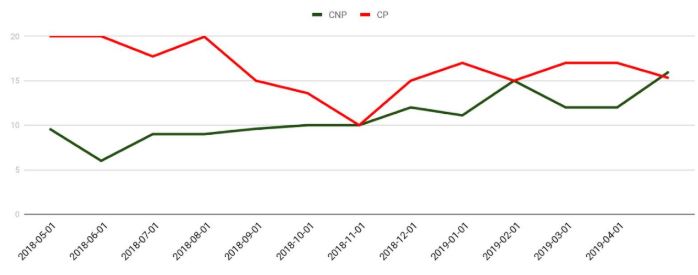
But according to Gemini Advisory, a New York-based company that works with financial institutions to monitor dozens of underground markets trafficking in both types of data, over the past year the demand for CVVs has far outstripped supply, bringing prices for both CVVs and dumps roughly in line with each other.

Median price of card not present (CNP) vs. card-present (CP) over the past year. Image: Gemini

Stas Alforov, director of research and development at Gemini, says his company is currently monitoring 55 underground stores that peddle stolen card data — including such heavy hitters as Joker’s Stash, Trump’s Dumps, and BriansDump.

Contrary to popular belief, when these shops sell a CVV or dump, that record is then removed from the inventory of items for sale, allowing companies that track such activity to determine roughly how many new cards are put up for sale and how many have sold. Underground markets that do otherwise quickly earn a reputation among criminals for selling unreliable card data and are soon forced out of business.

“We can see in pretty much real-time what’s being sold and which marketplaces are the most active or have the highest number of records and where the bad guys shop the most,” Alforov said. “The biggest trend we’ve seen recently is there appears to be a much greater demand than there is supply of card not present data being uploaded to these markets.”

Alforov said dumps are still way ahead in terms of the overall number of compromised records for sale. For example, over the past year Gemini has seen some 66 million new dumps show up on underground markets, and roughly half as many CVVs.

“The demand for card not present data remains strong while the supply is not as great as the bad guys need it to be, which means prices have been steadily going up,” Alforov said. “A lot of the bad guys who used to do card present fraud are now shifting to card-not-present fraud.”

One likely reason for that shift is the United States is the last of the G20 nations to make the transition to more secure chip-based payment cards, which is slowly making it more difficult and expensive for thieves to turn dumps into cold hard cash. This same increase in card-not-present fraud has occurred in virtually every other country that long ago made the chip card transition, including AustraliaCanadaFrance and the United Kingdom.

The increasing value of CVV data may help explain why we’ve seen such a huge uptick over the past year in e-commerce sites getting hacked. In a typical online retailer intrusion, the attackers will use vulnerabilities in content management systems, shopping cart software, or third-party hosted scripts to upload malicious code that snarfs customer payment details directly from the site before it can be encrypted and sent to card processors.

Research released last year by Thales eSecurity found that 50 percent of all medium and large online retailers it surveyed acknowledged they’d been hacked. That figure was more than two and a half times higher than a year earlier.

BIG BANG VS. LOW-AND-SLOW

Much of the media’s attention has been focused on recent hacks against larger online retailers, such those at the Web sites of British Airways, Ticketmaster, and electronics giant NewEgg. But these incidents tend to overshadow a great number of “low-and-slow” compromises at much smaller online retailers — which often take far longer to realize they’ve been hacked.

For example, in March 2019 an analysis of Gemini’s data strongly suggested that criminals had compromised Ticketstorm.com, an Oklahoma-based business that sells tickets to a range of sporting events and concerts. Going back many months through its data, Gemini determined that the site has likely been hacked for more than two years — allowing intruders to extract around 4,000 CVVs from the site’s customers each month, and approximately 35,000 accounts in total since February 2017.

Ticketstorm.com did not respond to requests for comment, but an individual at the company who answered a call from KrebsOnSecurity confirmed Ticketstorm had recently heard from Gemini and from card fraud investigators with the U.S. Secret Service.

“It’s not just large sites getting popped, it’s mostly small to mid-sized organizations that are being compromised for long periods of time,” Alforov said. “Ticketstorm is just one of ten or twenty different breaches we’ve seen where the fraudsters sell what they collected and then come back and collect more over several years.”

In some ways, CVVs are more versatile for fraudsters than dumps. That’s because about 90 percent of dumps for sale in the underground do not come with other consumer data points needed to complete a various online transactions — such as the cardholder’s name or billing address, Gemini found.

This is particularly true when CVV data is collected or amended by phishing sites, which often ask unwitting consumers to give up other personal information that can aid in identity theft and new account fraud — including Social Security number, date of birth and mother’s maiden name.

All of which means e-commerce retailers need to be stepping up their game when it comes to staving off card thieves. This in-depth report from payment security firm Trustwave contains a number of useful suggestions that sites can consider for a defense-in-depth approach to combating an increasingly crowded field of criminal groups turning more of their attention toward stealing CVV data.

“There is a lot more incentive now than ever before for thieves to compromise e-commerce sites,” Alforov said.

from Krebs on Security http://bit.ly/2LfgEwC
via IFTTT

P2P Weakness Exposes Millions of IoT Devices

A peer-to-peer (P2P) communications technology built into millions of security cameras and other consumer electronics includes several critical security flaws that expose the devices to eavesdropping, credential theft and remote compromise, new research has found.

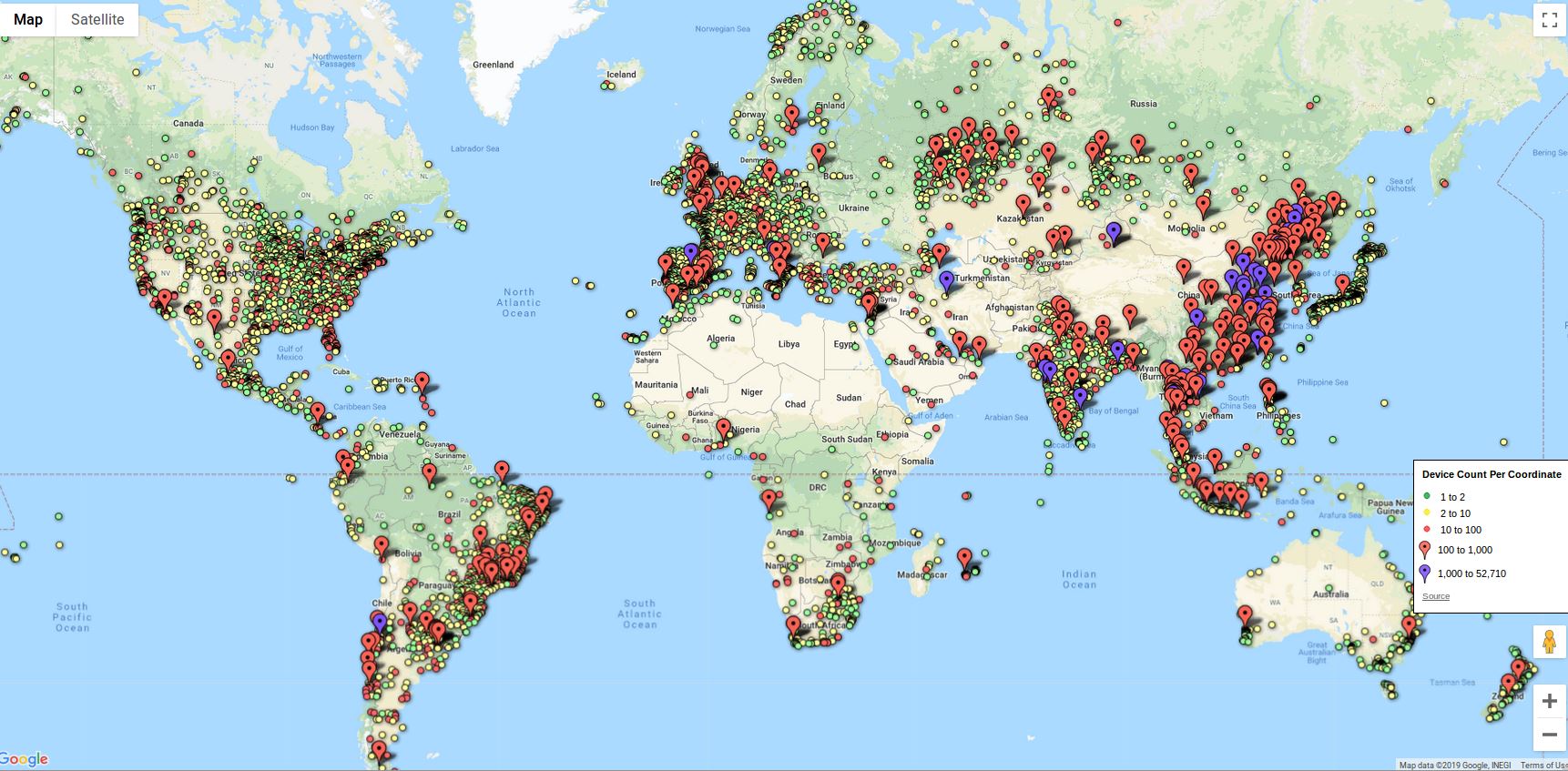
A map showing the distribution of some 2 million iLinkP2P-enabled devices that are vulnerable to eavesdropping, password theft and possibly remote compromise, according to new research.

The security flaws involve iLnkP2P, software developed by China-based Shenzhen Yunni Technology. iLnkP2p is bundled with millions of Internet of Things (IoT) devices, including security cameras and Webcams, baby monitors, smart doorbells, and digital video recorders.

iLnkP2P is designed to allow users of these devices to quickly and easily access them remotely from anywhere in the world, without having to tinker with one’s firewall: Users simply download a mobile app, scan a barcode or enter the six-digit ID stamped onto the bottom of the device, and the P2P software handles the rest.

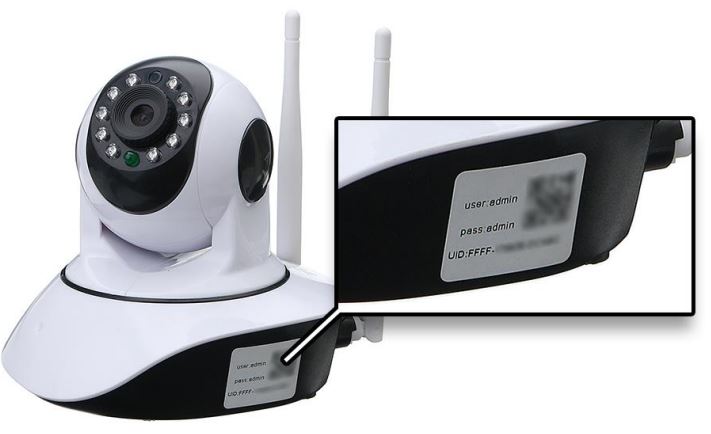
A Webcam made by HiChip that includes the iLnkP2P software.

But according to an in-depth analysis shared with KrebsOnSecurity by security researcher Paul Marrapese, iLnkP2P devices offer no authentication or encryption and can be easily enumerated, allowing potential attackers to establish a direct connection to these devices while bypassing any firewall restrictions.

Marrapese said a proof-of-concept script he built identified more than two million vulnerable devices around the globe (see map above). He found that 39 percent of the vulnerable IoT things were in China; another 19 percent are located in Europe; seven percent of them are in use in the United States.

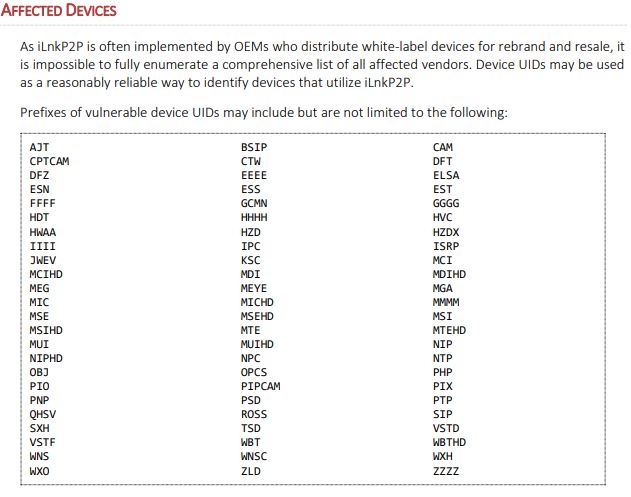
Although it may seem impossible to enumerate more than a million devices with just a six-digit ID, Marrapese notes that each ID begins with a unique alphabetic prefix that identifies which manufacturer produced the device, and there are dozens of companies that white-label the iLnkP2P software.

For example, HiChip — a Chinese IoT vendor that Marrapese said accounts for nearly half of the vulnerable devices — uses the prefixes FFFF, GGGG, HHHH, IIII, MMMM, ZZZZ.

These prefixes identify different product lines and vendors that use iLnkP2P. If the code stamped on your IoT device begins with one of these, it is vulnerable.

“In theory, this allows them to support nearly 6 million devices for these prefixes alone,” Marrapese said. “In reality, enumeration of these prefixes has shown that the number of online devices was ~1,517,260 in March 2019. By enumerating all of the other vendor prefixes, that pushes the number toward 2 million.”

Marrapese said he also built a proof-of-concept attack that can steal passwords from devices by abusing their built-in “heartbeat” feature. Upon being connected to a network, iLnkP2P devices will regularly send a heartbeat or “here I am” message to their preconfigured P2P servers and await further instructions.

“A P2P server will direct connection requests to the origin of the most recently-received heartbeat message,” Marrapese said. “Simply by knowing a valid device UID, it is possible for an attacker to issue fraudulent heartbeat messages that will supersede any issued by the genuine device. Upon connecting, most clients will immediately attempt to authenticate as an administrative user in plaintext, allowing an attacker to obtain the credentials to the device.”

To make matters worse, even if an attacker doesn’t want to bother intercepting device passwords, a great many of them will be running in their factory-default state with the factory-default password. The IoT malware Mirai proved this conclusively, as it rapidly spread to millions of devices using nothing more than the default credentials for IoT devices made by dozens of manufacturers.

What’s more, as we saw with Mirai the firmware and software built into these IoT devices is often based on computer code that is many years old and replete with security vulnerabilities, meaning that anyone able to communicate directly with them is also likely to be able to remotely compromise them with malicious software.

Marrapese said despite attempts to notify China’s CERT, iLnk and a half dozen major vendors whose products make up the bulk of the affected devices, none of them have responded to his reports — even though he first started reaching out to them more than four months ago. Neither HiChip nor iLnk responded to requests for comment sent by KrebsOnSecurity.

Interestingly, iLnk’s Web site (p1.i-lnk[.]com) currently appears to be non-functional, and a review of its HTML source code indicates the site is currently compromised by an obfuscated script that tries to redirect visitors to a Chinese gaming Web site.

Despite the widespread impact of these vulnerabilities, Marrapese’s research suggests that remediation from vendors is unlikely – and in fact, infeasible.

“The nature of these vulnerabilities makes them extremely difficult to remediate for several reasons,” Marrapese wrote. “Software-based remediation is unlikely due to the infeasibility of changing device UIDs, which are permanently assigned during the manufacturing process. Furthermore, even if software patches were issued, the likelihood of most users updating their device firmware is low. Physical device recalls are unlikely as well because of considerable logistical challenges. Shenzhen Yunni Technology is an upstream vendor with inestimable sub-vendors due to the practice of white-labeling and reselling.”

Marrapese said there is no practical way to turn off the P2P functionality on the affected devices. Many IoT devices can punch holes in firewalls using a feature built into hardware-based routers called Universal Plug and Play (UPnP). But simply turning off UPnP on one’s router won’t prevent the devices from establishing a P2P connection as they rely on a different communications technique called “UDP hole punching.”

Marrapese said it should be possible to block vulnerable devices from communicating with any P2P servers by setting up firewall rules that block traffic destined for UDP port 32100.

However, a much safer idea would be to simply avoid purchasing or using IoT devices that advertise any P2P capabilities. Previous research has unearthed similar vulnerabilities in the P2P functionality built into other IoT systems. For examples of this, see This is Why People Fear the Internet of Things, and Researchers Find Fresh Fodder for IoT Attack Cannons.

Marrapese documented his findings in more detail here. The enumeration vulnerability has been assigned CVE-2019-11219, and the man-in-the-middle vulnerability has been assigned CVE-2019-11220.

Additional reading: Some Basic Rules for Securing your IoT Stuff.

from Krebs on Security http://bit.ly/2II0mdv
via IFTTT

Who’s Behind the RevCode WebMonitor RAT?

The owner of a Swedish company behind a popular remote administration tool (RAT) implicated in thousands of malware attacks shares the same name as a Swedish man who pleaded guilty in 2015 to co-creating the Blackshades RAT, a similar product that was used to infect more than half a million computers with malware, KrebsOnSecurity has learned.

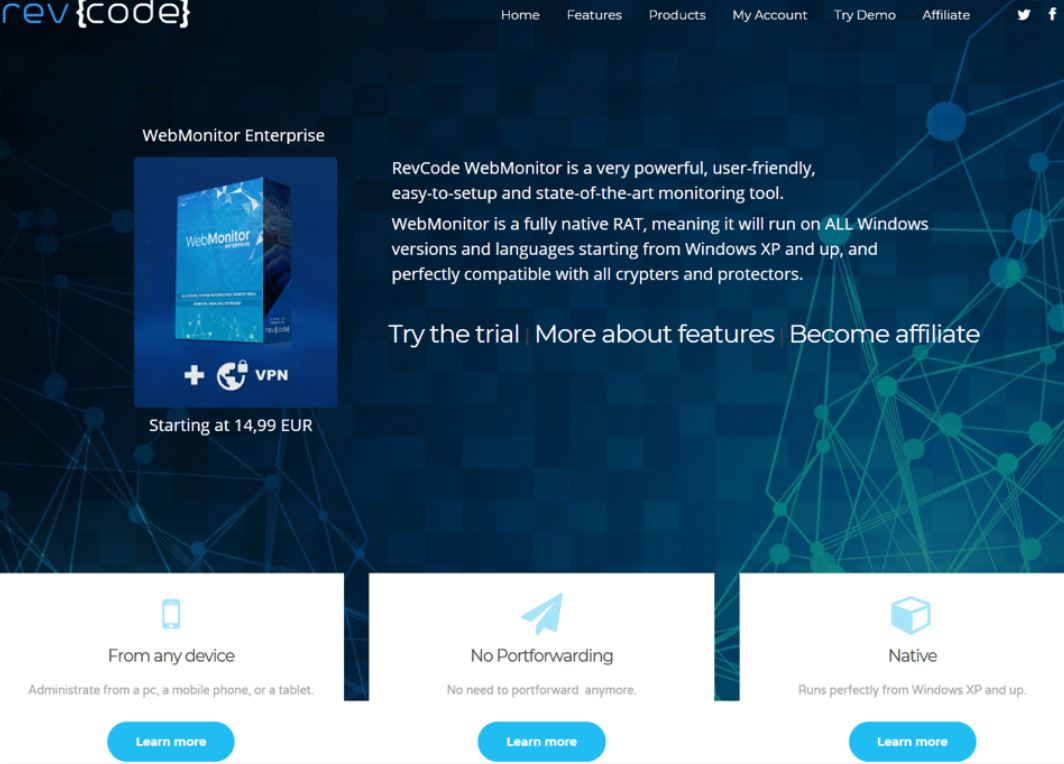
An advertisement for RevCode WebMonitor.

At issue is a program called “WebMonitor,” which was designed to allow users to remotely control a computer (or multiple machines) via a Web browser. The makers of WebMonitor, a company in Sweden called “RevCode,” say their product is legal and legitimate software “that helps firms and personal users handle the security of owned devices.”

But critics say WebMonitor is far more likely to be deployed on “pwned” devices, or those that are surreptitiously hacked. The software is broadly classified as malware by most antivirus companies, likely thanks to an advertised feature list that includes dumping the remote computer’s temporary memory; retrieving passwords from dozens of email programs; snarfing the target’s Wi-Fi credentials; and viewing the target’s Webcam.

In a writeup on WebMonitor published in April 2018, researchers from security firm Palo Alto Networks noted that the product has been primarily advertised on underground hacking forums, and that its developers promoted several qualities of the software likely to appeal to cybercriminals looking to secretly compromise PCs.

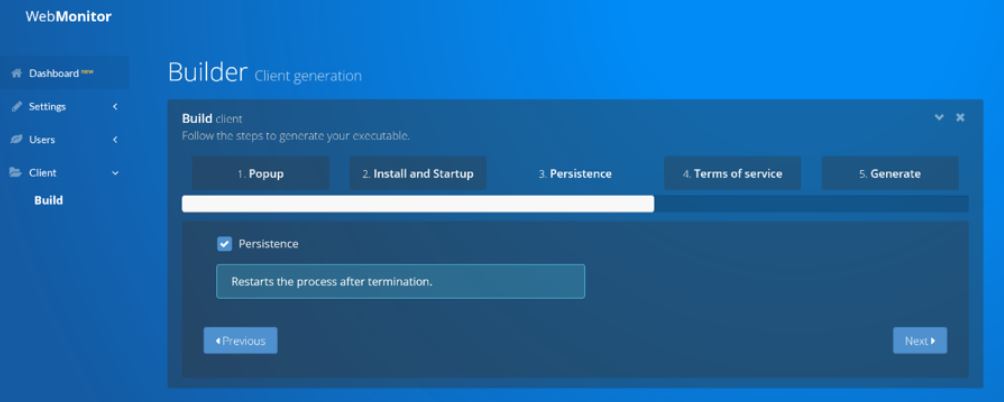
For example, RevCode’s website touted the software’s compatibility with all “crypters,” software that can encrypt, obfuscate and manipulate malware to make it harder to detect by antivirus programs. Palo Alto also noted WebMonitor includes the option to suppress any notification boxes that may pop up when the RAT is being installed on a computer.

A screenshot of the WebMonitor builder panel.

RevCode maintains it is a legitimate company officially registered in Sweden that obeys all applicable Swedish laws. A few hours of searching online turned up an interesting record at Ratsit AB, a credit information service based in Sweden. That record indicates RevCode is owned by 28-year-old Swedish resident Alex Yücel.

In February 2015, a then 24-year-old Alex Yücel pleaded guilty in a U.S. court to computer hacking and to creating, marketing and selling Blackshades, a RAT that was used to compromise and spy on hundreds of thousands of computers. Arrested in Moldova in 2013 as part of a large-scale, international takedown against Blackshades and hundreds of customers, Yücel became the first person ever to be extradited from Moldova to the United States.

Yücel was sentenced to 57 months in prison, but according to a record for Yücel at the U.S. Federal Bureau of Prisons, he was released on Nov. 1, 2016. The first advertisements in hacker forums for the sale of WebMonitor began in mid-2017. RevCode was registered as an official Swedish company in 2018, according to Ratsit.

Until recently, RevCode published on its Web site a value added tax (VAT) number, an identifier used in many European countries for value added tax purposes. That VAT number — first noted by the blog Krabsonsecurity.com (which borrows heavily from this site’s design and banner but otherwise bears no relation to KrebsOnSecurity.com) — has since been removed from the RevCode Web site and from historic records at The Internet Archive. The VAT number cited in that report is registered to Alex Yücel, and matches the number listed for RevCode by Ratsit AB.

Yücel could not be immediately reached for comment. But an unnamed person responded to an email sent to the customer support address listed at RevCode’s site. Presented with the information and links referenced above, the person responding wrote, “nobody working for/with RevCode is in any way related to BlackShades. Anything else suggesting otherwise is nothing but rumors and attempts to degrade our company by means of defamation.”

The person responding from the RevCode support email address contended that the Alex Yücel listed as owner of the company was not the same Alex Yücel convicted of co-authoring Blackshades. However, unless the Ratsit record is completely wrong, this seems unlikely to be true.

According to the Ratsit listing, the Alex Yücel who heads RevCode currently lives in a suburb of Stockholm, Sweden with his parents Can and Rita Yücel. Both Can and Rita Yücel co-signed a letter (PDF) in June 2015 testifying to a New York federal court regarding their son’s upstanding moral character prior to Yücel the younger’s sentencing for the Blackshades conviction, according to court records.

A letter from Alex Yücel’s parents to the court in June 2016.

from Krebs on Security http://bit.ly/2VYYpwg
via IFTTT

Marcus “MalwareTech” Hutchins Pleads Guilty to Writing, Selling Banking Malware

Marcus Hutchins, a 24-year-old blogger and malware researcher arrested in 2017 for allegedly authoring and selling malware designed to steal online banking credentials, has pleaded guilty to criminal charges of conspiracy and to making, selling or advertising illegal wiretapping devices.

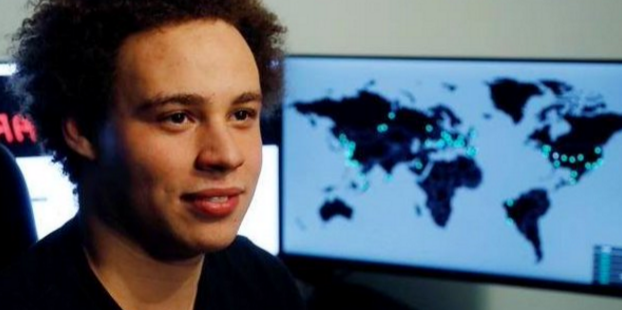
Marcus Hutchins, just after he was revealed as the security expert who stopped the WannaCry worm. Image: twitter.com/malwaretechblog

Hutchins, who authors the popular blog MalwareTech, was virtually unknown to most in the security community until May 2017 when the U.K. media revealed him as the “accidental hero” who inadvertently halted the global spread of WannaCry, a ransomware contagion that had taken the world by storm just days before.

In August 2017, Hutchins was arrested by FBI agents in Las Vegas on suspicion of authoring and/or selling “Kronos,” a strain of malware designed to steal online banking credentials. A British citizen, Hutchins has been barred from leaving the United States since his arrest.

Many of Hutchins’ supporters and readers had trouble believing the charges against him, and in response KrebsOnSecurity published a lengthy investigation into activities tied to his various online personas over the years.

As I wrote in summary of that story, the clues suggested “Hutchins began developing and selling malware in his mid-teens — only to later develop a change of heart and earnestly endeavor to leave that part of his life squarely in the rearview mirror.” Nevertheless, there were a number of indications that Hutchins’ alleged malware activity continued into his adulthood.

In a statement posted to his Twitter feed and to malwaretech.com, Hutchins said today he had pleaded guilty to two charges related to writing malware in the years prior to his career in security.

“I regret these actions and accept full responsibility for my mistakes,” Hutchins wrote. “Having grown up, I’ve since been using the same skills that I misused several years ago for constructive purposes. I will continue to devote my time to keeping people safe from malware attacks.”

Hutchins pleaded guilty to two of the 10 counts for which he was originally accused, including conspiracy charges and violating U.S.C. Title 18, Section 2512, which involves the manufacture, distribution, possession and advertising of devices for intercepting online communications.

Creating malware is a form of protect speech in the United States, but selling it and disseminating it is another matter. George Washington University Professor Orin Kerr‘s 2017 dissection of the government’s charges is worth a read for a deep dive on this sticky legal issue.

According to a copy of Hutchins’ plea agreement, both charges each carry a maximum of up to five years in prison, and up to a $250,000 fine, and up to one year of supervised release. However, those charges are likely to be substantially tempered by federal sentencing guidelines, and may take into account time already served in detention. It remains unclear when he will be sentenced.

The plea agreement is here (PDF). “Attachment A” beginning on page 15 outlines the government’s case against Hutchins and an alleged co-conspirator. The government says between July 2012 and Sept. 2015, Hutchins helped create and sell Kronos and a related piece of malware called UPAS Kit.

Despite what many readers here have alleged, I hold no ill will against Hutchins. He and I spoke briefly in a friendly exchange after a chance encounter at last year’s DEF CON security conference in Las Vegas, and said at the time I was rooting for him to beat the charges. I sincerely hope he is able to keep his nose clean and put this incident behind him soon.

Yours Truly shaking hands with Marcus Hutchins in Las Vegas, August 2018.

from Krebs on Security http://bit.ly/2vcQTlx
via IFTTT