Feds Allege Adconion Employees Hijacked IP Addresses for Spamming

Federal prosecutors in California have filed criminal charges against four employees of Adconion Direct, an email advertising firm, alleging they unlawfully hijacked vast swaths of Internet addresses and used them in large-scale spam campaigns. KrebsOnSecurity has learned that the charges are likely just the opening salvo in a much larger, ongoing federal investigation into the company’s commercial email practices.

Prior to its acquisition, Adconion offered digital advertising solutions to some of the world’s biggest companies, including Adidas, AT&T, Fidelity, Honda, Kohl’s and T-Mobile. Amobee, the Redwood City, Calif. online ad firm that acquired Adconion in 2014, bills itself as the world’s leading independent advertising platform. The CEO of Amobee is Kim Perell, formerly CEO of Adconion.

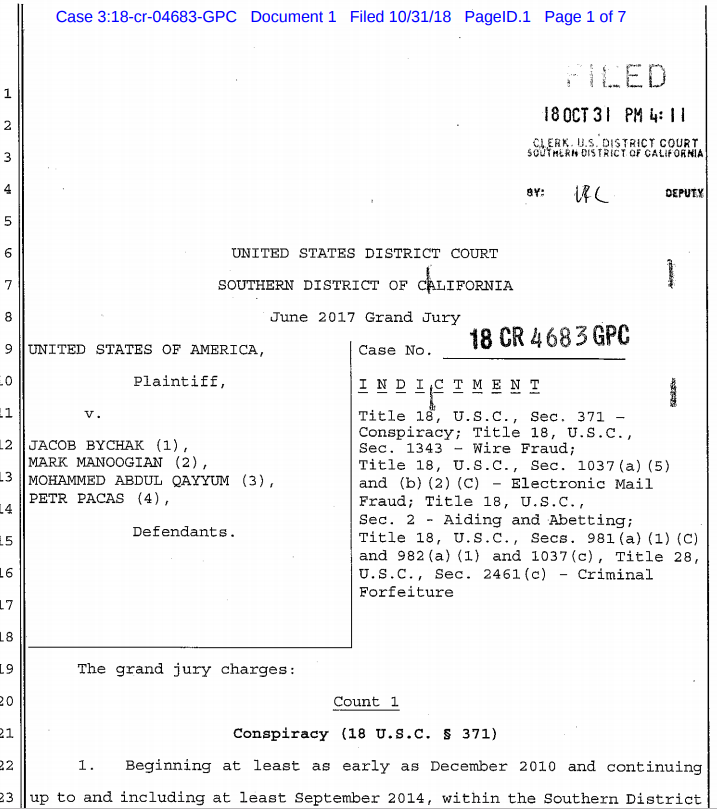
In October 2018, prosecutors in the Southern District of California named four Adconion employees — Jacob Bychak, Mark ManoogianPetr Pacas, and Mohammed Abdul Qayyum —  in a ten-count indictment on charges of conspiracy, wire fraud, and electronic mail fraud. All four men have pleaded not guilty to the charges, which stem from a grand jury indictment handed down in June 2017.
‘COMPANY A’

The indictment and other court filings in this case refer to the employer of the four men only as “Company A.” However, LinkedIn profiles under the names of three of the accused show they each work(ed) for Adconion and/or Amobee.

Mark Manoogian is an attorney whose LinkedIn profile states that he is director of legal and business affairs at Amobee, and formerly was senior business development manager at Adconion Direct; Bychak is listed as director of operations at Adconion Direct; Quayyum’s LinkedIn page lists him as manager of technical operations at Adconion. A statement of facts filed by the government indicates Petr Pacas was at one point director of operations at Company A (Adconion).

According to the indictment, between December 2010 and September 2014 the defendants engaged in a conspiracy to identify or pay to identify blocks of Internet Protocol (IP) addresses that were registered to others but which were otherwise inactive.

The government alleges the men sent forged letters to an Internet hosting firm claiming they had been authorized by the registrants of the inactive IP addresses to use that space for their own purposes.

“Members of the conspiracy would use the fraudulently acquired IP addresses to send commercial email (‘spam’) messages,” the government charged.

HOSTING IN THE WIND

Prosecutors say the accused were able to spam from the purloined IP address blocks after tricking the owner of Hostwinds, an Oklahoma-based Internet hosting firm, into routing the fraudulently obtained IP addresses on their behalf.

Hostwinds owner Peter Holden was the subject of a 2015 KrebsOnSecurity story titled, “Like Cutting Off a Limb to Save the Body,” which described how he’d initially built a lucrative business catering mainly to spammers, only to later have a change of heart and aggressively work to keep spammers off of his network.

Most of the spammers Hostswinds terminated were sending messages for marketing programs that sign consumers up for various products or services which bill monthly and can be very difficult for consumers to cancel. Others were involved in sending spam to people who’d given away their email addresses and other personal information in response to various “free gift” offers.

That a case of such potential import for the digital marketing industry has escaped any media attention for so long is unusual but not surprising given what’s at stake for the companies involved and for the government’s ongoing investigations.

Adconion’s parent Amobee manages ad campaigns for some of the world’s top brands, and has every reason not to call attention to charges that some of its key employees may have been involved in criminal activity.

Meanwhile, prosecutors are busy following up on evidence supplied by several cooperating witnesses in this and a related grand jury investigation, including a confidential informant who received information from an Adconion employee about the company’s internal operations.

THE BIGGER PICTURE

According to a memo jointly filed by the defendants, “this case spun off from a larger ongoing investigation into the commercial email practices of Company A.” Ironically, this memo appears to be the only one of several dozen documents related to the indictment that mentions Adconion by name (albeit only in a series of footnote references).

Prosecutors allege the four men bought hijacked IP address blocks from another man tied to this case who was charged separately. This individual, Daniel Dye, has a history of working with others to hijack IP addresses for use by spammers.

For many years, Dye was a system administrator for Optinrealbig, a Colorado company that relentlessly pimped all manner of junk email, from mortgage leads and adult-related services to counterfeit products and Viagra.

Optinrealbig’s CEO was the spam king Scott Richter, who later changed the name of the company to Media Breakaway after being successfully sued for spamming by AOL, MicrosoftMySpace, and the New York Attorney General Office, among others. In 2008, this author penned a column for The Washington Post detailing how Media Breakaway had hijacked tens of thousands of IP addresses from a defunct San Francisco company for use in its spamming operations.

Dye has been charged with violations of the CAN-SPAM Act. A review of the documents in his case suggest Dye accepted a guilty plea agreement in connection with the IP address thefts and is cooperating with the government’s ongoing investigation into Adconion’s email marketing practices, although the plea agreement itself remains under seal.

Lawyers for the four defendants in this case have asserted in court filings that the government’s confidential informant is an employee of Spamhaus.org, an organization that many Internet service providers around the world rely upon to help identify and block sources of malware and spam.

Interestingly, in 2014 Spamhaus was sued by Blackstar Media LLC, a bulk email marketing company and subsidiary of Adconion. Blackstar’s owners sued Spamhaus for defamation after Spamhaus included them at the top of its list of the Top 10 world’s worst spammers. Blackstar later dropped the lawsuit and agreed to paid Spamhaus’ legal costs.

Representatives for Spamhaus declined to comment for this story. Responding to questions about the indictment of Adconion employees, Amobee’s parent company SingTel referred comments to Amobee, which issued a brief statement saying, “Amobee has fully cooperated with the government’s investigation of this 2017 matter which pertains to alleged activities that occurred years prior to Amobee’s acquisition of the company.”

ONE OF THE LARGEST SPAMMERS IN HISTORY?

It appears the government has been investigating Adconion’s email practices since at least 2015, and possibly as early as 2013. The very first result in an online search for the words “Adconion” and “spam” returns a Microsoft Powerpoint document that was presented alongside this talk at an ARIN meeting in October 2016. ARIN stands for the American Registry for Internet Numbers, and it handles IP addresses allocations for entities in the United States, Canada and parts of the Caribbean.
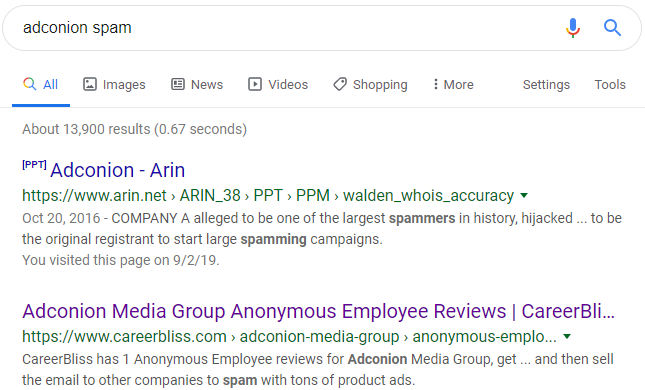
As the screenshot above shows, that Powerpoint deck was originally named “Adconion – Arin,” but the file has since been renamed. That is, unless one downloads the file and looks at the metadata attached to it, which shows the original filename and that it was created in 2015 by someone at the U.S. Department of Justice.

Slide #8 in that Powerpoint document references a case example of an unnamed company (again, “Company A”), which the presenter said was “alleged to be one of the largest spammers in history,” that had hijacked “hundreds of thousands of IP addresses.”
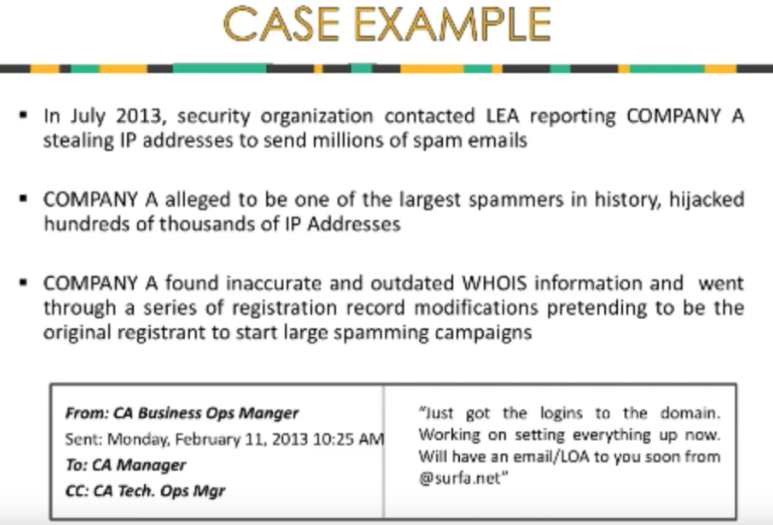
A slide from an ARIN presentation in 2016 that referenced Adconion.

There are fewer than four billion IPv4 addresses available for use, but the vast majority of them have already been allocated. In recent years, this global shortage has turned IP addresses into a commodity wherein each IP can fetch between $15-$25 on the open market.

The dearth of available IP addresses has created boom times for those engaged in the acquisition and sale of IP address blocks. It also has emboldened scammers and spammers who specialize in absconding with and spamming from dormant IP address blocks without permission from the rightful owners.

In May, KrebsOnSecurity broke the news that Amir Golestan — the owner of a prominent Charleston, S.C. tech company called Micfo LLC — had been indicted on criminal charges of fraudulently obtaining more than 735,000 IP addresses from ARIN and reselling the space to others.

KrebsOnSecurity has since learned that for several years prior to 2014, Adconion was one of Golestan’s biggest clients. More on that in an upcoming story.

from Krebs on Security https://ift.tt/2LAHAnx
via IFTTT
Phishers are Angling for Your Cloud Providers

Many companies are now outsourcing their marketing efforts to cloud-based Customer Relationship Management (CRM) providers. But when accounts at those CRM providers get hacked or phished, the results can be damaging for both the client’s brand and their customers. Here’s a look at a recent CRM-based phishing campaign that targeted customers of Fortune 500 construction equipment vendor United Rentals.

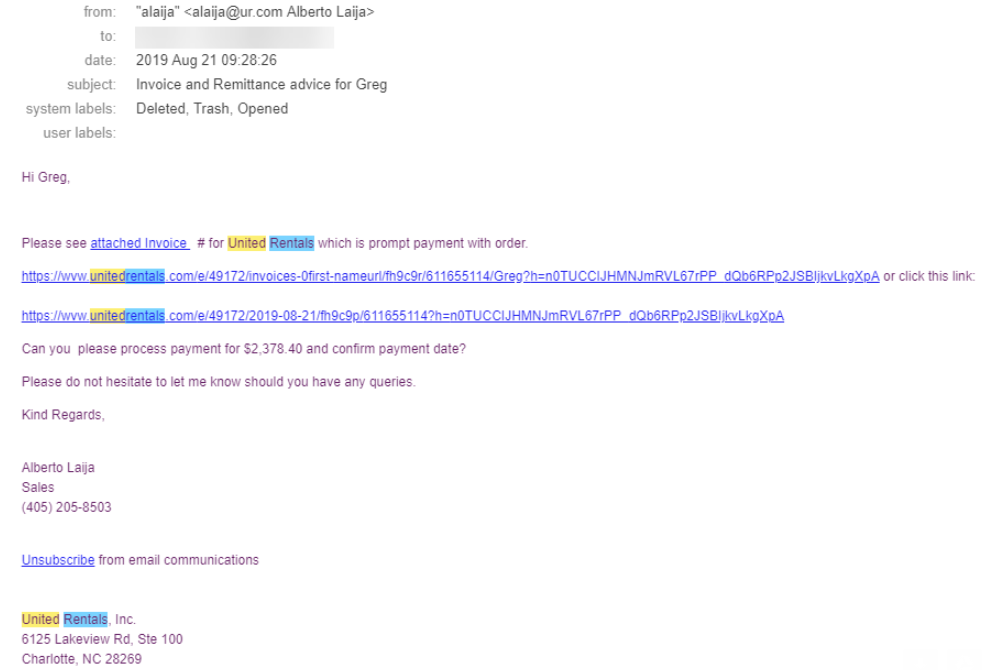
Stamford, Ct.-based United Rentals [NYSE:URI] is the world’s largest equipment rental company, with some 18,000 employees and earnings of approximately $4 billion in 2018. On August 21, multiple United Rental customers reported receiving invoice emails with booby-trapped links that led to a malware download for anyone who clicked.

While phony invoices are a common malware lure, this particular campaign sent users to a page on United Rentals’ own Web site (unitedrentals.com).

A screen shot of the malicious email that spoofed United Rentals.

In a notice to customers, the company said the unauthorized messages were not sent by United Rentals. One source who had at least two employees fall for the scheme forwarded KrebsOnSecurity a response from UR’s privacy division, which blamed the incident on a third-party advertising partner.

“Based on current knowledge, we believe that an unauthorized party gained access to a vendor platform United Rentals uses in connection with designing and executing email campaigns,” the response read.

“The unauthorized party was able to send a phishing email that appears to be from United Rentals through this platform,” the reply continued. “The phishing email contained links to a purported invoice that, if clicked on, could deliver malware to the recipient’s system. While our investigation is continuing, we currently have no reason to believe that there was unauthorized access to the United Rentals systems used by customers, or to any internal United Rentals systems.”

United Rentals told KrebsOnSecurity that its investigation so far reveals no compromise of its internal systems.

“At this point, we believe this to be an email phishing incident in which an unauthorized third party used a third-party system to generate an email campaign to deliver what we believe to be a banking trojan,” said Dan Higgins, UR’s chief information officer.

United Rentals would not name the third party marketing firm thought to be involved, but passive DNS lookups on the UR subdomain referenced in the phishing email (used by UL for marketing since 2014 and visible in the screenshot above as “wVw.unitedrentals.com”) points to Pardot, an email marketing division of cloud CRM giant Salesforce.

Companies that use cloud-based CRMs sometimes will dedicate a domain or subdomain they own specifically for use by their CRM provider, allowing the CRM to send emails that appear to come directly from the client’s own domains. However, in such setups the content that gets promoted through the client’s domain is actually hosted on the cloud CRM provider’s systems.

Salesforce did not respond to multiple requests for comment. But it seems likely that someone at Pardot with access to United Rental’s account was phished, hacked, or perhaps guilty of password re-use.

This attack comes on the heels of another targeted phishing campaign leveraging Pardot that was documented earlier this month by Netskope, a cloud security firm. Netskope’s Ashwin Vamshi said users of cloud CRM platforms have a high level of trust in the software because they view the data and associated links as internal, even though they are hosted in the cloud.

“A large number of enterprises provide their vendors and partners access to their CRM for uploading documents such as invoices, purchase orders, etc. (and often these happen as automated workflows),” Vamshi wrote. “The enterprise has no control over the vendor or partner device and, more importantly, over the files being uploaded from them. In many cases, vendor- or partner-uploaded files carry with them a high level of implicit trust.”

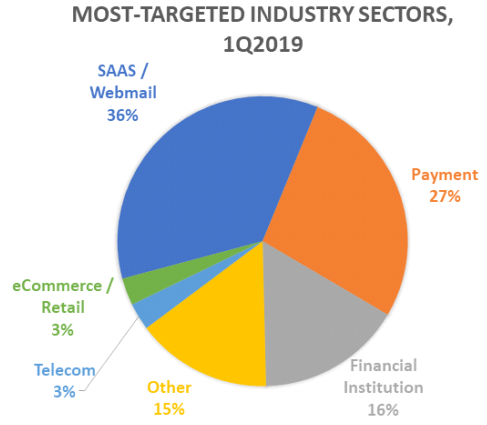
Cybercriminals increasingly are targeting cloud CRM providers because compromised accounts on these systems can be leveraged to conduct extremely targeted and convincing phishing attacks. According to the most recent stats (PDF) from the Anti-Phishing Working Group, software-as-a-service providers (including CRM and Webmail providers) were the most-targeted industry sector in the first quarter of 2019, accounting for 36 percent of all phishing attacks.

Image: APWG

from Krebs on Security https://ift.tt/2ZEZ8n6
via IFTTT

Ransomware Bites Dental Data Backup Firm

PerCSoft, a Wisconsin-based company that manages a remote data backup service relied upon by hundreds of dental offices across the country, is struggling to restore access to client systems after falling victim to a ransomware attack.

West Allis, Wis.-based PerCSoft is a cloud management provider for Digital Dental Record (DDR), which operates an online data backup service called DDS Safe that archives medical records, charts, insurance documents and other personal information for various dental offices across the United States.

The ransomware attack hit PerCSoft on the morning of Monday, Aug. 26, and encrypted dental records for some — but not all — of the practices that rely on DDS Safe.

PercSoft did not respond to requests for comment. But Brenna Sadler, director of  communications for the Wisconsin Dental Association, said the ransomware encrypted files for approximate 400 dental practices, and that somewhere between 80-100 of those clients have now had their files restored.

Sadler said she did not know whether PerCSoft and/or DDR had paid the ransom demand, what ransomware strain was involved, or how much the attackers had demanded.

But updates to PerCSoft’s Facebook page and statements published by both PerCSoft and DDR suggest someone may have paid up: The statements note that both companies worked with a third party software company and were able to obtain a decryptor to help clients regain access to files that were locked by the ransomware.

However, some affected dental offices have reported that the decryptor did not work to unlock at least some of the files encrypted by the ransomware. Meanwhile, several affected dentistry practices said they feared they might be unable to process payroll payments this week as a result of the attack.

Cloud data and backup services are a prime target of cybercriminals who deploy ransomware. In July, attackers hit QuickBooks cloud hosting firm iNSYNQ, holding data hostage for many of the company’s clients. In February, cloud payroll data provider Apex Human Capital Management was knocked offline for three days following a ransomware infestation.

On Christmas Eve 2018, cloud hosting provider Dataresolution.net took its systems offline in response to a ransomware outbreak on its internal networks. The company was adamant that it would not pay the ransom demand, but it ended up taking several weeks for customers to fully regain access to their data.

The FBI and multiple security firms have advised victims not to pay any ransom demands, as doing so just encourages the attackers and in any case may not result in actually regaining access to encrypted files. In practice, however, many cybersecurity consulting firms are quietly urging their customers that paying up is the fastest route back to business-as-usual.

It remains unclear if either PerCSoft or DDR — or perhaps their insurance provider — paid the ransom demand in this attack. But new reporting from independent news outlet ProPublica this week sheds light on another possible explanation why so many victims are simply coughing up the ransom demands: Their insurance providers will cover the cost — minus a deductible that is usually far less than the total ransom demanded by the attackers.

More to the point, ProPublica found, such attacks may be great for business if you’re in the insurance industry.

“More often than not, paying the ransom is a lot cheaper for insurers than the loss of revenue they have to cover otherwise,” said Minhee Cho, public relations director of ProPublica, in an email to KrebsOnSecurity. “But, by rewarding hackers, these companies have created a perverted cycle that encourages more ransomware attacks, which in turn frighten more businesses and government agencies into buying policies.”

“In fact, it seems hackers are specifically extorting American companies that they know have cyber insurance,” Cho continued. “After one small insurer highlighted the names of some of its cyber policyholders on its website, three of them were attacked by ransomware.”

Read the full ProPublica piece here. And if you haven’t already done so, check out this outstanding related reporting by ProPublica from earlier this year on how security firms that help companies respond to ransomware attacks also may be enabling and emboldening attackers.

from Krebs on Security https://ift.tt/2UeI9qM
via IFTTT

Cybersecurity Firm Imperva Discloses Breach

Imperva, a leading provider of Internet firewall services that help Web sites block malicious cyberattacks, alerted customers on Tuesday that a recent data breach exposed email addresses, scrambled passwords, API keys and SSL certificates for a subset of its firewall users.

Redwood Shores, Calif.-based Imperva sells technology and services designed to detect and block various types of malicious Web traffic, from denial-of-service attacks to digital probes aimed at undermining the security of Web-based software applications.

Image: Imperva

Earlier today, Imperva told customers that it learned on Aug. 20 about a security incident that exposed sensitive information for some users of Incapsula, the company’s cloud-based Web Application Firewall (WAF) product.

“On August 20, 2019, we learned from a third party of a data exposure that impacts a subset of customers of our Cloud WAF product who had accounts through September 15, 2017,” wrote Heli Erickson, director of analyst relations at Imperva.

“We want to be very clear that this data exposure is limited to our Cloud WAF product,” Erickson’s message continued. “While the situation remains under investigation, what we know today is that elements of our Incapsula customer database from 2017, including email addresses and hashed and salted passwords, and, for a subset of the Incapsula customers from 2017, API keys and customer-provided SSL certificates, were exposed.”

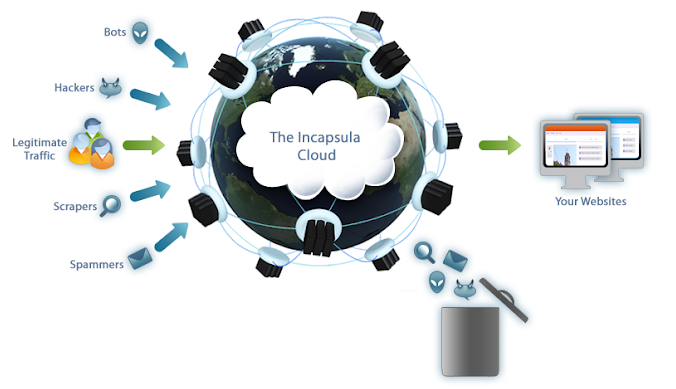
Companies that use the Incapsula WAF route all of their Web site traffic through the service, which scrubs the communications for any suspicious activity or attacks and then forwards the benign traffic on to its intended destination.

Rich Mogull, founder and vice president of product at Kansas City-based cloud security firm DisruptOps, said Imperva is among the top three Web-based firewall providers in business today.

According to Mogull, an attacker in possession of a customer’s API keys and SSL certificates could use that access to significantly undermine the security of traffic flowing to and from a customer’s various Web sites.

At a minimum, he said, an attacker in possession of these key assets could reduce the security of the WAF settings and exempt or “whitelist” from the WAF’s scrubbing technology any traffic coming from the attacker. A worst-case scenario could allow an attacker to intercept, view or modify traffic destined for an Incapsula client Web site, and even to divert all traffic for that site to or through a site owned by the attacker.

“Attackers could whitelist themselves and begin attacking the site without the WAF’s protection,” Mogull told KrebsOnSecurity. “They could modify any of the security Incapsula security settings, and if they got [the target’s SSL] certificate, that can potentially expose traffic. For a security-as-a-service provider like Imperva, this is the kind of mistake that’s up their with their worst nightmare.”

Imperva urged all of its customers to take several steps that might mitigate the threat from the data exposure, such as changing passwords for user accounts at Incapsula, enabling multi-factor authentication, resetting API keys, and generating/uploading new SSL certificates.

Alissa Knight, a senior analyst at Aite Group, said the exposure of Incapsula users’ scrambled passwords and email addresses was almost incidental given that the intruders also made off with customer API keys and SSL certificates.

Knight said although we don’t yet know the cause of this incident, such breaches at cloud-based firms often come down to small but ultimately significant security failures on the part of the provider.

“The moral of the story here is that people need to be asking tough questions of software-as-a-service firms they rely upon, because those vendors are being trusted with the keys to the kingdom,” Knight said. “Even if the vendor in question is a cybersecurity company, it doesn’t necessarily mean they’re eating their own dog food.”

from Krebs on Security https://ift.tt/2NxrZrj
via IFTTT

Breach at Hy-Vee Supermarket Chain Tied to Sale of 5M+ Stolen Credit, Debit Cards

On Tuesday of this week, one of the more popular underground stores peddling credit and debit card data stolen from hacked merchants announced a blockbuster new sale: More than 5.3 million new accounts belonging to cardholders from 35 U.S. states. Multiple sources now tell KrebsOnSecurity that the card data came from compromised gas pumps, coffee shops and restaurants operated by Hy-Vee, an Iowa-based company that operates a chain of more than 245 supermarkets throughout the Midwestern United States.

Hy-Vee, based in Des Moines, announced on Aug. 14 it was investigating a data breach involving payment processing systems that handle transactions at some Hy-Vee fuel pumps, drive-thru coffee shops and restaurants.

The restaurants affected include Hy-Vee Market Grilles, Market Grille Expresses and Wahlburgers locations that the company owns and operates. Hy-Vee said it was too early to tell when the breach initially began or for how long intruders were inside their payment systems.

But typically, such breaches occur when cybercriminals manage to remotely install malicious software on a retailer’s card-processing systems. This type of point-of-sale malware is capable of copying data stored on a credit or debit card’s magnetic stripe when those cards are swiped at compromised payment terminals. This data can then be used to create counterfeit copies of the cards.

Hy-Vee said it believes the breach does not affect payment card terminals used at its grocery store checkout lanes, pharmacies or convenience stores, as these systems rely on a security technology designed to defeat card-skimming malware.

“These locations have different point-of-sale systems than those located at our grocery stores, drugstores and inside our convenience stores, which utilize point-to-point encryption technology for processing payment card transactions,” Hy-Vee said. “This encryption technology protects card data by making it unreadable. Based on our preliminary investigation, we believe payment card transactions that were swiped or inserted on these systems, which are utilized at our front-end checkout lanes, pharmacies, customer service counters, wine & spirits locations, floral departments, clinics and all other food service areas, as well as transactions processed through Aisles Online, are not involved.”

According to two sources who asked not to be identified for this story — including one at a major U.S. financial institution — the card data stolen from Hy-Vee is now being sold under the code name “Solar Energy,” at the infamous Joker’s Stash carding bazaar.

An ad at the Joker’s Stash carding site for “Solar Energy,” a batch of more than 5 million credit and debit cards sources say was stolen from customers of supermarket chain Hy-Vee.

Hy-Vee said the company’s investigation is continuing.

“We are aware of reports from payment processors and the card networks of payment data being offered for sale and are working with the payment card networks so that they can identify the cards and work with issuing banks to initiate heightened monitoring on accounts,” Hy-Vee spokesperson Tina Pothoff said.

The card account records sold by Joker’s Stash, known as “dumps,” apparently stolen from Hy-Vee are being sold for prices ranging from $17 to $35 apiece. Buyers typically receive a text file that includes all of their dumps. Those individual dumps records — when encoded onto a new magnetic stripe on virtually anything the size of a credit card — can be used to purchase stolen merchandise in big box stores.

As noted in previous stories here, the organized cyberthieves involved in stealing card data from main street merchants have gradually moved down the food chain from big box retailers like Target and Home Deport to smaller but far more plentiful and probably less secure merchants (either by choice or because the larger stores became a harder target).

It’s really not worth spending time worrying about where your card number may have been breached, since it’s almost always impossible to say for sure and because it’s common for the same card to be breached at multiple establishments during the same time period.

Just remember that while consumers are not liable for fraudulent charges, it may still fall to you the consumer to spot and report any suspicious charges. So keep a close eye on your statements, and consider signing up for text message notifications of new charges if your card issuer offers this service. Most of these services also can be set to alert you if you’re about to miss an upcoming payment, so they can also be handy for avoiding late fees and other costly charges.

from Krebs on Security https://ift.tt/2TV0IjC
via IFTTT

Forced Password Reset? Check Your Assumptions

Almost weekly now I hear from an indignant reader who suspects a data breach at a Web site they frequent that has just asked the reader to reset their password. Further investigation almost invariably reveals that the password reset demand was not the result of a breach but rather the site’s efforts to identify customers who are reusing passwords from other sites that have already been hacked.

But ironically, many companies taking these proactive steps soon discover that their explanation as to why they’re doing it can get misinterpreted as more evidence of lax security. This post attempts to unravel what’s going on here.

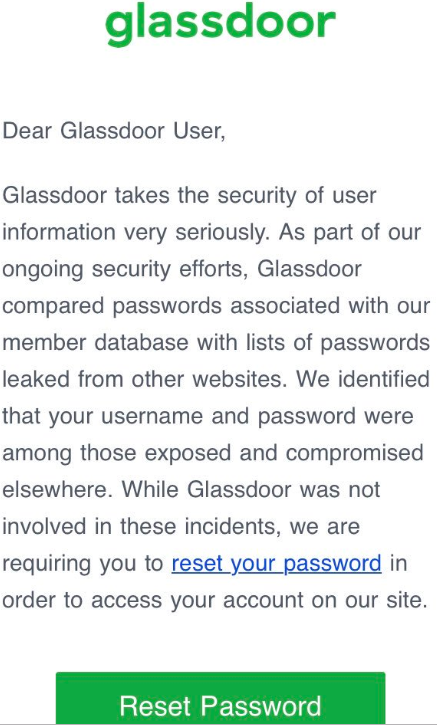
Over the weekend, a follower on Twitter included me in a tweet sent to California-based job search site Glassdoor, which had just sent him the following notice:

The Twitter follower expressed concern about this message, because it suggested to him that in order for Glassdoor to have done what it described, the company would have had to be storing its users’ passwords in plain text. I replied that this was in fact not an indication of storing passwords in plain text, and that many companies are now testing their users’ credentials against lists of hacked credentials that have been leaked and made available online.

The reality is Facebook, Netflix and a number of many big-name companies are regularly combing through huge data leak troves for credentials that match those of their customers, and then forcing a password reset for those users. Some are even checking for password re-use on all new account signups.

The idea here is to stymie a massively pervasive problem facing all companies that do business online today: Namely, “credential-stuffing attacks,” in which attackers take millions or even billions of email addresses and corresponding cracked passwords from compromised databases and see how many of them work at other online properties.

So how does the defense against this daily deluge of credential stuffing work? A company employing this strategy will first extract from these leaked credential lists any email addresses that correspond to their current user base.

From there, the corresponding cracked (plain text) passwords are fed into the same process that the company relies upon when users log in: That is, the company feeds those plain text passwords through its own password “hashing” or scrambling routine.

Password hashing is designed to be a one-way function which scrambles a plain text password so that it produces a long string of numbers and letters. Not all hashing methods are created equal, and some of the most commonly used methods — MD5 and SHA-1, for example — can be far less secure than others, depending on how they’re implemented (more on that in a moment). Whatever the hashing method used, it’s the hashed output that gets stored, not the password itself.

Back to the process: If a user’s plain text password from a hacked database matches the output of what a company would expect to see after running it through their own internal hashing process, then that user is then prompted to change their password to something truly unique.

Now, password hashing methods can be made more secure by amending the password with what’s known as a “salt” — or random data added to the input of a hash function to guarantee a unique output. And many readers of the Twitter thread on Glassdoor’s approach reasoned that the company couldn’t have been doing what it described without also forgoing this additional layer of security.

My tweeted explanatory reply as to why Glassdoor was doing this was (in hindsight) incomplete and in any case not as clear as it should have been. Fortunately, Glassdoor’s chief information officer Anthony Moisant chimed in to the Twitter thread to explain that the salt is in fact added as part of the password testing procedure.

“In our [user] database, we’ve got three columns — username, salt value and scrypt hash,” Moisant explained in an interview with KrebsOnSecurity. “We apply the salt that’s stored in the database and the hash [function] to the plain text password, and that resulting value is then checked against the hash in the database we store. For whatever reason, some people have gotten it into their heads that there’s no possible way to do these checks if you salt, but that’s not true.”

CHECK YOUR ASSUMPTIONS

You — the user — can’t be expected to know or control what password hashing methods a given site uses, if indeed they use them at all. But you can control the quality of the passwords you pick.

I can’t stress this enough: Do not re-use passwords. And don’t recycle them either. Recycling involves rather lame attempts to make a reused password unique by simply adding a digit or changing the capitalization of certain characters. Crooks who specialize in password attacks are wise to this approach as well.

If you have trouble remembering complex passwords (and this describes most people), consider relying instead on password length, which is a far more important determiner of whether a given password can be cracked by available tools in any timeframe that might be reasonably useful to an attacker.

In that vein, it’s safer and wiser to focus on picking passphrases instead of passwords. Passphrases are collections of multiple (ideally unrelated) words mushed together. Passphrases are not only generally more secure, they also have the added benefit of being easier to remember.

According to a recent blog entry by Microsoft group program manager Alex Weinert, none of the above advice about password complexity amounts to a hill of beans from the attacker’s standpoint.

Weinert’s post makes a compelling argument that as long as we’re stuck with passwords, taking full advantage of the most robust form of multi-factor authentication (MFA) offered by a site you frequent is the best way to deter attackers. Twofactorauth.org has a handy list of your options here, broken down by industry.

“Your password doesn’t matter, but MFA does,” Weinert wrote. “Based on our studies, your account is more than 99.9% less likely to be compromised if you use MFA.”

Glassdoor’s Moisant said the company doesn’t currently offer MFA for its users, but that is planning to roll that out later this year to both consumer and business users.

Password managers also can be useful for those who feel encumbered by having to come up with passphrases or complex passwords. If you’re uncomfortable with entrusting a third-party service or application to handle this process for you, there’s absolutely nothing wrong with writing down your passwords, provided a) you do not store them in a file on your computer or taped to your laptop or screen or whatever, and b) that your password notebook is stored somewhere relatively secure, i.e. not in your purse or car, but something like a locked drawer or safe.

Although many readers will no doubt take me to task on that last bit of advice, as in all things security related it’s important not to let the perfect become the enemy of the good. Many people (think moms/dads/grandparents) can’t be bothered to use password managers  — even when you go through the trouble of setting them up on their behalf. Instead, without an easier, non-technical method they will simply revert back to reusing or recycling passwords.

from Krebs on Security https://ift.tt/2zfNk05
via IFTTT

The Rise of “Bulletproof” Residential Networks

Cybercrooks increasingly are anonymizing their malicious traffic by routing it through residential broadband and wireless data connections. Traditionally, those connections have been mainly hacked computers, mobile phones, or home routers. But this story is about so-called “bulletproof residential VPN services” that appear to be built by purchasing or otherwise acquiring discrete chunks of Internet addresses from some of the world’s largest ISPs and mobile data providers.

In late April 2019, KrebsOnSecurity received a tip from an online retailer who’d seen an unusual number of suspicious transactions originating from a series of Internet addresses assigned to a relatively new Internet provider based in Maryland called Residential Networking Solutions LLC.

Now, this in itself isn’t unusual; virtually every provider has the occasional customers who abuse their access for fraudulent purposes. But upon closer inspection, several factors caused me to look more carefully at this company, also known as “Resnet.”

An examination of the IP address ranges assigned to Resnet shows that it maintains an impressive stable of IP blocks — totaling almost 70,000 IPv4 addresses — many of which had until quite recently been assigned to someone else.

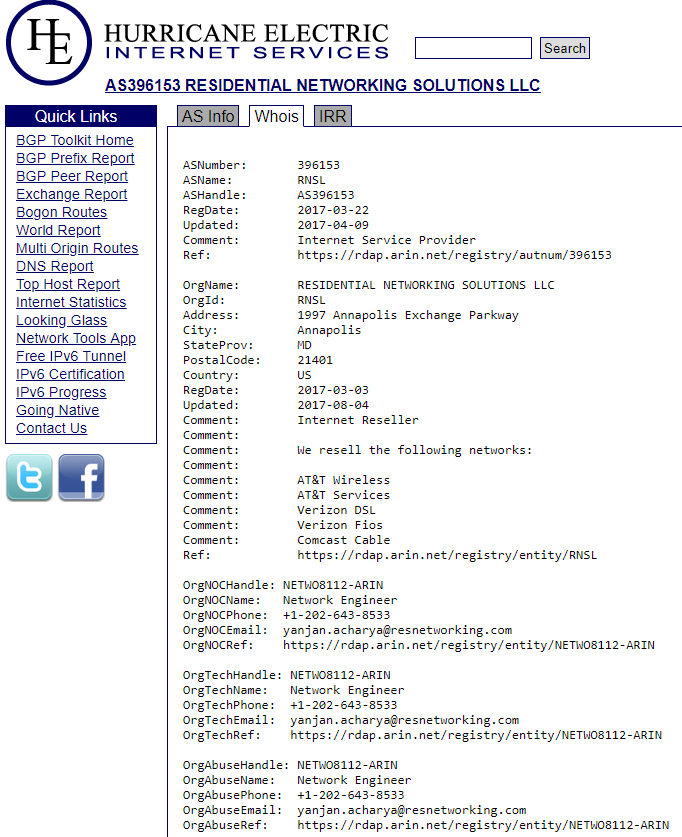
Most interestingly, about ten percent of those IPs — more than 7,000 of them — had until late 2018 been under the control of AT&T Mobility. Additionally, the WHOIS registration records for each of these mobile data blocks suggest Resnet has been somehow reselling data services for major mobile and broadband providers, including AT&T, Verizon, and Comcast Cable.

The WHOIS records for one of several networks associated with Residential Networking Solutions LLC.

Drilling down into the tracts of IPs assigned to Resnet’s core network indicates those 7,000+ mobile IP addresses under Resnet’s control were given the label  “Service Provider Corporation” — mostly those beginning with IPs in the range 198.228.x.x.

An Internet search reveals this IP range is administered by the Wireless Data Service Provider Corporation (WDSPC), a non-profit formed in the 1990s to manage IP address ranges that could be handed out to various licensed mobile carriers in the United States.

Back when the WDSPC was first created, there were quite a few mobile wireless data companies. But today the vast majority of the IP space managed by the WDSPC is leased by AT&T Mobility and Verizon Wireless — which have gradually acquired most of their competing providers over the years.

A call to the WDSPC revealed the nonprofit hadn’t leased any new wireless data IP space in more than 10 years. That is, until the organization received a communication at the beginning of this year that it believed was from AT&T, which recommended Resnet as a customer who could occupy some of the company’s mobile data IP address blocks.

“I’m afraid we got duped,” said the person answering the phone at the WDSPC, while declining to elaborate on the precise nature of the alleged duping or the medium that was used to convey the recommendation.

AT&T declined to discuss its exact relationship with Resnet  — or if indeed it ever had one to begin with. It responded to multiple questions about Resnet with a short statement that said, “We have taken steps to terminate this company’s services and have referred the matter to law enforcement.”

Why exactly AT&T would forward the matter to law enforcement remains unclear. But it’s not unheard of for hosting providers to forge certain documents in their quest for additional IP space, and anyone caught doing so via email, phone or fax could be charged with wire fraud, which is a federal offense that carries punishments of up to $500,000 in fines and as much as 20 years in prison.

WHAT IS RESNET?

The WHOIS registration records for Resnet’s main Web site, resnetworking[.]com, are hidden behind domain privacy protection. However, a cursory Internet search on that domain turned up plenty of references to it on Hackforums[.]net, a sprawling community that hosts a seemingly never-ending supply of up-and-coming hackers seeking affordable and anonymous ways to monetize various online moneymaking schemes.

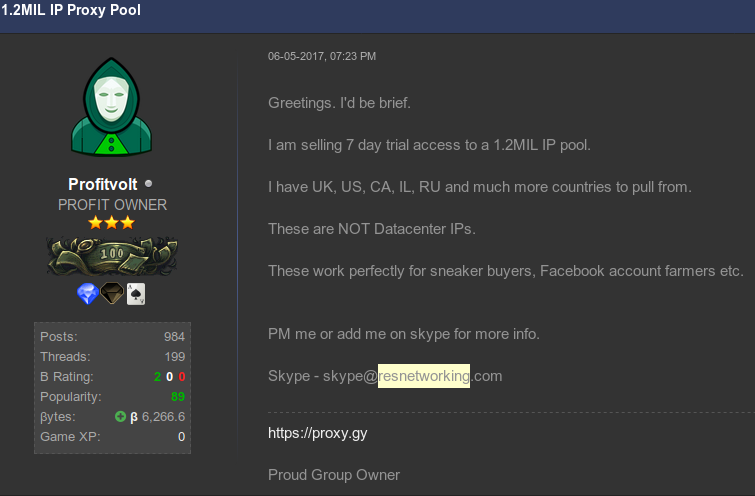
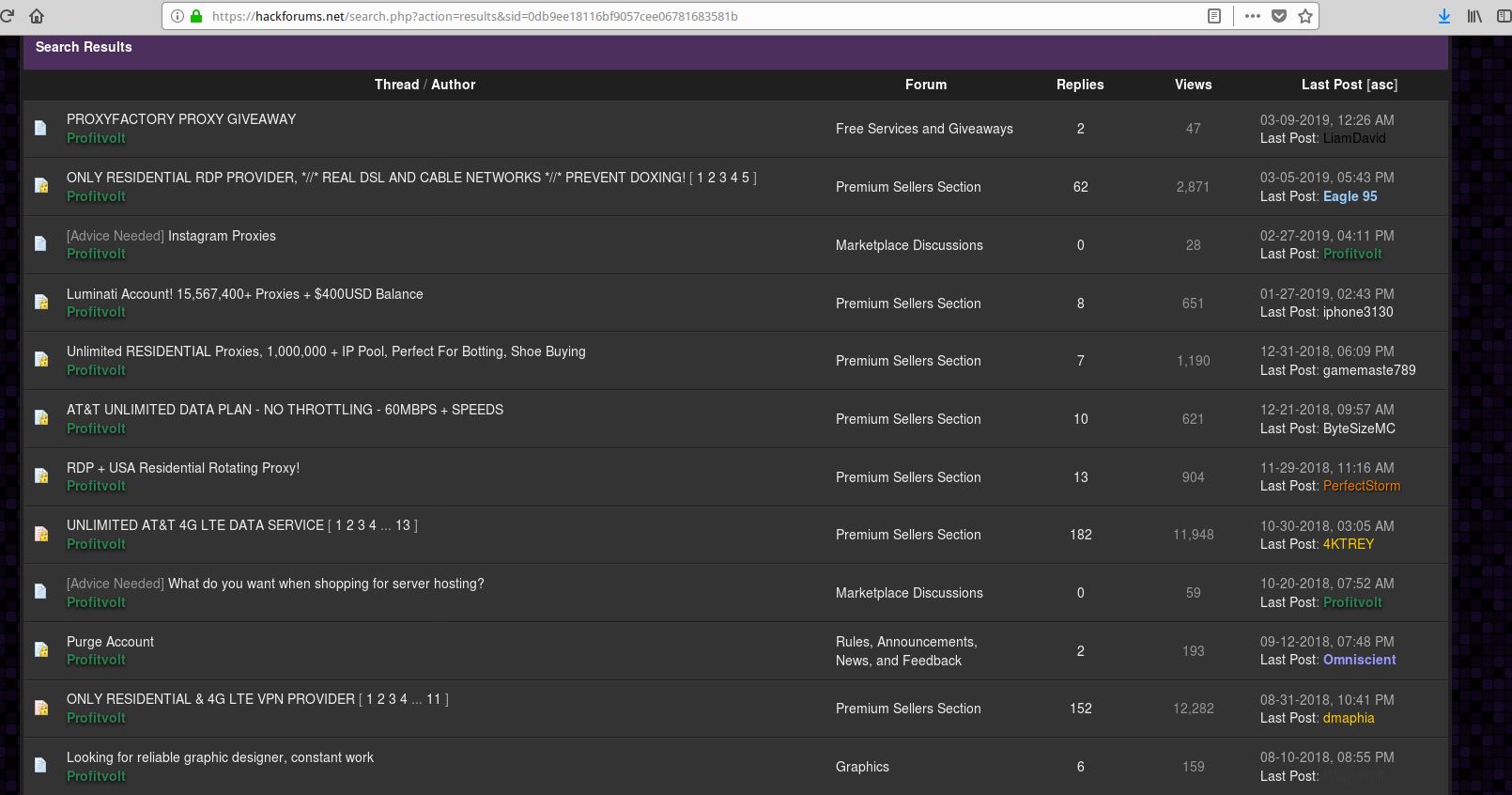
One user in particular — a Hackforums member who goes by the nickname “Profitvolt” — has spent several years advertising resnetworking[.]com and a number of related sites and services, including “unlimited” AT&T 4G/LTE data services, and the immediate availability of more than 1 million residential IPs that he suggested were “perfect for botting, shoe buying.”

The Hackforums user “Profitvolt” advertising residential proxies.

Profitvolt advertises his mobile and residential data services as ideal for anyone who wishes to run “various bots,” or “advertising campaigns.” Those services are meant to provide anonymity when customers are doing things like automating ad clicks on platforms like Google Adsense and Facebook; generating new PayPal accounts; sneaker bot activity; credential stuffing attacks; and different types of social media spam.

For readers unfamiliar with this term, “shoe botting” or “sneaker bots” refers to the use of automated bot programs and services that aid in the rapid acquisition of limited-release, highly sought-after designer shoes that can then be resold at a profit on secondary markets. All too often, it seems, the people who profit the most in this scheme are using multiple sets of compromised credentials from consumer accounts at online retailers, and/or stolen payment card data.

To say shoe botting has become a thorn in the side of online retailers and regular consumers alike would be a major understatement: A recent State of The Internet Security Report (PDF) from Akamai (an advertiser on this site) noted that such automated bot activity now accounts for almost half of the Internet bandwidth directed at online retailers. The prevalance of shoe botting also might help explain Footlocker‘s recent $100 million investment in goat.com, the largest secondary shoe resale market on the Web.

In other discussion threads, Profitvolt advertises he can rent out an “unlimited number” of so-called “residential proxies,” a term that describes home or mobile Internet connections that can be used to anonymously relay Internet traffic for a variety of dodgy deals.

From a ne’er-do-well’s perspective, the beauty of routing one’s traffic through residential IPs is that few online businesses will bother to block malicious or suspicious activity emanating from them.

That’s because in general the pool of IP addresses assigned to residential or mobile wireless connections cycles intermittently from one user to the next, meaning that blacklisting one residential IP for abuse or malicious activity may only serve to then block legitimate traffic (and e-commerce) from the next user who gets assigned that same IP.

A BULLETPROOF PLAN?

In one early post on Hackforums, Profitvolt laments the untimely demise of various “bulletproof” hosting providers over the years, from the Russian Business Network and Atrivo/Intercage, to McColo, 3FN and Troyak, among others.

All of these Internet providers had one thing in common: They specialized in cultivating customers who used their networks for nefarious purposes — from operating botnets and spamming to hosting malware. They were known as “bulletproof” because they generally ignored abuse complaints, or else blamed any reported abuse on a reseller of their services.

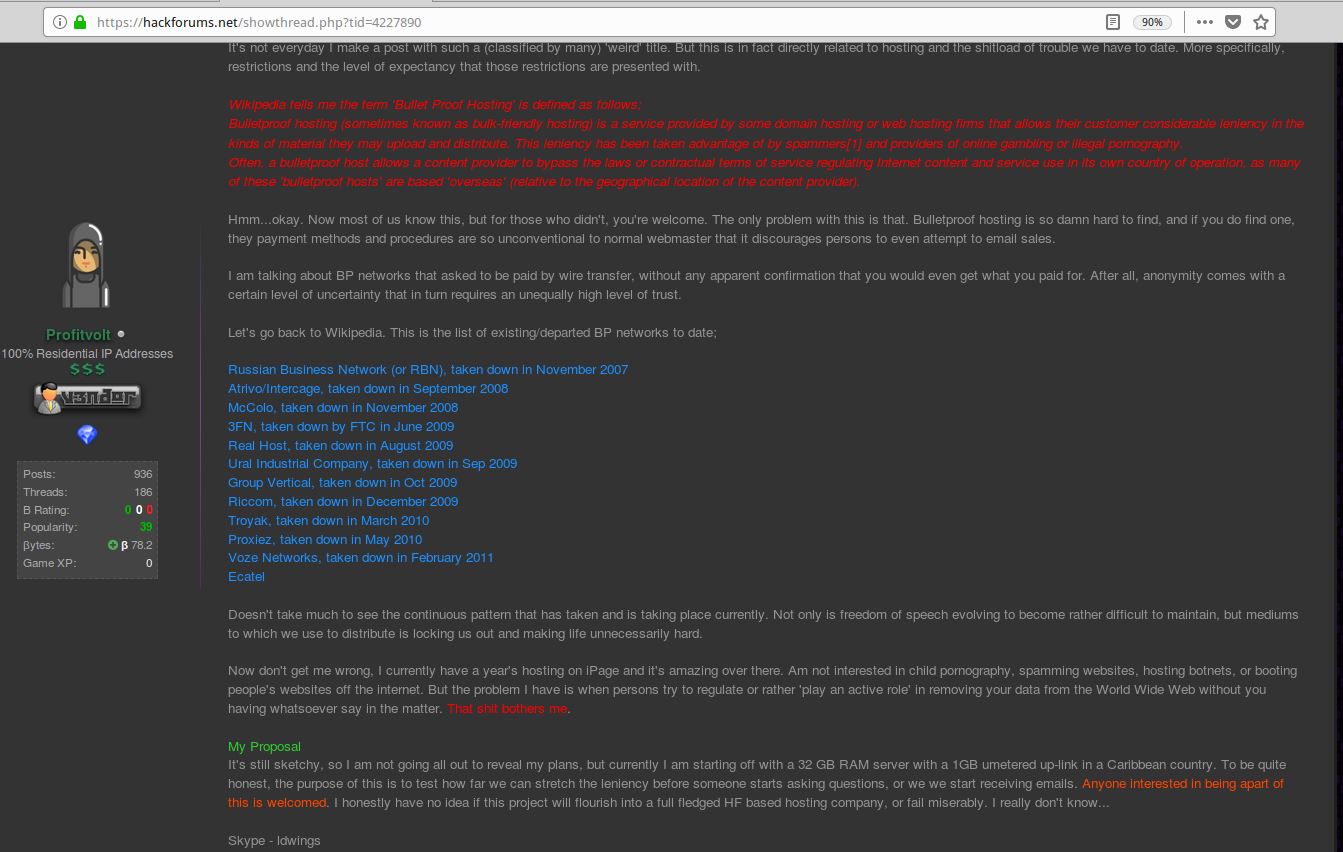
In that Hackforums post, Profitvolt bemoans that “mediums which we use to distribute [are] locking us out and making life unnecessarily hard.”

“It’s still sketchy, so I am not going all out to reveal my plans, but currently I am starting off with a 32 GB RAM server with a 1 GB unmetered up-link in a Caribbean country,” Profitvolt told forum members, while asking in different Hackforums posts whether there are any other users from the dual-island Caribbean nation of Trinidad and Tobago on the forum.

“To be quite honest, the purpose of this is to test how far we can stretch the leniency before someone starts asking questions, or we start receiving emails,” Profitvolt continued.

Hackforums user Profitvolt says he plans to build his own “bulletproof” hosting network catering to fellow forum users who might want to rent his services for a variety of dodgy activities.

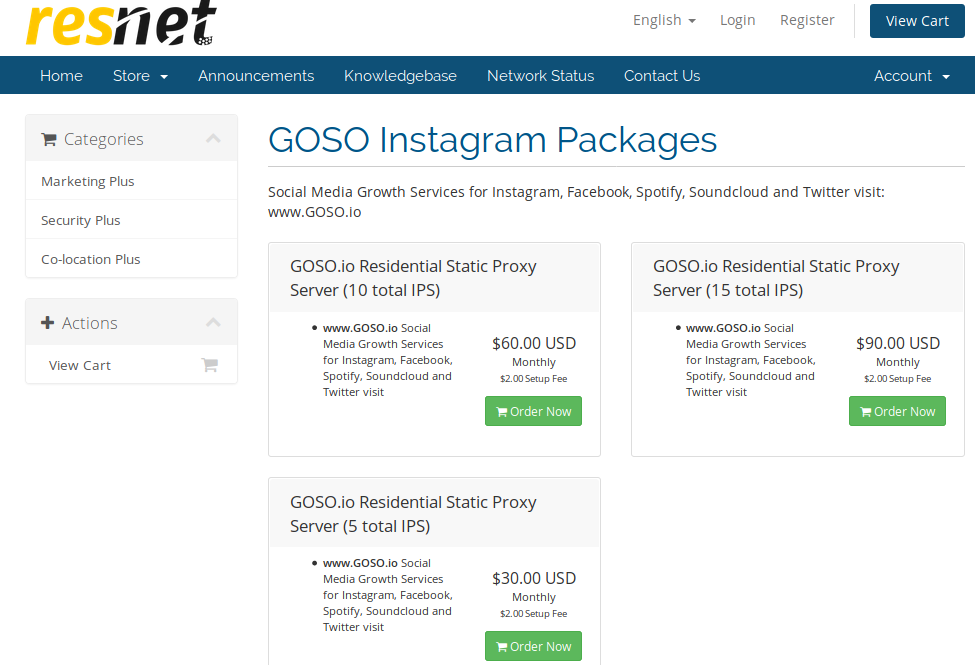
KrebsOnSecurity started asking questions of Resnet after stumbling upon several indications that this company was enabling different types of online abuse in bite-sized monthly packages. The site resnetworking[.]com appears normal enough on the surface, but a review of the customer packages advertised on it suggests the company has courted a very specific type of client.

“No bullshit, just proxies,” reads one (now hidden or removed) area of the site’s shopping cart. Other promotions advertise the use of residential proxies to promote “growth services” on multiple social media platforms including CraigslistFacebook, Google, Instagram, Spotify, Soundcloud and Twitter.

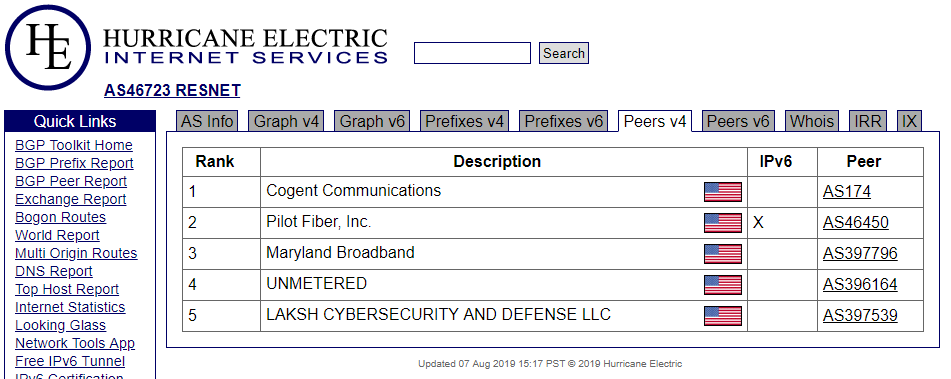
Resnet also peers with or partners with several other interesting organizations, including:

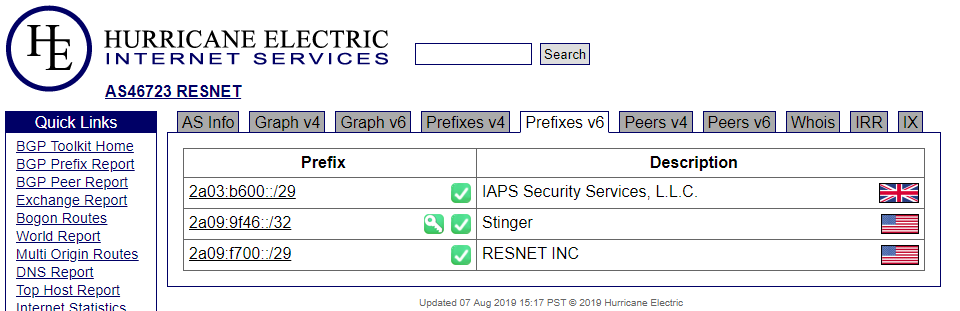
residential-network[.]com, also known as “IAPS Security Services” (formerly intl-alliance[.]com), which advertises the sale of residential VPNs and mobile 4G/IPv6 proxies aimed at helping customers avoid being blocked while automating different types of activity, from mass-creating social media and email accounts to bulk message sending on platforms like WhatsApp and Facebook.

Laksh Cybersecurity and Defense LLC, which maintains Hexproxy[.]com, another residential proxy service that largely courts customers involved in shoe botting.

-Several chunks of IP space from a Russian provider variously known by the names “SERVERSGET” and “Men Danil Valentinovich,” which has been associated with numerous instances of hijacking vast swaths of IP addresses from other organizations quite recently.

Some of Profitvolt’s discussion threads on Hackforums.

WHO IS RESNET?

Resnetworking[.]com lists on its home page the contact phone number 202-643-8533. That number is tied to the registration records for several domains, including resnetworking[.]com, residentialvpn[.]info, and residentialvpn[.]org. All of those domains also have in their historic WHOIS records the name Joshua Powder and Residential Networking Solutions LLC.

Running a reverse WHOIS lookup via Domaintools.com on “Joshua Powder” turns up almost 60 domain names — most of them tied to the email address joshua.powder@gmail.com. Among those are resnetworking[.]info, resvpn[.]com/net/org/info, tobagospeaks[.]com, tthack[.]com and profitvolt[.]com. Recall that “Profitvolt” is the nickname of the Hackforums user advertising resnetworking[.]com.

The email address josh@tthack.com was used to register an account on the scammer-friendly site blackhatworld[.]com under the nickname “BulletProofWebHost.” Here’s a list of domains registered to this email address.

A search on the Joshua Powder and tthack email addresses at Hyas, a startup that specializes in combining data from a number of sources to provide attribution of cybercrime activity, further associates those to mafiacloud@gmail.com and to the phone number 868-360-9983, which is a mobile number assigned by Digicel Trinidad and Tobago Ltd. A full list of domains tied to that 868- number is here.

Hyas’s service also pointed to this post on the Facebook page of the Prince George’s County Economic Development Corporation in Maryland, which appears to include a 2017 photo of Mr. Powder posing with county officials.

‘A GLORIFIED SOLUTIONS PROVIDER’

Roughly three weeks ago, KrebsOnSecurity called the 202 number listed at the top of resnetworking[.]com. To my surprise, a man speaking in a lovely Caribbean-sounding accent answered the call and identified himself as Josh Powder. When I casually asked from where he’d acquired that accent, Powder said he was a native of New Jersey but allowed that he has family members who now live in Trinidad and Tobago.

Powder said Residential Networking Solutions LLC is “a normal co-location Internet provider” that has been in operation for about three years and employs some 65 people.

“You’re not the first person to call us about residential VPNs,” Powder said. “In the past, we did have clients that did host VPNs, but it’s something that’s been discontinued since 2017. All we are is a glorified solutions provider, and we broker and lease Internet lines from different companies.”

When asked about the various “botting” packages for sale on Resnetworking[.]com, Powder replied that the site hadn’t been updated in a while and that these were inactive offers that resulted from a now-discarded business model.

“When we started back in 2016, we were really inexperienced, and hired some SEO [search engine optimization] firms to do marketing,” he explained. “Eventually we realized that this was creating a shitstorm, because it started to make us look a specific way to certain people. So we had to really go through a process of remodeling. That process isn’t complete, and the entire web site is going to retire in about a week’s time.”

Powder maintains that his company does have a contract with AT&T to resell LTE and 4G data services, and that he has a similar arrangement with Sprint. He also suggested that one of the aforementioned companies which partnered with Resnet — IAPS Security Services — was responsible for much of the dodgy activity that previously brought his company abuse complaints and strange phone calls about VPN services.

“That guy reached out to us and he leased service from us and nearly got us into a lot of trouble,” Powder said. “He was doing a lot of illegal stuff, and I think there is an ongoing matter with him legally. That’s what has caused us to be more vigilant and really look at what we do and change it. It attracted too much nonsense.”

Interestingly, when one visits IAPS Security Services’ old domain — intl-alliance[.]com — it now forwards to resvpn[.]com, which is one of the domains registered to Joshua Powder.

Shortly after our conversation, the monthly packages I asked Powder about that were for sale on resnetworking[.]com disappeared from the site, or were hidden behind a login. Also, Resnet’s IPv6 prefixes (a la IAPS Security Services) were removed from the company’s list of addresses. At the same time, a large number of Profitvolt’s posts prior to 2018 were deleted from Hackforums.

EPILOGUE

It appears that the future of low-level abuse targeting some of the most popular Internet destinations is tied to the increasing willingness of the world’s biggest ISPs to resell discrete chunks of their address space to whomever is able to pay for them.

Earlier this week, I had a Skype conversation with an individual who responded to my requests for more information from residential-network[.]com, and this person told me that plenty of mobile and land-line ISPs are more than happy to sell huge amounts of IP addresses to just about anybody.

“Mobile providers also sell mass services,” the person who responded to my Skype request offered. “Rogers in Canada just opened a new package for unlimited 4G data lines and we’re currently in negotiations with them for that service as well. The UK also has 4G providers that have unlimited data lines as well.”

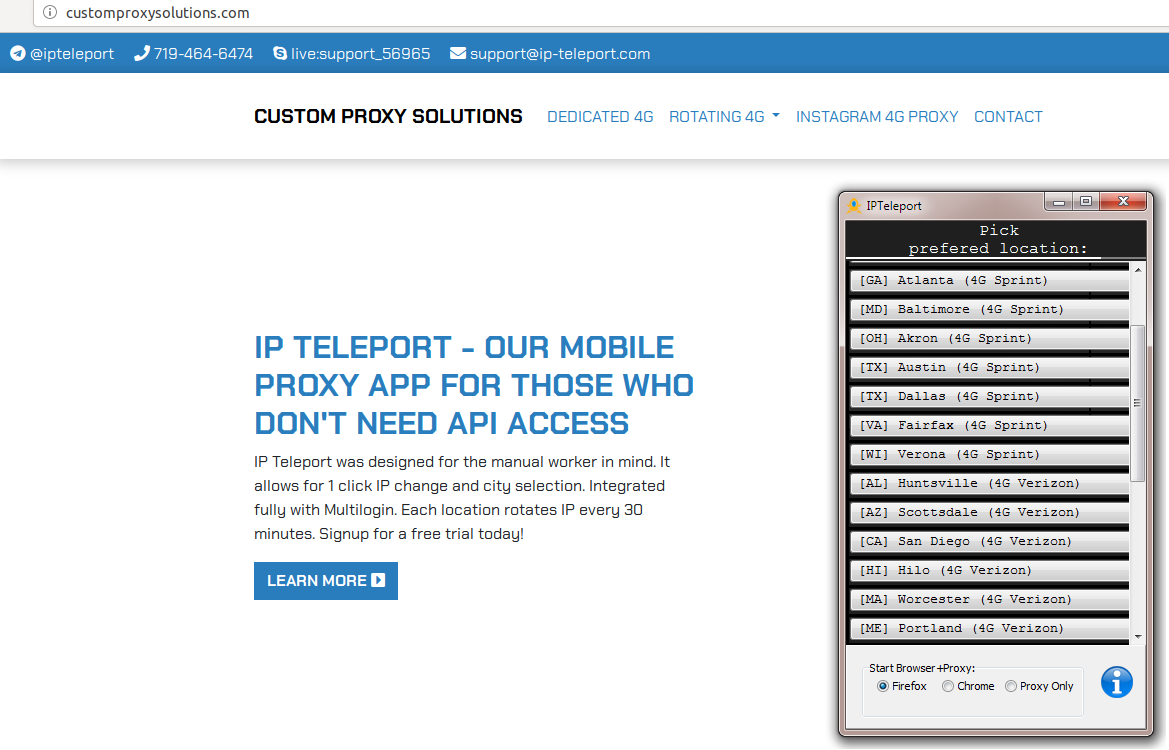
The person responding to my Skype messages said they bought most of their proxies from a reseller at customproxysolutions[.]com, which advertises “the world’s largest network of 4G LTE modems in the United States.”

He added that “Rogers in Canada has a special offer that if you buy more than 50 lines you get a reduced price lower than the $75 Canadian Dollar price tag that they would charge for fewer than 50 lines. So most mobile ISPs want to sell mass lines instead of single lines.”

It remains unclear how much of the Internet address space claimed by these various residential proxy and VPN networks has been acquired legally or through other means. But it seems that Resnet and its business associates are in fact on the cutting edge of what it means to be a bulletproof Internet provider today.

from Krebs on Security https://ift.tt/2NguY7a
via IFTTT

Meet Bluetana, the Scourge of Pump Skimmers

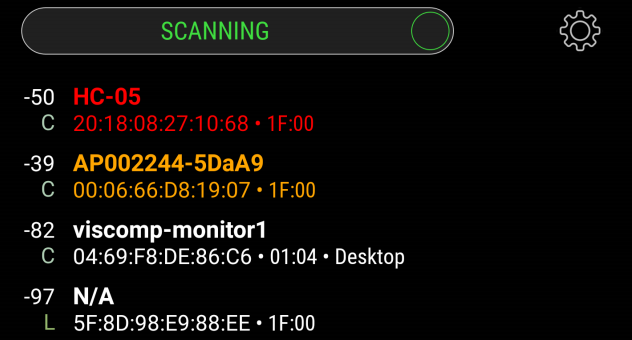
Bluetana,” a new mobile app that looks for Bluetooth-based payment card skimmers hidden inside gas pumps, is helping police and state employees more rapidly and accurately locate compromised fuel stations across the nation, a study released this week suggests. Data collected in the course of the investigation also reveals some fascinating details that may help explain why these pump skimmers are so lucrative and ubiquitous.

The new app, now being used by agencies in several states, is the brainchild of computer scientists from the University of California San Diego and the University of Illinois Urbana-Champaign, who say they developed the software in tandem with technical input from the U.S. Secret Service (the federal agency most commonly called in to investigate pump skimming rings).

The Bluetooth pump skimmer scanner app ‘Bluetana’ in action.

Gas pumps are a perennial target of skimmer thieves for several reasons. They are usually unattended, and in too many cases a handful of master keys will open a great many pumps at a variety of filling stations.

The skimming devices can then be attached to electronics inside the pumps in a matter of seconds, and because they’re also wired to the pump’s internal power supply the skimmers can operate indefinitely without the need of short-lived batteries.

And increasingly, these pump skimmers are fashioned to relay stolen card data and PINs via Bluetooth wireless technology, meaning the thieves who install them can periodically download stolen card data just by pulling up to a compromised pump and remotely connecting to it from a Bluetooth-enabled mobile device or laptop.

According to the study, some 44 volunteers  — mostly law enforcement officials and state employees — were equipped with Bluetana over a year-long experiment to test the effectiveness of the scanning app.

The researchers said their volunteers collected Bluetooth scans at 1,185 gas stations across six states, and that Bluetana detected a total of 64 skimmers across four of those states. All of the skimmers were later collected by law enforcement, including two that were reportedly missed in manual safety inspections of the pumps six months earlier.

While several other Android-based apps designed to find pump skimmers are already available, the researchers said Bluetana was developed with an eye toward eliminating false-positives that some of these other apps can fail to distinguish.

“Bluetooth technology used in these skimmers are also used for legitimate products commonly seen at and near gas stations such as speed-limit signs, weather sensors and fleet tracking systems,” said Nishant Bhaskar, UC San Diego Ph.D. student and principal author of the study. “These products can be mistaken for skimmers by existing detection apps.”

BLACK MARKET VALUE

The fuel skimmer study also helps explain how quickly these hidden devices can generate huge profits for the organized gangs that typically deploy them. The researchers found the skimmers their app found collected data from roughly 20 -25 payment cards each day — evenly distributed between debit and credit cards (although they note estimates from payment fraud prevention companies and the Secret Service that put the average figure closer to 50-100 cards daily per compromised machine).

The academics also studied court documents which revealed that skimmer scammers often are only able to “cashout” stolen cards — either through selling them on the black market or using them for fraudulent purchases — a little less than half of the time. This can result from the skimmers sometimes incorrectly reading card data, daily withdrawal limits, or fraud alerts at the issuing bank.

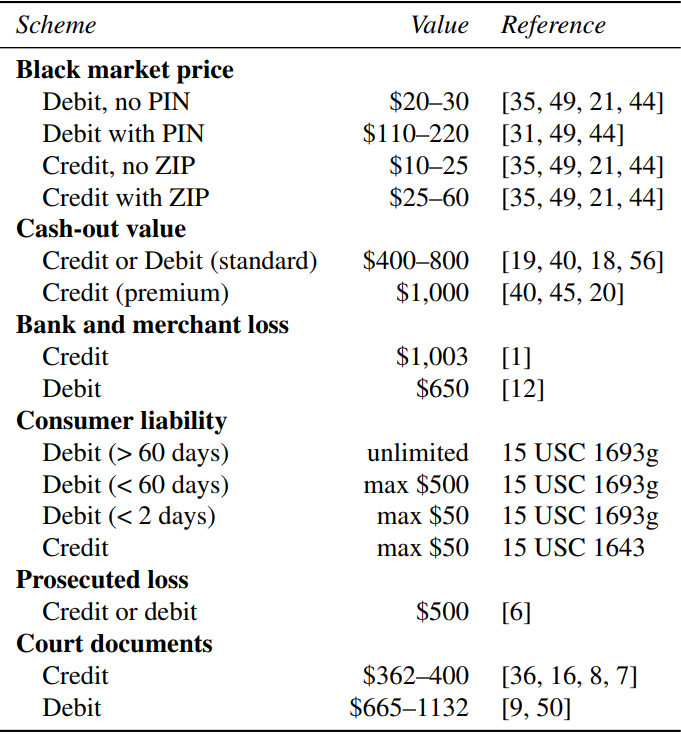
“Based on the prior figures, we estimate the range of per-day revenue from a skimmer is $4,253 (25 cards per day, cashout of $362 per card, and 47% cashout success rate), and our high end estimate is $63,638 (100 cards per day per day, $1,354 cashout per card, and cashout success rate of 47%),” the study notes.

Not a bad haul either way, considering these skimmers typically cost about $25 to produce.

Those earnings estimates assume an even distribution of credit and debit card use among customers of a compromised pump: The more customers pay with a debit card, the more profitable the whole criminal scheme may become. Armed with your PIN and debit card data, skimmer thieves or those who purchase stolen cards can clone your card and pull money out of your account at an ATM.

“Availability of a PIN code with a stolen debit card in particular, can increase its value five-fold on the black market,” the researchers wrote.

This highlights a warning that KrebsOnSecurity has relayed to readers in many previous stories on pump skimming attacks: Using a debit card at the pump can be way riskier than paying with cash or a credit card.

The black market value, impact to consumers and banks, and liability associated with different types of card fraud.

And as the above graphic from the report illustrates, there are different legal protections for fraudulent transactions on debit vs. credit cards. With a credit card, your maximum loss on any transactions you report as fraud is $50; with a debit card, that protection only extends for within two days of the unauthorized transaction. After that, the maximum consumer liability can increase to $500 within 60 days, and to an unlimited amount after 60 days.

In practice, your bank or debit card issuer may still waive additional liabilities, and many do. But even then, having your checking account emptied of cash while your bank sorts out the situation can still be a huge hassle and create secondary problems (bounced checks, for instance).

Interestingly, this advice against using debit cards at the pump often runs counter to the messaging pushed by fuel station owners themselves, many of whom offer lower prices for cash or debit card transactions. That’s because credit card transactions typically are more expensive to process.

For all its skimmer-skewering prowess, Bluetana will not be released to the public. The researchers said they the primary reason for this is highlighted in the core findings of the study.

“There are many legitimate devices near gas stations that look exactly like skimmers do in Bluetooth scans,” said UCSD Assistant Professor Aaron Schulman, in an email to KrebsOnSecurity. “Flagging suspicious devices in Bluetana is a only a way of notifying inspectors that they need to gather more data around the gas station to determine if the Bluetooth transmissions appear to be emanating from a device inside of of the pumps. If it does, they can then open the pump door and confirm that the signal strength rises, and begin their visual inspection for the skimmer.”

One of the best tips for avoiding fuel card skimmers is to favor filling stations that have updated security features, such as custom keys for each pump, better compartmentalization of individual components within the machine, and tamper protections that physically shut down a pump if the machine is improperly accessed.

How can you spot a gas station with these updated features, you ask? As noted in last summer’s story, How to Avoid Card Skimmers at the Pumps, these newer-model machines typically feature a horizontal card acceptance slot along with a raised metallic keypad. In contrast, older, less secure pumps usually have a vertical card reader a flat, membrane-based keypad.

Newer, more tamper-resistant fuel pumps include pump-specific key locks, raised metallic keypads, and horizontal card readers.

The researchers will present their work on Bluetana later today at the USENIX Security 2019 conference in Santa Clara, Calif. A copy of their paper is available here (PDF).

If you enjoyed this story, check out my series on all things skimmer-related: All About Skimmers. Looking for more information on fuel pump skimming? Have a look at some of these stories.

from Krebs on Security https://ift.tt/2YLmv2V
via IFTTT

Patch Tuesday, August 2019 Edition

Most Microsoft Windows (ab)users probably welcome the monthly ritual of applying security updates about as much as they look forward to going to the dentist: It always seems like you were there just yesterday, and you never quite know how it’s all going to turn out. Fortunately, this month’s patch batch from Redmond is mercifully light, at least compared to last month.

Okay, maybe a trip to the dentist’s office is still preferable. In any case, today is the second Tuesday of the month, which means it’s once again Patch Tuesday (or — depending on your setup and when you’re reading this post — Reboot Wednesday). Microsoft today released patches to fix some 93 vulnerabilities in Windows and related software, 35 of which affect various Server versions of Windows, and another 70 that apply to the Windows 10 operating system.

Although there don’t appear to be any zero-day vulnerabilities fixed this month — i.e. those that get exploited by cybercriminals before an official patch is available — there are several issues that merit attention.

Chief among those are patches to address four moderately terrifying flaws in Microsoft’s Remote Desktop Service, a feature which allows users to remotely access and administer a Windows computer as if they were actually seated in front of the remote computer. Security vendor Qualys says two of these weaknesses can be exploited remotely without any authentication or user interaction.

“According to Microsoft, at least two of these vulnerabilities (CVE-2019-1181 and CVE-2019-1182) can be considered ‘wormable’ and [can be equated] to BlueKeep,” referring to a dangerous bug patched earlier this year that Microsoft warned could be used to spread another WannaCry-like ransomware outbreak. “It is highly likely that at least one of these vulnerabilities will be quickly weaponized, and patching should be prioritized for all Windows systems.”

Fortunately, Remote Desktop is disabled by default in Windows 10, and as such these flaws are more likely to be a threat for enterprises that have enabled the application for various purposes. For those keeping score, this is the fourth time in 2019 Microsoft has had to fix critical security issues with its Remote Desktop service.

For all you Microsoft Edge and Internet Exploiter Explorer users, Microsoft has issued the usual panoply of updates for flaws that could be exploited to install malware after a user merely visits a hacked or booby-trapped Web site. Other equally serious flaws patched in Windows this month could be used to compromise the operating system just by convincing the user to open a malicious file (regardless of which browser the user is running).

As crazy as it may seem, this is the second month in a row that Adobe hasn’t issued a security update for its Flash Player browser plugin, which is bundled in IE/Edge and Chrome (although now hobbled by default in Chrome). However, Adobe did release important updates for its Acrobat and free PDF reader products.

If the tone of this post sounds a wee bit cantankerous, it might be because at least one of the updates I installed last month totally hosed my Windows 10 machine. I consider myself an equal OS abuser, and maintain multiple computers powered by a variety of operating systems, including Windows, Linux and MacOS.

Nevertheless, it is frustrating when being diligent about applying patches introduces so many unfixable problems that you’re forced to completely reinstall the OS and all of the programs that ride on top of it. On the bright side, my newly-refreshed Windows computer is a bit more responsive than it was before crash hell.

So, three words of advice. First off, don’t let Microsoft decide when to apply patches and reboot your computer. On the one hand, it’s nice Microsoft gives us a predictable schedule when it’s going to release patches. On the other, Windows 10 will by default download and install patches whenever it pleases, and then reboot the computer.

Unless you change that setting. Here’s a tutorial on how to do that. For all other Windows OS users, if you’d rather be alerted to new updates when they’re available so you can choose when to install them, there’s a setting for that in Windows Update.

Secondly, it doesn’t hurt to wait a few days to apply updates.  Very often fixes released on Patch Tuesday have glitches that cause problems for an indeterminate number of Windows systems. When this happens, Microsoft then patches their patches to minimize the same problems for users who haven’t yet applied the updates, but it sometimes takes a few days for Redmond to iron out the kinks.

Finally, please have some kind of system for backing up your files before applying any updates. You can use third-party software for this, or just the options built into Windows 10. At some level, it doesn’t matter. Just make sure you’re backing up your files, preferably following the 3-2-1 backup rule. Thankfully, I’m vigilant about backing up my files.

And, as ever, if you experience any problems installing any of these patches this month, please feel free to leave a comment about it below; there’s a good chance other readers have experienced the same and may even chime in here with some helpful tips.

from Krebs on Security https://ift.tt/2YMOsaD
via IFTTT

SEC Investigating Data Leak at First American Financial Corp.

The U.S. Securities and Exchange Commission (SEC) is investigating a security failure on the Web site of real estate title insurance giant First American Financial Corp. that exposed more than 885 million personal and financial records tied to mortgage deals going back to 2003, KrebsOnSecurity has learned.

First American Financial Corp.

In May, KrebsOnSecurity broke the news that the Web site for Santa Ana, Calif.-based First American [NYSE:FAFexposed some 885 million documents related to real estate closings over the past 16 years, including bank account numbers and statements, mortgage and tax records, Social Security numbers, wire transaction receipts and drivers license images. No authentication was required to view the documents.

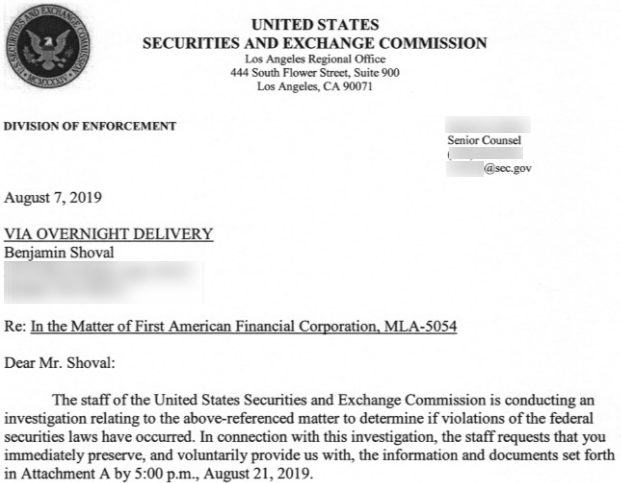
The initial tip on that story came from Ben Shoval, a real estate developer based in Seattle. Shoval said he recently received a letter from the SEC’s enforcement division which stated the agency was investigating the data exposure to determine if First American had violated federal securities laws.

In its letter, the SEC asked Shoval to preserve and share any documents or evidence he had related to the data exposure.

“This investigation is a non-public, fact-finding inquiry,” the letter explained. “The investigation does not mean that we have concluded that anyone has violated the law.”

The SEC did not respond to requests for comment.

Word of the SEC investigation comes weeks after regulators in New York said they were investigating the company in what could turn out to be the first test of the state’s strict new cybersecurity regulation, which requires financial companies to periodically audit and report on how they protect sensitive data, and provides for fines in cases where violations were reckless or willful. First American also is now the target of a class action lawsuit that alleges it “failed to implement even rudimentary security measures.”

First American has issued a series of statements over the past few months that seem to downplay the severity of the data exposure, which the company said was the result of a “design defect” in its Web site.

On June 18, First American said a review of system logs by an outside forensic firm, “based on guidance from the company, identified 484 files that likely were accessed by individuals without authorization. The company has reviewed 211 of these files to date and determined that only 14 (or 6.6%) of those files contain non-public personal information. The company is in the process of notifying the affected consumers and will offer them complimentary credit monitoring services.”

In a statement on July 16, First American said its now-completed investigation identified just 32 consumers whose non-public personal information likely was accessed without authorization.

“These 32 consumers have been notified and offered complimentary credit monitoring services,” the company said.

First American has not responded to questions about how long this “design defect” persisted on its site, how far back it maintained access logs, or how far back in those access logs the company’s review extended.

from Krebs on Security https://ift.tt/2ZX67ch
via IFTTT