Sale of 4 Million Stolen Cards Tied to Breaches at 4 Restaurant Chains

On Nov. 23, one of the cybercrime underground’s largest bazaars for buying and selling stolen payment card data announced the immediate availability of some four million freshly-hacked debit and credit cards. KrebsOnSecurity has learned this latest batch of cards was siphoned from four different compromised restaurant chains that are most prevalent across the midwest and eastern United States.
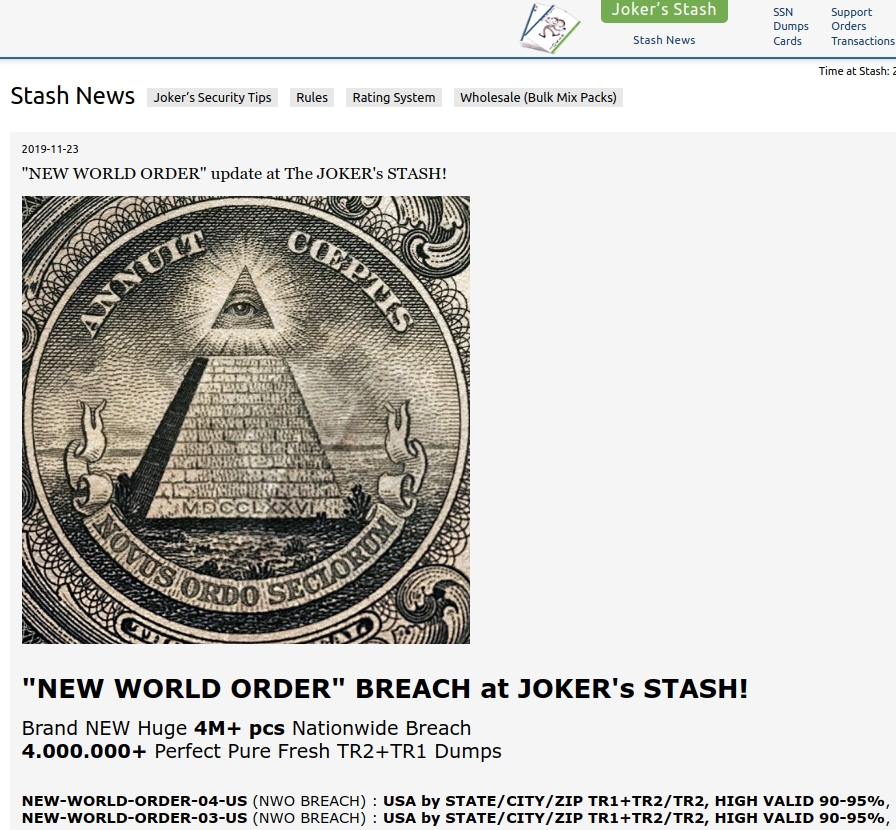
An advertisement on the cybercrime store Joker’s Stash for a new batch of ~4 million credit/debit cards stolen from four different restaurant chains across the midwest and eastern United States.

Two financial industry sources who track payment card fraud and asked to remain anonymous for this story said the four million cards were taken in breaches recently disclosed by restaurant chains Krystal, Moe’s, McAlister’s Deli and Schlotzsky’s. Krystal announced a card breach last month. The other three restaurants are all part of the same parent company and disclosed breaches in August 2019.

KrebsOnSecurity heard the same conclusion from Gemini Advisory, a New York-based fraud intelligence company.

“Gemini found that the four breached restaurants, ranked from most to least affected, were Krystal, Moe’s, McAlister’s and Schlotzsky’s,”  Gemini wrote in an analysis of the New World Order batch shared with this author. “Of the 1,750+ locations belonging to these restaurants, nearly 50% were breached and had customer payment card data exposed. These breached locations were concentrated in the central and eastern United States, with the highest exposure in Florida, Georgia, South Carolina, North Carolina, and Alabama.”
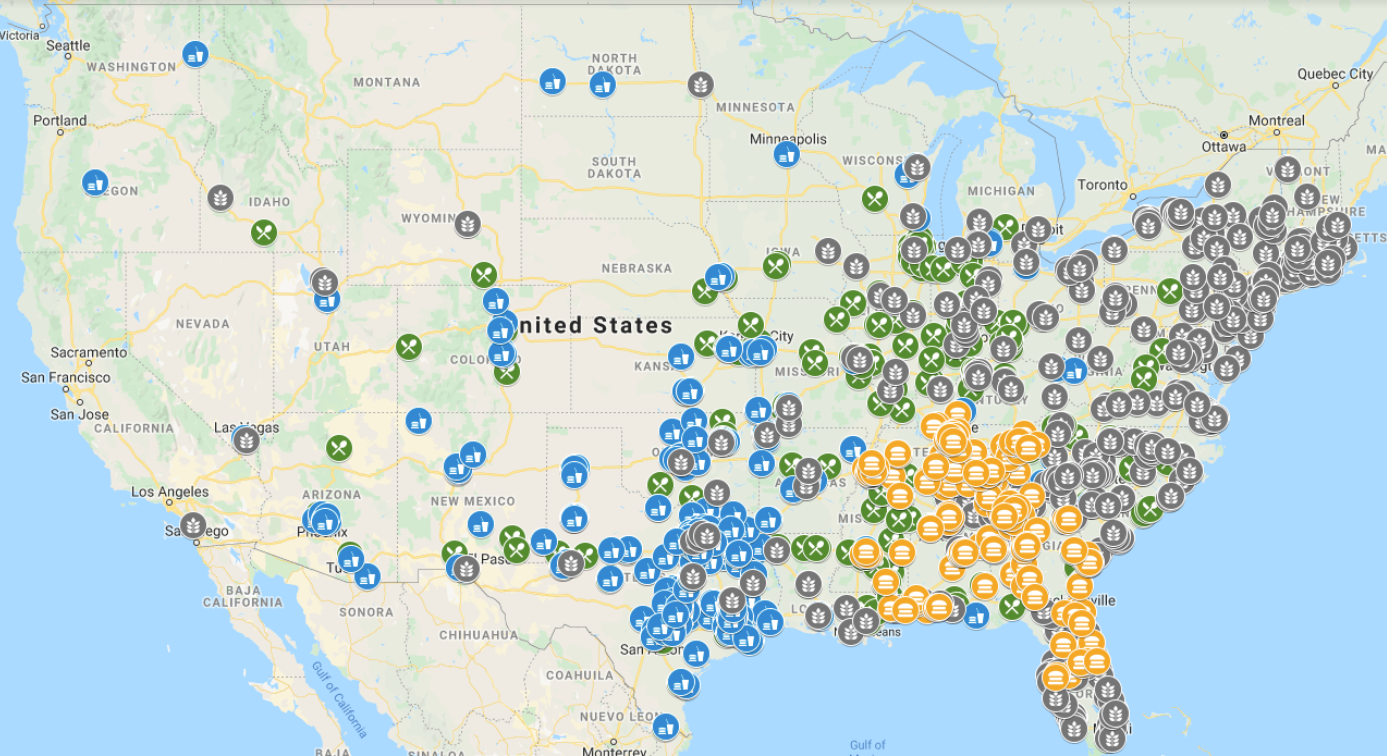
McAlister’s (green), Schlotzsky’s (blue), Moe’s (gray), and Krystal (orange) locations across the United States. There is an additional Moe’s location in Hawaii that is not depicted. Image: Gemini Advisory.

Focus Brands (which owns Moe’s, McAlister’s, and Schlotzsky’s) was breached between April and July 2019, and publicly disclosed this on August 23. Krystal claims to have been breached between July and September 2019, and disclosed this in late October.

The stolen cards went up for sale at the infamous Joker’s Stash carding bazaar. The most recent big breach marketed on Joker’s Stash was dubbed “Solar Energy,” and included more than five million cards stolen from restaurants, fuel pumps and drive-through coffee shops operated by Hy-Vee, a supermarket chain based in Iowa.

According to Gemini, Joker’s Stash likely delayed the debut of the New World Order cards to keep from flooding the market with too much stolen card data all at once, which can have the effect of lowering prices for stolen cards across the board.

“Joker’s Stash first announced their breach on November 11, 2019 and published the data on November 22,” Gemini found. “This delay between breaches occurring as early as July and data being offered in the dark web in November appears to be an effort to avoid oversaturating the dark web market with an excess of stolen payment records.”

Most card breaches at restaurants and other brick-and-mortar stores occur when cybercriminals manage to remotely install malicious software on the retailer’s card-processing systems, often by compromising third-party firms that help manage these systems. This type of point-of-sale malware is capable of copying data stored on a credit or debit card’s magnetic stripe when those cards are swiped at compromised payment terminals, and that data can then be used to create counterfeit copies of the cards.

Companies that accept, store, process and transmit credit and debit card payments are required to implement so-called Payment Card Industry (PCI) security standards, but not all entities are required to prove that they have met them. While the PCI standards are widely considered a baseline for merchants that accept payment cards, many security experts advise companies to put in place protections that go well beyond these standards.

Even so, the 2019 Payment Security Report from Verizon indicates the number of companies that maintain full compliance with PCI standards decreased for the second year in a row to just 36.7 percent worldwide.

As noted in previous stories here, the organized cyberthieves involved in stealing card data from main street merchants have gradually moved down the food chain from big box retailers like Target and Home Depot to smaller but far more plentiful and probably less secure merchants (either by choice or because the larger stores became a harder target).

It’s really not worth worrying about where your card number may have been breached, since it’s almost always impossible to say for sure and because it’s common for the same card to be breached at multiple establishments during the same time period.

Just remember that while consumers are not liable for fraudulent charges, it may still fall to you the consumer to spot and report any suspicious charges. So keep a close eye on your statements, and consider signing up for text message notifications of new charges if your card issuer offers this service. Most of these services also can be set to alert you if you’re about to miss an upcoming payment, so they can also be handy for avoiding late fees and other costly charges.

from Krebs on Security https://ift.tt/35A5VC8
via IFTTT

Hidden Cam Above Bluetooth Pump Skimmer

Tiny hidden spy cameras are a common sight at ATMs that have been tampered with by crooks who specialize in retrofitting the machines with card skimmers. But until this past week I’d never heard of hidden cameras being used at gas pumps in tandem with Bluetooth-based card skimming devices.

Apparently, I’m not alone.

“I believe this is the first time I’ve seen a camera on a gas pump with a Bluetooth card skimmer,” said Detective Matt Jogodka of the Las Vegas Police Department, referring to the compromised fuel pump pictured below.

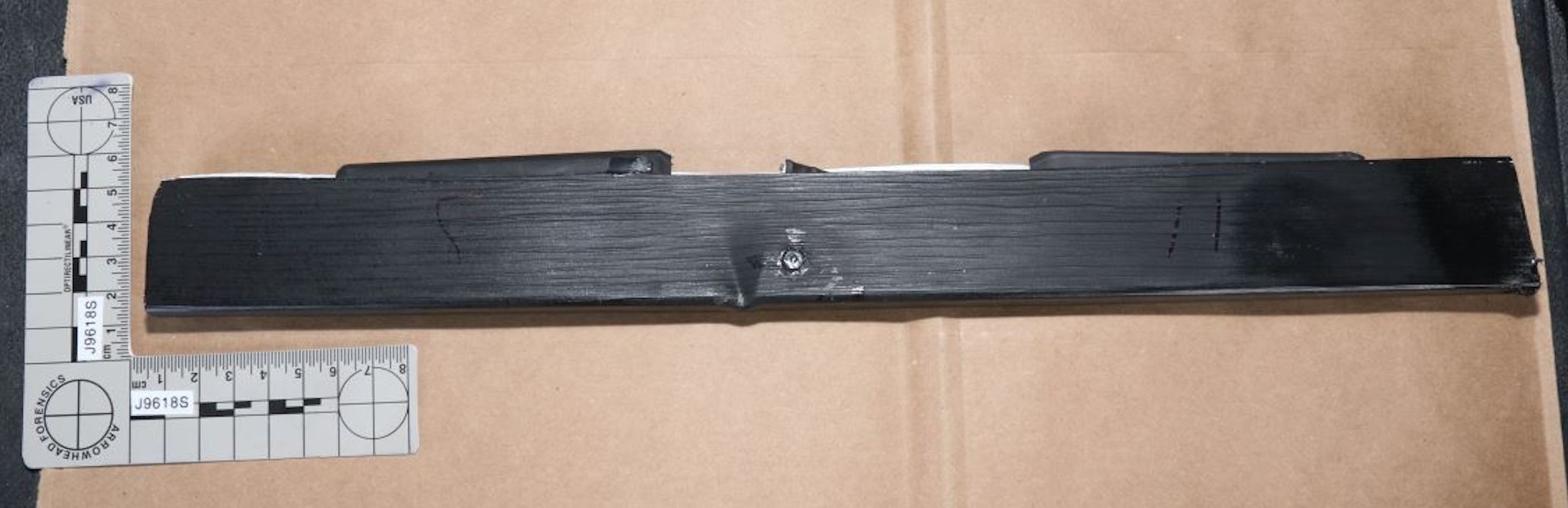
The fake panel (horizontal) above the “This Sale” display obscures a tiny hidden camera angled toward the gas pump’s PIN pad.

It may be difficult to tell from the angle of the photograph above, but the horizontal bar across the top of the machine (just above the “This Sale $” indicator) contains a hidden pinhole camera angled so as to record debit card users entering their PIN.

Here’s a look at the fake panel removed from the compromised pump:

A front view of the hidden camera panel.

Jogodka said although this pump’s PIN pad is encrypted, the hidden camera sidesteps that security feature.

“The PIN pad is encrypted, so this is a NEW way to capture the PIN,” Jogodka wrote in a message to a mailing list about skimming devices found on Arizona fuel pumps. “The camera was set on Motion, [to] save memory space and battery life. Sad for the suspect, it was recovered 2 hours after it was installed.”

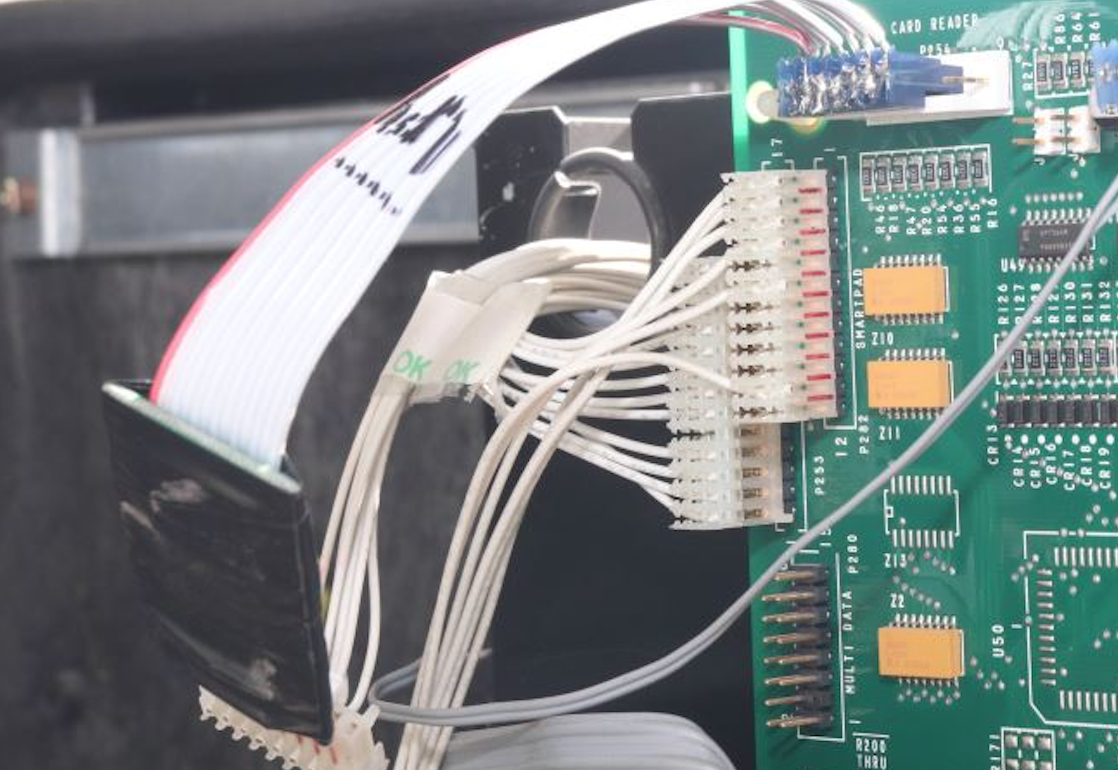
Whoever hacked this fuel pump was able to get inside the machine and install a Bluetooth-based circuit board that connects to the power and can transmit stolen card data wirelessly. This allows the thieves to drive by at any time and download the card data remotely from a mobile device or laptop.

The unauthorized Bluetooth circuit board can be seen at bottom left attached to the pump’s power and card reader.

This kind of fuel pump skimmer, while rare, serves as a reminder that it’s a good idea to choose credit over debit when buying fuel. For starters, there are different legal protections for fraudulent transactions on debit vs. credit cards.

With a credit card, your maximum loss on any transactions you report as fraud is $50; with a debit card, that protection only extends for within two days of the unauthorized transaction. After that, the maximum consumer liability can increase to $500 within 60 days, and to an unlimited amount after 60 days.

In practice, your bank or debit card issuer may still waive additional liabilities, and many do. But even then, having your checking account emptied of cash while your bank sorts out the situation can still be a huge hassle and create secondary problems (bounced checks, for instance).

Interestingly, this advice against using debit cards at the pump often runs counter to the messaging pushed by fuel station owners themselves, many of whom offer lower prices for cash or debit card transactions. That’s because credit card transactions typically are more expensive to process.

Anyone curious how to tell the difference between filling stations that prioritize card security versus those that haven’t should check out How to Avoid Card Skimmers at the Pump.

The compromised pump with the hidden camera bar still attached. Newer, more secure pumps have a horizontal card reader and a raised metallic keypad.

from Krebs on Security https://ift.tt/2KUdE63
via IFTTT

110 Nursing Homes Cut Off from Health Records in Ransomware Attack

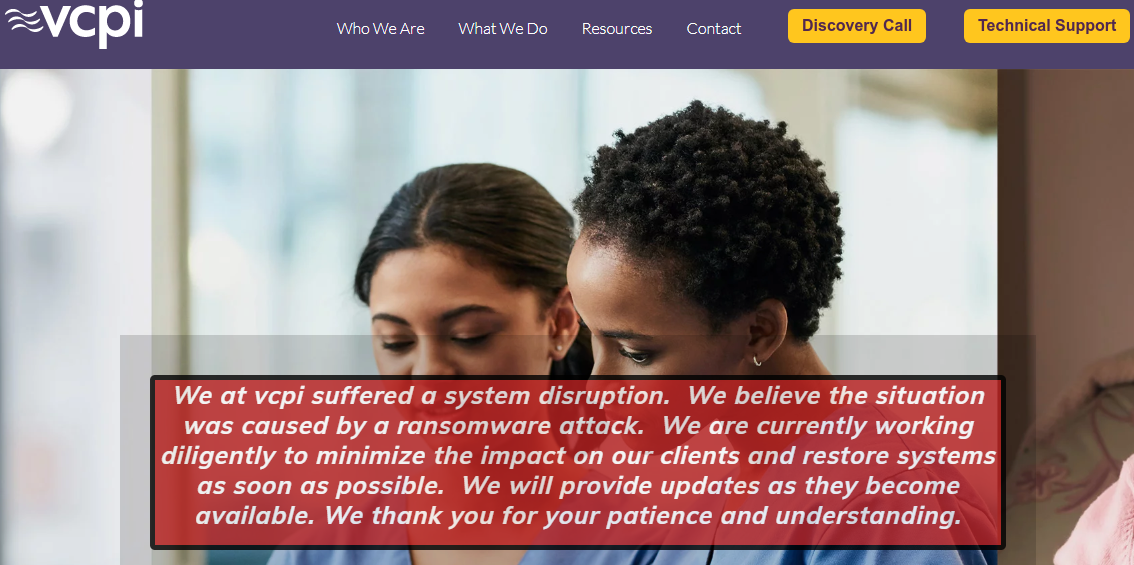
A ransomware outbreak has besieged a Wisconsin based IT company that provides cloud data hosting, security and access management to more than 100 nursing homes across the United States. The ongoing attack is preventing these care centers from accessing crucial patient medical records, and the IT company’s owner says she fears this incident could soon lead not only to the closure of her business, but also to the untimely demise of some patients.

Milwaukee, Wisc. based Virtual Care Provider Inc. (VCPI) provides IT consulting, Internet access, data storage and security services to some 110 nursing homes and acute-care facilities in 45 states. All told, VCPI is responsible for maintaining approximately 80,000 computers and servers that assist those facilities.

At around 1:30 a.m. CT on Nov. 17, unknown attackers launched a ransomware strain known as Ryuk inside VCPI’s networks, encrypting all data the company hosts for its clients and demanding a whopping $14 million ransom in exchange for a digital key needed to unlock access to the files. Ryuk has made a name for itself targeting businesses that supply services to other companies — particularly cloud-data firms — with the ransom demands set according to the victim’s perceived ability to pay.

In an interview with KrebsOnSecurity today, VCPI chief executive and owner Karen Christianson said the attack had affected virtually all of their core offerings, including Internet service and email, access to patient records, client billing and phone systems, and even VCPI’s own payroll operations that serve nearly 150 company employees.

The care facilities that VCPI serves access their records and other systems outsourced to VCPI by using a Citrix-based virtual private networking (VPN) platform, and Christianson said restoring customer access to this functionality is the company’s top priority right now.

“We have employees asking when we’re going to make payroll,” Christianson said. “But right now all we’re dealing with is getting electronic medical records back up and life-threatening situations handled first.”

Christianson said her firm cannot afford to pay the ransom amount being demanded — roughly $14 million worth of Bitcoin — and said some clients will soon be in danger of having to shut their doors if VCPI can’t recover from the attack.

“We’ve got some facilities where the nurses can’t get the drugs updated and the order put in so the drugs can arrive on time,” she said. “In another case, we have this one small assisted living place that is just a single unit that connects to billing. And if they don’t get their billing into Medicaid by December 5, they close their doors. Seniors that don’t have family to go to are then done. We have a lot of [clients] right now who are like, ‘Just give me my data,’ but we can’t.”

The ongoing incident at VCPI is just the latest in a string of ransomware attacks against healthcare organizations, which typically operate on razor thin profit margins and have comparatively little funds to invest in maintaining and securing their IT systems.

Earlier this week, a 1,300-bed hospital in France was hit by ransomware that knocked its computer systems offline, causing “very long delays in care” and forcing staff to resort to pen and paper.

On Nov. 20, Cape Girardeau, Mo.-based Saint Francis Healthcare System began notifying patients about a ransomware attack that left physicians unable to access medical records prior to Jan. 1.

Tragically, there is evidence to suggest that patient outcomes can suffer even after the dust settles from a ransomware infestation at a healthcare provider. New research indicates hospitals and other care facilities that have been hit by a data breach or ransomware attack can expect to see an increase in the death rate among certain patients in the following months or years because of cybersecurity remediation efforts.

Researchers at Vanderbilt University‘s Owen Graduate School of Management took the Department of Health and Human Services (HHS) list of healthcare data breaches and used it to drill down on data about patient mortality rates at more than 3,000 Medicare-certified hospitals, about 10 percent of which had experienced a data breach.

Their findings suggest that after data breaches as many as 36 additional deaths per 10,000 heart attacks occurred annually at the hundreds of hospitals examined. The researchers concluded that for care centers that experienced a breach, it took an additional 2.7 minutes for suspected heart attack patients to receive an electrocardiogram.

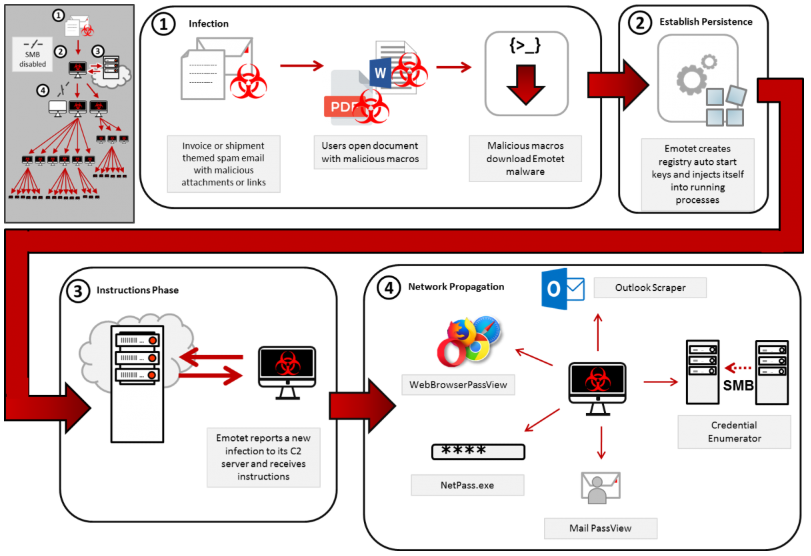
Companies hit by the Ryuk ransomware all too often are compromised for months or even years before the intruders get around to mapping out the target’s internal networks and compromising key resources and data backup systems. Typically, the initial infection stems from a booby-trapped email attachment that is used to download additional malware — such as Trickbot and Emotet.

This graphic from US-CERT depicts how the Emotet malware is typically used to lay the groundwork for a full-fledged ransomware infestation.

In this case, there is evidence to suggest that VCPI was compromised by one (or both) of these malware strains on multiple occasions over the past year. Alex Holden, founder of Milwaukee-based cyber intelligence firm Hold Security, showed KrebsOnSecurity information obtained from monitoring dark web communications which suggested the initial intrusion may have begun as far back as September 2018.

Holden said the attack was preventable up until the very end when the ransomware was deployed, and that this attack once again shows that even after the initial Trickbot or Emotet infection, companies can still prevent a ransomware attack. That is, of course, assuming they’re in the habit of regularly looking for signs of an intrusion.

“While it is clear that the initial breach occurred 14 months ago, the escalation of the compromise didn’t start until around November 15th of this year,” Holden said. “When we looked at this in retrospect, during these three days the cybercriminals slowly compromised the entire network, disabling antivirus, running customized scripts, and deploying ransomware. They didn’t even succeed at first, but they kept trying.”

VCPI’s CEO said her organization plans to publicly document everything that has happened so far when (and if) this attack is brought under control, but for now the company is fully focused on rebuilding systems and restoring operations, and on keeping clients informed at every step of the way.

“We’re going to make it part of our strategy to share everything we’re going through,” Christianson said, adding that when the company initially tried several efforts to sidestep the intruders their phone systems came under concerted assault. “But we’re still under attack, and as soon as we can open, we’re going to document everything.”

from Krebs on Security https://ift.tt/2ODsNd1
via IFTTT

DDoS-for-Hire Boss Gets 13 Months Jail Time

A 21-year-old Illinois man was sentenced last week to 13 months in prison for running multiple DDoS-for-hire services that launched millions of attacks over several years. This individual’s sentencing comes more than five years after KrebsOnSecurity interviewed both the defendant and his father and urged the latter to take a more active interest in his son’s online activities.

A screenshot of databooter[.]com, circa 2017. Image: Cisco Talos.

The jail time was handed down to Sergiy P. Usatyuk of Orland Park, Ill., who pleaded guilty in February to one count of conspiracy to cause damage to Internet-connected computers and owning, administering and supporting illegal “booter” or “stresser” services designed to knock Web sites offline, including exostress[.]in, quezstresser[.]com, betabooter[.]com, databooter[.]com, instabooter[.]com, polystress[.]com and zstress[.]net.

According to the U.S. Justice Department, in just the first 13 months of the 27-month long conspiracy, Usatyuk’s booter users ordered approximately 3,829,812 DDoS attacks. As of September 12, 2017, ExoStresser advertised on its website that this one booter service had launched 1,367,610 DDoS attacks, and caused targets to suffer 109,186.4 hours of network downtime (-4,549 days).

Usatyuk — operating under the hacker aliases “Andrew Quez” and “Brian Martinez,” among others — admitted developing, controlling and operating the aforementioned booter services from around August 2015 through November 2017. But Usatyuk’s involvement in the DDoS-for-hire space very much predates that period.

In February 2014, KrebsOnSecurity reached out to Usatyuk’s father Peter Usatyuk, an assistant professor at the University of Illinois at Chicago. I did so because a brief amount of sleuthing on Hackforums[.]net revealed that his then 15-year-old son Sergiy — who at the time went by the nicknames “Rasbora” and “Mr. Booter Master” — was heavily involved in helping to launch crippling DDoS attacks.

I phoned Usatyuk the elder because Sergiy’s alter egos had been posting evidence on Hackforums and elsewhere that he’d just hit KrebsOnSecurity.com with a 200 Gbps DDoS attack, which was then considered a fairly impressive DDoS assault.

“I am writing you after our phone conversation just to confirm that you may call evening time/weekend to talk to my son Sergio regarding to your reasons,” Peter Usatyuk wrote in an email to this author on Feb. 13, 2014. “I also have [a] major concern what my 15 yo son [is] doing. If you think that is any kind of illegal work, please, let me know.”

That 2014 story declined to quote Rasbora by name because he was a minor then, but his father seemed alarmed enough about my inquiry that he insisted his son speak with me about the matter.

Here’s  an excerpt of what I wrote about Sergiy at the time:

Rasbora’s most recent project just happens to be gathering, maintaining huge “top quality” lists of servers that can be used to launch amplification attacks online. Despite his insistence that he’s never launched DDoS attacks, Rasbora did eventually allow that someone reading his posts on Hackforums might conclude that he was actively involved in DDoS attacks for hire.

“I don’t see what a wall of text can really tell you about what someone does in real life though,” said Rasbora, whose real-life identity is being withheld because he’s a minor. This reply came in response to my reading him several posts that he’d made on Hackforums not 24 hours earlier that strongly suggested he was still in the business of knocking Web sites offline: In a Feb. 12 post on a thread called “Hiring a hit on a Web site” that Rasbora has since deleted, he tells a fellow Hackforums user, “If all else fails and you just want it offline, PM me.”

Rasbora has tried to clean up some of his more self-incriminating posts on Hackforums, but he remains defiantly steadfast in his claim that he doesn’t DDoS people. Who knows, maybe his dad will ground him and take away his Internet privileges.

I’m guessing young Sergiy never had his Internet privileges revoked, nor did he heed advice to use his skills for less destructive activities. His dad hung up on me when I called Wednesday evening requesting comment.

In addition to serving the 13-month jail sentence and three years of supervised release, Usatyuk will forfeit $542,925 in proceeds from the scheme, as well as dozens of servers and other computer equipment that powered his many DDoS-for-hire businesses.

from Krebs on Security https://ift.tt/2KFP0G6
via IFTTT

Ransomware Bites 400 Veterinary Hospitals

National Veterinary Associates (NVA), a California company that owns more than 700 animal care facilities around the globe, is still working to recover from a ransomware attack late last month that affected more than half of those properties, separating many veterinary practices from their patient records, payment systems and practice management software. NVA says it expects to have all facilities fully back up and running normally within the next week.

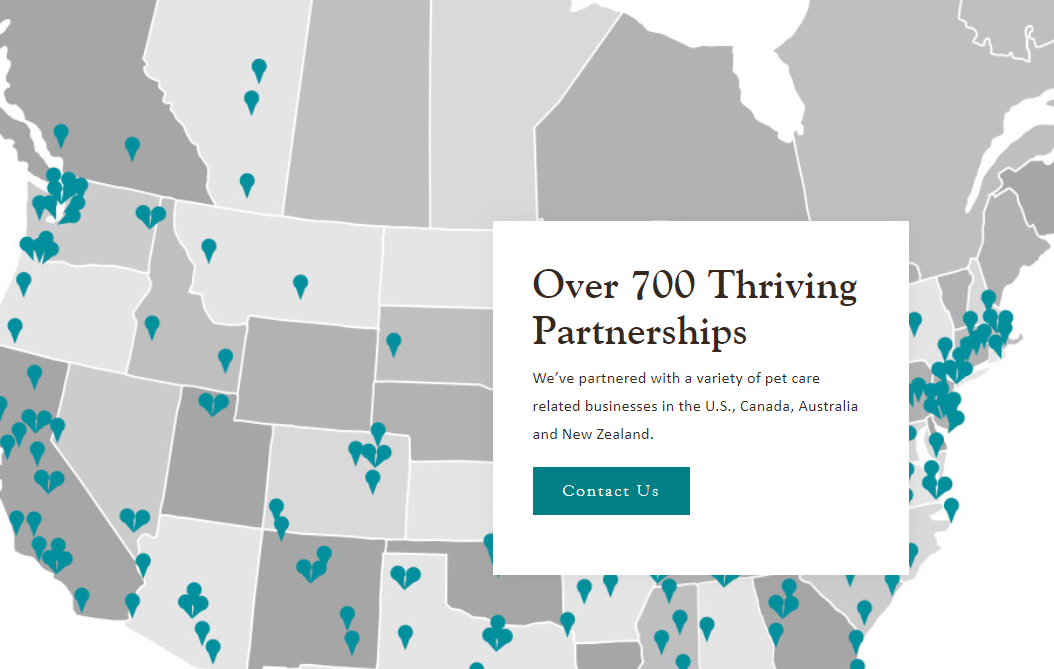
Agoura Hills, Calif.-based NVA bills itself as is the largest private owner of freestanding veterinary hospitals in the United States. The company’s Web site says it currently owns roughly 700 veterinary hospitals and animal boarding facilities in the United States, Canada, Australia and New Zealand.

NVA said it discovered the ransomware outbreak on the morning of Sunday, Oct. 27, and soon after hired two outside security firms to investigate and remediate the attack. A source close to the investigation told KrebsOnSecurity that NVA was hit with Ryuk, a ransomware strain first spotted in August 2018 that targets mostly large organizations for a high-ransom return.

NVA declined to answer questions about the malware, or whether the NVA paid the ransom demand.

“It was ransomware, but we’ve been referring to it as a malware incident,” said Laura Koester, NVA’s chief marketing officer.

Koester said because every NVA hospital runs their IT operations as they see fit, not all were affected. More importantly, she said, all of the NVA’s hospitals have remained open and able to see clients (animals in need of care), and access to patient records has been fully restored to all affected hospitals.

“For a few days, some [pet owners] couldn’t do online bookings, and some hospitals had to look at different records for their patients,” Koester said. “But throughout this whole thing, if there was a sick animal, we saw them. No one closed their doors.”

The source close to the investigation painted a slight less rosy picture of the situation at NVA, and said the company’s response has been complicated by the effects of wildfires surrounding its headquarters in Los Angeles County: A year ago, a destructive wildfire in Los Angeles and Ventura Counties burned almost 100,00 acres, destroyed more than 1,600 structures, killed three people and prompted the evacuation of nearly 300,000 people — including all residents of Agoura Hills.

“The support center was scheduled to be closed on Friday Oct 25, 2019 due to poor air quality caused by wildfires to the north,” said the source, who asked to remain anonymous. “Around 2 am PT [Oct. 27], the Ryuk virus was unleashed at NVA. Approximately 400 locations were infected. [Microsoft] Active Directory and Exchange servers were infected. Many of the infected locations immediately lost access to their Patient Information Management systems (PIMs). These locations were immediately unable to provide care.”

The source shared internal communications from different NVA executives to their hospitals about the extent of the remediation efforts and possible source of the compromise, which seemed to suggest that at least some NVA properties have been struggling to accommodate patients.

A missive from NVA’s Director of Operations Robert Hill on Oct. 30 acknowledged that “we continue to be faced with a monumental effort to restore IT service [to] nearly 400 of our hospitals.”

“This really hit home for me Saturday,” Hill wrote. “One of my best friends had to take his Yellow Lab into Conejo Valley for urgent care. Thankfully CV was able to provide care as their [systems] were up and running, but many of our hospitals are not in as good shape.”

In an update sent to NVA hospitals on Nov. 6, the company’s new head of technology Greg Hartmann said its security system successfully blocked the ransomware from infiltrating its systems — at least at first.

“Because of the scale of the attack, the virus eventually found three smaller points of entry through accounts that were unaffiliated with NVA, but unfortunately opened within our network,” Hartmann said. “Upon discovery of the incident, our technology team immediately implemented procedures to prevent the malware from spreading; however, many local systems were affected. Still, we have many hospitals whose systems are not recovered. The technology team continues to set up interim workstations at each affected hospital while they prepare to rebuild servers.”

The source told KrebsOnSecurity that NVA suffered a separate ransomware infestation earlier this summer that also involved Ryuk, and they expressed concern that the first incident may not have been fully remediated — potentially letting the attackers maintain a foothold within the organization.

“This is the second time this year Ryuk struck NVA,” the source said. “The first time, NVA was rather open to all facilities about what happened. This time, however, they are simply referring to it as a ‘system outage.’”

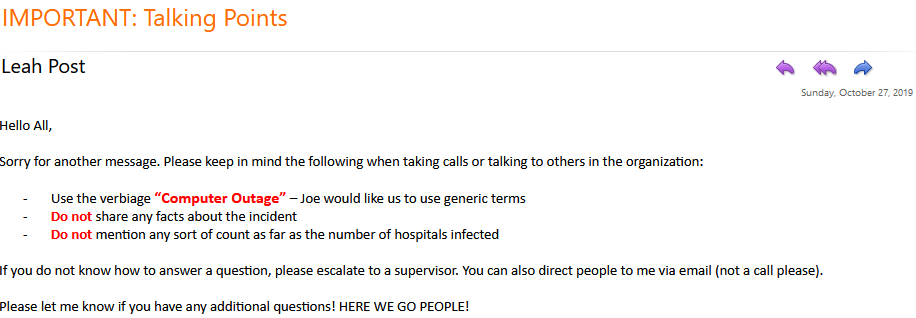
A set of talking points NVA distributed to staff on Oct. 27, the day some 400 veterinary hospitals were hit with the Ryuk ransomware.

Koester said some NVA facilities did get hit with a malware incident earlier this year, but that she did not believe ransomware was involved in that intrusion.

The Ryuk ransomware has made a name for itself going after businesses that supply services to other companies — particularly cloud-data firms — with the ransom demands set according to the victim’s perceived ability to pay. In February, payroll software provider Apex Human Capital Management chose to pay the ransom demand after a Ryuk infection severed payroll management services for hundreds of the company’s customers. And on Christmas Eve 2018, cloud hosting provider Dataresolution.net suffered a multi-week outage after a Ryuk attack.

According to a bulletin released by the FBI in May, cybercriminals had targeted over 100 U.S. and international businesses with Ryuk since August 2018. Security firm CrowdStrike estimated that attackers deploying Ryuk had netted over $3.7 million in bitcoin ransom payments between Aug. 2018 and January 2019.

Many people and organizations may be under the impression that ransomware attacks like Ryuk can appear at a moment’s notice merely from someone clicking a malicious link or opening a booby-trapped email attachment. While the latter appears to be the most common vector for ransomware infestations, an advisory released in September by the U.K’s National Cyber Security Centre suggests most Ryuk victims are compromised weeks or months before the ransomware is actually deployed inside the victim’s network.

“The Ryuk ransomware is often not observed until a period of time after the initial infection – ranging from days to months – which allows the actor time to carry out
reconnaissance inside an infected network, identifying and targeting critical network systems and therefore maximizing the impact of the attack,” reads the NCSC advisory, which includes tips on spotting signs of a Ryuk infection. “But it may also offer the potential to mitigate against a ransomware attack before it occurs, if the initial infection is detected and remedied.”

As for what changes NVA will be making to prevent yet another ransomware outbreak, an internal update on Nov. 7 from NVA’s chief information officer Joe Leggio said NVA was investing in software from Carbon Black, a cloud-based security solution that will be installed on all NVA property computers.

“Throughout my career, I have witnessed incredible advances in technology making our lives better,” Leggio wrote. “At nearly the same rate, the bad guys have been increasing the aggressiveness and sophistication of their attacks. As we rebuild, we are also thinking of the future. That is why we are investing in cybersecurity talent, new infrastructure, and better software.”

from Krebs on Security https://ift.tt/2QuMBSx
via IFTTT

Why Were the Russians So Set Against This Hacker Being Extradited?

The Russian government has for the past four years been fighting to keep 29-year-old alleged cybercriminal Alexei Burkov from being extradited by Israel to the United States. When Israeli authorities turned down requests to send him back to Russia — supposedly to face separate hacking charges there — the Russians then imprisoned an Israeli woman for seven years on trumped-up drug charges in a bid to trade prisoners. That effort failed as well, and Burkov had his first appearance in a U.S. court last week. What follows are some clues that might explain why the Russians are so eager to reclaim this young man.

Alexei Burkov, seated second from right, attends a hearing in Jerusalem in 2015. Andrei Shirokov / Tass via Getty Images.

On the surface, the charges the U.S. government has leveled against Burkov may seem fairly unremarkable: Prosecutors say he ran a credit card fraud forum called CardPlanet that sold more than 150,000 stolen credit cards.

However, a deep dive into the various pseudonyms allegedly used by Burkov suggests this individual may be one of the most connected and skilled malicious hackers ever apprehended by U.S. authorities, and that the Russian government is probably concerned that he simply knows too much.

Burkov calls himself a specialist in information security and denies having committed the crimes for which he’s been charged. But according to denizens of several Russian-language cybercrime forums that have been following his case in the Israeli news media, Burkov was by all accounts an elite cybercrook who primarily operated under the hacker alias “K0pa.”

This is the same nickname used by an individual who served as co-administrator of perhaps the most exclusive Russian-language hacking forums ever created, including Mazafaka and DirectConnection.

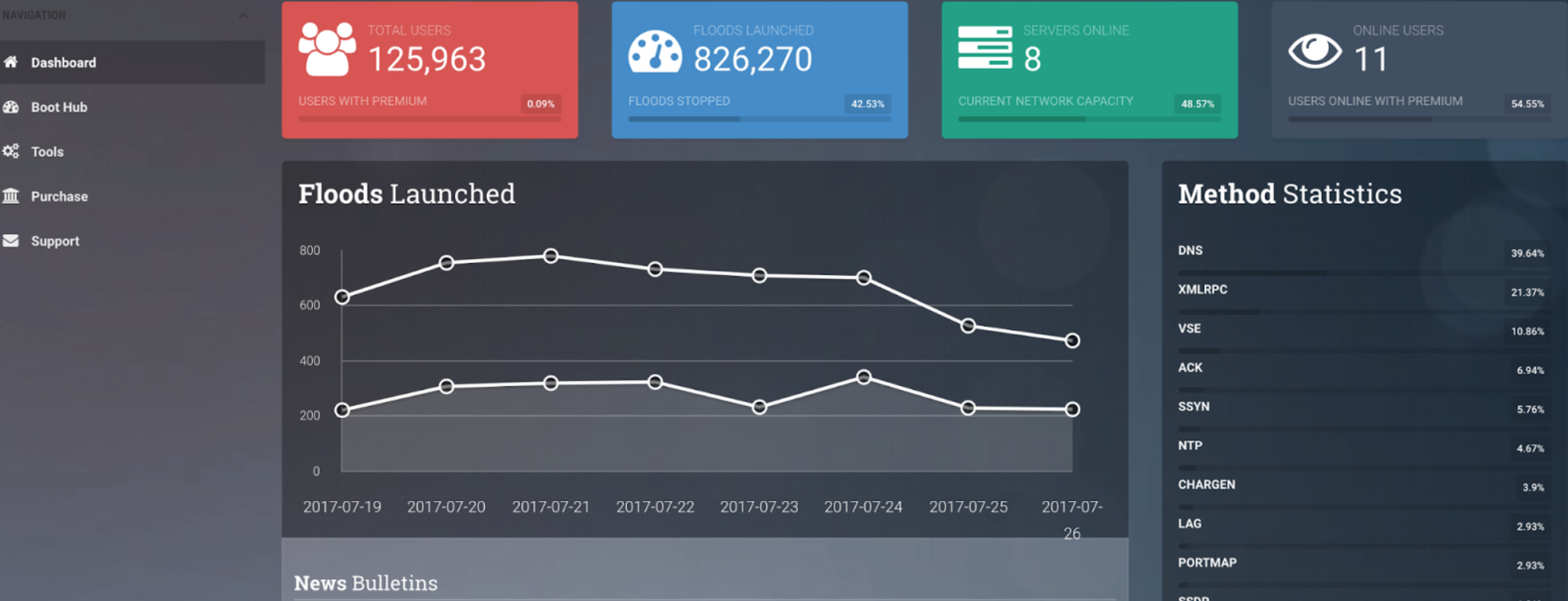
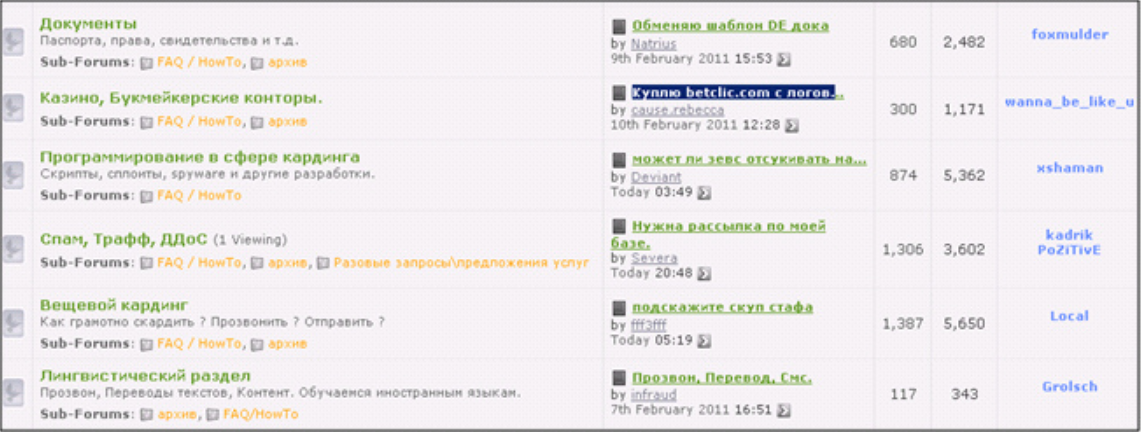
A screen shot from the Mazafaka cybercrime forum, circa 2011.

Since their inception in the mid-aughts, both of these forums have been among the most difficult to join — admitting only native Russian speakers and requiring each applicant to furnish a non-refundable cash deposit and “vouches” — or guarantees — from at least three existing members. Also, neither forum was accessible or even visible to anyone without a special encryption certificate supplied by forum administrators that allowed the sites to load properly in a Web browser.

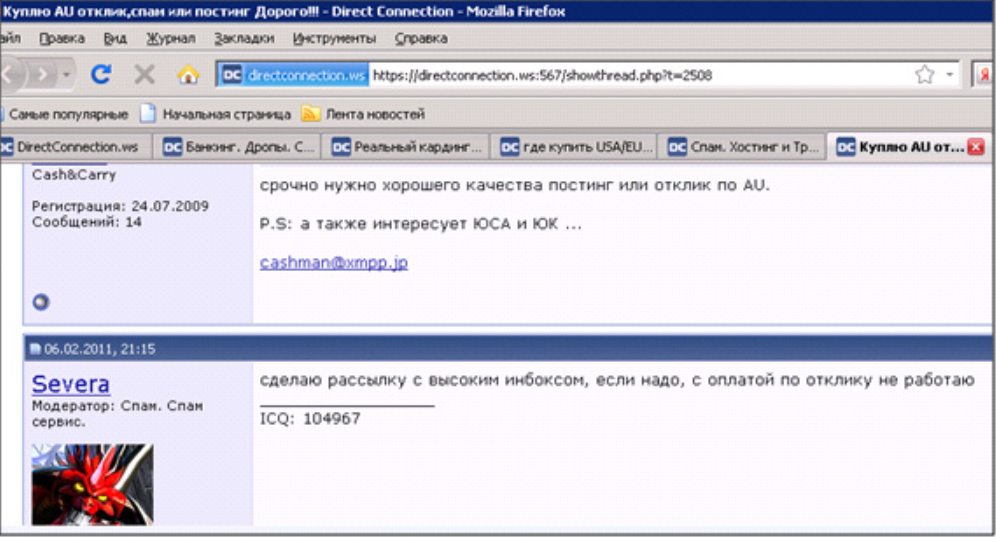
DirectConnection, circa 2011. The identity shown at the bottom of this screenshot — Severa — belonged to Peter Levashov, a prolific spammer who pleaded guilty in the United States last year to operating the Kelihos spam botnet.

Notably, some of the world’s most-wanted cybercriminals were members of these two highly exclusive forums, and many of those individuals have already been arrested, extradited and tried for various cybercrime charges in the United States over the years. Those include convicted credit card fraudsters Vladislav “Badb” Horohorin and Sergey “zo0mer” Kozerev, as well as the infamous spammer and botnet master Peter “Severa” Levashov.

A user database obtained by KrebsOnSecurity several years back indicates K0pa relied on the same email address he used to register at Mazafaka and DirectConnection to register the user account “Botnet” on Spamdot, which for years was the closely-guarded stomping ground of the world’s most prolific spammers and virus writers, as well as hackers who created services catering to both professions.

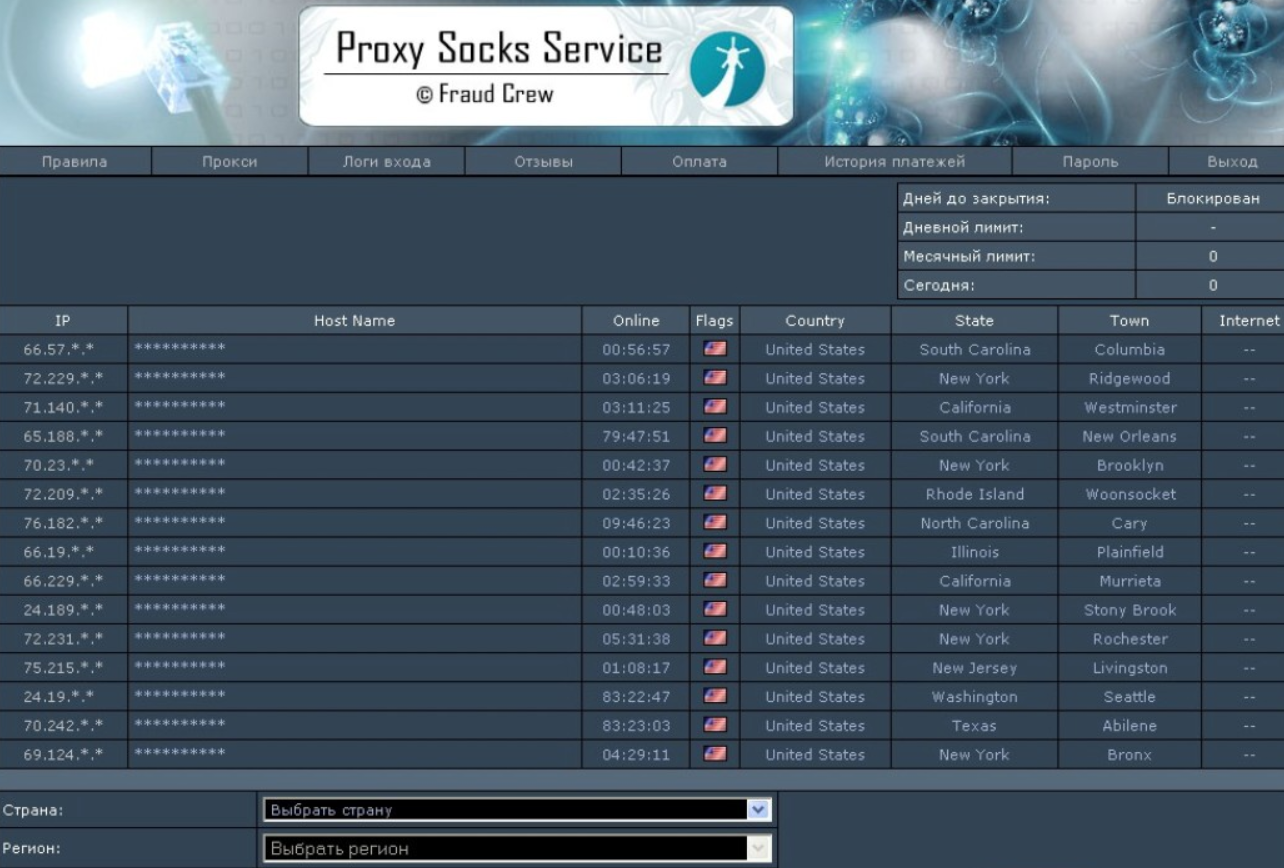
As a reporter for The Washington Post in 2008, I wrote about the core offering that K0pa/Botnet advertised on Spamdot and other exclusive forums: A botnet-based anonymity service called FraudCrew. This service sold access to hacked computers, which FraudCrew customers used for the purposes of hiding their real location online while conducting cybercriminal activities.

FraudCrew, a botnet-based anonymity service offered by K0pa.

K0pa also was a top staff member at Verified, among the oldest and most venerated of Russian language cybercrime forums. Specifically, K0pa’s role at Verified was in maintaining its blacklist, a dispute resolution process designed to weed out “dishonest” cybercriminals who seek only to rip off less experienced crooks. From this vantage point, K0pa would have held considerable sway on the forum, and almost certainly played a key role in vetting new applicants to the site.

Prior to his ascendance at these forums, K0pa was perhaps best known for being a founding member of a hacker group calling themselves the CyberLords. Over nearly a decade, the CyberLords team would release dozens of hacking tools and exploits targeting previously unknown security vulnerabilities in Web-based services and computer software.

According to security firm Cybereason, Russia has a history of using contractors — even cybercriminals — to run intelligence operations. These crooks-turned-spies “offer a resource to the state while enjoying a cloak of semi-protected ‘status’ for their extracurricular activities, provided they are directed against foreign targets.”

“Cybercriminals are recruited to Russia’s national cause through a mix of coercion, payments and appeals to patriotic sentiment,” reads a 2017 story from The Register on Cybereason’s analysis of the Russian cybercrime scene. “Russia’s use of private contractors also has other benefits in helping to decrease overall operational costs, mitigating the risk of detection and gaining technical expertise that they cannot recruit directly into the government. Combining a cyber-militia with official state-sponsored hacking teams has “created the most technically advanced and bold cybercriminal community in the world.”

A banner that ran on top of the Verified cybercrime forum for many years.

It’s probably worth noting that also present on both DirectConnection and Mazafaka were the core members of a prolific gang of online bank robbers called the JabberZeus Crew, who used custom versions of the ZeuS Trojan to steal tens — if not hundreds — of millions of dollars from hacked small businesses across the United States. In 2011, most of that crew was rounded up in an international cybercrime crackdown, although virtually all of them escaped prosecution in their home countries (mainly Russia and Ukraine).

I mention this because K0pa also was a member of the JabberZeus crew. This gang worked directly with the author of the ZeuS trojan — Evgeniy “Slavik” Bogachev — a Russian man with a $3 million bounty on his head from the FBI. The cybercriminal organization Bogchev allegedly ran was responsible for the theft of more than $100 million from banks and businesses worldwide that were infected with his ZeuS malware. That organization, dubbed the “Business Club,” had members spanning most of Russia’s 11 time zones.

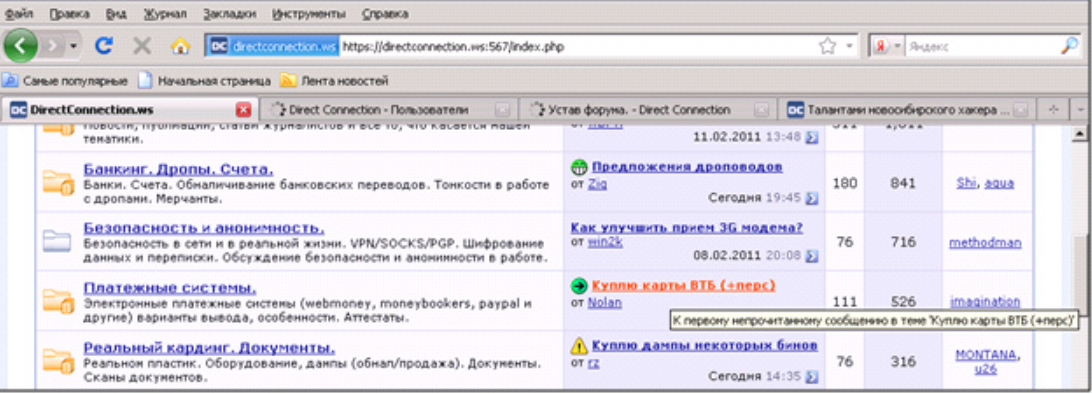
In this 2011 screenshot of DirectConnection, we can see the nickname “aqua,” one of the JabberZeus crime gang actors. K0pa also was part of the JabberZeus crew.

Fox-IT, a Dutch security firm that infiltrated the Business Club’s back-end operations, found that beginning in late fall 2013 — about the time that conflict between Ukraine and Russia was just beginning to heat up — Slavik retooled his cyberheist botnet to serve as purely a spying machine, and began scouring infected systems in Ukraine for specific keywords in emails and documents that would likely only be found in classified documents.

Likewise, the keyword searches that Slavik used to scour bot-infected systems in Turkey suggested the botmaster was searching for specific files from the Turkish Ministry of Foreign Affairs – a specialized police unit. Fox-IT said it was clear that Slavik was looking to intercept communications about the conflict in Syria on Turkey’s southern border — one that Russia has supported by reportedly shipping arms into the region.

To my knowledge, no one has accused Burkov of being some kind of cybercrime fixer or virtual badguy Rolodex for the Russian government. On the other hand, from his onetime lofty perch atop some of the most exclusive Russian cybercrime forums, K0pa certainly would have fit that role nicely.

Further reading, including the fascinating story on the diplomatic back and forth between Russia and Israel mentioned in the first paragraph: The Russian Hacker Who Just Became One of Israel’s Most Famous Prisoners.

How Russia Recruited Elite Hackers for Its Cyberwar

from Krebs on Security https://ift.tt/2Qx8654
via IFTTT

Orcus RAT Author Charged in Malware Scheme

In July 2016, KrebsOnSecurity published a story identifying a Toronto man as the author of the Orcus RAT, a software product that’s been marketed on underground forums and used in countless malware attacks since its creation in 2015. This week, Canadian authorities criminally charged him with orchestrating an international malware scheme.

An advertisement for Orcus RAT.

The accused, 36-year-old John “Armada” Revesz, has maintained that Orcus is a legitimate “Remote Administration Tool” aimed at helping system administrators remotely manage their computers, and that he’s not responsible for how licensed customers use his product.

In my 2016 piece, however, several sources noted that Armada and his team were marketing it more like a Remote Access Trojan, providing ongoing technical support and help to customers who’d purchased Orcus but were having trouble figuring out how to infect new machines or hide their activities online.

Follow-up reporting revealed that the list of features and plugins advertised for Orcus includes functionality that goes significantly beyond what one might see in a traditional remote administration tool, such as DDoS-for-hire capabilities, and the ability to disable the light indicator on webcams so as not to alert the target that the RAT is active.

Canadian investigators don’t appear to be buying Revesz’ claims. On Monday the Royal Canadian Mounted Police (RCMP) announced it had charged Revesz with operating an international malware distribution scheme under the company name “Orcus Technologies.”

“An RCMP criminal investigation began in July 2016 after reports of a significant amount of computers were being infected with a ‘Remote Access Trojan’ type of virus,” the agency said in a statement.

The RCMP filed the charges eight months after executing a search warrant at Revesz’ home, where they seized several hard drives containing Orcus RAT customer names, financial transactions, and other information.

“The evidence obtained shows that this virus has infected computers from around the world, making thousands of victims in multiple countries,” the RCMP said.

Revesz did not respond to requests for comment.

If Revesz’s customers are feeling the heat right now, they probably should be. Several former customers of his took to Hackforums[.]net to complain about being raided by investigators who are trying to track down individuals suspected of using Orcus to infect computers with malware.

“I got raided [and] within the first 5 minutes they mention Orcus to me,” complained one customer on Hackforums[.]net, the forum where Revesz principally advertised his software. That user pointed to a March 2019 media advisory released by the Australian Federal Police, who said they’d executed search warrants there as part of an investigation into RAT technology conducted in tandem with the RCMP.

According to Revesz himself, the arrests and searches related to Orcus have since expanded to individuals in the United States and Germany.

The sale and marketing of remote administration tools is not illegal in the United States, and indeed there are plenty such tools sold by legitimate companies to help computer experts remotely administer computers.

However, these tools tend to be viewed by prosecutors as malware and spyware when their proprietors advertise them as hacking devices and provide customer support aimed at helping buyers deploy the RATs stealthily and evade detection by anti-malware programs.

Last year, a 21-year-old Kentucky man pleaded guilty to authoring and distributing a popular hacking tool called “LuminosityLink,” which experts say was used by thousands of customers to gain access to tens of thousands of computers across 78 countries worldwide.

Also in 2018, 27-year-old Arkansas resident Taylor Huddleston was sentenced to three years in jail for making and selling the “NanoCore RAT,” which was being used to spy on webcams and steal passwords from systems running the software.

In many previous law enforcement investigations targeting RAT developers and sellers, investigators also have targeted customers of these products. In 2014, the U.S. Justice Department announced a series of actions against more than 100 people accused of purchasing and using “Blackshades,” a cheap and powerful RAT that the U.S. government said was used to infect more than a half million computers worldwide.

It’s remarkable how many denizens of various hacking forums persist in believing that an end-user licensing agreement (EULA) or “terms of service” (TOS) disavowing any responsibility for what customers do with the product somehow absolves sellers of RAT programs of any liability when they then turn around and actively assist customers in using the tools to infect systems with malware.

from Krebs on Security https://ift.tt/2NK3EhO
via IFTTT

Patch Tuesday, November 2019 Edition

Microsoft today released updates to plug security holes in its software, including patches to fix at least 74 weaknesses in various flavors of Windows and programs that run on top of it. The November updates include patches for a zero-day flaw in Internet Explorer that is currently being exploited in the wild, as well as a sneaky bug in certain versions of Office for Mac that bypasses security protections and was detailed publicly prior to today’s patches.

More than a dozen of the flaws tackled in this month’s release are rated “critical,” meaning they involve weaknesses that could be exploited to install malware without any action on the part of the user, except for perhaps browsing to a hacked or malicious Web site or opening a booby-trapped file attachment.


Perhaps the most concerning of those critical holes is a zero-day flaw in Internet Exploder Explorer (CVE-2019-1429) that has already seen active exploitation. Today’s updates also address two other critical vulnerabilities in the same Windows component that handles various scripting languages.

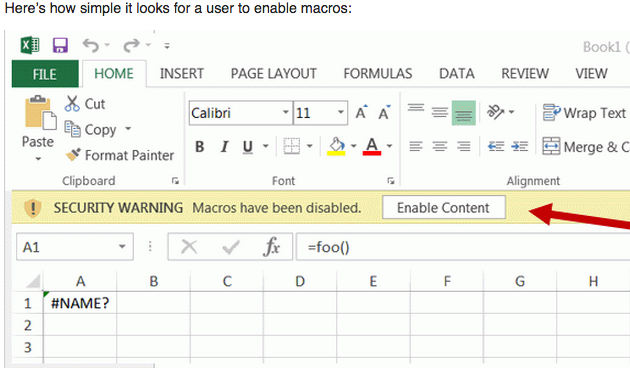
Microsoft also fixed a flaw in Microsoft Office for Mac (CVE-2019-1457) that could allow attackers to bypass security protections in some versions of the program that could let malicious macros through.

Macros are bits of computer code that can be embedded into Office files, and malicious macros are frequently used by malware purveyors to compromise Windows systems. Usually, this takes the form of a prompt urging the user to “enable macros” once they’ve opened a booby-trapped Office document delivered via email. Thus, Office has a feature called “disable all macros without notification.”

But Microsoft says all versions of Office still support an older type of macros that do not respect this setting, and can be used as a vector for pushing malware. Will Dornan of CERT/CC reports that while Office 2016 and 2019 for Mac will still prompt the user before executing these older macro types, Office for Mac 2011 fails to warn users before opening them.

Other Windows applications or components receiving patches for critical flaws today include Microsoft Exchange and Windows Media Player. In addition, Microsoft also patched nine vulnerabilities — five of them critical — in the Windows Hyper-V, an add-on to the Windows Server OS (and Windows 10 Pro) that allows users to create and run virtual machines (other “guest” operating systems) from within Windows.

Although Adobe typically issues patches for its Flash Player browser component on Patch Tuesday, this is the second month in a row that Adobe has not released any security updates for Flash. However, Adobe today did push security fixes for a variety of its creative software suites, including Animate, Illustrator, Media Encoder and Bridge. Also, I neglected to note last month that Adobe released a critical update for Acrobat/Reader that addressed at least 67 bugs, so if you’ve got either of these products installed, please be sure they’re patched and up to date.

Finally, Google recently fixed a zero-day flaw in its Chrome Web browser (CVE-2019-13720). If you use Chrome and see an upward-facing arrow to the right of the address bar, you have an update pending; fully closing and restarting the browser should install any available updates.

Now seems like a good time to remind all you Windows 7 end users that Microsoft will cease shipping security updates after January 2020 (this end-of-life also affects Windows Server 2008 and 2008 R2). While businesses and other volume-license purchasers will have the option to pay for further fixes after that point, all other Windows 7 users who want to stick with Windows will need to consider migrating to Windows 10 soon.

Standard heads-up: Windows 10 likes to install patches all in one go and reboot your computer on its own schedule. Microsoft doesn’t make it easy for Windows 10 users to change this setting, but it is possible. For all other Windows OS users, if you’d rather be alerted to new updates when they’re available so you can choose when to install them, there’s a setting for that in Windows Update. To get there, click the Windows key on your keyboard and type “windows update” into the box that pops up.

Keep in mind that while staying up-to-date on Windows patches is a good idea, it’s important to make sure you’re updating only after you’ve backed up your important data and files. A reliable backup means you’re probably not freaking out when the odd buggy patch causes problems booting the system. So do yourself a favor and backup your files before installing any patches.

As ever, if you experience glitches or problems installing any of these patches this month, please feel free to leave a comment about it below; there’s a decent chance other readers have experienced the same and may even chime in here with some helpful tips.

from Krebs on Security https://ift.tt/2qaPVY2
via IFTTT

Retailer Orvis.com Leaked Hundreds of Internal Passwords on Pastebin

Orvis, a Vermont-based retailer that specializes in high-end fly fishing equipment and other sporting goods, leaked hundreds of internal passwords on Pastebin.com for several weeks last month, exposing credentials the company used to manage everything from firewalls and routers to administrator accounts and database servers, KrebsOnSecurity has learned. Orvis says the exposure was inadvertent, and that many of the credentials were already expired.

Based in Sunderland, VT. and founded in 1856, privately-held Orvis is the oldest mail-order retailer in the United States. The company has approximately 1,700 employees, 69 retail stores and 10 outlets in the US, and 18 retail stores in the UK.

In late October, this author received a tip from Wisconsin-based security firm Hold Security that a file containing a staggering number of internal usernames and passwords for Orvis had been posted to Pastebin.

Reached for comment about the source of the document, Orvis spokesperson Tucker Kimball said it was only available for a day before the company had it removed from Pastebin.

“The file contains old credentials, so many of the devices associated with the credentials are decommissioned and we took steps to address the remaining ones,” Kimball said. “We are leveraging our existing security tools to conduct an investigation to determine how this occurred.”

However, according to Hold Security founder Alex Holden, this enormous passwords file was actually posted to Pastebin on two separate occasions last month, the first being on Oct. 4, and the second Oct. 22. That finding was corroborated by 4iq.com, a company that aggregates information from leaked databases online.

Orvis did not respond to follow-up requests for comment via phone and email; the last two email messages sent by KrebsOnSecurity to Orvis were returned simply as “blocked.”

It’s not unusual for employees or contractors to post bits of sensitive data to public sites like Pastebin and Github, but the credentials file apparently published by someone working at or for Orvis is by far the most extreme example I’ve ever witnessed.

For instance, included in the Pastebin files from Orvis were plaintext usernames and passwords for just about every kind of online service or security product the company has used, including:

-Antivirus engines
-Data backup services
-Multiple firewall products
-Linux servers
-Cisco routers
-Netflow data
-Call recording services
-DNS controls
-Orvis wireless networks (public and private)
-Employee wireless phone services
-Oracle database servers
-Microsoft 365 services
-Microsoft Active Directory accounts and passwords
-Battery backup systems
-Security cameras
-Encryption certificates
-Mobile payment services
-Door and Alarm Codes
-FTP credentials
-Apple ID credentials
-Door controllers

By all accounts, this was a comprehensive goof: The Orvis credentials file even contained the combination to a locked safe in the company’ server room.

The only clue about the source of the Orvis password file is a notation at the top of the document that reads “VT Technical Services.”

Holden said this particular exposure also highlights the issue with third parties, as the issue most likely originated not from Orvis staff itself.

“This is a continuously growing trend of exposures created not by the victims but for those that they consider to be trusted partners,” Holden said.

It’s fairly remarkable that a company can spend millions on all the security technology under the sun and have all of it potentially undermined by one ill-advised post to Pastebin, but that is certainly the reality we live in today.

Long gone are the days when one could post something for a few hours to a public document hosting service and expect nobody to notice when it’s taken down. Today there are a number of third-party services that regularly index and preserve such postings, regardless of how ephemeral those postings may be.

“Pastebin and other similar repositories are constantly being monitored and any data put out there will be preserved no matter how brief the posting is,” Holden said. “In the current threat landscape, we see data exposures nearly as often as we see data breaches. These exposures vary in scope and impact, and this particular one is as bad as they come without specific data exposures.”

If you’re responsible for securing your organization’s environment, it would be an excellent idea to create some tools for monitoring for your domains and brands at Pastebin, Github and other sites where employees sometimes publish sensitive corporate data, inadvertently or otherwise. There are many ways to do this; here’s one example.

Have you built such monitoring tools for your organization or employer? If so, please feel free to sound off about your approach in the comments below.

from Krebs on Security https://ift.tt/32y7C17
via IFTTT

Study: Ransomware, Data Breaches at Hospitals tied to Uptick in Fatal Heart Attacks

Hospitals that have been hit by a data breach or ransomware attack can expect to see an increase in the death rate among heart patients in the following months or years because of cybersecurity remediation efforts, a new study posits. Health industry experts say the findings should prompt a larger review of how security — or the lack thereof — may be impacting patient outcomes.

Researchers at Vanderbilt University‘s Owen Graduate School of Management took the Department of Health and Human Services (HHS) list of healthcare data breaches and used it to drill down on data about patient mortality rates at more than 3,000 Medicare-certified hospitals, about 10 percent of which had experienced a data breach.

As PBS noted in its coverage of the Vanderbilt study, after data breaches as many as 36 additional deaths per 10,000 heart attacks occurred annually at the hundreds of hospitals examined.

The researchers found that for care centers that experienced a breach, it took an additional 2.7 minutes for suspected heart attack patients to receive an electrocardiogram.

“Breach remediation efforts were associated with deterioration in timeliness of care and patient outcomes,” the authors found. “Remediation activity may introduce changes that delay, complicate or disrupt health IT and patient care processes.”

Leo Scanlon, former deputy chief information security officer at the HHS, said the findings in this report practically beg for a similar study to be done in the United Kingdom, whose healthcare system was particularly disrupted by the Wannacry virus, a global contagion in May 2017 that spread through a Microsoft Windows vulnerability prevalent in older healthcare systems.

“The exploitation of cybersecurity vulnerabilities is killing people,” Scanlon told KrebsOnSecurity. “There is a lot of possible research that might be unleashed by this study. I believe that nothing less than a congressional investigation will give the subject the attention it deserves.”

A post-mortem on the impact of WannaCry found the outbreak cost U.K. hospitals almost $100 million pounds and caused significant disruption to patient care, such as the cancellation of some 19,000 appointments — including operations — and the disruption of IT systems for at least a third of all U.K. National Health Service (NHS) hospitals and eight percent of general practitioners. In several cases, hospitals in the U.K. were forced to divert emergency room visitors to other hospitals.

But what isn’t yet known is how Wannacry affected mortality rates among heart attack and stroke patients whose ambulances were diverted to other hospitals because of IT system outages related to the malware. Or how many hospitals and practices experienced delays in getting test results back needed to make critical healthcare decisions.

Scanlon said although he’s asked around quite a bit over the years to see if any researchers have taken up the challenge of finding out, and that so far he hasn’t found anyone doing that analysis.

“A colleague who is familiar with large scale healthcare data sets told me that unless you are associated with a research institution, it would be almost impossible to pry that kind of data out of the institutions that have it,” Scanlon said. “The problem is this data is hard to come by — nobody likes to admit that death can be attributable to a non-natural cause like this — and is otherwise considered sensitive at a very high and proprietary level by the institutions that have the facts.”

A study published in the April 2017 edition of The New England Journal of Medicine would seem to suggest applying the approach used by the Vanderbilt researchers to measuring patient outcomes at U.K. hospitals in the wake of Wannacry might be worth carrying out.

In the NEJM study, morbidity and mortality data was used to show that there is a measurable impact when ambulances and emergency response teams are removed from normal service and redirected to standby during public events like marathons and other potential targets of terrorism.

The study found that “medicare beneficiaries who were admitted to marathon-affected hospitals with acute myocardial infarction or cardiac arrest on marathon dates had longer ambulance transport times before noon (4.4 minutes longer) and higher 30-day mortality than beneficiaries who were hospitalized on nonmarathon dates.”

“Several colleagues and I are convinced that the same can be shown about WannaCry, on the large scale, and also at the small scale when ransomware attacks impact a regional hospital,” Scanlon said.

In November 2018, I was honored to give the keynote at a conference held by the Health Information Sharing and Analysis Center (H-ISAC), a non-profit that promotes the sharing of cyber threat information and best practices in the healthcare sector.

In the weeks leading up to that speech, I interviewed more than a dozen experts in healthcare security to find out what was top of mind for these folks. Incredibly, one response I heard from multiple healthcare industry experts was that there is currently no data available to support the finding of a negative patient outcome as a result of a cybersecurity vulnerability or attack.

As I kept talking to experts, it occurred to me that if smart people in this industry could say something like that with a straight face, it was probably because not a lot of people were looking too hard for evidence to the contrary.

With this Vanderbilt study, that’s demonstrably no longer true.

A copy of the new study is available here (PDF).

from Krebs on Security https://ift.tt/2pUuGK7
via IFTTT