U.S. Soldier Charged in AT&T Hack Searched “Can Hacking Be Treason”

A U.S. Army soldier who pleaded guilty last week to leaking phone records for high-ranking U.S. government officials searched online for non-extradition countries and for an answer to the question “can hacking be treason?” prosecutors in the case said Wednesday. The government disclosed the details in a court motion to keep the defendant in custody until he is discharged from the military.

One of several selfies on the Facebook page of Cameron Wagenius.

Cameron John Wagenius, 20, was arrested near the Army base in Fort Cavazos, Texas on Dec. 20, and charged with two criminal counts of unlawful transfer of confidential phone records. Wagenius was a communications specialist at a U.S. Army base in South Korea, who secretly went by the nickname Kiberphant0m and was part of a trio of criminal hackers that extorted dozens of companies last year over stolen data.

At the end of 2023, malicious hackers learned that many companies had uploaded sensitive customer records to Snowflake accounts that were protected with little more than a username and password (no multi-factor authentication needed). After scouring darknet markets for stolen Snowflake account credentials, the hackers began raiding the data storage repositories used by some of the world’s largest corporations.

Among those was AT&T, which disclosed in July that cybercriminals had stolen personal information and phone and text message records for roughly 110 million people — nearly all of its customers. AT&T reportedly paid a hacker $370,000 to delete stolen phone records. More than 160 other Snowflake customers were relieved of data, including TicketMaster, Lending Tree, Advance Auto Parts and Neiman Marcus.

In several posts to an English-language cybercrime forum in November, Kiberphant0m leaked some of the phone records and threatened to leak them all unless paid a ransom. Prosecutors said that in addition to his public posts on the forum, Wagenius had engaged in multiple direct attempts to extort “Victim-1,” which appears to be a reference to AT&T. The government states that Kiberphant0m privately demanded $500,000 from Victim-1, threatening to release all of the stolen phone records unless he was paid.

On Feb. 19, Wagenius pleaded guilty to two counts of unlawfully transferring confidential phone records, but he did so without the benefit of a plea agreement. In entering the plea, Wagenius’s attorneys had asked the court to allow him to stay with his father pending his sentencing.

But in a response filed today (PDF), prosecutors in Seattle said Wagenius was a flight risk, partly because prior to his arrest he was searching online for how to defect to countries that do not extradite to the United States. According to the government, while Kiberphant0m was extorting AT&T, Wagenius’s searches included:

-“where can i defect the u.s government military which country will not hand me over”
-“U.S. military personnel defecting to Russia”
-“Embassy of Russia – Washington, D.C.”

“As discussed in the government’s sealed filing, the government has uncovered evidence suggesting that the charged conduct was only a small part of Wagenius’ malicious activity,” the government memo states. “On top of this, for more than two weeks in November 2024, Wagenius communicated with an email address he believed belonged to Country-1’s military intelligence service in an attempt to sell stolen information. Days after he apparently finished communicating with Country-1’s military intelligence service, Wagenius Googled, ‘can hacking be treason.’”

Prosecutors told the court investigators also found a screenshot on Wagenius’ laptop that suggested he had over 17,000 files that included passports, driver’s licenses, and other identity cards belonging to victims of a breach, and that in one of his online accounts, the government also found a fake identification document that contained his picture.

“Wagenius should also be detained because he presents a serious risk of flight, has the means and intent to flee, and is aware that he will likely face additional charges,” the Seattle prosecutors asserted.

The court filing says Wagenius is presently in the process of being separated from the Army but, but the government has not received confirmation that his discharge has been finalized.

“The government’s understanding is that, until his discharge from the Army is finalized (which is expected to happen in early March), he may only be released directly to the Army,” reads a footnote in the memo. “Until that process is completed, Wagenius’ proposed release to his father should be rejected for this additional reason.”

Wagenius’s interest in defecting to another country in order to escape prosecution mirrors that of his alleged co-conspirator, John Erin Binns, an 25-year-old elusive American man indicted by the Justice Department for a 2021 breach at T-Mobile that exposed the personal information of at least 76.6 million customers.

Binns has since been charged with the Snowflake hack and subsequent extortion activity. He is currently in custody in a Turkish prison. Sources close to the investigation told KrebsOnSecurity that prior to his arrest by Turkish police, Binns visited the Russian embassy in Turkey to inquire about Russian citizenship.

In late November 2024, Canadian authorities arrested a third alleged member of the extortion conspiracy, 25-year-old Connor Riley Moucka of Kitchener, Ontario. The U.S. government has indicted Moucka and Binns, charging them with one count of conspiracy; 10 counts of wire fraud; four counts of computer fraud and abuse; two counts of extortion in relation to computer fraud; and two counts aggravated identity theft.

Less than a month before Wagenius’s arrest, KrebsOnSecurity published a deep dive into Kiberphant0m’s various Telegram and Discord identities over the years, revealing how the owner of the accounts told others they were in the Army and stationed in South Korea.

The maximum penalty Wagenius could face at sentencing includes up to ten years in prison for each count, and fines not to exceed $250,000.

from Krebs on Security https://ift.tt/a1Ph4DL
via IFTTT

Trump 2.0 Brings Cuts to Cyber, Consumer Protections

One month into his second term, President Trump’s actions to shrink the government through mass layoffs, firings and withholding funds allocated by Congress have thrown federal cybersecurity and consumer protection programs into disarray. At the same time, agencies are battling an ongoing effort by the world’s richest man to wrest control over their networks and data.

Image: Shutterstock. Greg Meland.

The Trump administration has fired at least 130 employees at the federal government’s foremost cybersecurity body — the Cybersecurity and Infrastructure Security Agency (CISA). Those dismissals reportedly included CISA staff dedicated to securing U.S. elections, and fighting misinformation and foreign influence operations.

Earlier this week, technologists with Elon Musk’s Department of Government Efficiency (DOGE) arrived at CISA and gained access to the agency’s email and networked files. Those DOGE staffers include Edward “Big Balls” Coristine, a 19-year-old former denizen of the “Com,” an archipelago of Discord and Telegram chat channels that function as a kind of distributed cybercriminal social network.

The investigative journalist Jacob Silverman writes that Coristine is the grandson of Valery Martynov, a KGB double agent who spied for the United States. Silverman recounted how Martynov’s wife Natalya Martynova moved to the United States with her two children after her husband’s death.

“Her son became a Virginia police officer who sometimes posts comments on blogs about his historically famous father,” Silverman wrote. “Her daughter became a financial professional who married Charles Coristine, the proprietor of LesserEvil, a snack company. Among their children is a 19-year-old young man named Edward Coristine, who currently wields an unknown amount of power and authority over the inner-workings of our federal government.”

Another member of DOGE is Christopher Stanley, formerly senior director for security engineering at X and principal security engineer at Musk’s SpaceX. Stanley, 33, had a brush with celebrity on Twitter in 2015 when he leaked the user database for the DDoS-for-hire service LizardStresser, and soon faced threats of physical violence against his family.

My 2015 story on that leak did not name Stanley, but he exposed himself as the source by posting a video about it on his Youtube channel. A review of domain names registered by Stanley shows he went by the nickname “enKrypt,” and was the former owner of a pirated software and hacking forum called error33[.]net, as well as theC0re, a video game cheating community.

“A NATIONAL CYBERATTACK”

DOGE has been steadily gaining sensitive network access to federal agencies that hold a staggering amount of personal and financial information on Americans, including the Social Security Administration (SSA), the Department of Homeland Security, the Office of Personnel Management (OPM), and the Treasury Department.

Most recently, DOGE has sought broad access to systems at the Internal Revenue Service that contain the personal tax information on millions of Americans, including how much individuals earn and owe, property information, and even details related to child custody agreements. The New York Times reported Friday that the IRS had reached an agreement whereby a single DOGE employee — 25-year-old Gavin Kliger — will be allowed to see only anonymized taxpayer information.

The rapidity with which DOGE has rifled through one federal database after another in the name of unearthing “massive fraud” by government agencies has alarmed many security experts, who warned that DOGE’s actions bypassed essential safeguards and security measures.

“The most alarming aspect isn’t just the access being granted,” wrote Bruce Schneier and Davi Ottenheimer, referring to DOGE as a national cyberattack. “It’s the systematic dismantling of security measures that would detect and prevent misuse—including standard incident response protocols, auditing, and change-tracking mechanisms—by removing the career officials in charge of those security measures and replacing them with inexperienced operators.”

Jacob Williams is a former hacker with the U.S. National Security Agency who now works as managing director of the cybersecurity firm Hunter Labs. Williams kicked a virtual hornet’s nest last week when he posted on LinkedIn that the network incursions by DOGE were “a bigger threat to U.S. federal government information systems than China.”

Williams said while he doesn’t believe anyone at DOGE would intentionally harm the integrity and availability of these systems, it’s widely reported (and not denied) that DOGE introduced code changes into multiple federal IT systems. These code changes, he maintained, are not following the normal process for vetting and review given to federal government IT systems.

“For those thinking ‘I’m glad they aren’t following the normal federal government IT processes, those are too burdensome’ I get where you’re coming from,” Williams wrote. “But another name for ‘red tape’ are ‘controls.’ If you’re comfortable bypassing controls for the advancement of your agenda, I have questions – mostly about whether you do this in your day job too. Please tag your employer letting them know your position when you comment that controls aren’t important (doubly so if you work in cybersecurity). All satire aside, if you’re comfortable abandoning controls for expediency, I implore you to decide where the line is that you won’t cross in that regard.”

The DOGE website’s “wall of receipts” boasts that Musk and his team have saved the federal government more than $55 billion through staff reductions, lease cancellations and terminated contracts. But a team of reporters at The New York Times found the math that could back up those checks is marred with accounting errors, incorrect assumptions, outdated data and other mistakes.

For example, DOGE claimed it saved $8 billion in one contract, when the total amount was actually $8 million, The Times found.

“Some contracts the group claims credit for were double- or triple-counted,” reads a Times story with six bylines. “Another initially contained an error that inflated the totals by billions of dollars. While the DOGE team has surely cut some number of billions of dollars, its slapdash accounting adds to a pattern of recklessness by the group, which has recently gained access to sensitive government payment systems.”

So far, the DOGE website does not inspire confidence: We learned last week that the doge.gov administrators somehow left their database wide open, allowing someone to publish messages that ridiculed the site’s insecurity.
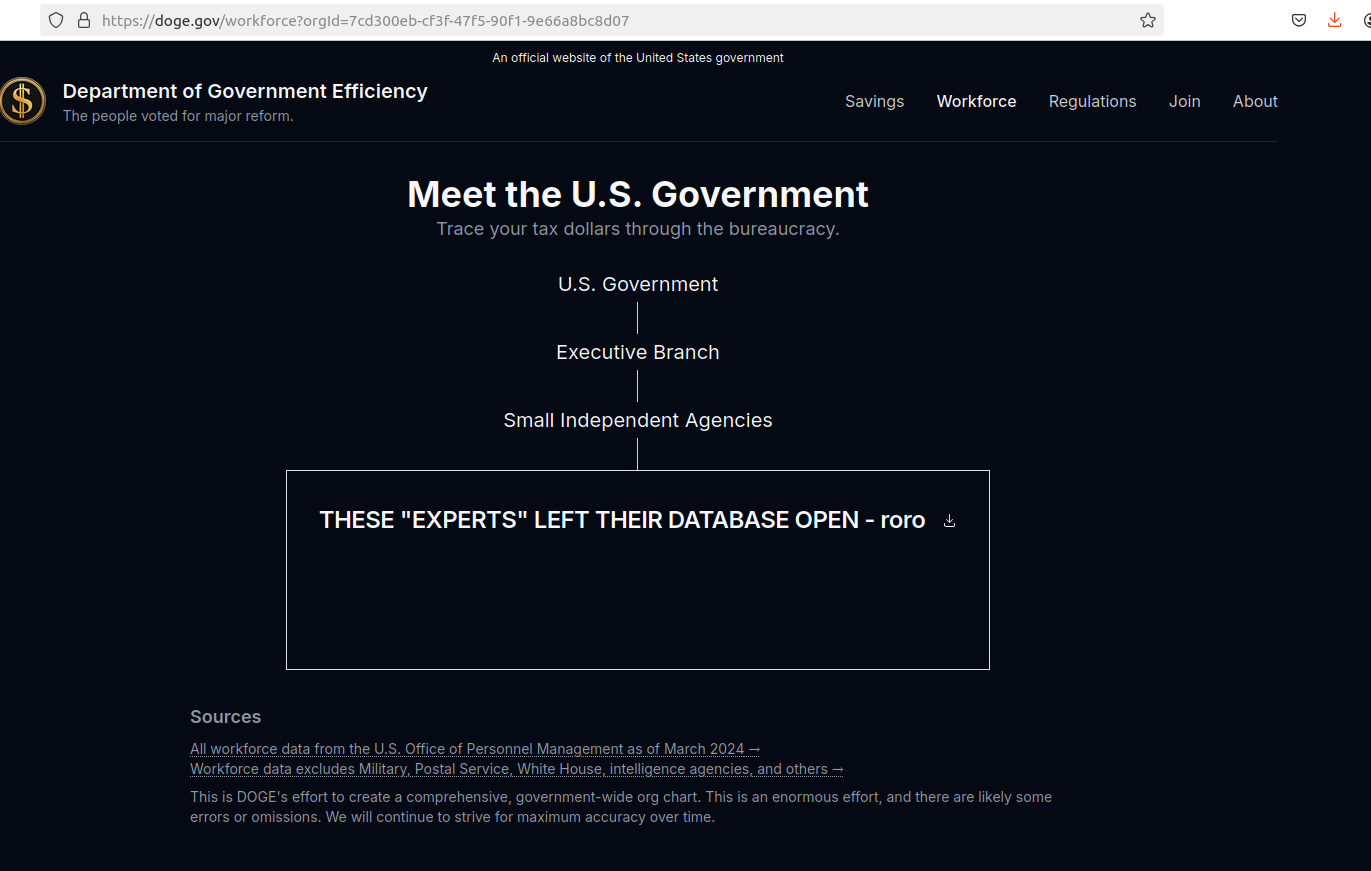
A screenshot of the DOGE website after it was defaced with the message: “These ‘experts’ left their database open – roro”

APPOINTMENTS

Trump’s efforts to grab federal agencies by their data has seen him replace career civil servants who refused to allow DOGE access to agency networks. CNN reports that Michelle King, acting commissioner of the Social Security Administration for more than 30 years, was shown the door after she denied DOGE access to sensitive information.

King was replaced by Leland Dudek, formerly a senior advisor in the SSA’s Office of Program Integrity. This week, Dudek posted a now-deleted message on LinkedIn acknowledging he had been placed on administrative leave for cooperating with DOGE.

“I confess,” Dudek wrote. “I bullied agency executives, shared executive contact information, and circumvented the chain of command to connect DOGE with the people who get stuff done. I confess. I asked where the fact was and is in our contracts so we can make the right tough choices.”
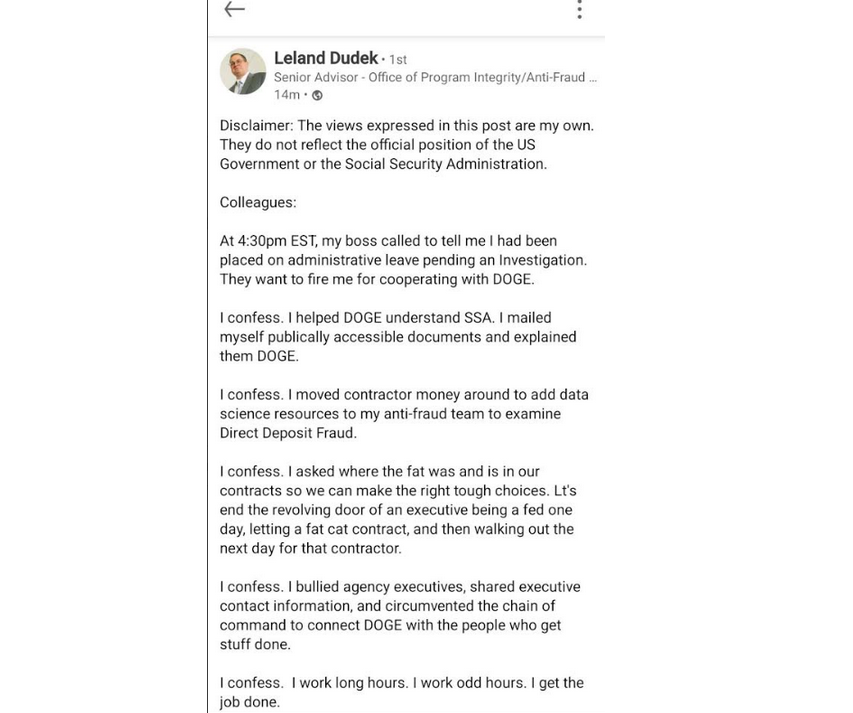
Dudek’s message on LinkedIn.

According to Wired, the National Institute of Standards and Technology (NIST) was also bracing this week for roughly 500 staffers to be fired, which could have serious impacts on NIST’s cybersecurity standards and software vulnerability tracking work.

“And cuts last week at the US Digital Service included the cybersecurity lead for the central Veterans Affairs portal, VA.gov, potentially leaving VA systems and data more vulnerable without someone in his role,” Wired’s Andy Greenberg and Lily Hay Newman wrote.

NextGov reports that Trump named the Department of Defense’s new chief information security officer: Katie Arrington, a former South Carolina state lawmaker who helped steer Pentagon cybersecurity contracting policy before being put on leave amid accusations that she disclosed classified data from a military intelligence agency.

NextGov notes that the National Security Agency suspended her clearance in 2021, although the exact reasons that led to the suspension and her subsequent leave were classified. Arrington argued that the suspension was a politically motivated effort to silence her.

Trump also appointed the former chief operating officer of the Republican National Committee as the new head of the Office of National Cyber Director. Sean Cairncross, who has no formal experience in technology or security, will be responsible for coordinating national cybersecurity policy, advising the president on cyber threats, and ensuring a unified federal response to emerging cyber-risks, Politico writes.

DarkReading reports that Cairncross would share responsibility for advising the president on cyber matters, along with the director of cyber at the White House National Security Council (NSC) — a group that advises the president on all matters security related, and not just cyber.

CONSUMER PROTECTION?

The president also ordered staffers at the Consumer Financial Protection Bureau (CFPB) to stop most work. Created by Congress in 2011 to be a clearinghouse of consumer complaints, the CFPB has sued some of the nation’s largest financial institutions for violating consumer protection laws.

The CFPB says its actions have put nearly $18 billion back in Americans’ pockets in the form of monetary compensation or canceled debts, and imposed $4 billion in civil money penalties against violators. The CFPB’s homepage has featured a “404: Page not found” error for weeks now.

Trump has appointed Russell Vought, the architect of the conservative policy playbook Project 2025, to be the CFPB’s acting director. Vought has publicly favored abolishing the agency, as has Elon Musk, whose efforts to remake X into a payments platform would otherwise be regulated by the CFPB.

The New York Times recently published a useful graphic showing all of the government staffing changes, including the firing of several top officials, affecting agencies with federal investigations into or regulatory battles with Musk’s companies. Democrats on the House Judiciary Committee also have released a comprehensive account (PDF) of Musk’s various conflicts of interest.
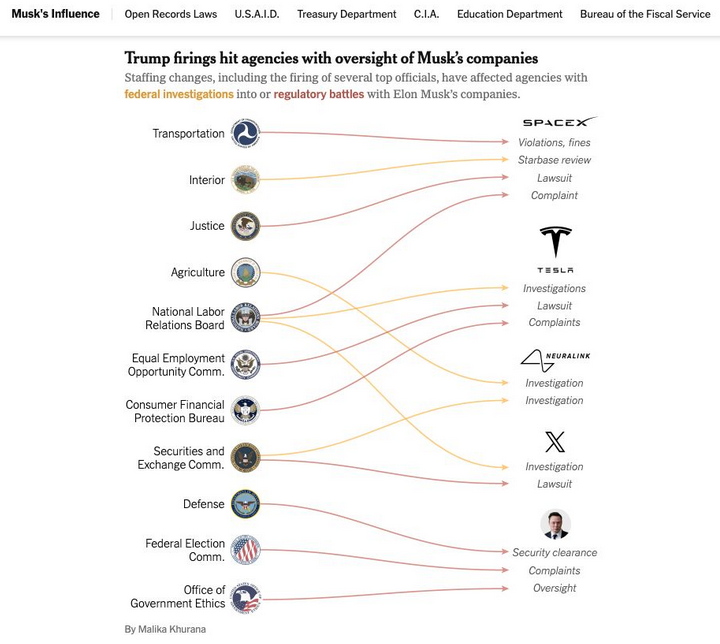
Image: nytimes.com

As the Times notes, Musk and his companies have repeatedly failed to comply with federal reporting protocols aimed at protecting state secrets, and these failures have prompted at least three federal reviews. Those include an inquiry launched last year by the Defense Department’s Office of Inspector General. Four days after taking office, Trump fired the DoD inspector general along with 17 other inspectors general.

The Trump administration also shifted the enforcement priorities of the U.S. Securities and Exchange Commission (SEC) away from prosecuting misconduct in the cryptocurrency sector, reassigning lawyers and renaming the unit to focus more on “cyber and emerging technologies.”

Reuters reports that the former SEC chair Gary Gensler made fighting misconduct in a sector he termed the “wild west” a priority for the agency, targeting not only cryptocurrency fraudsters but also the large firms that facilitate trading such as Coinbase.

On Friday, Coinbase said the SEC planned to withdraw its lawsuit against the crypto exchange. Also on Friday, the cryptocurrency exchange Bybit announced on X that a cybersecurity breach led to the theft of more than $1.4 billion worth of cryptocurrencies — making it the largest crypto heist ever.

ORGANIZED CRIME AND CORRUPTION

On Feb. 10, Trump ordered executive branch agencies to stop enforcing the U.S. Foreign Corrupt Practices Act, which froze foreign bribery investigations, and even allows for “remedial actions” of past enforcement actions deemed “inappropriate.”

Trump’s action also disbanded the Kleptocracy Asset Recovery Initiative and KleptoCapture Task Force — units which proved their value in corruption cases and in seizing the assets of sanctioned Russian oligarchs — and diverted resources away from investigating white-collar crime.

That’s according to the independent Organized Crime and Corruption Reporting Project (OCCRP), an investigative journalism outlet that until very recently was funded in part by the U.S. Agency for International Development (USAID).

The OCCRP lost nearly a third of its funding and was forced to lay off 43 reporters and staff after Trump moved to shutter USAID and freeze its spending. NBC News reports the Trump administration plans to gut the agency and leave fewer than 300 staffers on the job out of the current 8,000 direct hires and contractors.

The Global Investigative Journalism Network wrote this week that the sudden hold on USAID foreign assistance funding has frozen an estimated $268 million in agreed grants for independent media and the free flow of information in more than 30 countries — including several under repressive regimes.

Elon Musk has called USAID “a criminal organization” without evidence, and promoted fringe theories on his social media platform X that the agency operated without oversight and was rife with fraud. Just months before the election, USAID’s Office of Inspector General announced an investigation into USAID’s oversight of Starlink satellite terminals provided to the government of Ukraine.

KrebsOnSecurity this week heard from a trusted source that all outgoing email from USAID now carries a notation of “sensitive but unclassified,” a designation that experts say could make it more difficult for journalists and others to obtain USAID email records under the Freedom of Information Act (FOIA). On Feb. 20, Fedscoop reported also hearing the same thing from multiple sources, noting that the added message cannot be seen by senders until after the email is sent.

FIVE BULLETS

On Feb. 18, Trump issued an executive order declaring that only the U.S. attorney general and the president can provide authoritative interpretations of the law for the executive branch, and that this authority extends to independent agencies operating under the executive branch.

Trump is arguing that Article II, Clause 1 of the Constitution vests this power with the president. However, jurist.org writes that Article II does not expressly state the president or any other person in the executive branch has the power to interpret laws.

“The article states that the president is required to ‘take care that the laws be faithfully executed,’” Juris noted. “Jurisdiction to interpret laws and determine constitutionality belongs to the judicial branch under Article III. The framers of the Constitution designed the separation of duties to prevent any single branch of government from becoming too powerful.”

The executive order requires all agencies to submit to “performance standards and management objectives” to be established by the White House Office of Management and Budget, and to report periodically to the president.

Those performance metrics are already being requested: Employees at multiple federal agencies on Saturday reported receiving an email from the Office of Personnel Management ordering them to reply with a set of bullet points justifying their work for the past week.

“Please reply to this email with approx. 5 bullets of what you accomplished last week and cc your manager,” the notice read. “Please do not send any classified information, links, or attachments. Deadline is this Monday at 11:59 p.m. EST.”
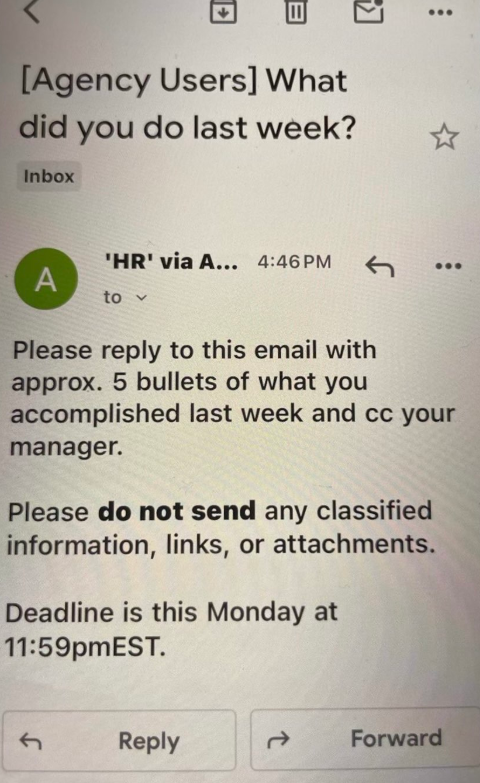
An email sent by the OPM to more than two million federal employees late in the afternoon EST on Saturday, Feb. 22.

In a social media post Saturday, Musk said the directive came at the behest of President Trump, and that failure to respond would be taken as a resignation. Meanwhile, Bloomberg writes the Department of Justice has been urging employees to hold off replying out of concern doing so could trigger ethics violations. The National Treasury Employees Union also is advising its employees not to respond.

A legal battle over Trump’s latest executive order is bound to join more than 70 other lawsuits currently underway to halt the administration’s efforts to massively reduce the size of the federal workforce through layoffs, firings and attrition.

KING TRUMP?

On Feb. 15, the president posted on social media, “He who saves his Country does not violate any Law,” citing a quote often attributed to the French dictator Napoleon Bonaparte. Four days later, Trump referred to himself as “the king” on social media, while the White House nonchalantly posted an illustration of him wearing a crown.

Trump has been publicly musing about running for an unconstitutional third-term in office, a statement that some of his supporters dismiss as Trump just trying to rile his liberal critics. However, just days after Trump began his second term, Rep. Andy Ogles (R-Tenn.) introduced a bill to amend the Constitution so that Trump — and any other future president — can be elected to serve a third term.

This week at the Conservative Political Action Conference (CPAC), Rep. Ogles reportedly led a group of Trump supporters calling itself the “Third Term Project,” which is trying to gain support for the bill from GOP lawmakers. The event featured images of Trump depicted as Caesar.

A banner at the CPAC conference this week in support of The Third Term Project, a group of conservatives trying to gain support for a bill to amend the Constitution and allow Trump to run for a third term.

Russia continues to be among the world’s top exporters of cybercrime, narcotics, money laundering, human trafficking, disinformation, war and death, and yet the Trump administration has suddenly broken with the Western world in normalizing relations with Moscow.

This week President Trump stunned U.S. allies by repeating Kremlin talking points that Ukraine is somehow responsible for Russia’s invasion, and that Ukrainian President Volodymyr Zelensky is a “dictator.” The president repeated these lies even as his administration is demanding that Zelensky give the United States half of his country’s mineral wealth in exchange for a promise that Russia will cease its territorial aggression there.

President Trump’s servility toward an actual dictatorRussian President Vladimir Putin — does not bode well for efforts to improve the cybersecurity of U.S. federal IT networks, or the private sector systems on which the government is largely reliant. In addition, this administration’s baffling moves to alienate, antagonize and sideline our closest allies could make it more difficult for the United States to secure their ongoing cooperation in cybercrime investigations.

It’s also startling how closely DOGE’s approach so far hews to tactics typically employed by ransomware gangs: A group of 20-somethings with names like “Big Balls” shows up on a weekend and gains access to your servers, deletes data, locks out key staff, takes your website down, and prevents you from serving customers.

When the federal executive starts imitating ransomware playbooks against its own agencies while Congress largely gazes on in either bewilderment or amusement, we’re in four-alarm fire territory. At least in theory, one can negotiate with ransomware purveyors.

from Krebs on Security https://ift.tt/tc1PRD9
via IFTTT

How Phished Data Turns into Apple & Google Wallets

Carding — the underground business of stealing, selling and swiping stolen payment card data — has long been the dominion of Russia-based hackers. Happily, the broad deployment of more secure chip-based payment cards in the United States has weakened the carding market. But a flurry of innovation from cybercrime groups in China is breathing new life into the carding industry, by turning phished card data into mobile wallets that can be used online and at main street stores.

An image from one Chinese phishing group’s Telegram channel shows various toll road phish kits available.

If you own a mobile phone, the chances are excellent that at some point in the past two years it has received at least one phishing message that spoofs the U.S. Postal Service to supposedly collect some outstanding delivery fee, or an SMS that pretends to be a local toll road operator warning of a delinquent toll fee.

These messages are being sent through sophisticated phishing kits sold by several cybercriminals based in mainland China. And they are not traditional SMS phishing or “smishing” messages, as they bypass the mobile networks entirely. Rather, the missives are sent through the Apple iMessage service and through RCS, the functionally equivalent technology on Google phones.

People who enter their payment card data at one of these sites will be told their financial institution needs to verify the small transaction by sending a one-time passcode to the customer’s mobile device. In reality, that code will be sent by the victim’s financial institution to verify that the user indeed wishes to link their card information to a mobile wallet.

If the victim then provides that one-time code, the phishers will link the card data to a new mobile wallet from Apple or Google, loading the wallet onto a mobile phone that the scammers control.

CARDING REINVENTED

Ford Merrill works in security research at SecAlliance, a CSIS Security Group company. Merrill has been studying the evolution of several China-based smishing gangs, and found that most of them feature helpful and informative video tutorials in their sales accounts on Telegram. Those videos show the thieves are loading multiple stolen digital wallets on a single mobile device, and then selling those phones in bulk for hundreds of dollars apiece.

“Who says carding is dead?,” said Merrill, who presented about his findings at the M3AAWG security conference in Lisbon earlier today. “This is the best mag stripe cloning device ever. This threat actor is saying you need to buy at least 10 phones, and they’ll air ship them to you.”

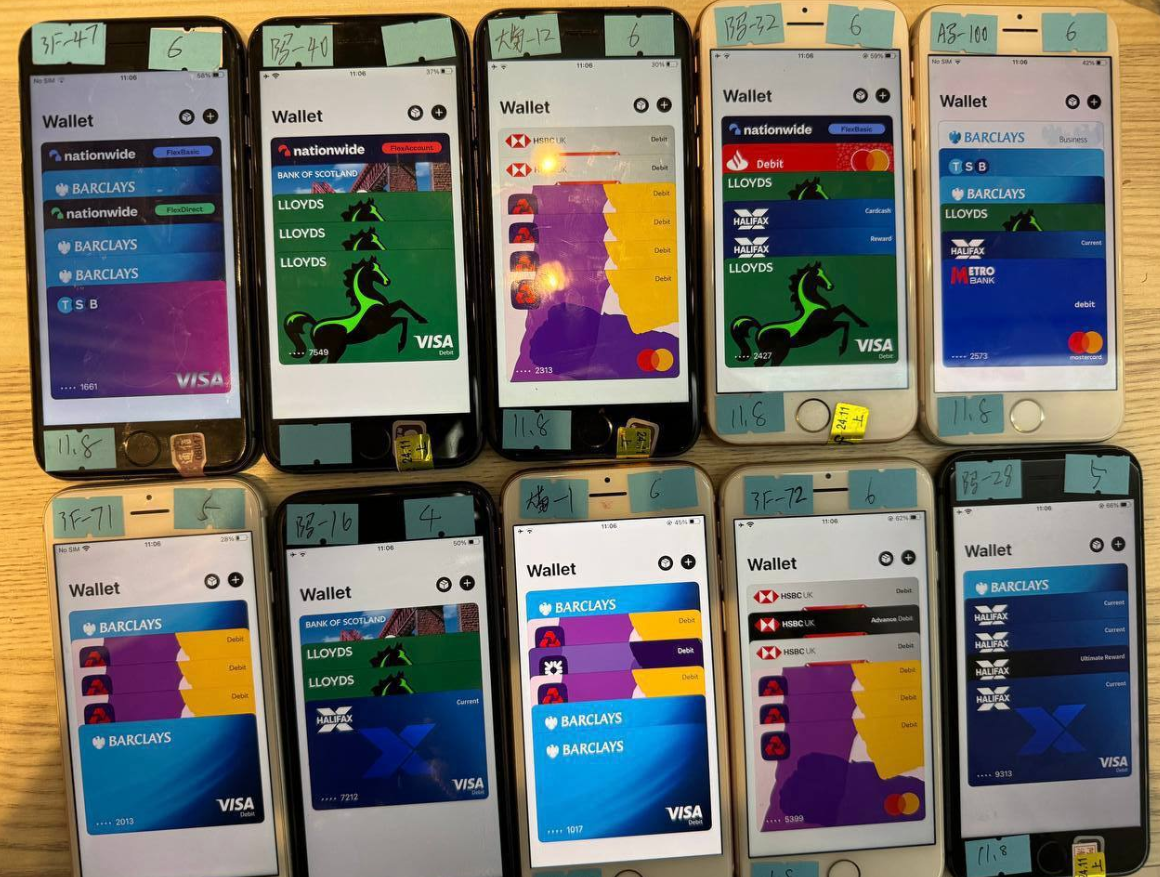
One promotional video shows stacks of milk crates stuffed full of phones for sale. A closer inspection reveals that each phone is affixed with a handwritten notation that typically references the date its mobile wallets were added, the number of wallets on the device, and the initials of the seller.

An image from the Telegram channel for a popular Chinese smishing kit vendor shows 10 mobile phones for sale, each loaded with 4-6 digital wallets from different UK financial institutions.

Merrill said one common way criminal groups in China are cashing out with these stolen mobile wallets involves setting up fake e-commerce businesses on Stripe or Zelle and running transactions through those entities — often for amounts totaling between $100 and $500.

Merrill said that when these phishing groups first began operating in earnest two years ago, they would wait between 60 to 90 days before selling the phones or using them for fraud. But these days that waiting period is more like just seven to ten days, he said.

“When they first installed this, the actors were very patient,” he said. “Nowadays, they only wait like 10 days before [the wallets] are hit hard and fast.”

GHOST TAP

Criminals also can cash out mobile wallets by obtaining real point-of-sale terminals and using tap-to-pay on phone after phone. But they also offer a more cutting-edge mobile fraud technology: Merrill found that at least one of the Chinese phishing groups sells an Android app called “ZNFC” that can relay a valid NFC transaction to anywhere in the world. The user simply waves their phone at a local payment terminal that accepts Apple or Google pay, and the app relays an NFC transaction over the Internet from a phone in China.

“The software can work from anywhere in the world,” Merrill said. “These guys provide the software for $500 a month, and it can relay both NFC enabled tap-to-pay as well as any digital wallet. The even have 24-hour support.”

The rise of so-called “ghost tap” mobile software was first documented in November 2024 by security experts at ThreatFabric. Andy Chandler, the company’s chief commercial officer, said their researchers have since identified a number of criminal groups from different regions of the world latching on to this scheme.

Chandler said those include organized crime gangs in Europe that are using similar mobile wallet and NFC attacks to take money out of ATMs made to work with smartphones.

“No one is talking about it, but we’re now seeing ten different methodologies using the same modus operandi, and none of them are doing it the same,” Chandler said. “This is much bigger than the banks are prepared to say.”

A November 2024 story in the Singapore daily The Straits Times reported authorities there arrested three foreign men who were recruited in their home countries via social messaging platforms, and given ghost tap apps with which to purchase expensive items from retailers, including mobile phones, jewelry, and gold bars.

“Since Nov 4, at least 10 victims who had fallen for e-commerce scams have reported unauthorised transactions totaling more than $100,000 on their credit cards for purchases such as electronic products, like iPhones and chargers, and jewelry in Singapore,” The Straits Times wrote, noting that in another case with a similar modus operandi, the police arrested a Malaysian man and woman on Nov 8.

Three individuals charged with using ghost tap software at an electronics store in Singapore. Image: The Straits Times.

ADVANCED PHISHING TECHNIQUES

According to Merrill, the phishing pages that spoof the USPS and various toll road operators are powered by several innovations designed to maximize the extraction of victim data.

For example, a would-be smishing victim might enter their personal and financial information, but then decide the whole thing is scam before actually submitting the data. In this case, anything typed into the data fields of the phishing page will be captured in real time, regardless of whether the visitor actually clicks the “submit” button.

Merrill said people who submit payment card data to these phishing sites often are then told their card can’t be processed, and urged to use a different card. This technique, he said, sometimes allows the phishers to steal more than one mobile wallet per victim.

Many phishing websites expose victim data by storing the stolen information directly on the phishing domain. But Merrill said these Chinese phishing kits will forward all victim data to a back-end database operated by the phishing kit vendors. That way, even when the smishing sites get taken down for fraud, the stolen data is still safe and secure.

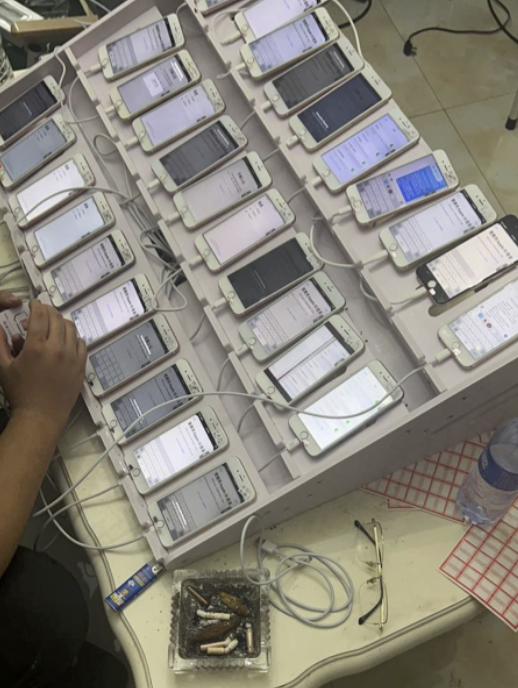
Another important innovation is the use of mass-created Apple and Google user accounts through which these phishers send their spam messages. One of the Chinese phishing groups posted images on their Telegram sales channels showing how these robot Apple and Google accounts are loaded onto Apple and Google phones, and arranged snugly next to each other in an expansive, multi-tiered rack that sits directly in front of the phishing service operator.

The ashtray says: You’ve been phishing all night.

In other words, the smishing websites are powered by real human operators as long as new messages are being sent. Merrill said the criminals appear to send only a few dozen messages at a time, likely because completing the scam takes manual work by the human operators in China. After all, most one-time codes used for mobile wallet provisioning are generally only good for a few minutes before they expire.

Notably, none of the phishing sites spoofing the toll operators or postal services will load in a regular Web browser; they will only render if they detect that a visitor is coming from a mobile device.

“One of the reasons they want you to be on a mobile device is they want you to be on the same device that is going to receive the one-time code,” Merrill said. “They also want to minimize the chances you will leave. And if they want to get that mobile tokenization and grab your one-time code, they need a live operator.”

Merrill found the Chinese phishing kits feature another innovation that makes it simple for customers to turn stolen card details into a mobile wallet: They programmatically take the card data supplied by the phishing victim and convert it into a digital image of a real payment card that matches that victim’s financial institution. That way, attempting to enroll a stolen card into Apple Pay, for example, becomes as easy as scanning the fabricated card image with an iPhone.

An ad from a Chinese SMS phishing group’s Telegram channel showing how the service converts stolen card data into an image of the stolen card.

“The phone isn’t smart enough to know whether it’s a real card or just an image,” Merrill said. “So it scans the card into Apple Pay, which says okay we need to verify that you’re the owner of the card by sending a one-time code.”

PROFITS

How profitable are these mobile phishing kits? The best guess so far comes from data gathered by other security researchers who’ve been tracking these advanced Chinese phishing vendors.

In August 2023, the security firm Resecurity discovered a vulnerability in one popular Chinese phish kit vendor’s platform that exposed the personal and financial data of phishing victims. Resecurity dubbed the group the Smishing Triad, and found the gang had harvested 108,044 payment cards across 31 phishing domains (3,485 cards per domain).

In August 2024, security researcher Grant Smith gave a presentation at the DEFCON security conference about tracking down the Smishing Triad after scammers spoofing the U.S. Postal Service duped his wife. By identifying a different vulnerability in the gang’s phishing kit, Smith said he was able to see that people entered 438,669 unique credit cards in 1,133 phishing domains (387 cards per domain).

Based on his research, Merrill said it’s reasonable to expect between $100 and $500 in losses on each card that is turned into a mobile wallet. Merrill said they observed nearly 33,000 unique domains tied to these Chinese smishing groups during the year between the publication of Resecurity’s research and Smith’s DEFCON talk.

Using a median number of 1,935 cards per domain and a conservative loss of $250 per card, that comes out to about $15 billion in fraudulent charges over a year.

Merrill was reluctant to say whether he’d identified additional security vulnerabilities in any of the phishing kits sold by the Chinese groups, noting that the phishers quickly fixed the vulnerabilities that were detailed publicly by Resecurity and Smith.

FIGHTING BACK

Adoption of touchless payments took off in the United States after the Coronavirus pandemic emerged, and many financial institutions in the United States were eager to make it simple for customers to link payment cards to mobile wallets. Thus, the authentication requirement for doing so defaulted to sending the customer a one-time code via SMS.

Experts say the continued reliance on one-time codes for onboarding mobile wallets has fostered this new wave of carding. KrebsOnSecurity interviewed a security executive from a large European financial institution who spoke on condition of anonymity because they were not authorized to speak to the press.

That expert said the lag between the phishing of victim card data and its eventual use for fraud has left many financial institutions struggling to correlate the causes of their losses.

“That’s part of why the industry as a whole has been caught by surprise,” the expert said. “A lot of people are asking, how this is possible now that we’ve tokenized a plaintext process. We’ve never seen the volume of sending and people responding that we’re seeing with these phishers.”

To improve the security of digital wallet provisioning, some banks in Europe and Asia require customers to log in to the bank’s mobile app before they can link a digital wallet to their device.

Addressing the ghost tap threat may require updates to contactless payment terminals, to better identify NFC transactions that are being relayed from another device. But experts say it’s unrealistic to expect retailers will be eager to replace existing payment terminals before their expected lifespans expire.

And of course Apple and Google have an increased role to play as well, given that their accounts are being created en masse and used to blast out these smishing messages. Both companies could easily tell which of their devices suddenly have 7-10 different mobile wallets added from 7-10 different people around the world. They could also recommend that financial institutions use more secure authentication methods for mobile wallet provisioning.

Neither Apple nor Google responded to requests for comment on this story.

from Krebs on Security https://ift.tt/28d4OVz
via IFTTT

Nearly a Year Later, Mozilla is Still Promoting OneRep

In mid-March 2024, KrebsOnSecurity revealed that the founder of the personal data removal service Onerep also founded dozens of people-search companies. Shortly after that investigation was published, Mozilla said it would stop bundling Onerep with the Firefox browser and wind down its partnership with the company. But nearly a year later, Mozilla is still promoting it to Firefox users.

Mozilla offers Onerep to Firefox users on a subscription basis as part of Mozilla Monitor Plus. Launched in 2018 under the name Firefox Monitor, Mozilla Monitor also checks data from the website Have I Been Pwned? to let users know when their email addresses or password are leaked in data breaches.

The ink on that partnership agreement had barely dried before KrebsOnSecurity published a story showing that Onerep’s Belarusian CEO and founder Dimitiri Shelest launched dozens of people-search services since 2010, including a still-active data broker called Nuwber that sells background reports on people. This seemed to contradict Onerep’s stated motto, “We believe that no one should compromise personal online security and get a profit from it.”

Shelest released a lengthy statement (PDF) wherein he acknowledged maintaining an ownership stake in Nuwber, a consumer data broker he founded in 2015 — around the same time he started Onerep.

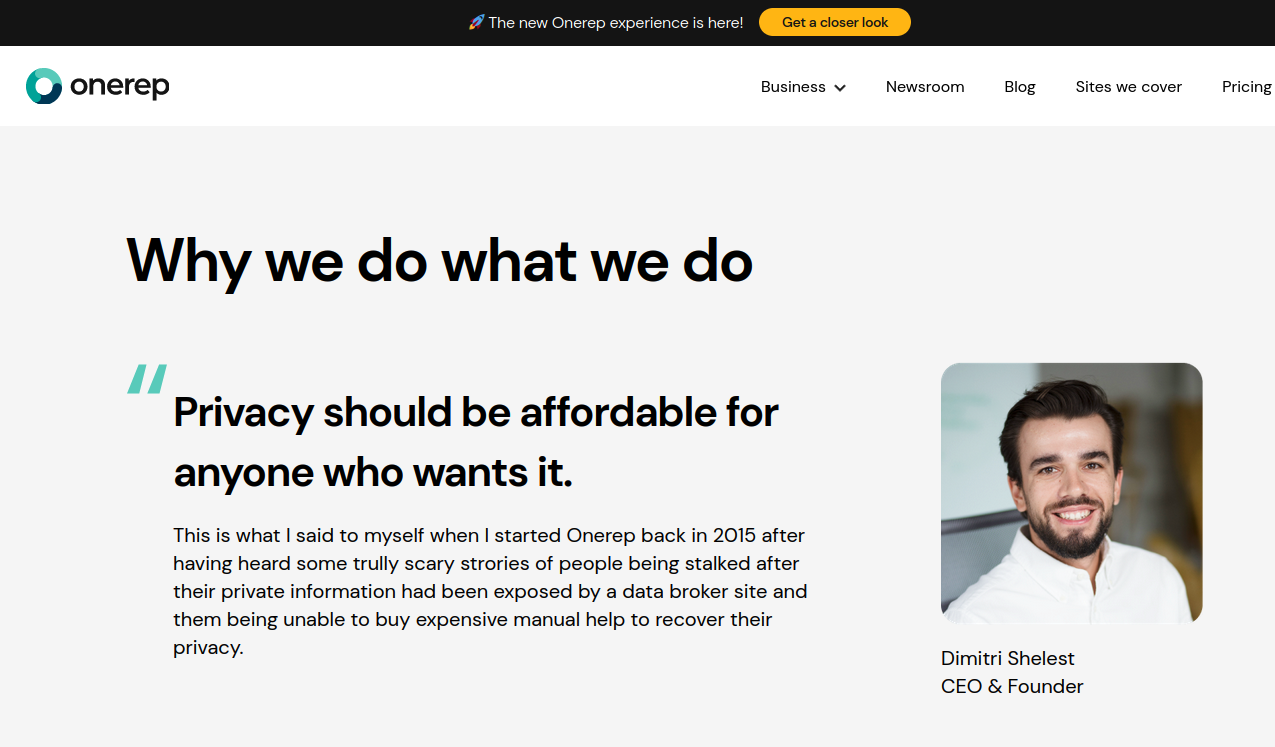
Onerep.com CEO and founder Dimitri Shelest, as pictured on the “about” page of onerep.com.

Shelest maintained that Nuwber has “zero cross-over or information-sharing with Onerep,” and said any other old domains that may be found and associated with his name are no longer being operated by him.

“I get it,” Shelest wrote. “My affiliation with a people search business may look odd from the outside. In truth, if I hadn’t taken that initial path with a deep dive into how people search sites work, Onerep wouldn’t have the best tech and team in the space. Still, I now appreciate that we did not make this more clear in the past and I’m aiming to do better in the future.”

When asked to comment on the findings, Mozilla said then that although customer data was never at risk, the outside financial interests and activities of Onerep’s CEO did not align with their values.

“We’re working now to solidify a transition plan that will provide customers with a seamless experience and will continue to put their interests first,” Mozilla said.

In October 2024, Mozilla published a statement saying the search for a different provider was taking longer than anticipated.

“While we continue to evaluate vendors, finding a technically excellent and values-aligned partner takes time,” Mozilla wrote. “While we continue this search, Onerep will remain the backend provider, ensuring that we can maintain uninterrupted services while we continue evaluating new potential partners that align more closely with Mozilla’s values and user expectations. We are conducting thorough diligence to find the right vendor.”

Asked for an update, Mozilla said the search for a replacement partner continues.

“The work’s ongoing but we haven’t found the right alternative yet,” Mozilla said in an emailed statement. “Our customers’ data remains safe, and since the product provides a lot of value to our subscribers, we’ll continue to offer it during this process.”

It’s a win-win for Mozilla that they’ve received accolades for their principled response while continuing to partner with Onerep almost a year later. But if it takes so long to find a suitable replacement, what does that say about the personal data removal industry itself?

Onerep appears to be working in partnership with another problematic people-search service: Radaris, which has a history of ignoring opt-out requests or failing to honor them. A week before breaking the story about Onerep, KrebsOnSecurity published research showing the co-founders of Radaris were two native Russian brothers who’d built a vast network of affiliate marketing programs and consumer data broker services.

Lawyers for the Radaris co-founders threatened to sue KrebsOnSecurity unless that story was retracted in full, claiming the founders were in fact Ukrainian and that our reporting had defamed the brothers by associating them with the actions of Radaris. Instead, we published a follow-up investigation which showed that not only did the brothers from Russia create Radaris, for many years they issued press releases quoting a fictitious CEO seeking money from investors.

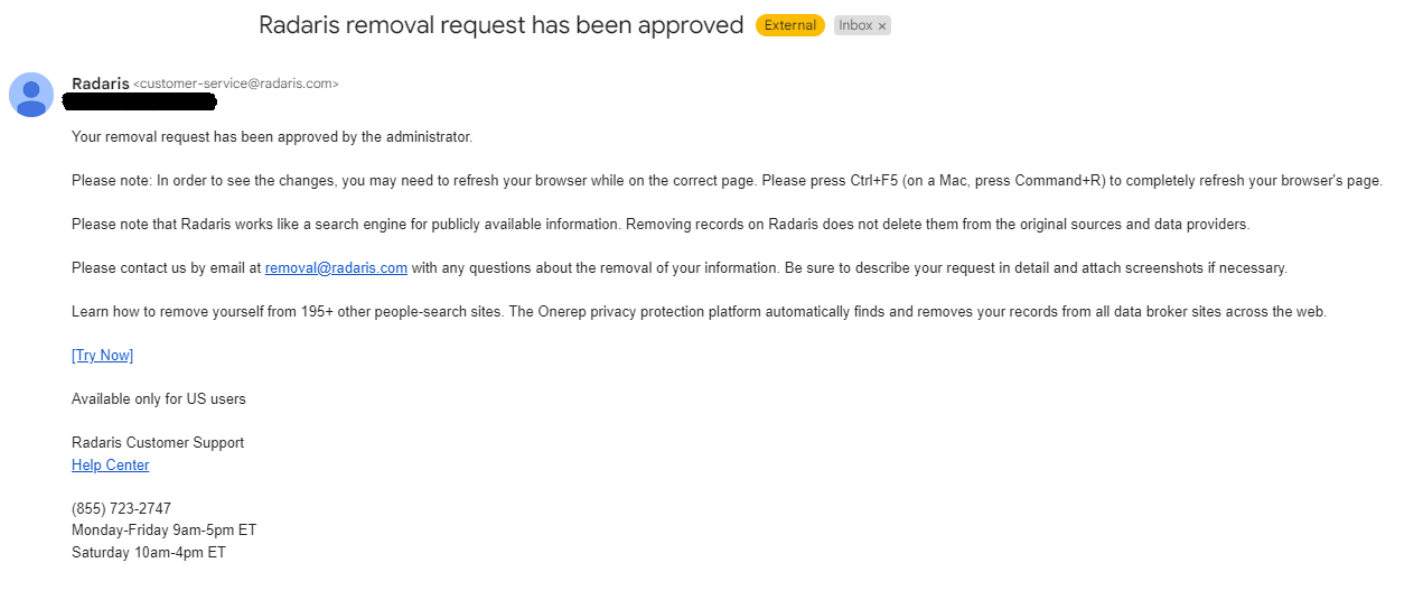
Several readers have shared emails they received from Radaris after attempting to remove their personal data, and those messages show Radaris has been promoting Onerep.

An email from Radaris promoting Onerep.

from Krebs on Security https://ift.tt/BMCbckh
via IFTTT

Microsoft Patch Tuesday, February 2025 Edition

Microsoft today issued security updates to fix at least 56 vulnerabilities in its Windows operating systems and supported software, including two zero-day flaws that are being actively exploited.

All supported Windows operating systems will receive an update this month for a buffer overflow vulnerability that carries the catchy name CVE-2025-21418. This patch should be a priority for enterprises, as Microsoft says it is being exploited, has low attack complexity, and no requirements for user interaction.

Tenable senior staff research engineer Satnam Narang noted that since 2022, there have been nine elevation of privilege vulnerabilities in this same Windows component — three each year — including one in 2024 that was exploited in the wild as a zero day (CVE-2024-38193).

“CVE-2024-38193 was exploited by the North Korean APT group known as Lazarus Group to implant a new version of the FudModule rootkit in order to maintain persistence and stealth on compromised systems,” Narang said. “At this time, it is unclear if CVE-2025-21418 was also exploited by Lazarus Group.”

The other zero-day, CVE-2025-21391, is an elevation of privilege vulnerability in Windows Storage that could be used to delete files on a targeted system. Microsoft’s advisory on this bug references something called “CWE-59: Improper Link Resolution Before File Access,” says no user interaction is required, and that the attack complexity is low.

Adam Barnett, lead software engineer at Rapid7, said although the advisory provides scant detail, and even offers some vague reassurance that ‘an attacker would only be able to delete targeted files on a system,’ it would be a mistake to assume that the impact of deleting arbitrary files would be limited to data loss or denial of service.

“As long ago as 2022, ZDI researchers set out how a motivated attacker could parlay arbitrary file deletion into full SYSTEM access using techniques which also involve creative misuse of symbolic links,”Barnett wrote.

One vulnerability patched today that was publicly disclosed earlier is CVE-2025-21377, another weakness that could allow an attacker to elevate their privileges on a vulnerable Windows system. Specifically, this is yet another Windows flaw that can be used to steal NTLMv2 hashes — essentially allowing an attacker to authenticate as the targeted user without having to log in.

According to Microsoft, minimal user interaction with a malicious file is needed to exploit CVE-2025-21377, including selecting, inspecting or “performing an action other than opening or executing the file.”

“This trademark linguistic ducking and weaving may be Microsoft’s way of saying ‘if we told you any more, we’d give the game away,’” Barnett said. “Accordingly, Microsoft assesses exploitation as more likely.”

The SANS Internet Storm Center has a handy list of all the Microsoft patches released today, indexed by severity. Windows enterprise administrators would do well to keep an eye on askwoody.com, which often has the scoop on any patches causing problems.

It’s getting harder to buy Windows software that isn’t also bundled with Microsoft’s flagship Copilot artificial intelligence (AI) feature. Last month Microsoft started bundling Copilot with Microsoft Office 365, which Redmond has since rebranded as “Microsoft 365 Copilot.” Ostensibly to offset the costs of its substantial AI investments, Microsoft also jacked up prices from 22 percent to 30 percent for upcoming license renewals and new subscribers.

Office-watch.com writes that existing Office 365 users who are paying an annual cloud license do have the option of “Microsoft 365 Classic,” an AI-free subscription at a lower price, but that many customers are not offered the option until they attempt to cancel their existing Office subscription.

In other security patch news, Apple has shipped iOS 18.3.1, which fixes a zero day vulnerability (CVE-2025-24200) that is showing up in attacks.

Adobe has issued security updates that fix a total of 45 vulnerabilities across InDesign, Commerce, Substance 3D Stager, InCopy, Illustrator, Substance 3D Designer and Photoshop Elements.

Chris Goettl at Ivanti notes that Google Chrome is shipping an update today which will trigger updates for Chromium based browsers including Microsoft Edge, so be on the lookout for Chrome and Edge updates as we proceed through the week.

from Krebs on Security https://ift.tt/St6EH8u
via IFTTT

Teen on Musk’s DOGE Team Graduated from ‘The Com’

Wired reported this week that a 19-year-old working for Elon Musk‘s so-called Department of Government Efficiency (DOGE) was given access to sensitive US government systems even though his past association with cybercrime communities should have precluded him from gaining the necessary security clearances to do so. As today’s story explores, the DOGE teen is a former denizen of ‘The Com,’ an archipelago of Discord and Telegram chat channels that function as a kind of distributed cybercriminal social network for facilitating instant collaboration.

Since President Trump’s second inauguration, Musk’s DOGE team has gained access to a truly staggering amount of personal and sensitive data on American citizens, moving quickly to seize control over databases at the U.S. Treasury, the Office of Personnel Management, the Department of Education, and the Department of Health and Human Resources, among others.

Wired first reported on Feb. 2 that one of the young technologists on Musk’s crew is a 19-year-old high school graduate named Edward Coristine, who reportedly goes by the nickname “Big Balls” online. One of the companies Coristine founded, Tesla.Sexy LLC, was set up in 2021, when he would have been around 16 years old.

“Tesla.Sexy LLC controls dozens of web domains, including at least two Russian-registered domains,” Wired reported. “One of those domains, which is still active, offers a service called Helfie, which is an AI bot for Discord servers targeting the Russian market. While the operation of a Russian website would not violate US sanctions preventing Americans doing business with Russian companies, it could potentially be a factor in a security clearance review.”

Mr. Coristine has not responded to requests for comment. In a follow-up story this week, Wired found that someone using a Telegram handle tied to Coristine solicited a DDoS-for-hire service in 2022, and that he worked for a short time at a company that specializes in protecting customers from DDoS attacks.

A profile photo from Coristine’s WhatsApp account.

Internet routing records show that Coristine runs an Internet service provider called Packetware (AS400495). Also known as “DiamondCDN,” Packetware currently hosts tesla[.]sexy and diamondcdn[.]com, among other domains.

DiamondCDN was advertised and claimed by someone who used the nickname “Rivage” on several Com-based Discord channels over the years. A review of chat logs from some of those channels show other members frequently referred to Rivage as “Edward.”

From late 2020 to late 2024, Rivage’s conversations would show up in multiple Com chat servers that are closely monitored by security companies. In November 2022, Rivage could be seen requesting recommendations for a reliable and powerful DDoS-for-hire service.

Rivage made that request in the cybercrime channel “Dstat,” a core Com hub where users could buy and sell attack services. Dstat’s website dstat[.]cc was seized in 2024 as part of “Operation PowerOFF,” an international law enforcement action against DDoS services.

Coristine’s LinkedIn profile said that in 2022 he worked at an anti-DDoS company called Path Networks, which Wired generously described as a “network monitoring firm known for hiring reformed blackhat hackers.” Wired wrote:

“At Path Network, Coristine worked as a systems engineer from April to June of 2022, according to his now-deleted LinkedIn résumé. Path has at times listed as employees Eric Taylor, also known as Cosmo the God, a well-known former cybercriminal and member of the hacker group UGNazis, as well as Matthew Flannery, an Australian convicted hacker whom police allege was a member of the hacker group LulzSec. It’s unclear whether Coristine worked at Path concurrently with those hackers, and WIRED found no evidence that either Coristine or other Path employees engaged in illegal activity while at the company.”

The founder of Path is a young man named Marshal Webb. I wrote about Webb back in 2016, in a story about a DDoS defense company he co-founded called BackConnect Security LLC. On September 20, 2016, KrebsOnSecurity published data showing that the company had a history of hijacking Internet address space that belonged to others.

Less than 24 hours after that story ran, KrebsOnSecurity.com was hit with the biggest DDoS attack the Internet had ever seen at the time. That sustained attack kept this site offline for nearly 4 days.

The other founder of BackConnect Security LLC was Tucker Preston, a Georgia man who pleaded guilty in 2020 to paying a DDoS-for-hire service to launch attacks against others.

The aforementioned Path employee Eric Taylor pleaded guilty in 2017 to charges including an attack on our home in 2013. Taylor was among several men involved in making a false report to my local police department about a supposed hostage situation at our residence in Virginia. In response, a heavily-armed police force surrounded my home and put me in handcuffs at gunpoint before the police realized it was all a dangerous hoax known as “swatting.”

CosmoTheGod rocketed to Internet infamy in 2013 when he and a number of other hackers set up the Web site exposed[dot]su, which “doxed” dozens of public officials and celebrities by publishing the address, Social Security numbers and other personal information on the former First Lady Michelle Obama, the then-director of the FBI and the U.S. attorney general, among others. The group also swatted many of the people they doxed.

Wired noted that Coristine only worked at Path for a few months in 2022, but the story didn’t mention why his tenure was so short. A screenshot shared on the website pathtruths.com includes a snippet of conversations in June 2022 between Path employees discussing Coristine’s firing.

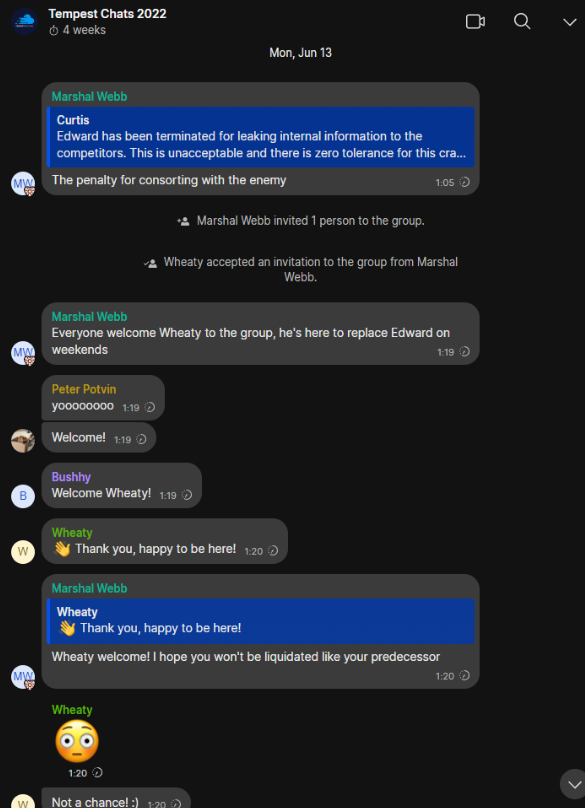
According to that record, Path founder Marshal Webb dismissed Coristine for making it known that one of its technicians was a Canadian man named Curtis Gervais who was convicted in 2017 of perpetrating dozens of swatting attacks and fake bomb threats — including at least two attempts against our home in 2014.

A snippet of text from an internal Path chat room, wherein members discuss the reason for Coristine’s termination: Allegedly, leaking internal company information. Source: Pathtruths.com.

On May 11, 2024, Rivage posted on a Discord channel for a DDoS protection service that is chiefly marketed to members of The Com. Rivage expressed frustration with his time spent on Com-based communities, suggesting that its profitability had been oversold.

“I don’t think there’s a lot of money to be made in the com,” Rivage lamented. “I’m not buying Heztner [servers] to set up some com VPN.”

Rivage largely stopped posting messages on Com channels after that. Wired reports that Coristine subsequently spent three months last summer working at Neuralink, Elon Musk’s brain implant startup.

The trouble with all this is that even if someone sincerely intends to exit The Com after years of consorting with cybercriminals, they are often still subject to personal attacks, harassment and hacking long after they have left the scene.

That’s because a huge part of Com culture involves harassing, swatting and hacking other members of the community. These internecine attacks are often for financial gain, but just as frequently they are perpetrated by cybercrime groups to exact retribution from or assert dominance over rival gangs.

Experts say it is extremely difficult for former members of violent street gangs to gain a security clearance needed to view sensitive or classified information held by the U.S. government. That’s because ex-gang members are highly susceptible to extortion and coercion from current members of the same gang, and that alone presents an unacceptable security risk for intelligence agencies.

And make no mistake: The Com is the English-language cybercriminal hacking equivalent of a violent street gang. KrebsOnSecurity has published numerous stories detailing how feuds within the community periodically spill over into real-world violence.

When Coristine’s name surfaced in Wired‘s report this week, members of The Com immediately took notice. In the following segment from a February 5, 2025 chat in a Com-affiliated hosting provider, members criticized Rivage’s skills, and discussed harassing his family and notifying authorities about incriminating accusations that may or may not be true.

2025-02-05 16:29:44 UTC vperked#0 they got this nigga on indiatimes man
2025-02-05 16:29:46 UTC alexaloo#0 Their cropping is worse than AI could have done
2025-02-05 16:29:48 UTC hebeatsme#0 bro who is that
2025-02-05 16:29:53 UTC hebeatsme#0 yalla re talking about
2025-02-05 16:29:56 UTC xewdy#0 edward
2025-02-05 16:29:56 UTC .yarrb#0 rivagew
2025-02-05 16:29:57 UTC vperked#0 Rivarge
2025-02-05 16:29:57 UTC xewdy#0 diamondcdm
2025-02-05 16:29:59 UTC vperked#0 i cant spell it
2025-02-05 16:30:00 UTC hebeatsme#0 rivage
2025-02-05 16:30:08 UTC .yarrb#0 yes
2025-02-05 16:30:14 UTC hebeatsme#0 i have him added
2025-02-05 16:30:20 UTC hebeatsme#0 hes on discord still
2025-02-05 16:30:47 UTC .yarrb#0 hes focused on stroking zaddy elon
2025-02-05 16:30:47 UTC vperked#0 https://ift.tt/GfZ1kjR
2025-02-05 16:30:50 UTC vperked#0 no fucking way
2025-02-05 16:30:53 UTC vperked#0 they even made a wiki for him
2025-02-05 16:30:55 UTC vperked#0 LOOOL
2025-02-05 16:31:05 UTC hebeatsme#0 no way
2025-02-05 16:31:08 UTC hebeatsme#0 hes not a good dev either
2025-02-05 16:31:14 UTC hebeatsme#0 like????
2025-02-05 16:31:22 UTC hebeatsme#0 has to be fake
2025-02-05 16:31:24 UTC xewdy#0 and theyre saying ts
2025-02-05 16:31:29 UTC xewdy#0 like ok bro
2025-02-05 16:31:51 UTC .yarrb#0 now i wanna know what all the other devs are like…
2025-02-05 16:32:00 UTC vperked#0 “`Coristine used the moniker “bigballs” on LinkedIn and @Edwardbigballer on Twitter, according to The Daily Dot.[“`
2025-02-05 16:32:05 UTC vperked#0 LOL
2025-02-05 16:32:06 UTC hebeatsme#0 lmfaooo
2025-02-05 16:32:07 UTC vperked#0 bro
2025-02-05 16:32:10 UTC hebeatsme#0 bro
2025-02-05 16:32:17 UTC hebeatsme#0 has to be fake right
2025-02-05 16:32:22 UTC .yarrb#0 does it mention Rivage?
2025-02-05 16:32:23 UTC xewdy#0 He previously worked for NeuraLink, a brain computer interface company led by Elon Musk
2025-02-05 16:32:26 UTC xewdy#0 bro what
2025-02-05 16:32:27 UTC alexaloo#0 I think your current occupation gives you a good insight of what probably goes on
2025-02-05 16:32:29 UTC hebeatsme#0 bullshit man
2025-02-05 16:32:33 UTC xewdy#0 this nigga got hella secrets
2025-02-05 16:32:37 UTC hebeatsme#0 rivage couldnt print hello world
2025-02-05 16:32:42 UTC hebeatsme#0 if his life was on the line
2025-02-05 16:32:50 UTC xewdy#0 nigga worked for neuralink
2025-02-05 16:32:54 UTC hebeatsme#0 bullshit
2025-02-05 16:33:06 UTC Nashville Dispatch ##0000 ||@PD Ping||
2025-02-05 16:33:07 UTC hebeatsme#0 must have killed all those test pigs with some bugs
2025-02-05 16:33:24 UTC hebeatsme#0 ur telling me the rivage who failed to start a company
2025-02-05 16:33:28 UTC hebeatsme#0 https://cdn.camp
2025-02-05 16:33:32 UTC hebeatsme#0 who didnt pay for servers
2025-02-05 16:33:34 UTC hebeatsme#0 ?
2025-02-05 16:33:42 UTC hebeatsme#0 was too cheap
2025-02-05 16:33:44 UTC vperked#0 yes
2025-02-05 16:33:50 UTC hebeatsme#0 like??
2025-02-05 16:33:53 UTC hebeatsme#0 it aint adding up
2025-02-05 16:33:56 UTC alexaloo#0 He just needed to find his calling idiot.
2025-02-05 16:33:58 UTC alexaloo#0 He found it.
2025-02-05 16:33:59 UTC hebeatsme#0 bro
2025-02-05 16:34:01 UTC alexaloo#0 Cope in a river dude
2025-02-05 16:34:04 UTC hebeatsme#0 he cant make good money right
2025-02-05 16:34:08 UTC hebeatsme#0 doge is about efficiency
2025-02-05 16:34:11 UTC hebeatsme#0 he should make $1/he
2025-02-05 16:34:15 UTC hebeatsme#0 $1/hr
2025-02-05 16:34:25 UTC hebeatsme#0 and be whipped for better code
2025-02-05 16:34:26 UTC vperked#0 prolly makes more than us
2025-02-05 16:34:35 UTC vperked#0 with his dad too
2025-02-05 16:34:52 UTC hebeatsme#0 time to report him for fraud
2025-02-05 16:34:54 UTC hebeatsme#0 to donald trump
2025-02-05 16:35:04 UTC hebeatsme#0 rivage participated in sim swap hacks in 2018
2025-02-05 16:35:08 UTC hebeatsme#0 put that on his wiki
2025-02-05 16:35:10 UTC hebeatsme#0 thanks
2025-02-05 16:35:15 UTC hebeatsme#0 and in 2021
2025-02-05 16:35:17 UTC hebeatsme#0 thanks
2025-02-05 16:35:19 UTC chainofcommand#0 i dont think they’ll care tbh

Given the speed with which Musk’s DOGE team was allowed access to such critical government databases, it strains credulity that Coristine could have been properly cleared beforehand. After all, he’d recently been dismissed from a job for allegedly leaking internal company information to outsiders.

According to the national security adjudication guidelines (PDF) released by the Director of National Intelligence (DNI), eligibility determinations take into account a person’s stability, trustworthiness, reliability, discretion, character, honesty, judgement, and ability to protect classified information.

The DNI policy further states that “eligibility for covered individuals shall be granted only when facts and circumstances indicate that eligibility is clearly consistent with the national security interests of the United States, and any doubt shall be resolved in favor of national security.”

On Thursday, 25-year-old DOGE staff member Marko Elez resigned after being linked to a deleted social media account that advocated racism and eugenics. Elez resigned after The Wall Street Journal asked the White House about his connection to the account.

“Just for the record, I was racist before it was cool,” the account posted in July. “You could not pay me to marry outside of my ethnicity,” the account wrote on X in September. “Normalize Indian hate,” the account wrote the same month, in reference to a post noting the prevalence of people from India in Silicon Valley.

Elez’s resignation came a day after the Department of Justice agreed to limit the number of DOGE employees who have access to federal payment systems. The DOJ said access would be limited to two people, Elez and Tom Krause, the CEO of a company called Cloud Software Group.

Earlier today, Musk said he planned to rehire Elez after President Trump and Vice President JD Vance reportedly endorsed the idea. Speaking at The White House today, Trump said he wasn’t concerned about the security of personal information and other data accessed by DOGE, adding that he was “very proud of the job that this group of young people” are doing.

A White House official told Reuters on Wednesday that Musk and his engineers have appropriate security clearances and are operating in “full compliance with federal law, appropriate security clearances, and as employees of the relevant agencies, not as outside advisors or entities.”

NPR reports Trump added that his administration’s cost-cutting efforts would soon turn to the Education Department and the Pentagon, “where he suggested without evidence that there could be ‘trillions’ of dollars in wasted spending within the $6.75 trillion the federal government spent in fiscal year 2024.”

GOP leaders in the Republican-controlled House and Senate have largely shrugged about Musk’s ongoing efforts to seize control over federal databases, dismantle agencies mandated by Congress, freeze federal spending on a range of already-appropriated government programs, and threaten workers with layoffs.

Meanwhile, multiple parties have sued to stop DOGE’s activities. ABC News says a federal judge was to rule today on whether DOGE should be blocked from accessing Department of Labor records, following a lawsuit alleging Musk’s team sought to illegally access highly sensitive data, including medical information, from the federal government.

At least 13 state attorney general say they plan to file a lawsuit to stop DOGE from accessing federal payment systems containing Americans’ sensitive personal information, reports The Associated Press.

Reuters reported Thursday that the U.S. Treasury Department had agreed not to give Musk’s team access to its payment systems while a judge hearing arguments in a lawsuit by employee unions and retirees alleging Musk illegally searched those records.

Ars Technica writes that The Department of Education (DoE) was sued Friday by a California student association demanding an “immediate stop” to DOGE’s “unlawfully” digging through student loan data to potentially dismantle the DoE.

from Krebs on Security https://ift.tt/ijyuL8C
via IFTTT

Experts Flag Security, Privacy Risks in DeepSeek AI App

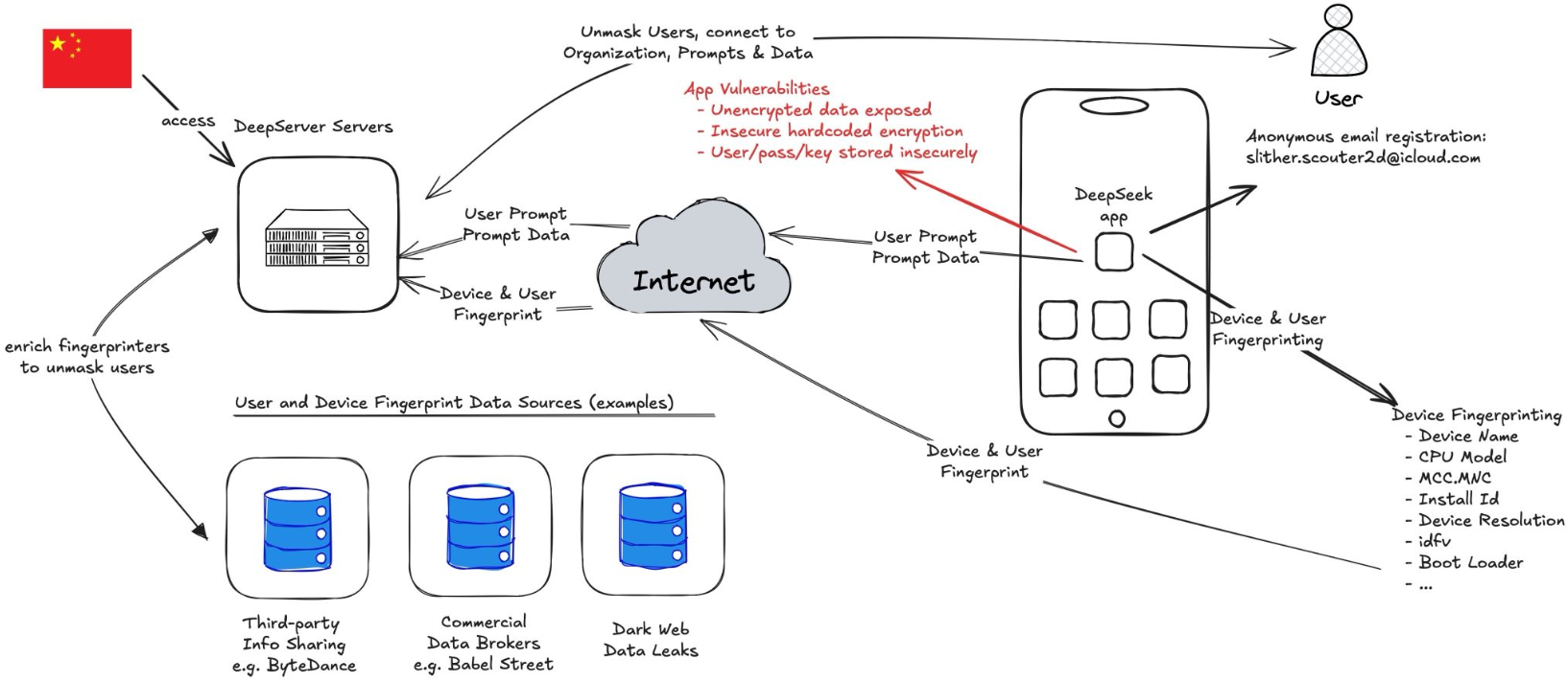
New mobile apps from the Chinese artificial intelligence (AI) company DeepSeek have remained among the top three “free” downloads for Apple and Google devices since their debut on Jan. 25, 2025. But experts caution that many of DeepSeek’s design choices — such as using hard-coded encryption keys, and sending unencrypted user and device data to Chinese companies — introduce a number of glaring security and privacy risks.

Public interest in the DeepSeek AI chat apps swelled following widespread media reports that the upstart Chinese AI firm had managed to match the abilities of cutting-edge chatbots while using a fraction of the specialized computer chips that leading AI companies rely on. As of this writing, DeepSeek is the third most-downloaded “free” app on the Apple store, and #1 on Google Play.

DeepSeek’s rapid rise caught the attention of the mobile security firm NowSecure, a Chicago-based company that helps clients screen mobile apps for security and privacy threats. In a teardown of the DeepSeek app published today, NowSecure urged organizations to remove the DeepSeek iOS mobile app from their environments, citing security concerns.

NowSecure founder Andrew Hoog said they haven’t yet concluded an in-depth analysis of the DeepSeek app for Android devices, but that there is little reason to believe its basic design would be functionally much different.

Hoog told KrebsOnSecurity there were a number of qualities about the DeepSeek iOS app that suggest the presence of deep-seated security and privacy risks. For starters, he said, the app collects an awful lot of data about the user’s device.

“They are doing some very interesting things that are on the edge of advanced device fingerprinting,” Hoog said, noting that one property of the app tracks the device’s name — which for many iOS devices defaults to the customer’s name followed by the type of iOS device.

The device information shared, combined with the user’s Internet address and data gathered from mobile advertising companies, could be used to deanonymize users of the DeepSeek iOS app, NowSecure warned. The report notes that DeepSeek communicates with Volcengine, a cloud platform developed by ByteDance (the makers of TikTok), although NowSecure said it wasn’t clear if the data is just leveraging ByteDance’s digital transformation cloud service or if the declared information share extends further between the two companies.

Image: NowSecure.

Perhaps more concerning, NowSecure said the iOS app transmits device information “in the clear,” without any encryption to encapsulate the data. This means the data being handled by the app could be intercepted, read, and even modified by anyone who has access to any of the networks that carry the app’s traffic.

“The DeepSeek iOS app globally disables App Transport Security (ATS) which is an iOS platform level protection that prevents sensitive data from being sent over unencrypted channels,” the report observed. “Since this protection is disabled, the app can (and does) send unencrypted data over the internet.”

Hoog said the app does selectively encrypt portions of the responses coming from DeepSeek servers. But they also found it uses an insecure and now deprecated encryption algorithm called 3DES (aka Triple DES), and that the developers had hard-coded the encryption key. That means the cryptographic key needed to decipher those data fields can be extracted from the app itself.

There were other, less alarming security and privacy issues highlighted in the report, but Hoog said he’s confident there are additional, unseen security concerns lurking within the app’s code.

“When we see people exhibit really simplistic coding errors, as you dig deeper there are usually a lot more issues,” Hoog said. “There is virtually no priority around security or privacy. Whether cultural, or mandated by China, or a witting choice, taken together they point to significant lapse in security and privacy controls, and that puts companies at risk.”

Apparently, plenty of others share this view. Axios reported on January 30 that U.S. congressional offices are being warned not to use the app.

“[T]hreat actors are already exploiting DeepSeek to deliver malicious software and infect devices,” read the notice from the chief administrative officer for the House of Representatives. “To mitigate these risks, the House has taken security measures to restrict DeepSeek’s functionality on all House-issued devices.”

TechCrunch reports that Italy and Taiwan have already moved to ban DeepSeek over security concerns. Bloomberg writes that The Pentagon has blocked access to DeepSeek. CNBC says NASA also banned employees from using the service, as did the U.S. Navy.

Beyond security concerns tied to the DeepSeek iOS app, there are indications the Chinese AI company may be playing fast and loose with the data that it collects from and about users. On January 29, researchers at Wiz said they discovered a publicly accessible database linked to DeepSeek that exposed “a significant volume of chat history, backend data and sensitive information, including log streams, API secrets, and operational details.”

“More critically, the exposure allowed for full database control and potential privilege escalation within the DeepSeek environment, without any authentication or defense mechanism to the outside world,” Wiz wrote. [Full disclosure: Wiz is currently an advertiser on this website.]

KrebsOnSecurity sought comment on the report from DeepSeek and from Apple. This story will be updated with any substantive replies.

from Krebs on Security https://ift.tt/6bz81f5
via IFTTT

Who’s Behind the Seized Forums ‘Cracked’ & ‘Nulled’?

The FBI joined authorities across Europe last week in seizing domain names for Cracked and Nulled, English-language cybercrime forums with millions of users that trafficked in stolen data, hacking tools and malware. An investigation into the history of these communities shows their apparent co-founders quite openly operate an Internet service provider and a pair of e-commerce platforms catering to buyers and sellers on both forums.

In this 2019 post from Cracked, a forum moderator told the author of the post (Buddie) that the owner of the RDP service was the founder of Nulled, a.k.a. “Finndev.” Image: Ke-la.com.

On Jan. 30, the U.S. Department of Justice said it seized eight domain names that were used to operate Cracked, a cybercrime forum that sprang up in 2018 and attracted more than four million users. The DOJ said the law enforcement action, dubbed Operation Talent, also seized domains tied to Sellix, Cracked’s payment processor.

In addition, the government seized the domain names for two popular anonymity services that were heavily advertised on Cracked and Nulled and allowed customers to rent virtual servers: StarkRDP[.]io, ; and rdp[.]sh.

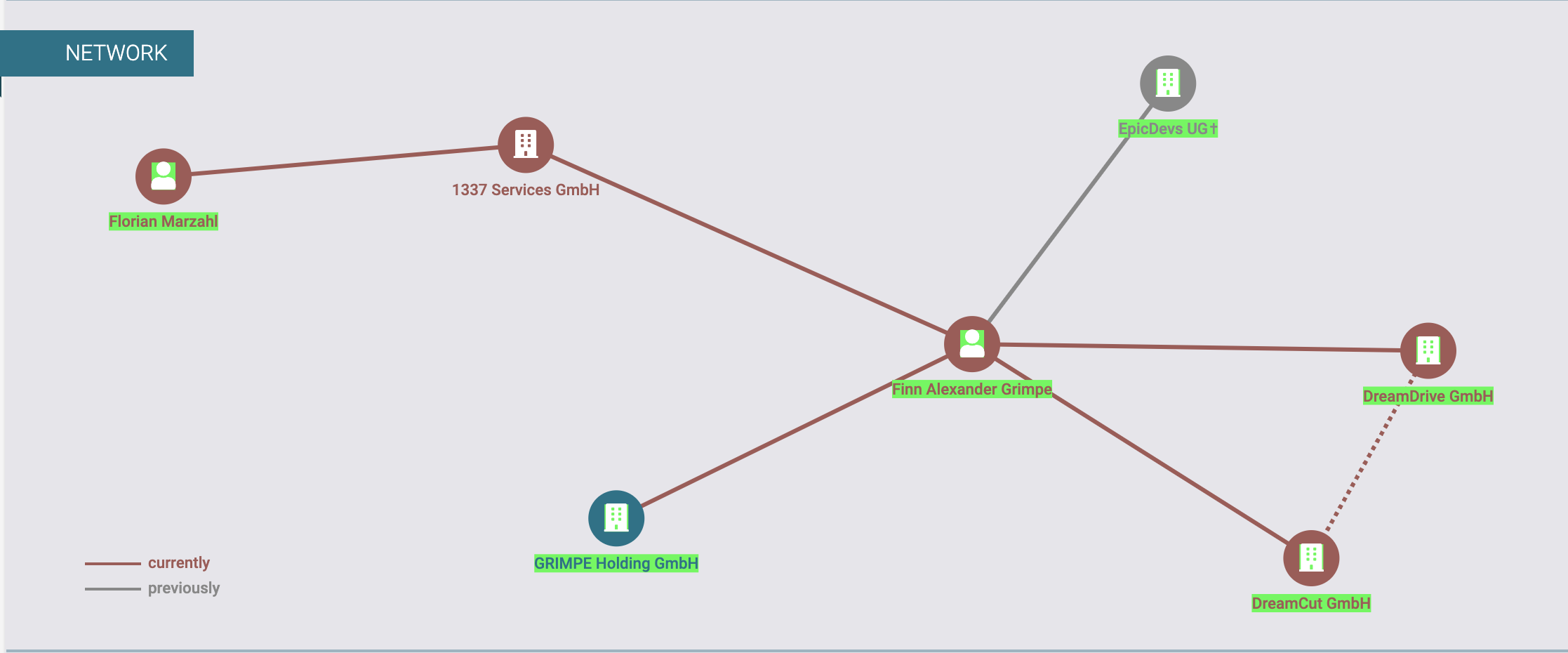
Those archived webpages show both RDP services were owned by an entity called 1337 Services Gmbh. According to corporate records compiled by Northdata.com, 1337 Services GmbH is also known as AS210558 and is incorporated in Hamburg, Germany.

The Cracked forum administrator went by the nicknames “FlorainN” and “StarkRDP” on multiple cybercrime forums. Meanwhile, a LinkedIn profile for a Florian M. from Germany refers to this person as the co-founder of Sellix and founder of 1337 Services GmbH.

Northdata’s business profile for 1337 Services GmbH shows the Hamburg, Germany-based company is controlled by two individuals: 32-year-old Florian Marzahl and Finn Alexander Grimpe, 28.

An organization chart showing the owners of 1337 Services GmbH as Florian Marzahl and Finn Grimpe. Image: Northdata.com.

Neither Marzahl nor Grimpe responded to requests for comment. But Grimpe’s first name is interesting because it corresponds to the nickname chosen by the founder of Nulled, who goes by the moniker “Finn” and “Finndev.” NorthData reveals that Grimpe was the founder of a German entity called DreamDrive GmbH, which rented out high-end sports cars and motorcycles.

According to the cyber intelligence firm Intel 471, a user named Finndev registered on multiple cybercrime forums, including Raidforums [seized by the FBI in 2022], Void[.]to, and vDOS, a DDoS-for-hire service that was shut down in 2016 after its founders were arrested.

The email address used for those accounts was f.grimpe@gmail.com. DomainTools.com reports f.grimpe@gmail.com was used to register at least nine domain names, including nulled[.]lol, nulled[.]it. Neither of these domains were among those seized in Operation Talent.

Intel471 finds the user FlorainN registered across multiple cybercrime forums using the email address olivia.messla@outlook.de. The breach tracking service Constella Intelligence says this email address used the same password (and slight variations of it) across many accounts online — including at hacker forums — and that the same password was used in connection with dozens of other email addresses, such as florianmarzahl@hotmail.de, and fmarzahl137@gmail.com.

The Justice Department said the Nulled marketplace had more than five million members, and has been selling stolen login credentials, stolen identification documents and hacking services, as well as tools for carrying out cybercrime and fraud, since 2016.

Perhaps fittingly, both Cracked and Nulled have been hacked over the years, exposing countless private messages between forum users. A review of those messages archived by Intel 471 showed that dozens of early forum members referred privately to Finndev as the owner of shoppy[.]gg, an e-commerce platform that caters to the same clientele as Sellix.

Shoppy was not targeted as part of Operation Talent, and its website remains online. Northdata reports that Shoppy’s business name — Shoppy Ecommerce Ltd. — is registered at an address in Gan-Ner, Israel, but there is no ownership information about this entity. Shoppy did not respond to requests for comment.

Constella found that a user named Shoppy registered on Cracked in 2019 using the email address finn@shoppy[.]gg. Constella says that email address is tied to a Twitter/X account for Shoppy Ecommerce in Israel.

The DOJ said one of the alleged administrators of Nulled, a 29-year-old Argentinian national named Lucas Sohn, was arrested in Spain. The government has not announced any other arrests or charges associated with Operation Talent.

Indeed, both StarkRDP and FloraiN have posted to their accounts on Telegram that there were no charges levied against the proprietors of 1337 Services GmbH. FlorainN told former customers they were in the process of moving to a new name and domain for StarkRDP, where existing accounts and balances would be transferred.

“StarkRDP has always been operating by the law and is not involved in any of these alleged crimes and the legal process will confirm this,” the StarkRDP Telegram account wrote on January 30. “All of your servers are safe and they have not been collected in this operation. The only things that were seized is the website server and our domain. Unfortunately, no one can tell who took it and with whom we can talk about it. Therefore, we will restart operation soon, under a different name, to close the chapter [of] ‘StarkRDP.’”

from Krebs on Security https://ift.tt/SrtbaPe
via IFTTT

FBI, Dutch Police Disrupt ‘Manipulaters’ Phishing Gang

The FBI and authorities in The Netherlands this week seized dozens of servers and domains for a hugely popular spam and malware dissemination service operating out of Pakistan. The proprietors of the service, who use the collective nickname “The Manipulaters,” have been the subject of three stories published here since 2015. The FBI said the main clientele are organized crime groups that try to trick victim companies into making payments to a third party.

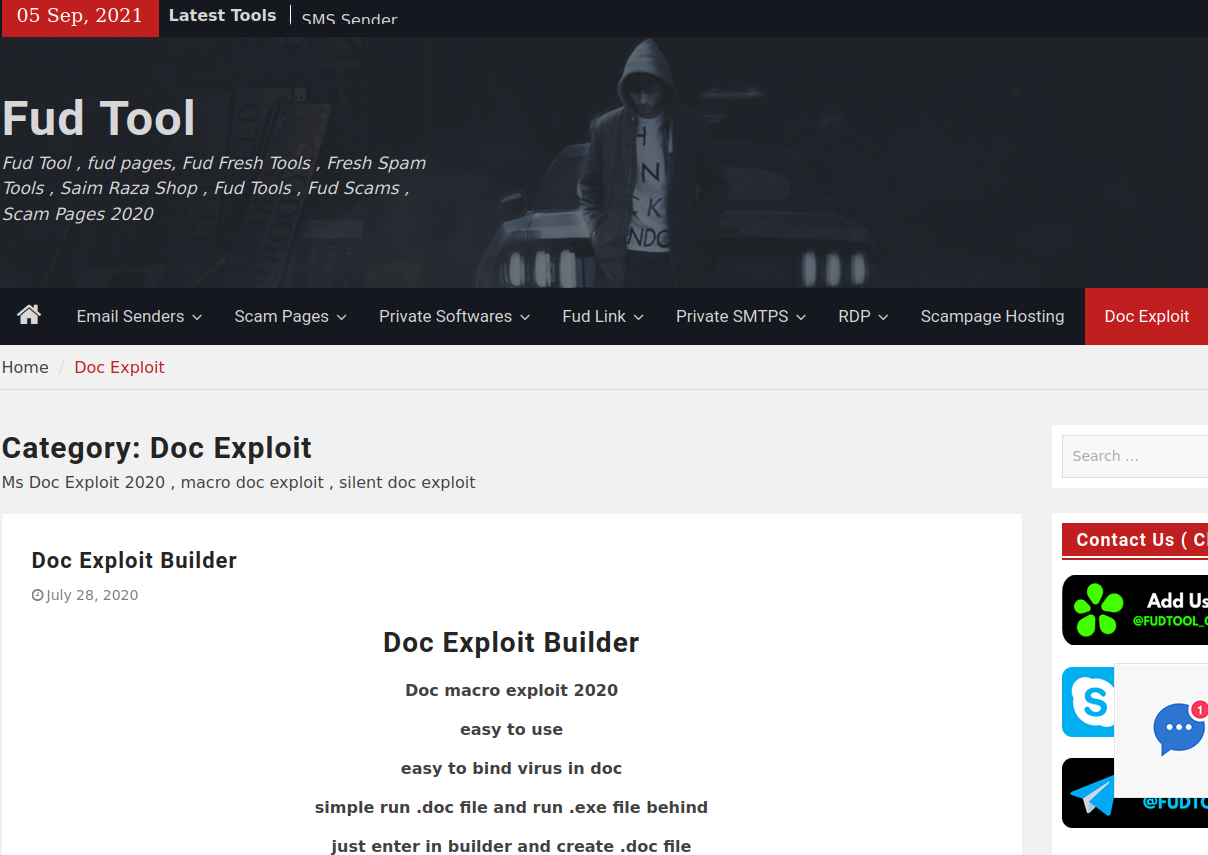
One of several current Fudtools sites run by the principals of The Manipulators.

On January 29, the FBI and the Dutch national police seized the technical infrastructure for a cybercrime service marketed under the brands Heartsender, Fudpage and Fudtools (and many other “fud” variations). The “fud” bit stands for “Fully Un-Detectable,” and it refers to cybercrime resources that will evade detection by security tools like antivirus software or anti-spam appliances.

The Dutch authorities said 39 servers and domains abroad were seized, and that the servers contained millions of records from victims worldwide — including at least 100,000 records pertaining to Dutch citizens.

A statement from the U.S. Department of Justice refers to the cybercrime group as Saim Raza, after a pseudonym The Manipulaters communally used to promote their spam, malware and phishing services on social media.

“The Saim Raza-run websites operated as marketplaces that advertised and facilitated the sale of tools such as phishing kits, scam pages and email extractors often used to build and maintain fraud operations,” the DOJ explained.

The core Manipulaters product is Heartsender, a spam delivery service whose homepage openly advertised phishing kits targeting users of various Internet companies, including Microsoft 365YahooAOLIntuitiCloud and ID.me, to name a few.

The government says transnational organized crime groups that purchased these services primarily used them to run business email compromise (BEC) schemes, wherein the cybercrime actors tricked victim companies into making payments to a third party.

“Those payments would instead be redirected to a financial account the perpetrators controlled, resulting in significant losses to victims,” the DOJ wrote. “These tools were also used to acquire victim user credentials and utilize those credentials to further these fraudulent schemes. The seizure of these domains is intended to disrupt the ongoing activity of these groups and stop the proliferation of these tools within the cybercriminal community.”

Manipulaters advertisement for “Office 365 Private Page with Antibot” phishing kit sold via Heartsender. “Antibot” refers to functionality that attempts to evade automated detection techniques, keeping a phish deployed and accessible as long as possible. Image: DomainTools.

KrebsOnSecurity first wrote about The Manipulaters in May 2015, mainly because their ads at the time were blanketing a number of popular cybercrime forums, and because they were fairly open and brazen about what they were doing — even who they were in real life.

We caught up with The Manipulaters again in 2021, with a story that found the core employees had started a web coding company in Lahore called WeCodeSolutions — presumably as a way to account for their considerable Heartsender income. That piece examined how WeCodeSolutions employees had all doxed themselves on Facebook by posting employee pictures from company parties each year featuring a large cake with the words FudCo written in icing.

A follow-up story last year about The Manipulaters prompted messages from various WeCodeSolutions employees who pleaded with this publication to remove stories about them. The Saim Raza identity told KrebsOnSecurity they were recently released from jail after being arrested and charged by local police, although they declined to elaborate on the charges.

The Manipulaters never seemed to care much about protecting their own identities, so it’s not surprising that they were unable or unwilling to protect their own customers. In an analysis released last year, DomainTools.com found the web-hosted version of Heartsender leaked an extraordinary amount of user information to unauthenticated users, including customer credentials and email records from Heartsender employees.

Almost every year since their founding, The Manipulaters have posted a picture of a FudCo cake from a company party celebrating its anniversary.

DomainTools also uncovered evidence that the computers used by The Manipulaters were all infected with the same password-stealing malware, and that vast numbers of credentials were stolen from the group and sold online.

“Ironically, the Manipulaters may create more short-term risk to their own customers than law enforcement,” DomainTools wrote. “The data table ‘User Feedbacks’ (sic) exposes what appear to be customer authentication tokens, user identifiers, and even a customer support request that exposes root-level SMTP credentials–all visible by an unauthenticated user on a Manipulaters-controlled domain.”

Police in The Netherlands said the investigation into the owners and customers of the service is ongoing.

“The Cybercrime Team is on the trail of a number of buyers of the tools,” the Dutch national police said. “Presumably, these buyers also include Dutch nationals. The investigation into the makers and buyers of this phishing software has not yet been completed with the seizure of the servers and domains.”

U.S. authorities this week also joined law enforcement in Australia, France, Greece, Italy, Romania, Spain in seizing a number of domains for several long-running cybercrime forums and services, including Cracked and Nulled. According to a statement from the European police agency Europol, the two communities attracted more than 10 million users in total.

Other domains seized as part of “Operation Talent” included Sellix, an e-commerce platform that was frequently used by cybercrime forum members to buy and sell illicit goods and services.

from Krebs on Security https://ift.tt/ofrYsxv
via IFTTT

Infrastructure Laundering: Blending in with the Cloud

Image: Shutterstock, ArtHead.

In an effort to blend in and make their malicious traffic tougher to block, hosting firms catering to cybercriminals in China and Russia increasingly are funneling their operations through major U.S. cloud providers. Research published this week on one such outfit — a sprawling network tied to Chinese organized crime gangs and aptly named “Funnull” — highlights a persistent whac-a-mole problem facing cloud services.

In October 2024, the security firm Silent Push published a lengthy analysis of how Amazon AWS and Microsoft Azure were providing services to Funnull, a two-year-old Chinese content delivery network that hosts a wide variety of fake trading apps, pig butchering scams, gambling websites, and retail phishing pages.

Funnull made headlines last summer after it acquired the domain name polyfill[.]io, previously the home of a widely-used open source code library that allowed older browsers to handle advanced functions that weren’t natively supported. There were still tens of thousands of legitimate domains linking to the Polyfill domain at the time of its acquisition, and Funnull soon after conducted a supply-chain attack that redirected visitors to malicious sites.

Silent Push’s October 2024 report found a vast number of domains hosted via Funnull promoting gambling sites and junkets in Macau operated by the Suncity Group, a Chinese entity named in a 2024 UN report (PDF) for laundering millions of dollars for the North Korean Lazarus Group.

In 2023, Suncity’s CEO was sentenced to 18 years in prison on charges of fraud, illegal gambling, and “triad offenses,” i.e. working with Chinese transnational organized crime syndicates. Suncity is alleged to have built an underground banking system that laundered billions of dollars for criminals.

Gambling is illegal in China except in Macau, a special administrative region of China. Silent Push researchers say Funnull may be helping online gamblers in China evade the Communist party’s “Great Firewall,” which blocks access to gambling destinations.

Silent Push’s Zach Edwards said that upon revisiting Funnull’s infrastructure again this month, they found dozens of the same Amazon and Microsoft cloud Internet addresses still forwarding Funnull traffic through a dizzying chain of auto-generated domain names before redirecting malicious or phishous websites.

Edwards said Funnull is a textbook example of an increasing trend Silent Push calls “infrastructure laundering,” wherein crooks selling cybercrime services will relay some or all of their malicious traffic through U.S. cloud providers.

“It’s crucial for global hosting companies based in the West to wake up to the fact that extremely low quality and suspicious web hosts based out of China are deliberately renting IP space from multiple companies and then mapping those IPs to their criminal client websites,” Edwards told KrebsOnSecurity. “We need these major hosts to create internal policies so that if they are renting IP space to one entity, who further rents it to host numerous criminal websites, all of those IPs should be reclaimed and the CDN who purchased them should be banned from future IP rentals or purchases.”

A Suncity gambling site promoted via Funnull. The sites feature a prompt for a Tether/USDT deposit program.

Reached for comment, Amazon referred this reporter to a statement Silent Push included in a report released today. Amazon said AWS was already aware of the Funnull addresses tracked by Silent Push, and that it had suspended all known accounts linked to the activity.

Amazon said that contrary to implications in the Silent Push report, it has every reason to aggressively police its network against infrastructure laundering, noting the accounts tied to Funnull used “fraudulent methods to temporarily acquire infrastructure, for which it never pays. Thus, AWS incurs damages as a result of the abusive activity.”

“When AWS’s automated or manual systems detect potential abuse, or when we receive reports of potential abuse, we act quickly to investigate and take action to stop any prohibited activity,” Amazon’s statement continues. “In the event anyone suspects that AWS resources are being used for abusive activity, we encourage them to report it to AWS Trust & Safety using the report abuse form. In this case, the authors of the report never notified AWS of the findings of their research via our easy-to-find security and abuse reporting channels. Instead, AWS first learned of their research from a journalist to whom the researchers had provided a draft.”

Microsoft likewise said it takes such abuse seriously, and encouraged others to report suspicious activity found on its network.

“We are committed to protecting our customers against this kind of activity and actively enforce acceptable use policies when violations are detected,” Microsoft said in a written statement. “We encourage reporting suspicious activity to Microsoft so we can investigate and take appropriate actions.”

Richard Hummel is threat intelligence lead at NETSCOUT. Hummel said it used to be that “noisy” and frequently disruptive malicious traffic — such as automated application layer attacks, and “brute force” efforts to crack passwords or find vulnerabilities in websites — came mostly from botnets, or large collections of hacked devices.

But he said the vast majority of the infrastructure used to funnel this type of traffic is now proxied through major cloud providers, which can make it difficult for organizations to block at the network level.

“From a defenders point of view, you can’t wholesale block cloud providers, because a single IP can host thousands or tens of thousands of domains,” Hummel said.

In May 2024, KrebsOnSecurity published a deep dive on Stark Industries Solutions, an ISP that materialized at the start of Russia’s invasion of Ukraine and has been used as a global proxy network that conceals the true source of cyberattacks and disinformation campaigns against enemies of Russia. Experts said much of the malicious traffic  traversing Stark’s network (e.g. vulnerability scanning and password brute force attacks) was being bounced through U.S.-based cloud providers.

Stark’s network has been a favorite of the Russian hacktivist group called NoName057(16), which frequently launches huge distributed denial-of-service (DDoS) attacks against a variety of targets seen as opposed to Moscow. Hummel said NoName’s history suggests they are adept at cycling through new cloud provider accounts, making anti-abuse efforts into a game of whac-a-mole.

“It almost doesn’t matter if the cloud provider is on point and takes it down because the bad guys will just spin up a new one,” he said. “Even if they’re only able to use it for an hour, they’ve already done their damage. It’s a really difficult problem.”

Edwards said Amazon declined to specify whether the banned Funnull users were operating using compromised accounts or stolen payment card data, or something else.

“I’m surprised they wanted to lean into ‘We’ve caught this 1,200+ times and have taken these down!’ and yet didn’t connect that each of those IPs was mapped to [the same] Chinese CDN,” he said. “We’re just thankful Amazon confirmed that account mules are being used for this and it isn’t some front-door relationship. We haven’t heard the same thing from Microsoft but it’s very likely that the same thing is happening.”

Funnull wasn’t always a bulletproof hosting network for scam sites. Prior to 2022, the network was known as Anjie CDN, based in the Philippines. One of Anjie’s properties was a website called funnull[.]app. Loading that domain reveals a pop-up message by the original Anjie CDN owner, who said their operations had been seized by an entity known as Fangneng CDN and ACB Group, the parent company of Funnull.

A machine-translated message from the former owner of Anjie CDN, a Chinese content delivery network that is now Funnull.

“After I got into trouble, the company was managed by my family,” the message explains. “Because my family was isolated and helpless, they were persuaded by villains to sell the company. Recently, many companies have contacted my family and threatened them, believing that Fangneng CDN used penetration and mirroring technology through customer domain names to steal member information and financial transactions, and stole customer programs by renting and selling servers. This matter has nothing to do with me and my family. Please contact Fangneng CDN to resolve it.”

In January 2024, the U.S. Department of Commerce issued a proposed rule that would require cloud providers to create a “Customer Identification Program” that includes procedures to collect data sufficient to determine whether each potential customer is a foreign or U.S. person.

According to the law firm Crowell & Moring LLP, the Commerce rule also would require “infrastructure as a service” (IaaS) providers to report knowledge of any transactions with foreign persons that might allow the foreign entity to train a large AI model with potential capabilities that could be used in malicious cyber-enabled activity.

“The proposed rulemaking has garnered global attention, as its cross-border data collection requirements are unprecedented in the cloud computing space,” Crowell wrote. “To the extent the U.S. alone imposes these requirements, there is concern that U.S. IaaS providers could face a competitive disadvantage, as U.S. allies have not yet announced similar foreign customer identification requirements.”

It remains unclear if the new White House administration will push forward with the requirements. The Commerce action was mandated as part of an executive order President Trump issued a day before leaving office in January 2021.

from Krebs on Security https://ift.tt/iwjNoO6
via IFTTT