Patch Tuesday, May 2025 Edition

Microsoft on Tuesday released software updates to fix at least 70 vulnerabilities in Windows and related products, including five zero-day flaws that are already seeing active exploitation. Adding to the sense of urgency with this month’s patch batch from Redmond are fixes for two other weaknesses that now have public proof-of-concept exploits available.

Microsoft and several security firms have disclosed that attackers are exploiting a pair of bugs in the Windows Common Log File System (CLFS) driver that allow attackers to elevate their privileges on a vulnerable device. The Windows CLFS is a critical Windows component responsible for logging services, and is widely used by Windows system services and third-party applications for logging. Tracked as CVE-2025-32701 & CVE-2025-32706, these flaws are present in all supported versions of Windows 10 and 11, as well as their server versions.

Kev Breen, senior director of threat research at Immersive Labs, said privilege escalation bugs assume an attacker already has initial access to a compromised host, typically through a phishing attack or by using stolen credentials. But if that access already exists, Breen said, attackers can gain access to the much more powerful Windows SYSTEM account, which can disable security tooling or even gain domain administration level permissions using credential harvesting tools.

“The patch notes don’t provide technical details on how this is being exploited, and no Indicators of Compromise (IOCs) are shared, meaning the only mitigation security teams have is to apply these patches immediately,” he said. “The average time from public disclosure to exploitation at scale is less than five days, with threat actors, ransomware groups, and affiliates quick to leverage these vulnerabilities.”

Two other zero-days patched by Microsoft today also were elevation of privilege flaws: CVE-2025-32709, which concerns afd.sys, the Windows Ancillary Function Driver that enables Windows applications to connect to the Internet; and CVE-2025-30400, a weakness in the Desktop Window Manager (DWM) library for Windows. As Adam Barnett at Rapid7 notes, tomorrow marks the one-year anniversary of CVE-2024-30051, a previous zero-day elevation of privilege vulnerability in this same DWM component.

The fifth zero-day patched today is CVE-2025-30397, a flaw in the Microsoft Scripting Engine, a key component used by Internet Explorer and Internet Explorer mode in Microsoft Edge.

Chris Goettl at Ivanti points out that the Windows 11 and Server 2025 updates include some new AI features that carry a lot of baggage and weigh in at around 4 gigabytes. Said baggage includes new artificial intelligence (AI) capabilities, including the controversial Recall feature, which constantly takes screenshots of what users are doing on Windows CoPilot-enabled computers.

Microsoft went back to the drawing board on Recall after a fountain of negative feedback from security experts, who warned it would present an attractive target and a potential gold mine for attackers. Microsoft appears to have made some efforts to prevent Recall from scooping up sensitive financial information, but privacy and security concerns still linger. Former Microsoftie Kevin Beaumont has a good teardown on Microsoft’s updates to Recall.

In any case, windowslatest.com reports that Windows 11 version 24H2 shows up ready for downloads, even if you don’t want it.

“It will now show up for ‘download and install’ automatically if you go to Settings > Windows Update and click Check for updates, but only when your device does not have a compatibility hold,” the publication reported. “Even if you don’t check for updates, Windows 11 24H2 will automatically download at some point.”

Apple users likely have their own patching to do. On May 12 Apple released security updates to fix at least 30 vulnerabilities in iOS and iPadOS (the updated version is 18.5). TechCrunch writes that iOS 18.5 also expands emergency satellite capabilities to iPhone 13 owners for the first time (previously it was only available on iPhone 14 or later).

Apple also released updates for macOS Sequoia, macOS Sonoma, macOS Ventura, WatchOS, tvOS and visionOS. Apple said there is no indication of active exploitation for any of the vulnerabilities fixed this month.

As always, please back up your device and/or important data before attempting any updates. And please feel free to sound off in the comments if you run into any problems applying any of these fixes.

from Krebs on Security https://ift.tt/PEezvRY
via IFTTT

Pakistani Firm Shipped Fentanyl Analogs, Scams to US

A Texas firm recently charged with conspiring to distribute synthetic opioids in the United States is at the center of a vast network of companies in the U.S. and Pakistan whose employees are accused of using online ads to scam westerners seeking help with trademarks, book writing, mobile app development and logo designs, a new investigation reveals.

In an indictment (PDF) unsealed last month, the U.S. Department of Justice said Dallas-based eWorldTrade “operated an online business-to-business marketplace that facilitated the distribution of synthetic opioids such as isotonitazene and carfentanyl, both significantly more potent than fentanyl.”

Launched in 2017, eWorldTrade[.]com now features a seizure notice from the DOJ. eWorldTrade operated as a wholesale seller of consumer goods, including clothes, machinery, chemicals, automobiles and appliances. The DOJ’s indictment includes no additional details about eWorldTrade’s business, origins or other activity, and at first glance the website might appear to be a legitimate e-commerce platform that also just happened to sell some restricted chemicals

A screenshot of the eWorldTrade homepage on March 25, 2025. Image: archive.org.

However, an investigation into the company’s founders reveals they are connected to a sprawling network of websites that have a history of extortionate scams involving trademark registration, book publishing, exam preparation, and the design of logos, mobile applications and websites.

Records from the U.S. Patent and Trademark Office (USPTO) show the eWorldTrade mark is owned by an Azneem Bilwani in Karachi (this name also is in the registration records for the now-seized eWorldTrade domain). Mr. Bilwani is perhaps better known as the director of the Pakistan-based IT provider Abtach Ltd., which has been singled out by the USPTO and Google for operating trademark registration scams (the main offices for eWorldtrade and Abtach share the same address in Pakistan).

In November 2021, the USPTO accused Abtach of perpetrating “an egregious scheme to deceive and defraud applicants for federal trademark registrations by improperly altering official USPTO correspondence, overcharging application filing fees, misappropriating the USPTO’s trademarks, and impersonating the USPTO.”

Abtach offered trademark registration at suspiciously low prices compared to legitimate costs of over USD $1,500, and claimed they could register a trademark in 24 hours. Abtach reportedly rebranded to Intersys Limited after the USPTO banned Abtach from filing any more trademark applications.
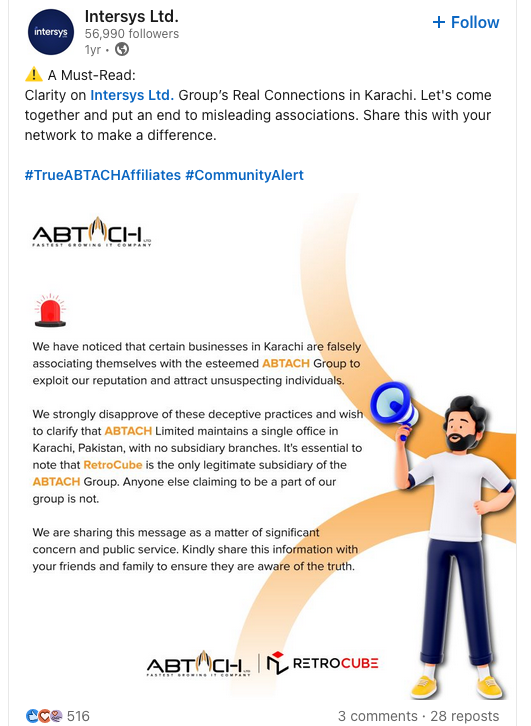
In a note published to its LinkedIn profile, Intersys Ltd. asserted last year that certain scam firms in Karachi were impersonating the company.

FROM AXACT TO ABTACH

Many of Abtach’s employees are former associates of a similar company in Pakistan called Axact that was shut down by Pakistani authorities for fraud in 2015. Axact met its demise not long after The New York Times ran a front-page story about the company’s most lucrative scam business: Hundreds of sites peddling fake college degrees and diplomas.

People who purchased fake certifications were subsequently blackmailed by Axact employees posing as government officials, who would demand additional payments under threats of prosecution or imprisonment for having bought fraudulent “unauthorized” academic degrees. This practice created a continuous cycle of extortion, internally referred to as “upselling.”

“Axact took money from at least 215,000 people in 197 countries — one-third of them from the United States,” The Times reported. “Sales agents wielded threats and false promises and impersonated government officials, earning the company at least $89 million in its final year of operation.”

Dozens of top Axact employees were arrested, jailed, held for months, tried and sentenced to seven years for various fraud violations. But a 2019 research brief on Axact’s diploma mills found none of those convicted had started their prison sentence, and that several had fled Pakistan and never returned.

“In October 2016, a Pakistan district judge acquitted 24 Axact officials at trial due to ‘not enough evidence’ and then later admitted he had accepted a bribe (of $35,209) from Axact,” reads a history (PDF) published by the American Association of Collegiate Registrars and Admissions Officers.

In 2021, Pakistan’s Federal Investigation Agency (FIA) charged Bilwani and nearly four dozen others — many of them Abtach employees — with running an elaborate trademark scam. The authorities called it “the biggest money laundering case in the history of Pakistan,” and named a number of businesses based in Texas that allegedly helped move the proceeds of cybercrime.
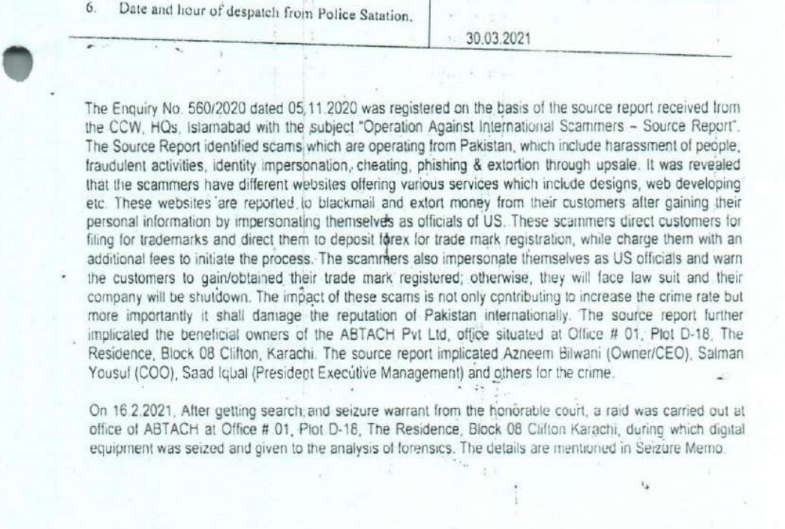
A page from the March 2021 FIA report alleging that Digitonics Labs and Abtach employees conspired to extort and defraud consumers.

The FIA said the defendants operated a large number of websites offering low-cost trademark services to customers, before then “ignoring them after getting the funds and later demanding more funds from clients/victims in the name of up-sale (extortion).” The Pakistani law enforcement agency said that about 75 percent of customers received fake or fabricated trademarks as a result of the scams.

The FIA found Abtach operates in conjunction with a Karachi firm called Digitonics Labs, which earned a monthly revenue of around $2.5 million through the “extortion of international clients in the name of up-selling, the sale of fake/fabricated USPTO certificates, and the maintaining of phishing websites.”

According the Pakistani authorities, the accused also ran countless scams involving ebook publication and logo creation, wherein customers are subjected to advance-fee fraud and extortion — with the scammers demanding more money for supposed “copyright release” and threatening to release the trademark.

Also charged by the FIA was Junaid Mansoor, the owner of Digitonics Labs in Karachi. Mansoor’s U.K.-registered company Maple Solutions Direct Limited has run at least 700 ads for logo design websites since 2015, the Google Ads Transparency page reports. The company has approximately 88 ads running on Google as of today. 

Junaid Mansoor. Source: youtube/@Olevels․com School.

Mr. Mansoor is actively involved with and promoting a Quran study business called quranmasteronline[.]com, which was founded by Junaid’s brother Qasim Mansoor (Qasim is also named in the FIA criminal investigation). The Google ads promoting quranmasteronline[.]com were paid for by the same account advertising a number of scam websites selling logo and web design services. 

Junaid Mansoor did not respond to requests for comment. An address in Teaneck, New Jersey where Mr. Mansoor previously lived is listed as an official address of exporthub[.]com, a Pakistan-based e-commerce website that appears remarkably similar to eWorldTrade (Exporthub says its offices are in Texas). Interestingly, a search in Google for this domain shows ExportHub currently features multiple listings for fentanyl citrate from suppliers in China and elsewhere.

The CEO of Digitonics Labs is Muhammad Burhan Mirza, a former Axact official who was arrested by the FIA as part of its money laundering and trademark fraud investigation in 2021. In 2023, prosecutors in Pakistan charged Mirza, Mansoor and 14 other Digitonics employees with fraud, impersonating government officials, phishing, cheating and extortion. Mirza’s LinkedIn profile says he currently runs an educational technology/life coach enterprise called TheCoach360, which purports to help young kids “achieve financial independence.”

Reached via LinkedIn, Mr. Mirza denied having anything to do with eWorldTrade or any of its sister companies in Texas.

“Moreover, I have no knowledge as to the companies you have mentioned,” said Mr. Mirza, who did not respond to follow-up questions.

The current disposition of the FIA’s fraud case against the defendants is unclear. The investigation was marred early on by allegations of corruption and bribery. In 2021, Pakistani authorities alleged Bilwani paid a six-figure bribe to FIA investigators. Meanwhile, attorneys for Mr. Bilwani have argued that although their client did pay a bribe, the payment was solicited by government officials. Mr. Bilwani did not respond to requests for comment.

THE TEXAS NEXUS

KrebsOnSecurity has learned that the people and entities at the center of the FIA investigations have built a significant presence in the United States, with a strong concentration in Texas. The Texas businesses promote websites that sell logo and web design, ghostwriting, and academic cheating services. Many of these entities have recently been sued for fraud and breach of contract by angry former customers, who claimed the companies relentlessly upsold them while failing to produce the work as promised.

For example, the FIA complaints named Retrocube LLC and 360 Digital Marketing LLC, two entities that share a street address with eWorldTrade: 1910 Pacific Avenue, Suite 8025, Dallas, Texas. Also incorporated at that Pacific Avenue address is abtach[.]ae, a web design and marketing firm based in Dubai; and intersyslimited[.]com, the new name of Abtach after they were banned by the USPTO. Other businesses registered at this address market services for logo design, mobile app development, and ghostwriting.
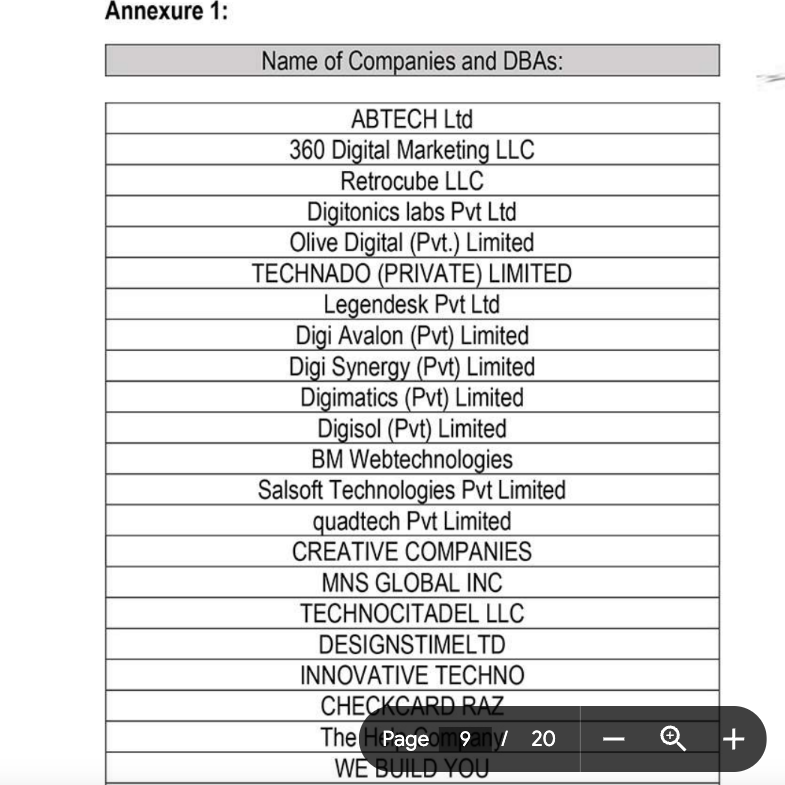
A list published in 2021 by Pakistan’s FIA of different front companies allegedly involved in scamming people who are looking for help with trademarks, ghostwriting, logos and web design.

360 Digital Marketing’s website 360digimarketing[.]com is owned by an Abtach front company called Abtech LTD. Meanwhile, business records show 360 Digi Marketing LTD is a U.K. company whose officers include former Abtach director Bilwani; Muhammad Saad Iqbal, formerly Abtach, now CEO of Intersys Ltd; Niaz Ahmed, a former Abtach associate; and Muhammad Salman Yousuf, formerly a vice president at Axact, Abtach, and Digitonics Labs.

Google’s Ads Transparency Center finds 360 Digital Marketing LLC ran at least 500 ads promoting various websites selling ghostwriting services . Another entity tied to Junaid Mansoor — a company called Octa Group Technologies AU — has run approximately 300 Google ads for book publishing services, promoting confusingly named websites like amazonlistinghub[.]com and barnesnoblepublishing[.]co.
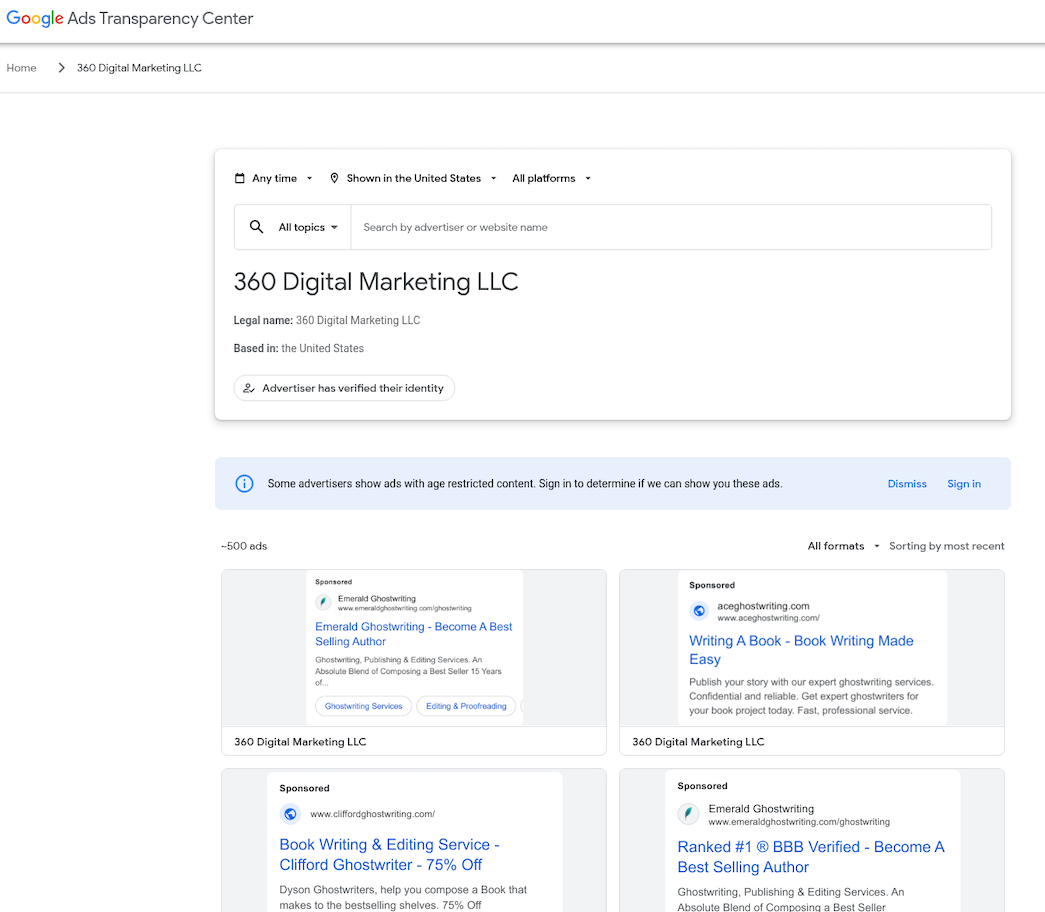
360 Digital Marketing LLC ran approximately 500 ads for scam ghostwriting sites.

Rameez Moiz is a Texas resident and former Abtach product manager who has represented 360 Digital Marketing LLC and RetroCube. Moiz told KrebsOnSecurity he stopped working for 360 Digital Marketing in the summer of 2023. Mr. Moiz did not respond to follow-up questions, but an Upwork profile for him states that as of April 2025 he is employed by Dallas-based Vertical Minds LLC.

In April 2025, California resident Melinda Will sued the Texas firm Majestic Ghostwriting — which is doing business as ghostwritingsquad[.]com —  alleging they scammed her out of $100,000 after she hired them to help write her book. Google’s ad transparency page shows Moiz’s employer Vertical Minds LLC paid to run approximately 55 ads for ghostwritingsquad[.]com and related sites.

Google’s ad transparency listing for ghostwriting ads paid for by Vertical Minds LLC.

VICTIMS SPEAK OUT

Ms. Will’s lawsuit is just one of more than two-dozen complaints over the past four years wherein plaintiffs sued one of this group’s web design, wiki editing or ghostwriting services. In 2021, a New Jersey man sued Octagroup Technologies, alleging they ripped him off when he paid a total of more than $26,000 for the design and marketing of a web-based mapping service.

The plaintiff in that case did not respond to requests for comment, but his complaint alleges Octagroup and a myriad other companies it contracted with produced minimal work product despite subjecting him to relentless upselling. That case was decided in favor of the plaintiff because the defendants never contested the matter in court.

In 2023, 360 Digital Marketing LLC and Retrocube LLC were sued by a woman who said they scammed her out of $40,000 over a book she wanted help writing. That lawsuit helpfully showed an image of the office front door at 1910 Pacific Ave Suite 8025, which featured the logos of 360 Digital Marketing, Retrocube, and eWorldTrade.

The front door at 1910 Pacific Avenue, Suite 8025, Dallas, Texas.

The lawsuit was filed pro se by Leigh Riley, a 64-year-old career IT professional who paid 360 Digital Marketing to have a company called Talented Ghostwriter co-author and promote a series of books she’d outlined on spirituality and healing.

“The main reason I hired them was because I didn’t understand what I call the formula for writing a book, and I know there’s a lot of marketing that goes into publishing,” Riley explained in an interview. “I know nothing about that stuff, and these guys were convincing that they could handle all aspects of it. Until I discovered they couldn’t write a damn sentence in English properly.”

Riley’s well-documented lawsuit (not linked here because it features a great deal of personal information) includes screenshots of conversations with the ghostwriting team, which was constantly assigning her to new writers and editors, and ghosting her on scheduled conference calls about progress on the project. Riley said she ended up writing most of the book herself because the work they produced was unusable.

“Finally after months of promising the books were printed and on their way, they show up at my doorstep with the wrong title on the book,” Riley said. When she demanded her money back, she said the people helping her with the website to promote the book locked her out of the site.
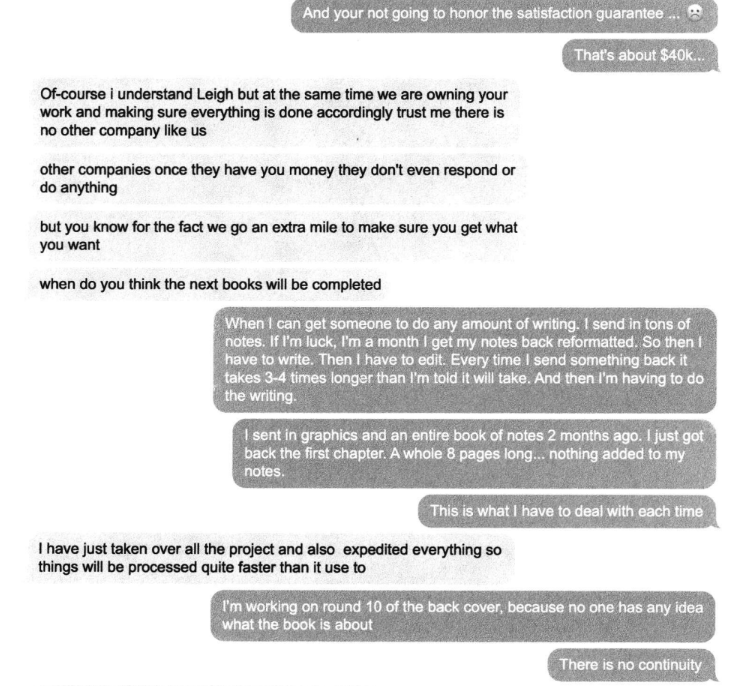
A conversation snippet from Leigh Riley’s lawsuit against Talented Ghostwriter, aka 360 Digital Marketing LLC. “Other companies once they have you money they don’t even respond or do anything,” the ghostwriting team manager explained.

Riley decided to sue, naming 360 Digital Marketing LLC and Retrocube LLC, among others.  The companies offered to settle the matter for $20,000, which she accepted. “I didn’t have money to hire a lawyer, and I figured it was time to cut my losses,” she said.

Riley said she could have saved herself a great deal of headache by doing some basic research on Talented Ghostwriter, whose website claims the company is based in Los Angeles. According to the California Secretary of State, however, there is no registered entity by that name. Rather, the address claimed by talentedghostwriter[.]com is a vacant office building with a “space available” sign in the window.

California resident Walter Horsting discovered something similar when he sued 360 Digital Marketing in small claims court last year, after hiring a company called Vox Ghostwriting to help write, edit and promote a spy novel he’d been working on. Horsting said he paid Vox $3,300 to ghostwrite a 280-page book, and was upsold an Amazon marketing and publishing package for $7,500.

In an interview, Horsting said the prose that Vox Ghostwriting produced was “juvenile at best,” forcing him to rewrite and edit the work himself, and to partner with a graphical artist to produce illustrations. Horsting said that when it came time to begin marketing the novel, Vox Ghostwriting tried to further upsell him on marketing packages, while dodging scheduled meetings with no follow-up.

“They have a money back guarantee, and when they wouldn’t refund my money I said I’m taking you to court,” Horsting recounted. “I tried to serve them in Los Angeles but found no such office exists. I talked to a salon next door and they said someone else had recently shown up desperately looking for where the ghostwriting company went, and it appears there are a trail of corpses on this. I finally tracked down where they are in Texas.”

It was the same office that Ms. Riley served her lawsuit against. Horsting said he has a court hearing scheduled later this month, but he’s under no illusions that winning the case means he’ll be able to collect.

“At this point, I’m doing it out of pride more than actually expecting anything to come to good fortune for me,” he said.

The following mind map was helpful in piecing together key events, individuals and connections mentioned above. It’s important to note that this graphic only scratches the surface of the operations tied to this group. For example, in Case 2 we can see mention of academic cheating services, wherein people can be hired to take online proctored exams on one’s behalf. Those who hire these services soon find themselves subject to impersonation and blackmail attempts for larger and larger sums of money, with the threat of publicly exposing their unethical academic cheating activity.
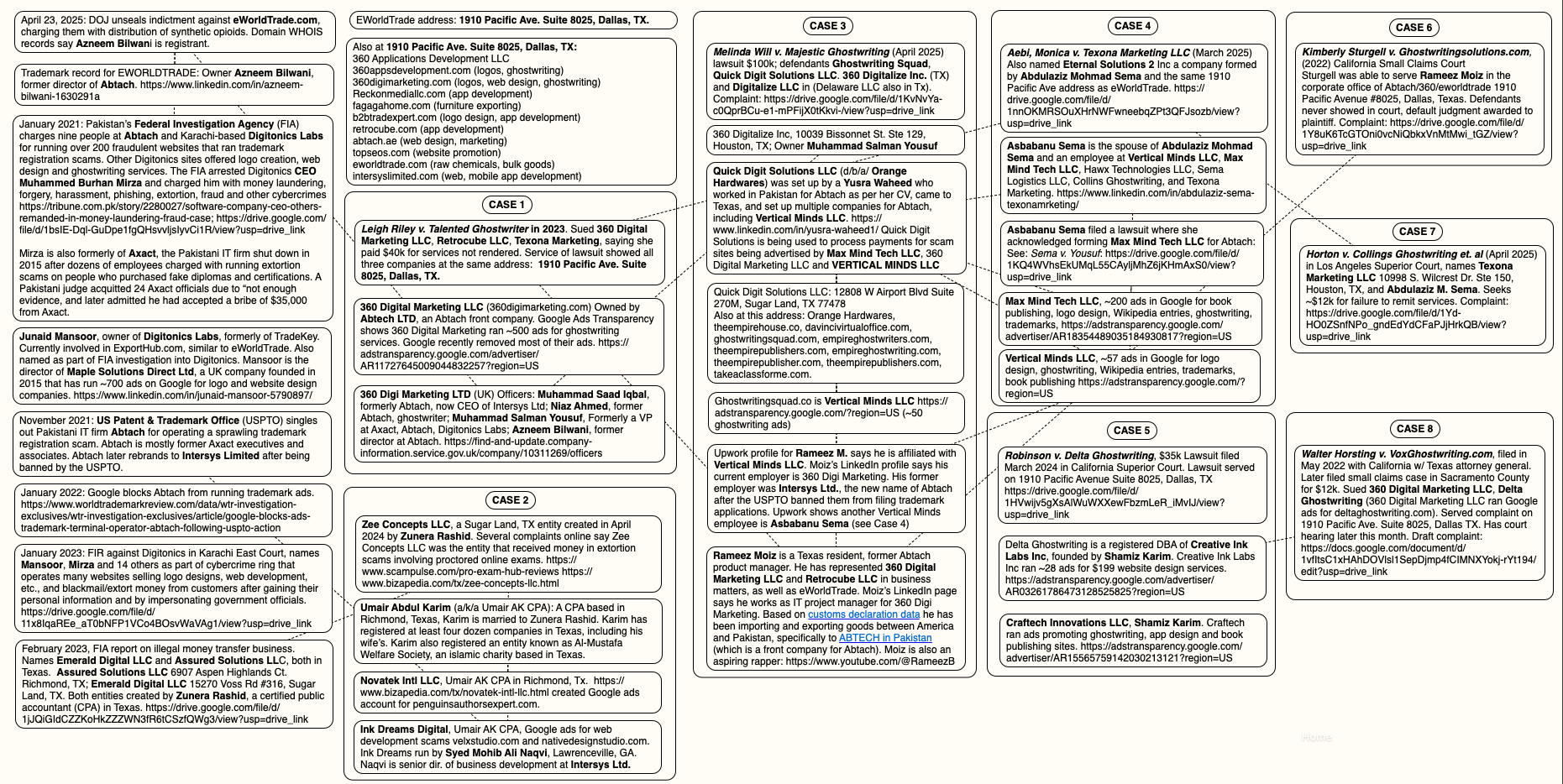
A “mind map” illustrating the connections between and among entities referenced in this story. Click to enlarge.

GOOGLE RESPONDS

KrebsOnSecurity reviewed the Google Ad Transparency links for nearly 500 different websites tied to this network of ghostwriting, logo, app and web development businesses. Those website names were then fed into spyfu.com, a competitive intelligence company that tracks the reach and performance of advertising keywords. Spyfu estimates that between April 2023 and April 2025, those websites spent more than $10 million on Google ads.

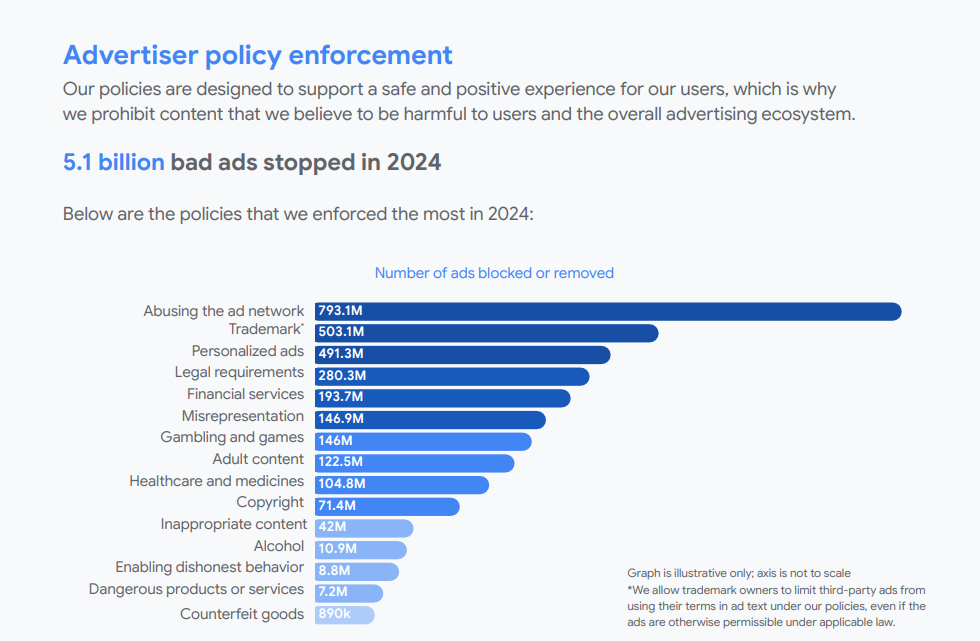
Reached for comment, Google said in a written statement that it is constantly policing its ad network for bad actors, pointing to an ads safety report (PDF) showing Google blocked or removed 5.1 billion bad ads last year — including more than 500 million ads related to trademarks.

“Our policy against Enabling Dishonest Behavior prohibits products or services that help users mislead others, including ads for paper-writing or exam-taking services,” the statement reads. “When we identify ads or advertisers that violate our policies, we take action, including by suspending advertiser accounts, disapproving ads, and restricting ads to specific domains when appropriate.”
Google did not respond to specific questions about the advertising entities mentioned in this story, saying only that “we are actively investigating this matter and addressing any policy violations, including suspending advertiser accounts when appropriate.”

From reviewing the ad accounts that have been promoting these scam websites, it appears Google has very recently acted to remove a large number of the offending ads. Prior to my notifying Google about the extent of this ad network on April 28, the Google Ad Transparency network listed over 500 ads for 360 Digital Marketing; as of this publication, that number had dwindled to 10.

On April 30, Google announced that starting this month its ads transparency page will display the payment profile name as the payer name for verified advertisers, if that name differs from their verified advertiser name. Searchengineland.com writes the changes are aimed at increasing accountability in digital advertising.

This spreadsheet lists the domain names, advertiser names, and Google Ad Transparency links for more than 350 entities offering ghostwriting, publishing, web design and academic cheating services.

KrebsOnSecurity would like to thank the anonymous security researcher NatInfoSec for their assistance in this investigation.

For further reading on Abtach and its myriad companies in all of the above-mentioned verticals (ghostwriting, logo design, etc.), see this Wikiwand entry.

from Krebs on Security https://ift.tt/yw9NgMC
via IFTTT

xAI Dev Leaks API Key for Private SpaceX, Tesla LLMs

A employee at Elon Musk’s artificial intelligence company xAI leaked a private key on GitHub that for the past two months could have allowed anyone to query private xAI large language models (LLMs) which appear to have been custom made for working with internal data from Musk’s companies, including SpaceX, Tesla and Twitter/X, KrebsOnSecurity has learned.

Image: Shutterstock, @sdx15.

Philippe Caturegli, “chief hacking officer” at the French security consultancy Seralys, was the first to publicize the leak of credentials for an x.ai application programming interface (API) exposed in the GitHub code repository of a technical staff member at xAI.

Caturegli’s post on LinkedIn caught the attention of researchers at GitGuardian, a company that specializes in detecting and remediating exposed secrets in public and proprietary environments. GitGuardian’s systems constantly scan GitHub and other code repositories for exposed API keys, and fire off automated alerts to affected users.

GitGuardian’s Eric Fourrier told KrebsOnSecurity the exposed API key had access to several unreleased models of Grok, the AI chatbot developed by xAI. In total, GitGuardian found the key had access to at least 60 distinct data sets.

“The credentials can be used to access the X.ai API with the identity of the user,” GitGuardian wrote in an email explaining their findings to xAI. “The associated account not only has access to public Grok models (grok-2-1212, etc) but also to what appears to be unreleased (grok-2.5V), development (research-grok-2p5v-1018), and private models (tweet-rejector, grok-spacex-2024-11-04).”

Fourrier found GitGuardian had alerted the xAI employee about the exposed API key nearly two months ago — on March 2. But as of April 30, when GitGuardian directly alerted xAI’s security team to the exposure, the key was still valid and usable. xAI told GitGuardian to report the matter through its bug bounty program at HackerOne, but just a few hours later the repository containing the API key was removed from GitHub.

“It looks like some of these internal LLMs were fine-tuned on SpaceX data, and some were fine-tuned with Tesla data,” Fourrier said. “I definitely don’t think a Grok model that’s fine-tuned on SpaceX data is intended to be exposed publicly.”

xAI did not respond to a request for comment. Nor did the 28-year-old xAI technical staff member whose key was exposed.

Carole Winqwist heads the research team at GitGuardian. Winquist said giving potentially hostile users free access to private LLMs is a recipe for disaster.

“If you’re an attacker and you have direct access to the model and the back end interface for things like Grok, it’s definitely something you can use for further attacking,” she said. “An attacker could it use for prompt injection, to tweak the (LLM) model to serve their purposes, or try to implant code into the supply chain.”

The inadvertent exposure of internal LLMs for xAI comes as Musk’s so-called Department of Government Efficiency (DOGE) has been feeding sensitive government records into artificial intelligence tools. In February, The Washington Post reported DOGE officials were feeding data from across the Education Department into AI tools to probe the agency’s programs and spending.

The Post said DOGE plans to replicate this process across many departments and agencies, accessing the back-end software at different parts of the government and then using AI technology to extract and sift through information about spending on employees and programs.

“Feeding sensitive data into AI software puts it into the possession of a system’s operator, increasing the chances it will be leaked or swept up in cyberattacks,” Post reporters wrote.

Wired reported in March that DOGE has deployed a proprietary chatbot called GSAi to 1,500 federal workers at the General Services Administration, part of an effort to automate tasks previously done by humans as DOGE continues its purge of the federal workforce.

A Reuters report last month said Trump administration officials told some U.S. government employees that DOGE is using AI to surveil at least one federal agency’s communications for hostility to President Trump and his agenda. Reuters wrote that the DOGE team has heavily deployed Musk’s Grok AI chatbot as part of their work slashing the federal government, although Reuters said it could not establish exactly how Grok was being used.

Caturegli said while there is no indication that federal government or user data could be accessed through the exposed x.ai API key, these private models are likely trained on proprietary data and may unintentionally expose details related to internal development efforts at xAI, Twitter, or SpaceX.

“The fact that this key was publicly exposed for two months and granted access to internal models is concerning,” Caturegli said. “This kind of long-lived credential exposure highlights weak key management and insufficient internal monitoring, raising questions about safeguards around developer access and broader operational security.”

from Krebs on Security https://ift.tt/QskB0zC
via IFTTT

Alleged ‘Scattered Spider’ Member Extradited to U.S.

A 23-year-old Scottish man thought to be a member of the prolific Scattered Spider cybercrime group was extradited last week from Spain to the United States, where he is facing charges of wire fraud, conspiracy and identity theft. U.S. prosecutors allege Tyler Robert Buchanan and co-conspirators hacked into dozens of companies in the United States and abroad, and that he personally controlled more than $26 million stolen from victims.

Scattered Spider is a loosely affiliated criminal hacking group whose members have broken into and stolen data from some of the world’s largest technology companies. Buchanan was arrested in Spain last year on a warrant from the FBI, which wanted him in connection with a series of SMS-based phishing attacks in the summer of 2022 that led to intrusions at Twilio, LastPass, DoorDash, Mailchimp, and many other tech firms.

Tyler Buchanan, being escorted by Spanish police at the airport in Palma de Mallorca in June 2024.

As first reported by KrebsOnSecurity, Buchanan (a.k.a. “tylerb”) fled the United Kingdom in February 2023, after a rival cybercrime gang hired thugs to invade his home, assault his mother, and threaten to burn him with a blowtorch unless he gave up the keys to his cryptocurrency wallet. Buchanan was arrested in June 2024 at the airport in Palma de Mallorca while trying to board a flight to Italy. His extradition to the United States was first reported last week by Bloomberg.

Members of Scattered Spider have been tied to the 2023 ransomware attacks against MGM and Caesars casinos in Las Vegas, but it remains unclear whether Buchanan was implicated in that incident. The Justice Department’s complaint against Buchanan makes no mention of the 2023 ransomware attack.

Rather, the investigation into Buchanan appears to center on the SMS phishing campaigns from 2022, and on SIM-swapping attacks that siphoned funds from individual cryptocurrency investors. In a SIM-swapping attack, crooks transfer the target’s phone number to a device they control and intercept any text messages or phone calls to the victim’s device — including one-time passcodes for authentication and password reset links sent via SMS.

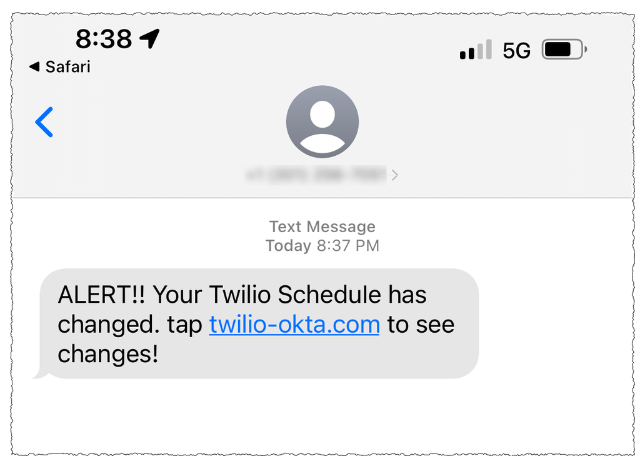
In August 2022, KrebsOnSecurity reviewed data harvested in a months-long cybercrime campaign by Scattered Spider involving countless SMS-based phishing attacks against employees at major corporations. The security firm Group-IB called them by a different name — 0ktapus, because the group typically spoofed the identity provider Okta in their phishing messages to employees at targeted firms.

A Scattered Spider/0Ktapus SMS phishing lure sent to Twilio employees in 2022.

The complaint against Buchanan (PDF) says the FBI tied him to the 2022 SMS phishing attacks after discovering the same username and email address was used to register numerous Okta-themed phishing domains seen in the campaign. The domain registrar NameCheap found that less than a month before the phishing spree, the account that registered those domains logged in from an Internet address in the U.K. FBI investigators said the Scottish police told them the address was leased to Buchanan from January 26, 2022 to November 7, 2022.

Authorities seized at least 20 digital devices when they raided Buchanan’s residence, and on one of those devices they found usernames and passwords for employees of three different companies targeted in the phishing campaign.

“The FBI’s investigation to date has gathered evidence showing that Buchanan and his co-conspirators targeted at least 45 companies in the United States and abroad, including Canada, India, and the United Kingdom,” the FBI complaint reads. “One of Buchanan’s devices contained a screenshot of Telegram messages between an account known to be used by Buchanan and other unidentified co-conspirators discussing dividing up the proceeds of SIM swapping.”

U.S. prosecutors allege that records obtained from Discord showed the same U.K. Internet address was used to operate a Discord account that specified a cryptocurrency wallet when asking another user to send funds. The complaint says the publicly available transaction history for that payment address shows approximately 391 bitcoin was transferred in and out of this address between October 2022 and
February 2023; 391 bitcoin is presently worth more than $26 million.

In November 2024, federal prosecutors in Los Angeles unsealed criminal charges against Buchanan and four other alleged Scattered Spider members, including Ahmed Elbadawy, 23, of College Station, Texas; Joel Evans, 25, of Jacksonville, North Carolina; Evans Osiebo, 20, of Dallas; and Noah Urban, 20, of Palm Coast, Florida. KrebsOnSecurity reported last year that another suspected Scattered Spider member — a 17-year-old from the United Kingdom — was arrested as part of a joint investigation with the FBI into the MGM hack.

Mr. Buchanan’s court-appointed attorney did not respond to a request for comment. The accused faces charges of wire fraud conspiracy, conspiracy to obtain information by computer for private financial gain, and aggravated identity theft. Convictions on the latter charge carry a minimum sentence of two years in prison.

Documents from the U.S. District Court for the Central District of California indicate Buchanan is being held without bail pending trial. A preliminary hearing in the case is slated for May 6.

from Krebs on Security https://ift.tt/p4ZAtfs
via IFTTT

DOGE Worker’s Code Supports NLRB Whistleblower

A whistleblower at the National Labor Relations Board (NLRB) alleged last week that denizens of Elon Musk’s Department of Government Efficiency (DOGE) siphoned gigabytes of data from the agency’s sensitive case files in early March. The whistleblower said accounts created for DOGE at the NLRB downloaded three code repositories from GitHub. Further investigation into one of those code bundles shows it is remarkably similar to a program published in January 2025 by Marko Elez, a 25-year-old DOGE employee who has worked at a number of Musk’s companies.

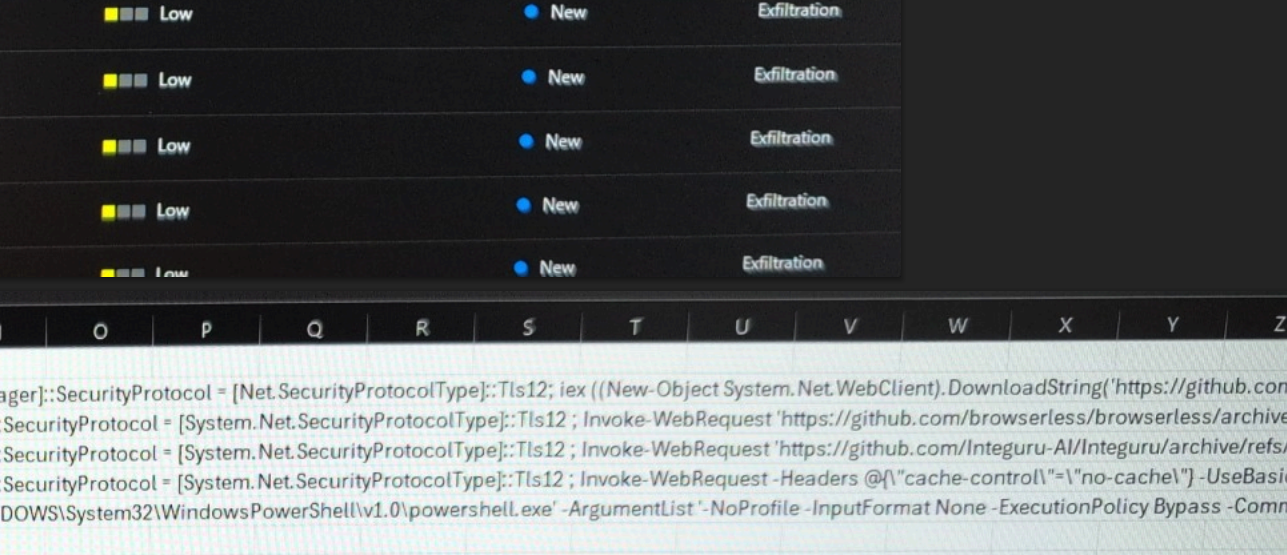
A screenshot shared by NLRB whistleblower Daniel Berulis shows three downloads from GitHub.

According to a whistleblower complaint filed last week by Daniel J. Berulis, a 38-year-old security architect at the NLRB, officials from DOGE met with NLRB leaders on March 3 and demanded the creation of several all-powerful “tenant admin” accounts that were to be exempted from network logging activity that would otherwise keep a detailed record of all actions taken by those accounts.

Berulis said the new DOGE accounts had unrestricted permission to read, copy, and alter information contained in NLRB databases. The new accounts also could restrict log visibility, delay retention, route logs elsewhere, or even remove them entirely — top-tier user privileges that neither Berulis nor his boss possessed.

Berulis said he discovered one of the DOGE accounts had downloaded three external code libraries from GitHub that neither NLRB nor its contractors ever used. A “readme” file in one of the code bundles explained it was created to rotate connections through a large pool of cloud Internet addresses that serve “as a proxy to generate pseudo-infinite IPs for web scraping and brute forcing.” Brute force attacks involve automated login attempts that try many credential combinations in rapid sequence.

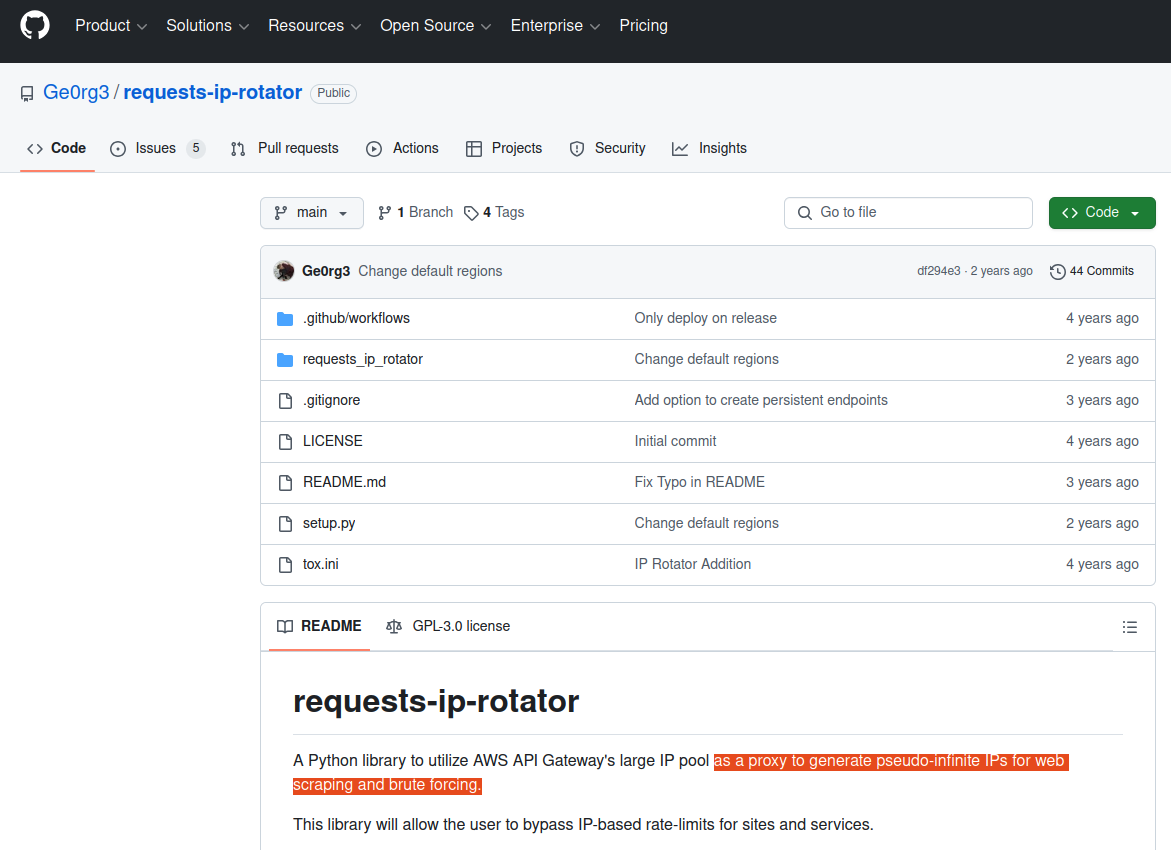
A search on that description in Google brings up a code repository at GitHub for a user with the account name “Ge0rg3” who published a program roughly four years ago called “requests-ip-rotator,” described as a library that will allow the user “to bypass IP-based rate-limits for sites and services.”

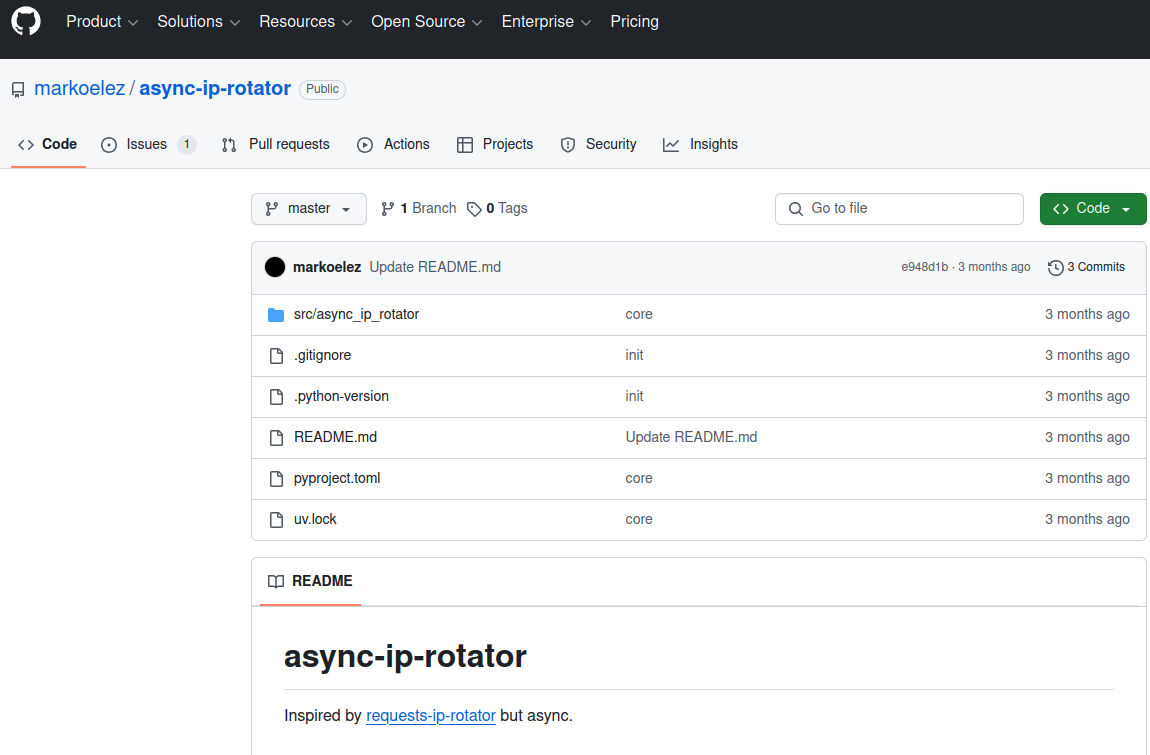
The README file from the GitHub user Ge0rg3’s page for requests-ip-rotator includes the exact wording of a program the whistleblower said was downloaded by one of the DOGE users. Marko Elez created an offshoot of this program in January 2025.

“A Python library to utilize AWS API Gateway’s large IP pool as a proxy to generate pseudo-infinite IPs for web scraping and brute forcing,” the description reads.

Ge0rg3’s code is “open source,” in that anyone can copy it and reuse it non-commercially. As it happens, there is a newer version of this project that was derived or “forked” from Ge0rg3’s code — called “async-ip-rotator” — and it was committed to GitHub in January 2025 by DOGE captain Marko Elez.

The whistleblower stated that one of the GitHub files downloaded by the DOGE employees who transferred sensitive files from an NLRB case database was an archive whose README file read: “Python library to utilize AWS API Gateway’s large IP pool as a proxy to generate pseudo-infinite IPs for web scraping and brute forcing.” Elez’s code pictured here was forked in January 2025 from a code library that shares the same description.

A key DOGE staff member who gained access to the Treasury Department’s central payments system, Elez has worked for a number of Musk companies, including X, SpaceX, and xAI. Elez was among the first DOGE employees to face public scrutiny, after The Wall Street Journal linked him to social media posts that advocated racism and eugenics.

Elez resigned after that brief scandal, but was rehired after President Donald Trump and Vice President JD Vance expressed support for him. Politico reports Elez is now a Labor Department aide detailed to multiple agencies, including the Department of Health and Human Services.

“During Elez’s initial stint at Treasury, he violated the agency’s information security policies by sending a spreadsheet containing names and payments information to officials at the General Services Administration,” Politico wrote, citing court filings.

KrebsOnSecurity sought comment from both the NLRB and DOGE, and will update this story if either responds.

The NLRB has been effectively hobbled since President Trump fired three board members, leaving the agency without the quorum it needs to function. Both Amazon and Musk’s SpaceX have been suing the NLRB over complaints the agency filed in disputes about workers’ rights and union organizing, arguing that the NLRB’s very existence is unconstitutional. On March 5, a U.S. appeals court unanimously rejected Musk’s claim that the NLRB’s structure somehow violates the Constitution.

Berulis’s complaint alleges the DOGE accounts at NLRB downloaded more than 10 gigabytes of data from the agency’s case files, a database that includes reams of sensitive records including information about employees who want to form unions and proprietary business documents. Berulis said he went public after higher-ups at the agency told him not to report the matter to the US-CERT, as they’d previously agreed.

Berulis told KrebsOnSecurity he worried the unauthorized data transfer by DOGE could unfairly advantage defendants in a number of ongoing labor disputes before the agency.

“If any company got the case data that would be an unfair advantage,” Berulis said. “They could identify and fire employees and union organizers without saying why.”

Marko Elez, in a photo from a social media profile.

Berulis said the other two GitHub archives that DOGE employees downloaded to NLRB systems included Integuru, a software framework designed to reverse engineer application programming interfaces (APIs) that websites use to fetch data; and a “headless” browser called Browserless, which is made for automating web-based tasks that require a pool of browsers, such as web scraping and automated testing.

On February 6, someone posted a lengthy and detailed critique of Elez’s code on the GitHub “issues” page for async-ip-rotator, calling it “insecure, unscalable and a fundamental engineering failure.”

“If this were a side project, it would just be bad code,” the reviewer wrote. “But if this is representative of how you build production systems, then there are much larger concerns. This implementation is fundamentally broken, and if anything similar to this is deployed in an environment handling sensitive data, it should be audited immediately.”

Further reading: Berulis’s complaint (PDF).

from Krebs on Security https://ift.tt/eKlrzdR
via IFTTT

Whistleblower: DOGE Siphoned NLRB Case Data

A security architect with the National Labor Relations Board (NLRB) alleges that employees from Elon Musk‘s Department of Government Efficiency (DOGE) transferred gigabytes of sensitive data from agency case files in early March, using short-lived accounts configured to leave few traces of network activity. The NLRB whistleblower said the unusual large data outflows coincided with multiple blocked login attempts from an Internet address in Russia that tried to use valid credentials for a newly-created DOGE user account.

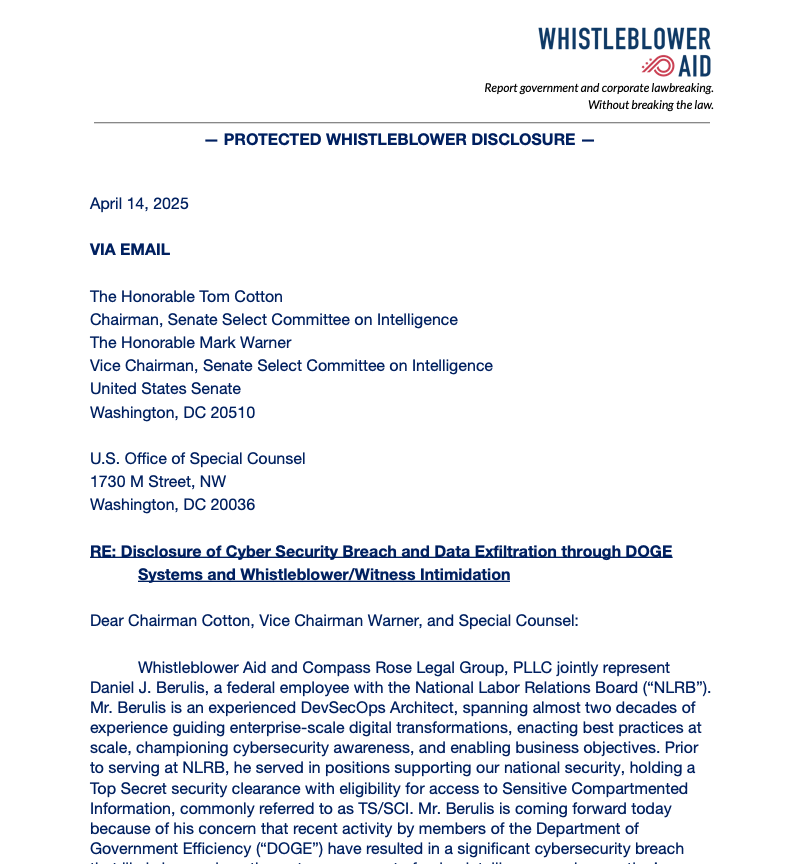
The cover letter from Berulis’s whistleblower statement, sent to the leaders of the Senate Select Committee on Intelligence.

The allegations came in an April 14 letter to the Senate Select Committee on Intelligence, signed by Daniel J. Berulis, a 38-year-old security architect at the NLRB.

NPR, which was the first to report on Berulis’s whistleblower complaint, says NLRB is a small, independent federal agency that investigates and adjudicates complaints about unfair labor practices, and stores “reams of potentially sensitive data, from confidential information about employees who want to form unions to proprietary business information.”

The complaint documents a one-month period beginning March 3, during which DOGE officials reportedly demanded the creation of all-powerful “tenant admin” accounts in NLRB systems that were to be exempted from network logging activity that would otherwise keep a detailed record of all actions taken by those accounts.

Berulis said the new DOGE accounts had unrestricted permission to read, copy, and alter information contained in NLRB databases. The new accounts also could restrict log visibility, delay retention, route logs elsewhere, or even remove them entirely — top-tier user privileges that neither Berulis nor his boss possessed.

Berulis writes that on March 3, a black SUV accompanied by a police escort arrived at his building — the NLRB headquarters in Southeast Washington, D.C. The DOGE staffers did not speak with Berulis or anyone else in NLRB’s IT staff, but instead met with the agency leadership.

“Our acting chief information officer told us not to adhere to standard operating procedure with the DOGE account creation, and there was to be no logs or records made of the accounts created for DOGE employees, who required the highest level of access,” Berulis wrote of their instructions after that meeting.

“We have built in roles that auditors can use and have used extensively in the past but would not give the ability to make changes or access subsystems without approval,” he continued. “The suggestion that they use these accounts was not open to discussion.”

Berulis found that on March 3 one of the DOGE accounts created an opaque, virtual environment known as a “container,” which can be used to build and run programs or scripts without revealing its activities to the rest of the world. Berulis said the container caught his attention because he polled his colleagues and found none of them had ever used containers within the NLRB network.

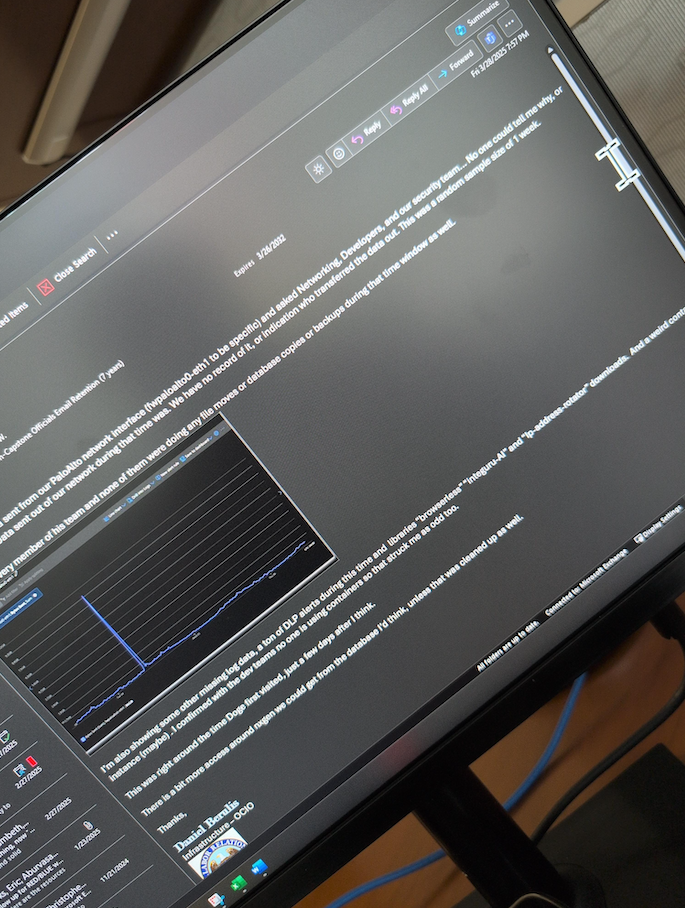
Berulis said he also noticed that early the next morning — between approximately 3 a.m. and 4 a.m. EST on Tuesday, March 4  — there was a large increase in outgoing traffic from the agency. He said it took several days of investigating with his colleagues to determine that one of the new accounts had transferred approximately 10 gigabytes worth of data from the NLRB’s NxGen case management system.

Berulis said neither he nor his co-workers had the necessary network access rights to review which files were touched or transferred — or even where they went. But his complaint notes the NxGen database contains sensitive information on unions, ongoing legal cases, and corporate secrets.

“I also don’t know if the data was only 10gb in total or whether or not they were consolidated and compressed prior,” Berulis told the senators. “This opens up the possibility that even more data was exfiltrated. Regardless, that kind of spike is extremely unusual because data almost never directly leaves NLRB’s databases.”

Berulis said he and his colleagues grew even more alarmed when they noticed nearly two dozen login attempts from a Russian Internet address (83.149.30,186) that presented valid login credentials for a DOGE employee account — one that had been created just minutes earlier. Berulis said those attempts were all blocked thanks to rules in place that prohibit logins from non-U.S. locations.

“Whoever was attempting to log in was using one of the newly created accounts that were used in the other DOGE related activities and it appeared they had the correct username and password due to the authentication flow only stopping them due to our no-out-of-country logins policy activating,” Berulis wrote. “There were more than 20 such attempts, and what is particularly concerning is that many of these login attempts occurred within 15 minutes of the accounts being created by DOGE engineers.”

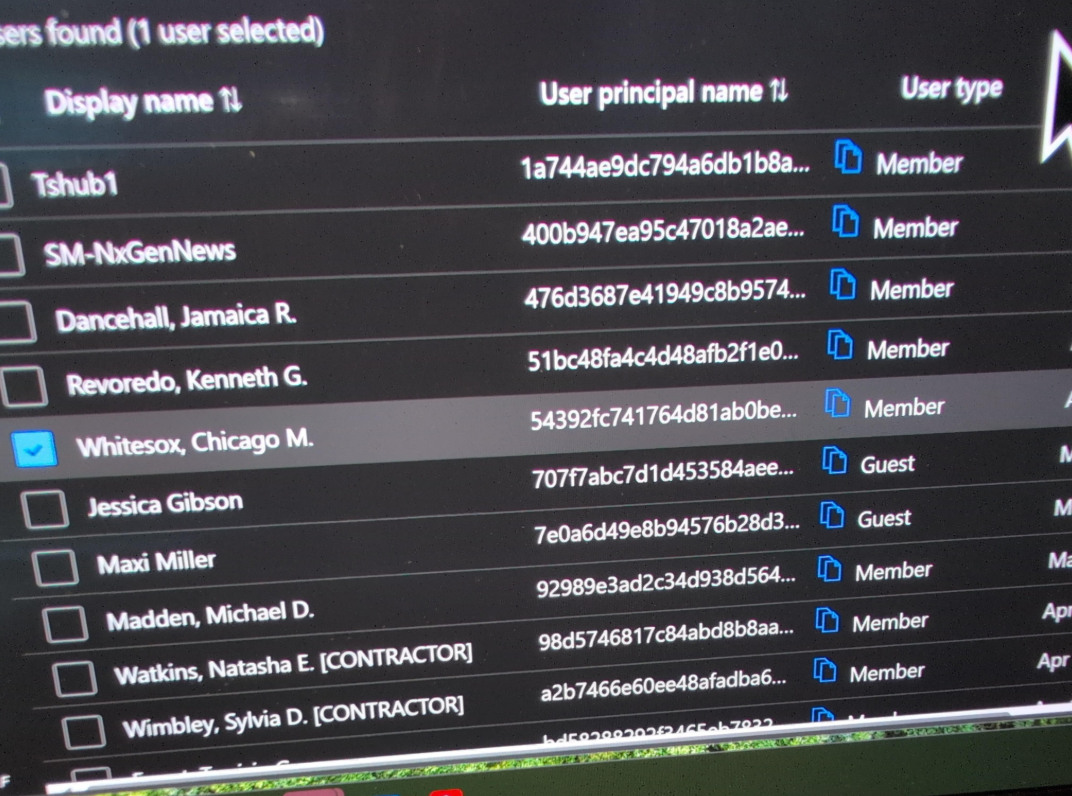
According to Berulis, the naming structure of one Microsoft user account connected to the suspicious activity suggested it had been created and later deleted for DOGE use in the NLRB’s cloud systems: “DogeSA_2d5c3e0446f9@nlrb.microsoft.com.” He also found other new Microsoft cloud administrator accounts with nonstandard usernames, including “Whitesox, Chicago M.” and “Dancehall, Jamaica R.”

A screenshot shared by Berulis showing the suspicious user accounts.

On March 5, Berulis documented that a large section of logs for recently created network resources were missing, and a network watcher in Microsoft Azure was set to the “off” state, meaning it was no longer collecting and recording data like it should have.

Berulis said he discovered someone had downloaded three external code libraries from GitHub that neither NLRB nor its contractors ever use. A “readme” file in one of the code bundles explained it was created to rotate connections through a large pool of cloud Internet addresses that serve “as a proxy to generate pseudo-infinite IPs for web scraping and brute forcing.” Brute force attacks involve automated login attempts that try many credential combinations in rapid sequence.

The complaint alleges that by March 17 it became clear the NLRB no longer had the resources or network access needed to fully investigate the odd activity from the DOGE accounts, and that on March 24, the agency’s associate chief information officer had agreed the matter should be reported to US-CERT. Operated by the Department of Homeland Security’s Cybersecurity and Infrastructure Security Agency (CISA), US-CERT provides on-site cyber incident response capabilities to federal and state agencies.

But Berulis said that between April 3 and 4, he and the associate CIO were informed that “instructions had come down to drop the US-CERT reporting and investigation and we were directed not to move forward or create an official report.” Berulis said it was at this point he decided to go public with his findings.

An email from Daniel Berulis to his colleagues dated March 28, referencing the unexplained traffic spike earlier in the month and the unauthorized changing of security controls for user accounts.

Tim Bearese, the NLRB’s acting press secretary, told NPR that DOGE neither requested nor received access to its systems, and that “the agency conducted an investigation after Berulis raised his concerns but ‘determined that no breach of agency systems occurred.’” The NLRB did not respond to questions from KrebsOnSecurity.

Nevertheless, Berulis has shared a number of supporting screenshots showing agency email discussions about the unexplained account activity attributed to the DOGE accounts, as well as NLRB security alerts from Microsoft about network anomalies observed during the timeframes described.

As CNN reported last month, the NLRB has been effectively hobbled since President Trump fired three board members, leaving the agency without the quorum it needs to function.

“Despite its limitations, the agency had become a thorn in the side of some of the richest and most powerful people in the nation — notably Elon Musk, Trump’s key supporter both financially and arguably politically,” CNN wrote.

Both Amazon and Musk’s SpaceX have been suing the NLRB over complaints the agency filed in disputes about workers’ rights and union organizing, arguing that the NLRB’s very existence is unconstitutional. On March 5, a U.S. appeals court unanimously rejected Musk’s claim that the NLRB’s structure somehow violates the Constitution.

Berulis shared screenshots with KrebsOnSecurity showing that on the day the NPR published its story about his claims (April 14), the deputy CIO at NLRB sent an email stating that administrative control had been removed from all employee accounts. Meaning, suddenly none of the IT employees at the agency could do their jobs properly anymore, Berulis said.

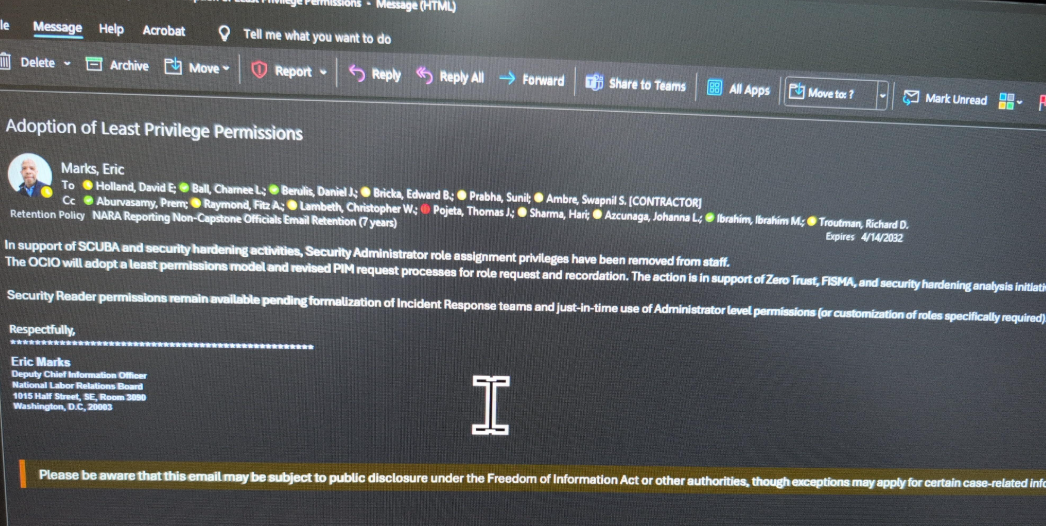
An email from the NLRB’s associate chief information officer Eric Marks, notifying employees they will lose security administrator privileges.

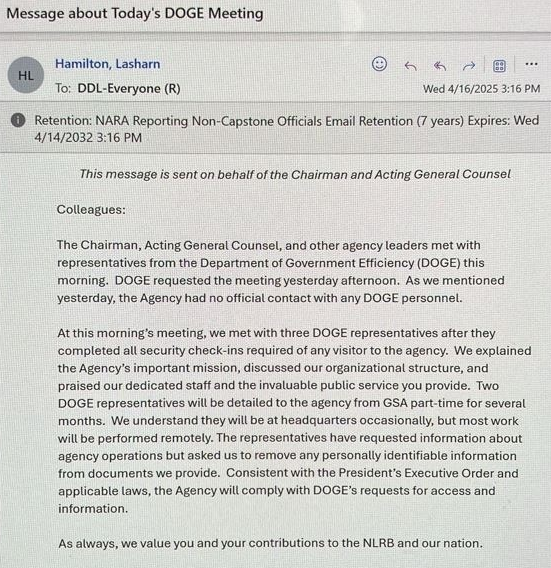
Berulis shared a screenshot of an agency-wide email dated April 16 from NLRB director Lasharn Hamilton saying DOGE officials had requested a meeting, and reiterating claims that the agency had no prior “official” contact with any DOGE personnel. The message informed NLRB employees that two DOGE representatives would be detailed to the agency part-time for several months.

An email from the NLRB Director Lasharn Hamilton on April 16, stating that the agency previously had no contact with DOGE personnel.

Berulis told KrebsOnSecurity he was in the process of filing a support ticket with Microsoft to request more information about the DOGE accounts when his network administrator access was restricted. Now, he’s hoping lawmakers will ask Microsoft to provide more information about what really happened with the accounts.

“That would give us way more insight,” he said. “Microsoft has to be able to see the picture better than we can. That’s my goal, anyway.”

Berulis’s attorney told lawmakers that on April 7, while his client and legal team were preparing the whistleblower complaint, someone physically taped a threatening note to Mr. Berulis’s home door with photographs — taken via drone — of him walking in his neighborhood.

“The threatening note made clear reference to this very disclosure he was preparing for you, as the proper oversight authority,” reads a preface by Berulis’s attorney Andrew P. Bakaj. “While we do not know specifically who did this, we can only speculate that it involved someone with the ability to access NLRB systems.”

Berulis said the response from friends, colleagues and even the public has been largely supportive, and that he doesn’t regret his decision to come forward.

“I didn’t expect the letter on my door or the pushback from [agency] leaders,” he said. “If I had to do it over, would I do it again? Yes, because it wasn’t really even a choice the first time.”

For now, Mr. Berulis is taking some paid family leave from the NLRB. Which is just as well, he said, considering he was stripped of the tools needed to do his job at the agency.

“They came in and took full administrative control and locked everyone out, and said limited permission will be assigned on a need basis going forward” Berulis said of the DOGE employees. “We can’t really do anything, so we’re literally getting paid to count ceiling tiles.”

Further reading: Berulis’s complaint (PDF).

from Krebs on Security https://ift.tt/ZtSp2Ks
via IFTTT

Funding Expires for Key Cyber Vulnerability Database

A critical resource that cybersecurity professionals worldwide rely on to identify, mitigate and fix security vulnerabilities in software and hardware is in danger of breaking down. The federally funded, non-profit research and development organization MITRE warned today that its contract to maintain the Common Vulnerabilities and Exposures (CVE) program — which is traditionally funded each year by the Department of Homeland Security — expires on April 16.

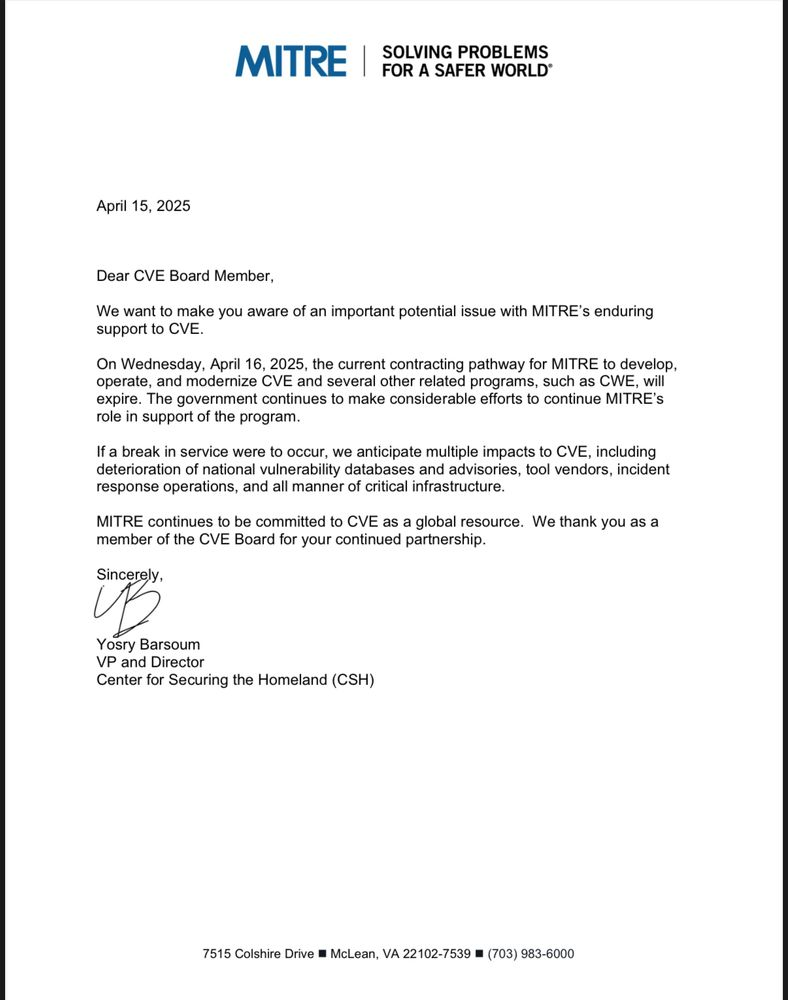
A letter from MITRE vice president Yosry Barsoum, warning that the funding for the CVE program will expire on April 16, 2025.

Tens of thousands of security flaws in software are found and reported every year, and these vulnerabilities are eventually assigned their own unique CVE tracking number (e.g. CVE-2024-43573, which is a Microsoft Windows bug that Redmond patched last year).

There are hundreds of organizations — known as CVE Numbering Authorities (CNAs) — that are authorized by MITRE to bestow these CVE numbers on newly reported flaws. Many of these CNAs are country and government-specific, or tied to individual software vendors or vulnerability disclosure platforms (a.k.a. bug bounty programs).

Put simply, MITRE is a critical, widely-used resource for centralizing and standardizing information on software vulnerabilities. That means the pipeline of information it supplies is plugged into an array of cybersecurity tools and services that help organizations identify and patch security holes — ideally before malware or malcontents can wriggle through them.

“What the CVE lists really provide is a standardized way to describe the severity of that defect, and a centralized repository listing which versions of which products are defective and need to be updated,” said Matt Tait, chief operating officer of Corellium, a cybersecurity firm that sells phone-virtualization software for finding security flaws.

In a letter sent today to the CVE board, MITRE Vice President Yosry Barsoum warned that on April 16, 2025, “the current contracting pathway for MITRE to develop, operate and modernize CVE and several other related programs will expire.”

“If a break in service were to occur, we anticipate multiple impacts to CVE, including deterioration of national vulnerability databases and advisories, tool vendors, incident response operations, and all manner of critical infrastructure,” Barsoum wrote.

MITRE told KrebsOnSecurity the CVE website listing vulnerabilities will remain up after the funding expires, but that new CVEs won’t be added after April 16.

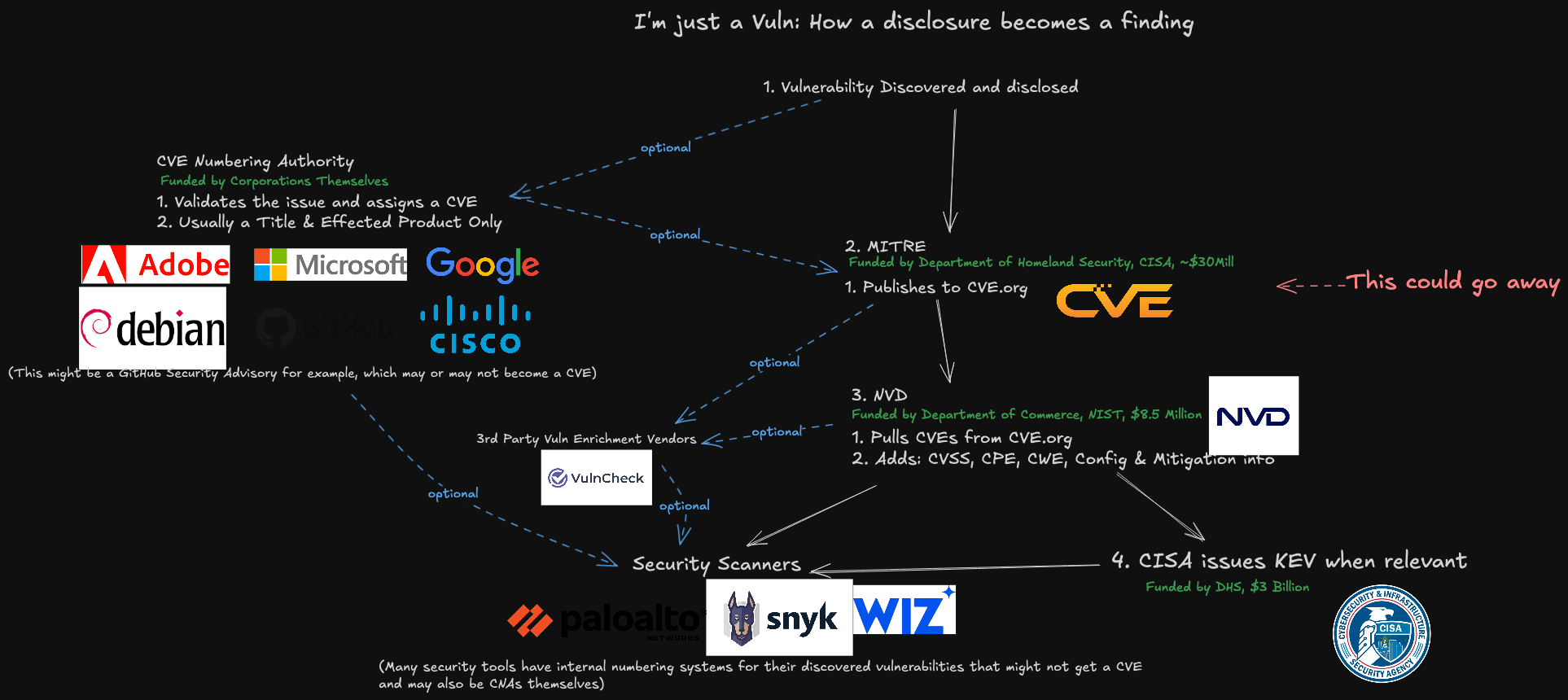
A representation of how a vulnerability becomes a CVE, and how that information is consumed. Image: James Berthoty, Latio Tech, via LinkedIn.

DHS officials did not immediately respond to a request for comment. The program is funded through DHS’s Cybersecurity & Infrastructure Security Agency (CISA), which is currently facing deep budget and staffing cuts by the Trump administration.

Former CISA Director Jen Easterly said the CVE program is a bit like the Dewey Decimal System, but for cybersecurity.

“It’s the global catalog that helps everyone—security teams, software vendors, researchers, governments—organize and talk about vulnerabilities using the same reference system,” Easterly said in a post on LinkedIn. “Without it, everyone is using a different catalog or no catalog at all, no one knows if they’re talking about the same problem, defenders waste precious time figuring out what’s wrong, and worst of all, threat actors take advantage of the confusion.”

John Hammond, principal security researcher at the managed security firm Huntress, told Reuters he swore out loud when he heard the news that CVE’s funding was in jeopardy, and that losing the CVE program would be like losing “the language and lingo we used to address problems in cybersecurity.”

“I really can’t help but think this is just going to hurt,” said Hammond, who posted a Youtube video to vent about the situation and alert others.

Several people close to the matter told KrebsOnSecurity this is not the first time the CVE program’s budget has been left in funding limbo until the last minute. Barsoum’s letter, which was apparently leaked, sounded a hopeful note, saying the government is making “considerable efforts to continue MITRE’s role in support of the program.”

Tait said that without the CVE program, risk managers inside companies would need to continuously monitor many other places for information about new vulnerabilities that may jeopardize the security of their IT networks. Meaning, it may become more common that software updates get mis-prioritized, with companies having hackable software deployed for longer than they otherwise would, he said.

“Hopefully they will resolve this, but otherwise the list will rapidly fall out of date and stop being useful,” he said.

from Krebs on Security https://ift.tt/to8yp5T
via IFTTT

Trump Revenge Tour Targets Cyber Leaders, Elections

President Trump last week revoked security clearances for Chris Krebs, the former director of the Cybersecurity and Infrastructure Security Agency (CISA) who was fired by Trump after declaring the 2020 election the most secure in U.S. history. The White House memo, which also suspended clearances for other security professionals at Krebs’s employer SentinelOne, comes as CISA is facing huge funding and staffing cuts.

Chris Krebs. Image: Getty Images.

The extraordinary April 9 memo directs the attorney general to investigate Chris Krebs (no relation), calling him “a significant bad-faith actor who weaponized and abused his government authority.”

The memo said the inquiry will include “a comprehensive evaluation of all of CISA’s activities over the last 6 years and will identify any instances where Krebs’ or CISA’s conduct appears to be contrary to the administration’s commitment to free speech and ending federal censorship, including whether Krebs’ conduct was contrary to suitability standards for federal employees or involved the unauthorized dissemination of classified information.”

CISA was created in 2018 during Trump’s first term, with Krebs installed as its first director. In 2020, CISA launched Rumor Control, a website that sought to rebut disinformation swirling around the 2020 election.

That effort ran directly counter to Trump’s claims that he lost the election because it was somehow hacked and stolen. The Trump campaign and its supporters filed at least 62 lawsuits contesting the election, vote counting, and vote certification in nine states, and nearly all of those cases were dismissed or dropped for lack of evidence or standing.

When the Justice Department began prosecuting people who violently attacked the U.S. Capitol on January 6, 2021, President Trump and Republican leaders shifted the narrative, claiming that Trump lost the election because the previous administration had censored conservative voices on social media.

Incredibly, the president’s memo seeking to ostracize Krebs stands reality on its head, accusing Krebs of promoting the censorship of election information, “including known risks associated with certain voting practices.” Trump also alleged that Krebs “falsely and baselessly denied that the 2020 election was rigged and stolen, including by inappropriately and categorically dismissing widespread election malfeasance and serious vulnerabilities with voting machines” [emphasis added].

Krebs did not respond to a request for comment. SentinelOne issued a statement saying it would cooperate in any review of security clearances held by its personnel, which is currently fewer than 10 employees.

Krebs’s former agency is now facing steep budget and staff reductions. The Record reports that CISA is looking to remove some 1,300 people by cutting about half its full-time staff and another 40% of its contractors.

“The agency’s National Risk Management Center, which serves as a hub analyzing risks to cyber and critical infrastructure, is expected to see significant cuts, said two sources familiar with the plans,” The Record’s Suzanne Smalley wrote. “Some of the office’s systematic risk responsibilities will potentially be moved to the agency’s Cybersecurity Division, according to one of the sources.”

CNN reports the Trump administration is also advancing plans to strip civil service protections from 80% of the remaining CISA employees, potentially allowing them to be fired for political reasons.

The Electronic Frontier Foundation (EFF) urged professionals in the cybersecurity community to defend Krebs and SentinelOne, noting that other security companies and professionals could be the next victims of Trump’s efforts to politicize cybersecurity.

“The White House must not be given free reign to turn cybersecurity professionals into political scapegoats,” the EFF wrote. “It is critical that the cybersecurity community now join together to denounce this chilling attack on free speech and rally behind Krebs and SentinelOne rather than cowering because they fear they will be next.”

However, Reuters said it found little sign of industry support for Krebs or SentinelOne, and that many security professionals are concerned about potentially being targeted if they speak out.

“Reuters contacted 33 of the largest U.S. cybersecurity companies, including tech companies and professional services firms with large cybersecurity practices, and three industry groups, for comment on Trump’s action against SentinelOne,” wrote Raphael Satter and A.J. Vicens. “Only one offered comment on Trump’s action. The rest declined, did not respond or did not answer questions.”

CYBERCOM-PLICATIONS

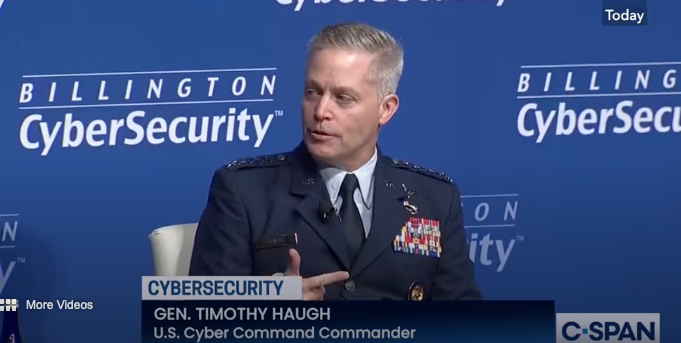
On April 3, President Trump fired Gen. Timothy Haugh, the head of the National Security Agency (NSA) and the U.S. Cyber Command, as well as Haugh’s deputy, Wendy Noble. The president did so immediately after meeting in the Oval Office with far-right conspiracy theorist Laura Loomer, who reportedly urged their dismissal. Speaking to reporters on Air Force One after news of the firings broke, Trump questioned Haugh’s loyalty.

Gen. Timothy Haugh. Image: C-SPAN.

Virginia Senator Mark Warner, the top Democrat on the Senate Intelligence Committee, called it inexplicable that the administration would remove the senior leaders of NSA-CYBERCOM without cause or warning, and risk disrupting critical ongoing intelligence operations.

“It is astonishing, too, that President Trump would fire the nonpartisan, experienced leader of the National Security Agency while still failing to hold any member of his team accountable for leaking classified information on a commercial messaging app – even as he apparently takes staffing direction on national security from a discredited conspiracy theorist in the Oval Office,” Warner said in a statement.

On Feb. 28, The Record’s Martin Matishak cited three sources saying Defense Secretary Pete Hegseth ordered U.S. Cyber Command to stand down from all planning against Russia, including offensive digital actions. The following day, The Guardian reported that analysts at CISA were verbally informed that they were not to follow or report on Russian threats, even though this had previously been a main focus for the agency.

A follow-up story from The Washington Post cited officials saying Cyber Command had received an order to halt active operations against Russia, but that the pause was intended to last only as long as negotiations with Russia continue.

The Department of Defense responded on Twitter/X that Hegseth had “neither canceled nor delayed any cyber operations directed against malicious Russian targets and there has been no stand-down order whatsoever from that priority.”

But on March 19, Reuters reported several U.S. national security agencies have halted work on a coordinated effort to counter Russian sabotage, disinformation and cyberattacks.

“Regular meetings between the National Security Council and European national security officials have gone unscheduled, and the NSC has also stopped formally coordinating efforts across U.S. agencies, including with the FBI, the Department of Homeland Security and the State Department,” Reuters reported, citing current and former officials.

TARIFFS VS TYPHOONS

President’s Trump’s institution of 125% tariffs on goods from China has seen Beijing strike back with 84 percent tariffs on U.S. imports. Now, some security experts are warning that the trade war could spill over into a cyber conflict, given China’s successful efforts to burrow into America’s critical infrastructure networks.

Over the past year, a number of Chinese government-backed digital intrusions have come into focus, including a sprawling espionage campaign involving the compromise of at least nine U.S. telecommunications providers. Dubbed “Salt Typhoon” by Microsoft, these telecom intrusions were pervasive enough that CISA and the FBI in December 2024 warned Americans against communicating sensitive information over phone networks, urging people instead to use encrypted messaging apps (like Signal).

The other broad ranging China-backed campaign is known as “Volt Typhoon,” which CISA described as “state-sponsored cyber actors seeking to pre-position themselves on IT networks for disruptive or destructive cyberattacks against U.S. critical infrastructure in the event of a major crisis or conflict with the United States.”

Responsibility for determining the root causes of the Salt Typhoon security debacle fell to the Cyber Safety Review Board (CSRB), a nonpartisan government entity established in February 2022 with a mandate to investigate the security failures behind major cybersecurity events. But on his first full day back in the White House, President Trump dismissed all 15 CSRB advisory committee members — likely because those advisers included Chris Krebs.

Last week, Sen. Ron Wyden (D-Ore.) placed a hold on Trump’s nominee to lead CISA, saying the hold would continue unless the agency published a report on the telecom industry hacks, as promised.

“CISA’s multi-year cover up of the phone companies’ negligent cybersecurity has real consequences,” Wyden said in a statement. “Congress and the American people have a right to read this report.”

The Wall Street Journal reported last week Chinese officials acknowledged in a secret December meeting that Beijing was behind the widespread telecom industry compromises.

“The Chinese official’s remarks at the December meeting were indirect and somewhat ambiguous, but most of the American delegation in the room interpreted it as a tacit admission and a warning to the U.S. about Taiwan,” The Journal’s Dustin Volz wrote, citing a former U.S. official familiar with the meeting.

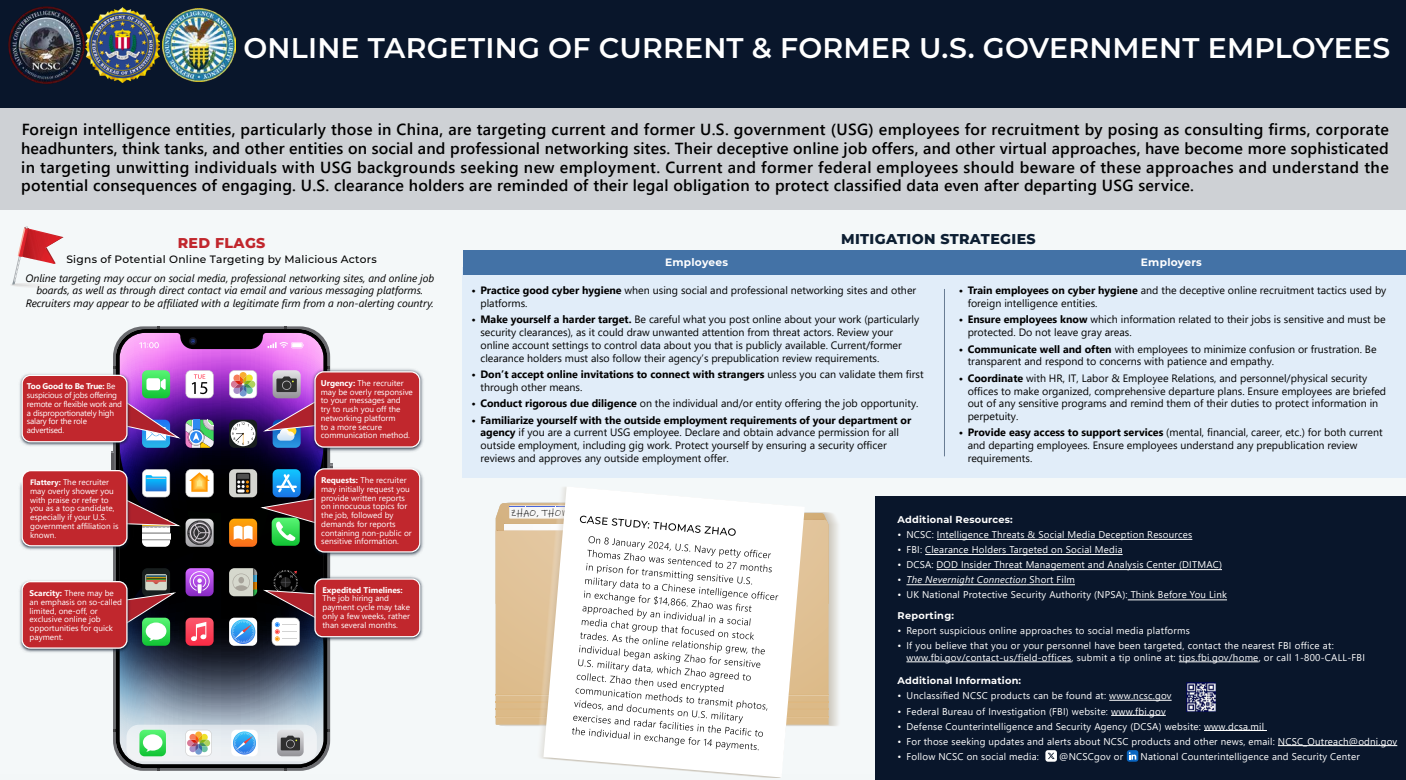
Meanwhile, China continues to take advantage of the mass firings of federal workers. On April 9, the National Counterintelligence and Security Center warned (PDF) that Chinese intelligence entities are pursuing an online effort to recruit recently laid-off U.S. employees.

“Foreign intelligence entities, particularly those in China, are targeting current and former U.S. government (USG) employees for recruitment by posing as consulting firms, corporate headhunters, think tanks, and other entities on social and professional networking sites,” the alert warns. “Their deceptive online job offers, and other virtual approaches, have become more sophisticated in targeting unwitting individuals with USG backgrounds seeking new employment.”

Image: Dni.gov

ELECTION THREATS

As Reuters notes, the FBI last month ended an effort to counter interference in U.S. elections by foreign adversaries including Russia, and put on leave staff working on the issue at the Department of Homeland Security.

Meanwhile, the U.S. Senate is now considering a House-passed bill dubbed the “Safeguard American Voter Eligibility (SAVE) Act,” which would order states to obtain proof of citizenship, such as a passport or a birth certificate, in person from those seeking to register to vote.

Critics say the SAVE Act could disenfranchise millions of voters and discourage eligible voters from registering to vote. What’s more, documented cases of voter fraud are few and far between, as is voting by non-citizens. Even the conservative Heritage Foundation acknowledges as much: An interactive “election fraud map” published by Heritage lists just 1,576 convictions or findings of voter fraud between 1982 and the present day.

Nevertheless, the GOP-led House passed the SAVE Act with the help of four Democrats. Its passage in the Senate will require support from at least seven Democrats, Newsweek writes.

In February, CISA cut roughly 130 employees, including its election security advisors. The agency also was forced to freeze all election security activities pending an internal review. The review was reportedly completed in March, but the Trump administration has said the findings would not be made public, and there is no indication of whether any cybersecurity support has been restored.

Many state leaders have voiced anxiety over the administration’s cuts to CISA programs that provide assistance and threat intelligence to election security efforts. Iowa Secretary of State Paul Pate last week told the PBS show Iowa Press he would not want to see those programs dissolve.

“If those (systems) were to go away, it would be pretty serious,” Pate said. “We do count on a lot those cyber protections.”

Pennsylvania’s Secretary of the Commonwealth Al Schmidt recently warned the CISA election security cuts would make elections less secure, and said no state on its own can replace federal election cybersecurity resources.

The Pennsylvania Capital-Star reports that several local election offices received bomb threats around the time polls closed on Nov. 5, and that in the week before the election a fake video showing mail-in ballots cast for Trump and Sen. Dave McCormick (R-Pa.) being destroyed and thrown away was linked to a Russian disinformation campaign.

“CISA was able to quickly identify not only that it was fraudulent, but also the source of it, so that we could share with our counties and we could share with the public so confidence in the election wasn’t undermined,” Schmidt said.

According to CNN, the administration’s actions have deeply alarmed state officials, who warn the next round of national elections will be seriously imperiled by the cuts. A bipartisan association representing 46 secretaries of state, and several individual top state election officials, have pressed the White House about how critical functions of protecting election security will perform going forward. However, CNN reports they have yet to receive clear answers.

Nevada and 18 other states are suing Trump over an executive order he issued on March 25 that asserts the executive branch has broad authority over state election procedures.

“None of the president’s powers allow him to change the rules of elections,” Nevada Secretary of State Cisco Aguilar wrote in an April 11 op-ed. “That is an intentional feature of our Constitution, which the Framers built in to ensure election integrity. Despite that, Trump is seeking to upend the voter registration process; impose arbitrary deadlines on vote counting; allow an unelected and unaccountable billionaire to invade state voter rolls; and withhold congressionally approved funding for election security.”

The order instructs the U.S. Election Assistance Commission to abruptly amend the voluntary federal guidelines for voting machines without going through the processes mandated by federal law. And it calls for allowing the administrator of the so-called Department of Government Efficiency (DOGE), along with DHS, to review state voter registration lists and other records to identify non-citizens.

The Atlantic’s Paul Rosenzweig notes that the chief executive of the country — whose unilateral authority the Founding Fathers most feared — has literally no role in the federal election system.

“Trump’s executive order on elections ignores that design entirely,” Rosenzweig wrote. “He is asserting an executive-branch role in governing the mechanics of a federal election that has never before been claimed by a president. The legal theory undergirding this assertion — that the president’s authority to enforce federal law enables him to control state election activity — is as capacious as it is frightening.”

from Krebs on Security https://ift.tt/FEyOluq
via IFTTT

China-based SMS Phishing Triad Pivots to Banks

China-based purveyors of SMS phishing kits are enjoying remarkable success converting phished payment card data into mobile wallets from Apple and Google. Until recently, the so-called “Smishing Triad” mainly impersonated toll road operators and shipping companies. But experts say these groups are now directly targeting customers of international financial institutions, while dramatically expanding their cybercrime infrastructure and support staff.

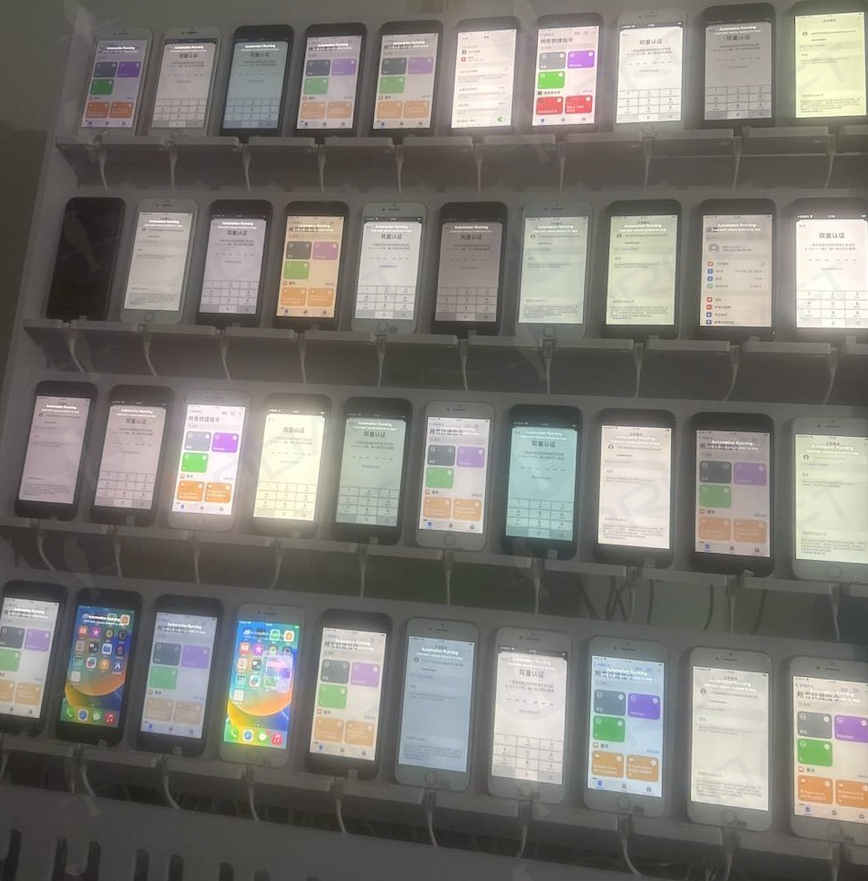
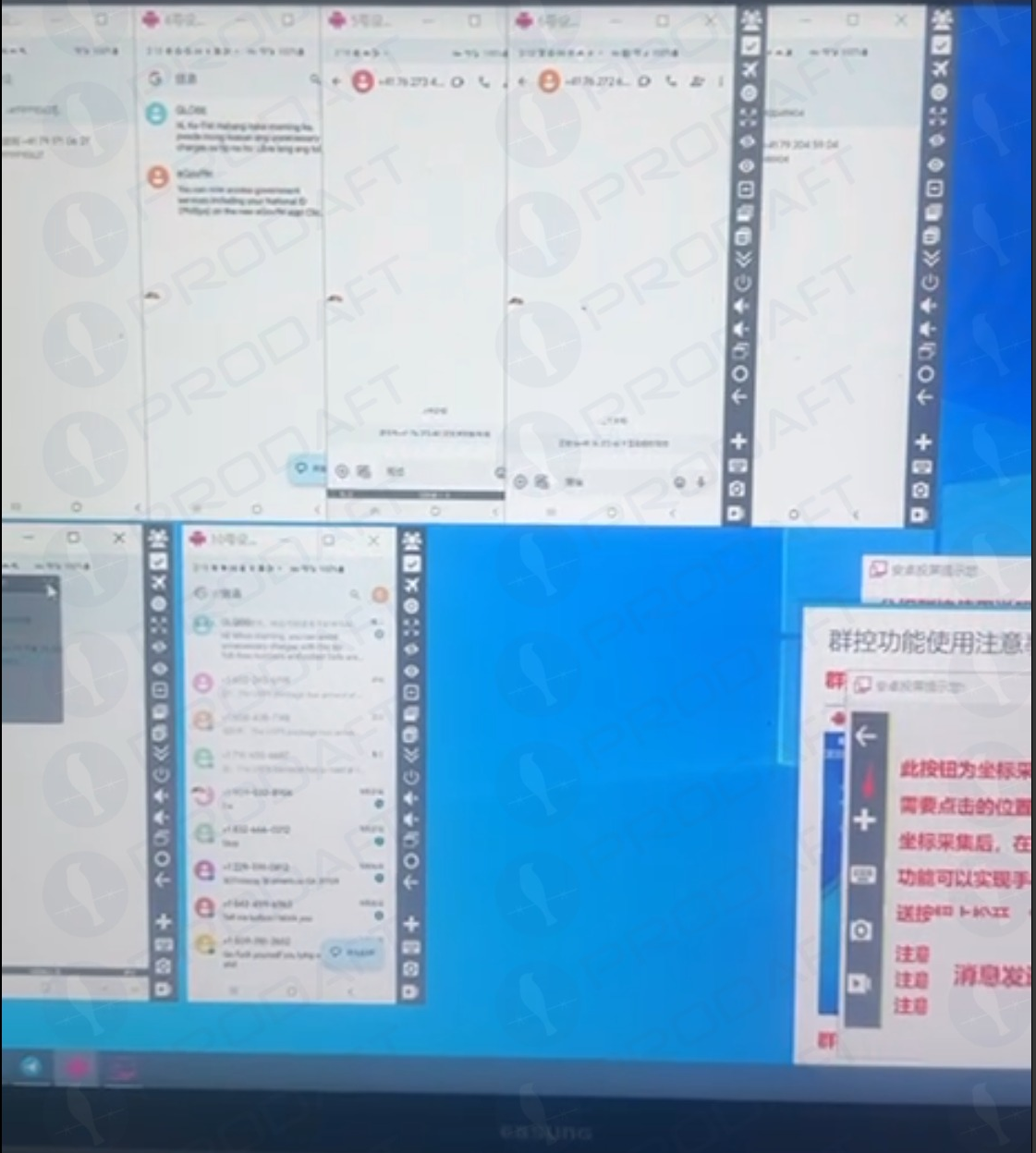
An image of an iPhone device farm shared on Telegram by one of the Smishing Triad members. Image: Prodaft.

If you own a mobile device, the chances are excellent that at some point in the past two years you’ve received at least one instant message that warns of a delinquent toll road fee, or a wayward package from the U.S. Postal Service (USPS). Those who click the promoted link are brought to a website that spoofs the USPS or a local toll road operator and asks for payment card information.

The site will then complain that the visitor’s bank needs to “verify” the transaction by sending a one-time code via SMS. In reality, the bank is sending that code to the mobile number on file for their customer because the fraudsters have just attempted to enroll that victim’s card details into a mobile wallet.

If the visitor supplies that one-time code, their payment card is then added to a new mobile wallet on an Apple or Google device that is physically controlled by the phishers. The phishing gangs typically load multiple stolen digital wallets onto a single Apple or Android device, and then sell those phones in bulk to scammers who use them for fraudulent e-commerce and tap-to-pay transactions.

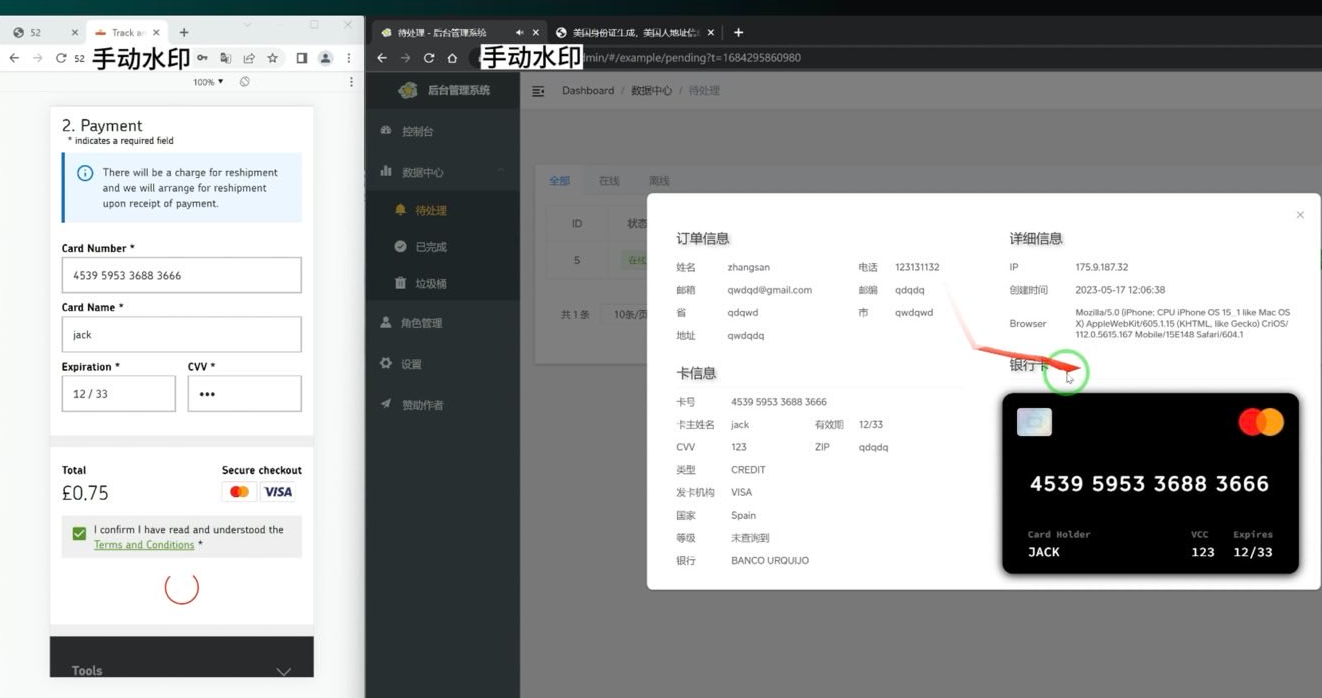
A screenshot of the administrative panel for a smishing kit. On the left is the (test) data entered at the phishing site. On the right we can see the phishing kit has superimposed the supplied card number onto an image of a payment card. When the phishing kit scans that created card image into Apple or Google Pay, it triggers the victim’s bank to send a one-time code. Image: Ford Merrill.

The moniker “Smishing Triad” comes from Resecurity, which was among the first to report in August 2023 on the emergence of three distinct mobile phishing groups based in China that appeared to share some infrastructure and innovative phishing techniques. But it is a bit of a misnomer because the phishing lures blasted out by these groups are not SMS or text messages in the conventional sense.

Rather, they are sent via iMessage to Apple device users, and via RCS on Google Android devices. Thus, the missives bypass the mobile phone networks entirely and enjoy near 100 percent delivery rate (at least until Apple and Google suspend the spammy accounts).

In a report published on March 24, the Swiss threat intelligence firm Prodaft detailed the rapid pace of innovation coming from the Smishing Triad, which it characterizes as a loosely federated group of Chinese phishing-as-a-service operators with names like Darcula, Lighthouse, and the Xinxin Group.

Prodaft said they’re seeing a significant shift in the underground economy, particularly among Chinese-speaking threat actors who have historically operated in the shadows compared to their Russian-speaking counterparts.

“Chinese-speaking actors are introducing innovative and cost-effective systems, enabling them to target larger user bases with sophisticated services,” Prodaft wrote. “Their approach marks a new era in underground business practices, emphasizing scalability and efficiency in cybercriminal operations.”

A new report from researchers at the security firm SilentPush finds the Smishing Triad members have expanded into selling mobile phishing kits targeting customers of global financial institutions like CitiGroup, MasterCard, PayPal, Stripe, and Visa, as well as banks in Canada, Latin America, Australia and the broader Asia-Pacific region.

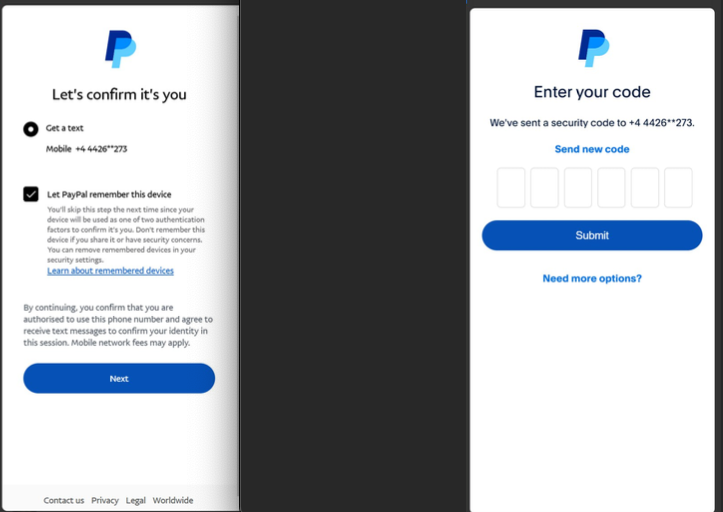
Phishing lures from the Smishing Triad spoofing PayPal. Image: SilentPush.

SilentPush found the Smishing Triad now spoofs recognizable brands in a variety of industry verticals across at least 121 countries and a vast number of industries, including the postal, logistics, telecommunications, transportation, finance, retail and public sectors.

According to SilentPush, the domains used by the Smishing Triad are rotated frequently, with approximately 25,000 phishing domains active during any 8-day period and a majority of them sitting at two Chinese hosting companies: Tencent (AS132203) and Alibaba (AS45102).

“With nearly two-thirds of all countries in the world targeted by [the] Smishing Triad, it’s safe to say they are essentially targeting every country with modern infrastructure outside of Iran, North Korea, and Russia,” SilentPush wrote. “Our team has observed some potential targeting in Russia (such as domains that mentioned their country codes), but nothing definitive enough to indicate Russia is a persistent target. Interestingly, even though these are Chinese threat actors, we have seen instances of targeting aimed at Macau and Hong Kong, both special administrative regions of China.”

SilentPush’s Zach Edwards said his team found a vulnerability that exposed data from one of the Smishing Triad’s phishing pages, which revealed the number of visits each site received each day across thousands of phishing domains that were active at the time. Based on that data, SilentPush estimates those phishing pages received well more than a million visits within a 20-day time span.

The report notes the Smishing Triad boasts it has “300+ front desk staff worldwide” involved in one of their more popular phishing kits — Lighthouse — staff that is mainly used to support various aspects of the group’s fraud and cash-out schemes.

The Smishing Triad members maintain their own Chinese-language sales channels on Telegram, which frequently offer videos and photos of their staff hard at work. Some of those images include massive walls of phones used to send phishing messages, with human operators seated directly in front of them ready to receive any time-sensitive one-time codes.

As noted in February’s story How Phished Data Turns Into Apple and Google Wallets, one of those cash-out schemes involves an Android app called Z-NFC, which can relay a valid NFC transaction from one of these compromised digital wallets to anywhere in the world. For a $500 month subscription, the customer can wave their phone at any payment terminal that accepts Apple or Google pay, and the app will relay an NFC transaction over the Internet from a stolen wallet on a phone in China.

Chinese nationals were recently busted trying to use these NFC apps to buy high-end electronics in Singapore. And in the United States, authorities in California and Tennessee arrested Chinese nationals accused of using NFC apps to fraudulently purchase gift cards from retailers.

The Prodaft researchers said they were able to find a previously undocumented backend management panel for Lucid, a smishing-as-a-service operation tied to the XinXin Group. The panel included victim figures that suggest the smishing campaigns maintain an average success rate of approximately five percent, with some domains receiving over 500 visits per week.

“In one observed instance, a single phishing website captured 30 credit card records from 550 victim interactions over a 7-day period,” Prodaft wrote.

Prodaft’s report details how the Smishing Triad has achieved such success in sending their spam messages. For example, one phishing vendor appears to send out messages using dozens of Android device emulators running in parallel on a single machine.

Phishers using multiple virtualized Android devices to orchestrate and distribute RCS-based scam campaigns. Image: Prodaft.

According to Prodaft, the threat actors first acquire phone numbers through various means including data breaches, open-source intelligence, or purchased lists from underground markets. They then exploit technical gaps in sender ID validation within both messaging platforms.

“For iMessage, this involves creating temporary Apple IDs with impersonated display names, while RCS exploitation leverages carrier implementation inconsistencies in sender verification,” Prodaft wrote. “Message delivery occurs through automated platforms using VoIP numbers or compromised credentials, often deployed in precisely timed multi-wave campaigns to maximize effectiveness.

In addition, the phishing links embedded in these messages use time-limited single-use URLs that expire or redirect based on device fingerprinting to evade security analysis, they found.

“The economics strongly favor the attackers, as neither RCS nor iMessage messages incur per-message costs like traditional SMS, enabling high-volume campaigns at minimal operational expense,” Prodaft continued. “The overlap in templates, target pools, and tactics among these platforms underscores a unified threat landscape, with Chinese-speaking actors driving innovation in the underground economy. Their ability to scale operations globally and evasion techniques pose significant challenges to cybersecurity defenses.”

Ford Merrill works in security research at SecAlliance, a CSIS Security Group company. Merrill said he’s observed at least one video of a Windows binary that wraps a Chrome executable and can be used to load in target phone numbers and blast messages via RCS, iMessage, Amazon, Instagram, Facebook, and WhatsApp.

“The evidence we’ve observed suggests the ability for a single device to send approximately 100 messages per second,” Merrill said. “We also believe that there is capability to source country specific SIM cards in volume that allow them to register different online accounts that require validation with specific country codes, and even make those SIM cards available to the physical devices long-term so that services that rely on checks of the validity of the phone number or SIM card presence on a mobile network are thwarted.”

Experts say this fast-growing wave of card fraud persists because far too many financial institutions still default to sending one-time codes via SMS for validating card enrollment in mobile wallets from Apple or Google. KrebsOnSecurity interviewed multiple security executives at non-U.S. financial institutions who spoke on condition of anonymity because they were not authorized to speak to the press. Those banks have since done away with SMS-based one-time codes and are now requiring customers to log in to the bank’s mobile app before they can link their card to a digital wallet.

from Krebs on Security https://ift.tt/QIXwz1g
via IFTTT

Patch Tuesday, April 2025 Edition

Microsoft today released updates to plug at least 121 security holes in its Windows operating systems and software, including one vulnerability that is already being exploited in the wild. Eleven of those flaws earned Microsoft’s most-dire “critical” rating, meaning malware or malcontents could exploit them with little to no interaction from Windows users.

The zero-day flaw already seeing exploitation is CVE-2025-29824, a local elevation of privilege bug in the Windows Common Log File System (CLFS) driver.  Microsoft rates it as “important,” but as Chris Goettl from Ivanti points out, risk-based prioritization warrants treating it as critical.

This CLFS component of Windows is no stranger to Patch Tuesday: According to Tenable’s Satnam Narang, since 2022 Microsoft has patched 32 CLFS vulnerabilities — averaging 10 per year — with six of them exploited in the wild. The last CLFS zero-day was patched in December 2024.

Narang notes that while flaws allowing attackers to install arbitrary code are consistently top overall Patch Tuesday features, the data is reversed for zero-day exploitation.

“For the past two years, elevation of privilege flaws have led the pack and, so far in 2025, account for over half of all zero-days exploited,” Narang wrote.

Rapid7’s Adam Barnett warns that any Windows defenders responsible for an LDAP server — which means almost any organization with a non-trivial Microsoft footprint — should add patching for the critical flaw CVE-2025-26663 to their to-do list.

“With no privileges required, no need for user interaction, and code execution presumably in the context of the LDAP server itself, successful exploitation would be an attractive shortcut to any attacker,” Barnett said. “Anyone wondering if today is a re-run of December 2024 Patch Tuesday can take some small solace in the fact that the worst of the trio of LDAP critical RCEs published at the end of last year was likely easier to exploit than today’s example, since today’s CVE-2025-26663 requires that an attacker win a race condition. Despite that, Microsoft still expects that exploitation is more likely.”

Among the critical updates Microsoft patched this month are remote code execution flaws in Windows Remote Desktop services (RDP), including CVE-2025-26671, CVE-2025-27480 and CVE-2025-27482; only the latter two are rated “critical,” and Microsoft marked both of them as “Exploitation More Likely.”

Perhaps the most widespread vulnerabilities fixed this month were in web browsers. Google Chrome updated to fix 13 flaws this week, and Mozilla Firefox fixed eight bugs, with possibly more updates coming later this week for Microsoft Edge.

As it tends to do on Patch Tuesdays, Adobe has released 12 updates resolving 54 security holes across a range of products, including ColdFusion, Adobe Commerce, Experience Manager Forms, After Effects, Media Encoder, BridgePremiere Pro, Photoshop, Animate, AEM Screens, and FrameMaker.

Apple users may need to patch as well. On March 31, Apple released a huge security update (more than three gigabytes in size) to fix issues in a range of their products, including at least one zero-day flaw.

And in case you missed it, on March 31, 2025 Apple released a rather large batch of security updates for a wide range of their products, from macOS to the iOS operating systems on iPhones and iPads.

Earlier today, Microsoft included a note saying Windows 10 security updates weren’t available but would be released as soon as possible. It appears from browsing askwoody.com that this snafu has since been rectified. Either way, if you run into complications applying any of these updates please leave a note about it in the comments below, because the chances are good that someone else had the same problem.

As ever, please consider backing up your data and or devices prior to updating, which makes it far less complicated to undo a software update gone awry. For more granular details on today’s Patch Tuesday, check out the SANS Internet Storm Center’s roundup. Microsoft’s update guide for April 2025 is here.

For more details on Patch Tuesday, check out the write-ups from Action1 and Automox.

from Krebs on Security https://ift.tt/dgiLQNo
via IFTTT