Online Security Guards Hiring System 1.0 – Reflected XSS
from Exploit-DB.com RSS Feed https://ift.tt/C8fBAVW
via IFTTT

Online Security Guards Hiring System 1.0 – Reflected XSS
from Exploit-DB.com RSS Feed https://ift.tt/C8fBAVW
via IFTTT
Flexense HTTP Server 10.6.24 – Buffer Overflow (DoS) (Metasploit)
from Exploit-DB.com RSS Feed https://ift.tt/Nm60Klp
via IFTTT
unilogies/bumsys v1.0.3 beta – Unrestricted File Upload
from Exploit-DB.com RSS Feed https://ift.tt/sPTM5A6
via IFTTT
SCRMS 2023-05-27 1.0 – Multiple SQL Injection
from Exploit-DB.com RSS Feed https://ift.tt/lDykMPC
via IFTTT
Rukovoditel 3.3.1 – CSV injection
from Exploit-DB.com RSS Feed https://ift.tt/prh8H9Z
via IFTTT
A number of Discord communities focused on cryptocurrency have been hacked this past month after their administrators were tricked into running malicious Javascript code disguised as a Web browser bookmark.
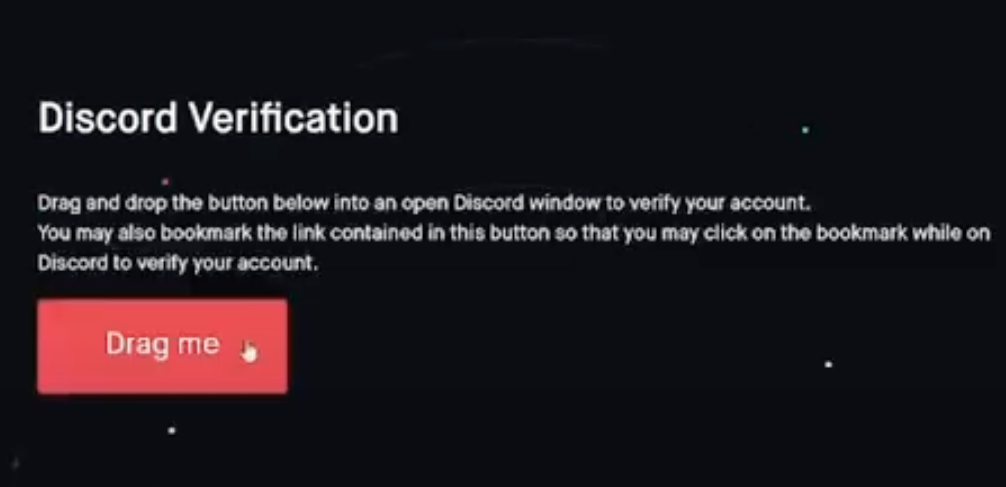
This attack involves malicious Javascript that is added to one’s browser by dragging a component from a web page to one’s browser bookmarks.
According to interviews with victims, several of the attacks began with an interview request from someone posing as a reporter for a crypto-focused news outlet online. Those who take the bait are sent a link to a Discord server that appears to be the official Discord of the crypto news site, where they are asked to complete a verification step to validate their identity.
As shown in this Youtube video, the verification process involves dragging a button from the phony crypto news Discord server to the bookmarks bar in one’s Web browser. From there, the visitor is instructed to go back to discord.com and then click the new bookmark to complete the verification process.
However, the bookmark is actually a clever snippet of Javascript that quietly grabs the user’s Discord token and sends it to the scammer’s website. The attacker then loads the stolen token into their own browser session and (usually late at night after the admins are asleep) posts an announcement in the targeted Discord about an exclusive “airdrop,” “NFT mint event” or some other potential money making opportunity for the Discord members.
The unsuspecting Discord members click the link provided by the compromised administrator account, and are asked to connect their crypto wallet to the scammer’s site, where it asks for unlimited spend approvals on their tokens, and subsequently drains the balance of any valuable accounts.
Meanwhile, anyone in the compromised Discord channel who notices the scam and replies is banned, and their messages are deleted by the compromised admin account.
Nicholas Scavuzzo is an associate at Ocean Protocol, which describes itself as an “open-source protocol that aims to allow businesses and individuals to exchange and monetize data and data-based services.” On May 22, an administrator for Ocean Protocol’s Discord server clicked a link in a direct message from a community member that prompted them to prove their identity by dragging a link to their bookmarks.
Scavuzzo, who is based in Maine, said the attackers waited until around midnight in his timezone time before using the administrator’s account to send out an unauthorized message about a new Ocean airdrop.
Scavuzzo said the administrator’s account was hijacked even though she had multi-factor authentication turned on.
“A CAPTCHA bot that allows Discord cookies to be accessed by the person hosting the CAPTCHA,” was how Scavuzzo described the attack. “I’ve seen all kinds of crypto scams, but I’ve never seen one like this.”
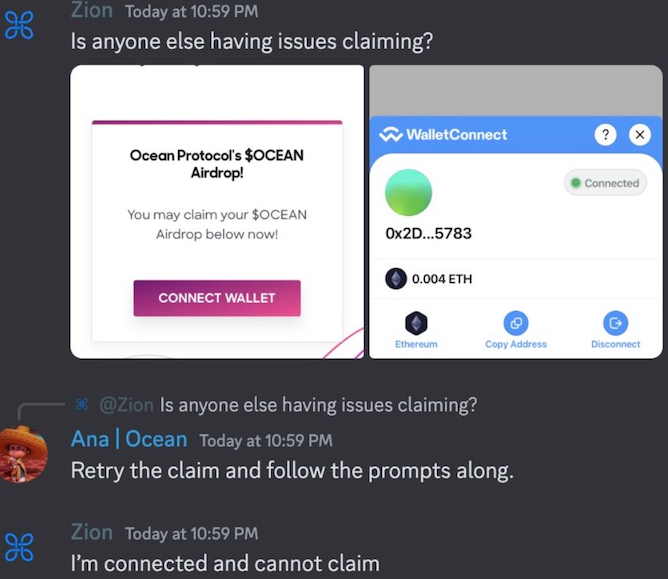
In this conversation, “Ana | Ocean” is a compromised Discord server administrator account promoting a phony airdrop.
Importantly, the stolen token only works for the attackers as long as its rightful owner doesn’t log out and back in, or else change their credentials.
Assuming the administrator can log in, that is. In Ocean’s case, one of the first things the intruders did once they swiped the administrator’s token was change the server’s access controls and remove all core Ocean team members from the server.
Fortunately for Ocean, Scavuzzo was able to reach the operator of the server that hosts the Discord channel, and have the channel’s settings reverted back to normal.
“Thankfully, we are a globally distributed team, so we have people awake at all hours,” Scavuzzo said, noting that Ocean is not aware of any Discord community members who fell for the phony airdrop offer, which was live for about 30 minutes. “This could have been a lot worse.”
On May 26, Aura Network reported on Twitter that its Discord server was compromised in a phishing attack that resulted in the deletion of Discord channels and the dissemination of fake Aura Network Airdrop Campaign links.
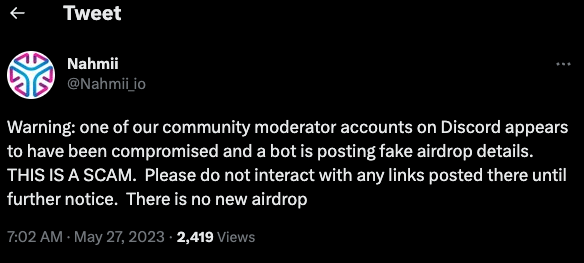
On May 27, Nahmii — a cryptocurrency technology based on the Ethereum blockchain — warned on Twitter that one of its community moderators on Discord was compromised and posting fake airdrop details.
On May 9, MetrixCoin reported that its Discord server was hacked, with fake airdrop details pushed to all users.
KrebsOnSecurity recently heard from a trusted source in the cybersecurity industry who dealt firsthand with one of these attacks and asked to remain anonymous.
“I do pro bono Discord security work for a few Discords, and I was approached by one of these fake journalists,” the source said. “I played along and got the link to their Discord, where they were pretending to be journalists from the Cryptonews website using several accounts.”
The source took note of all the Discord IDs of the admins of the fake Cryptonews Discord, so that he could ensure they were blocked from the Discords he helps to secure.
“Since I’ve been doing this for a while now, I’ve built up a substantial database of Discord users and messages, so often I can see these scammers’ history on Discord,” the source said.
In this case, he noticed a user with the “CEO” role in the fake Cryptonews Discord had been seen previously under another username — “Levatax.” Searching on that Discord ID and username revealed a young Turkish coder named Berk Yilmaz whose Github page linked to the very same Discord ID as the scammer CEO.
Reached via instant message on Telegram, Levatax said he’s had no involvement in such schemes, and that he hasn’t been on Discord since his Microsoft Outlook account was hacked months ago.
“The interesting thing [is] that I didn’t use Discord since few months or even social media because of the political status of Turkey,” Levatax explained, referring to the recent election in his country. “The only thing I confirm is losing my Outlook account which connected to my Discord, and I’m already in touch with Microsoft to recover it.”
The verification method used in the above scam involves a type of bookmark called a “bookmarklet” that stores Javascript code as a clickable link in the bookmarks bar at the top of one’s browser.
While bookmarklets can be useful and harmless, malicious Javascript that is executed in the browser by the user is especially dangerous. So please avoid adding (or dragging) any bookmarks or bookmarklets to your browser unless it was your idea in the first place.
from Krebs on Security https://ift.tt/fJbp6Mr
via IFTTT
What good is a popup asking for your approval if an attacker can bypass it simply by suprpessing it?
from Naked Security https://ift.tt/iqYN5zS
via IFTTT
ESET research uncovers an Android app that initially had no harmful features but months later turned into a spying tool
The post How an innocuous app morphed into a trojan – Week in security with Tony Anscombe appeared first on WeLiveSecurity
from WeLiveSecurity https://ift.tt/1ESBZap
via IFTTT
Camaleon CMS v2.7.0 – Server-Side Template Injection (SSTI)
from Exploit-DB.com RSS Feed https://ift.tt/ugfYvSC
via IFTTT
The number of phishing websites tied to domain name registrar Freenom dropped precipitously in the months surrounding a recent lawsuit from social networking giant Meta, which alleged the free domain name provider has a long history of ignoring abuse complaints about phishing websites while monetizing traffic to those abusive domains.
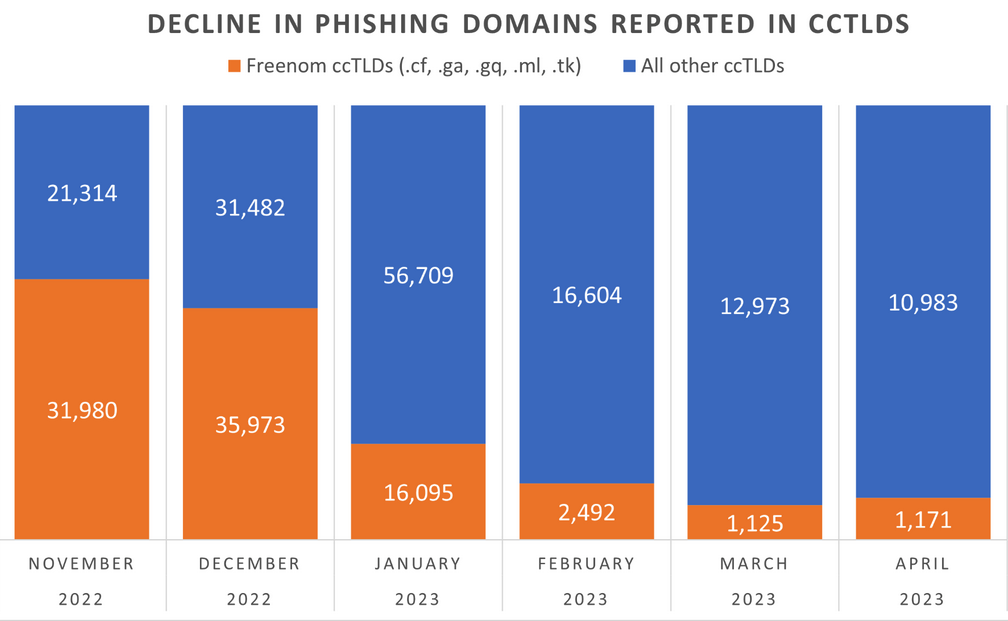
The volume of phishing websites registered through Freenom dropped considerably since the registrar was sued by Meta. Image: Interisle Consulting.
Freenom is the domain name registry service provider for five so-called “country code top level domains” (ccTLDs), including .cf for the Central African Republic; .ga for Gabon; .gq for Equatorial Guinea; .ml for Mali; and .tk for Tokelau.
Freenom has always waived the registration fees for domains in these country-code domains, but the registrar also reserves the right to take back free domains at any time, and to divert traffic to other sites — including adult websites. And there are countless reports from Freenom users who’ve seen free domains removed from their control and forwarded to other websites.
By the time Meta initially filed its lawsuit in December 2022, Freenom was the source of well more than half of all new phishing domains coming from country-code top-level domains. Meta initially asked a court to seal its case against Freenom, but that request was denied. Meta withdrew its December 2022 lawsuit and re-filed it in March 2023.
“The five ccTLDs to which Freenom provides its services are the TLDs of choice for cybercriminals because Freenom provides free domain name registration services and shields its customers’ identity, even after being presented with evidence that the domain names are being used for illegal purposes,” Meta’s complaint charged. “Even after receiving notices of infringement or phishing by its customers, Freenom continues to license new infringing domain names to those same customers.”
Meta pointed to research from Interisle Consulting Group, which discovered in 2021 and again last year that the five ccTLDs operated by Freenom made up half of the Top Ten TLDs most abused by phishers.
Interisle partner Dave Piscitello said something remarkable has happened in the months since the Meta lawsuit.
“We’ve observed a significant decline in phishing domains reported in the Freenom commercialized ccTLDs in months surrounding the lawsuit,” Piscitello wrote on Mastodon. “Responsible for over 60% of phishing domains reported in November 2022, Freenom’s percentage has dropped to under 15%.”
Interisle collects data from 12 major blocklists for spam, malware, and phishing, and it receives phishing-specific data from Spamhaus, Phishtank, OpenPhish and the APWG Ecrime Exchange. The company publishes historical data sets quarterly, both on malware and phishing.
Piscitello said it’s too soon to tell the full impact of the Freenom lawsuit, noting that Interisle’s sources of spam and phishing data all have different policies about when domains are removed from their block lists.
“One of the things we don’t have visibility into is how each of the blocklists determine to remove a URL from their lists,” he said. “Some of them time out [listed domains] after 14 days, some do it after 30, and some keep them forever.”
Freenom did not respond to requests for comment.
This is the second time in as many years that a lawsuit by Meta against a domain registrar has disrupted the phishing industry. In March 2020, Meta sued domain registrar giant Namecheap, alleging cybersquatting and trademark infringement.
The two parties settled the matter in April 2022. While the terms of that settlement have not been disclosed, new phishing domains registered through Namecheap declined more than 50 percent the following quarter, Interisle found.
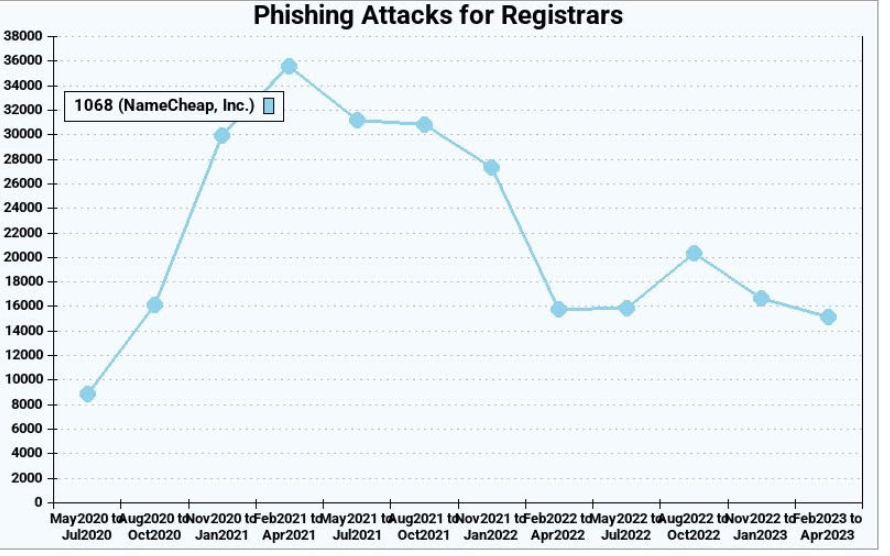
Phishing attacks using websites registered through Namecheap, before and after the registrar settled a lawsuit with Meta. Image: Interisle Consulting.
Unfortunately, the lawsuits have had little effect on the overall number of phishing attacks and phishing-related domains, which have steadily increased in volume over the years. Piscitello said the phishers tend to gravitate toward registrars that offer the least resistance and lowest price per domain. And with new top-level domains constantly being introduced, there is rarely a shortage of super low-priced domains.
“The abuse of a new top-level domain is largely the result of one registrar’s portfolio,” Piscitello told KrebsOnSecurity. “Alibaba or Namecheap or another registrar will run a promotion for a cheap domain, and then we’ll see flocking and migration of the phishers to that TLD. It’s like strip mining, where they’ll buy hundreds or thousands of domains, use those in a campaign, exhaust that TLD and then move on to another provider.”
Piscitello said despite the steep drop in phishing domains coming out of Freenom, the alternatives available to phishers are many. After all, there are more than 2,000 accredited domain registrars, not to mention dozens of services that let anyone set up a website for free without even owning a domain.
“There is no evidence that the trend line is even going to level off,” he said. “I think what the Meta lawsuit tells us is that litigation is like giving someone a standing eight count. It temporarily disrupts a process. And in that sense, litigation appears to be working.”
from Krebs on Security https://ift.tt/cy2hLRo
via IFTTT
 Pacosite's Blog