Russia Sends Cybersecurity CEO to Jail for 14 Years

The Russian government today handed down a treason conviction and 14-year prison sentence on Iyla Sachkov, the former founder and CEO of one of Russia’s largest cybersecurity firms. Sachkov, 37, has been detained for nearly two years under charges that the Kremlin has kept classified and hidden from public view, and he joins a growing roster of former Russian cybercrime fighters who are now serving hard time for farcical treason convictions.

Ilya Sachkov. Image: Group-IB.com.

In 2003, Sachkov founded Group-IB, a cybersecurity and digital forensics company that quickly earned a reputation for exposing and disrupting large-scale cybercrime operations, including quite a few that were based in Russia and stealing from Russian companies and citizens.

In September 2021, the Kremlin issued treason charges against Sachkov, although it has refused to disclose any details about the allegations. Sachkov pleaded not guilty. After a three-week “trial” that was closed to the public, Sachkov was convicted of treason and sentenced to 14 years in prison. Prosecutors had asked for 18 years.

Group-IB relocated its headquarters to Singapore several years ago, although it did not fully exit the Russian market until April 2023. In a statement, Group-IB said that during their founder’s detainment, he was denied the right to communicate — no calls, no letters — with the outside world for the first few months, and was deprived of any visits from family and friends.

“Ultimately, Ilya has been denied a chance for an impartial trial,” reads a blog post on the company’s site. “All the materials of the case are kept classified, and all hearings were held in complete secrecy with no public scrutiny. As a result, we might never know the pretext for his conviction.”

Prior to his arrest in 2021, Sachkov publicly chastised the Kremlin for turning a blind eye to the epidemic of ransomware attacks coming from Russia. In a speech covered by the Financial Times in 2021, Sachkov railed against the likes of Russian hacker Maksim Yakubets, the accused head of a hacking group called Evil Corp. that U.S. officials say has stolen hundreds of millions of dollars over the past decade.

“Yakubets has been spotted driving around Moscow in a fluorescent camouflage Lamborghini, with a custom licence plate that reads ‘THIEF,’” FT’s Max Seddon wrote. “He also ‘provides direct assistance to the Russian government’s malicious cyber efforts,’ according to US Treasury sanctions against him.”

In December 2021, Bloomberg reported that Sachkov was alleged to have given the United States information about the Russian “Fancy Bear” operation that sought to influence the 2016 U.S. election. Fancy Bear is one of several names (e.g., APT28) for an advanced Russian cyber espionage group that has been linked to the Russian military intelligence agency GRU.

In 2019, a Moscow court meted out a 22-year prison sentence for alleged treason charges against Sergei Mikhailov, formerly deputy chief of Russia’s top anti-cybercrime unit. The court also levied a 14-year sentence against Ruslan Stoyanov, a senior employee at Kaspersky Lab. Both men maintained their innocence throughout the trial, and the supposed reason for the treason charges has never been disclosed.

Following their dramatic arrests in 2016, some media outlets reported that the men were suspected of having tipped off American intelligence officials about those responsible for Russian hacking activities tied to the 2016 U.S. presidential election.

That’s because two others arrested for treason at the same time — Mikhailov subordinates Georgi Fomchenkov and Dmitry Dokuchaev — were reported by Russian media to have helped the FBI investigate Russian servers linked to the 2016 hacking of the Democratic National Committee.

from Krebs on Security https://ift.tt/jQWoAlN
via IFTTT

Who and What is Behind the Malware Proxy Service SocksEscort?

Researchers this month uncovered a two-year-old Linux-based remote access trojan dubbed AVrecon that enslaves Internet routers into botnet that bilks online advertisers and performs password-spraying attacks. Now new findings reveal that AVrecon is the malware engine behind a 12-year-old service called SocksEscort, which rents hacked residential and small business devices to cybercriminals looking to hide their true location online.
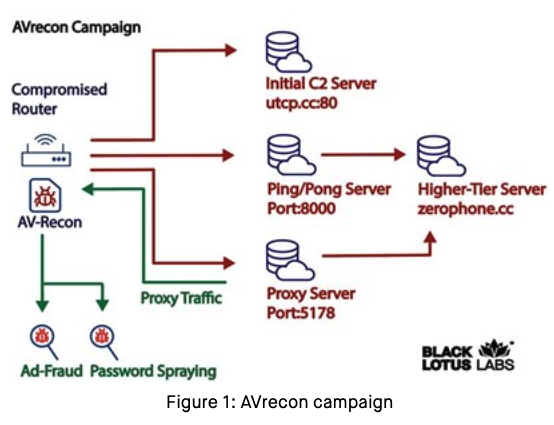
Image: Lumen’s Black Lotus Labs.

In a report released July 12, researchers at Lumen’s Black Lotus Labs called the AVrecon botnet “one of the largest botnets targeting small-office/home-office (SOHO) routers seen in recent history,” and a crime machine that has largely evaded public attention since first being spotted in mid-2021.

“The malware has been used to create residential proxy services to shroud malicious activity such as password spraying, web-traffic proxying and ad fraud,” the Lumen researchers wrote.

Malware-based anonymity networks are a major source of unwanted and malicious web traffic directed at online retailers, Internet service providers (ISPs), social networks, email providers and financial institutions. And a great many of these “proxy” networks are marketed primarily to cybercriminals seeking to anonymize their traffic by routing it through an infected PC, router or mobile device.

Proxy services can be used in a legitimate manner for several business purposes — such as price comparisons or sales intelligence — but they are massively abused for hiding cybercrime activity because they make it difficult to trace malicious traffic to its original source. Proxy services also let users appear to be getting online from nearly anywhere in the world, which is useful if you’re a cybercriminal who is trying to impersonate someone from a specific place.

Spur.us, a startup that tracks proxy services, told KrebsOnSecurity that the Internet addresses Lumen tagged as the AVrecon botnet’s “Command and Control” (C2) servers all tie back to a long-running proxy service called SocksEscort.

SocksEscort[.]com, is what’s known as a “SOCKS Proxy” service. The SOCKS (or SOCKS5) protocol allows Internet users to channel their Web traffic through a proxy server, which then passes the information on to the intended destination. From a website’s perspective, the traffic of the proxy network customer appears to originate from a rented/malware-infected PC tied to a residential ISP customer, not from the proxy service customer.
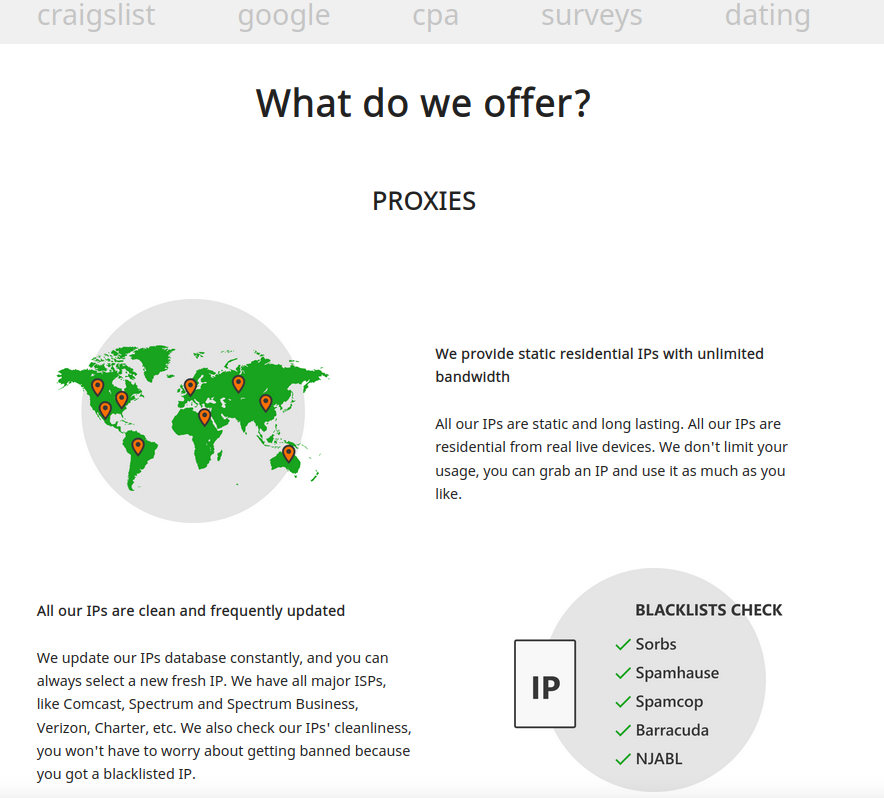
The SocksEscort home page says its services are perfect for people involved in automated online activity that often results in IP addresses getting blocked or banned, such as Craigslist and dating scams, search engine results manipulation, and online surveys.

Spur tracks SocksEscort as a malware-based proxy offering, which means the machines doing the proxying of traffic for SocksEscort customers have been infected with malicious software that turns them into a traffic relay. Usually, these users have no idea their systems are compromised.

Spur says the SocksEscort proxy service requires customers to install a Windows based application in order to access a pool of more than 10,000 hacked devices worldwide.

“We created a fingerprint to identify the call-back infrastructure for SocksEscort proxies,” Spur co-founder Riley Kilmer said. “Looking at network telemetry, we were able to confirm that we saw victims talking back to it on various ports.”

According to Kilmer, AVrecon is the malware that gives SocksEscort its proxies.

“When Lumen released their report and IOCs [indicators of compromise], we queried our system for which proxy service call-back infrastructure overlapped with their IOCs,” Kilmer continued. “The second stage C2s they identified were the same as the IPs we labeled for SocksEscort.”

Lumen’s research team said the purpose of AVrecon appears to be stealing bandwidth – without impacting end-users – in order to create a residential proxy service to help launder malicious activity and avoid attracting the same level of attention from Tor-hidden services or commercially available VPN services.

“This class of cybercrime activity threat may evade detection because it is less likely than a crypto-miner to be noticed by the owner, and it is unlikely to warrant the volume of abuse complaints that internet-wide brute-forcing and DDoS-based botnets typically draw,” Lumen’s Black Lotus researchers wrote.

Preserving bandwidth for both customers and victims was a primary concern for SocksEscort in July 2022, when 911S5 — at the time the world’s largest known malware proxy network — got hacked and imploded just days after being exposed in a story here. Kilmer said after 911’s demise, SocksEscort closed its registration for several months to prevent an influx of new users from swamping the service.

Danny Adamitis, principal information security researcher at Lumen and co-author of the report on AVrecon, confirmed Kilmer’s findings, saying the C2 data matched up with what Spur was seeing for SocksEscort dating back to September 2022.

Adamitis said that on July 13 — the day after Lumen published research on AVrecon and started blocking any traffic to the malware’s control servers — the people responsible for maintaining the botnet reacted quickly to transition infected systems over to a new command and control infrastructure.

“They were clearly reacting and trying to maintain control over components of the botnet,” Adamitis said. “Probably, they wanted to keep that revenue stream going.”

Frustratingly, Lumen was not able to determine how the SOHO devices were being infected with AVrecon. Some possible avenues of infection include exploiting weak or default administrative credentials on routers, and outdated, insecure firmware that has known, exploitable security vulnerabilities.

WHO’S BEHIND SOCKSESCORT?

KrebsOnSecurity briefly visited SocksEscort last year and promised a follow-up on the history and possible identity of its proprietors. A review of the earliest posts about this service on Russian cybercrime forums suggests the 12-year-old malware proxy network is tied to a Moldovan company that also offers VPN software on the Apple Store and elsewhere.

SocksEscort began in 2009 as “super-socks[.]com,” a Russian-language service that sold access to thousands of compromised PCs that could be used to proxy traffic. Someone who picked the nicknames “SSC” and “super-socks” and email address “michvatt@gmail.com” registered on multiple cybercrime forums and began promoting the proxy service.

According to DomainTools.com, the apparently related email address “michdomain@gmail.com” was used to register SocksEscort[.]com, super-socks[.]com, and a few other proxy-related domains, including ip-score[.]com, segate[.]org seproxysoft[.]com, and vipssc[.]us. Cached versions of both super-socks[.]com and vipssc[.]us show these sites sold the same proxy service, and both displayed the letters “SSC” prominently at the top of their homepages.
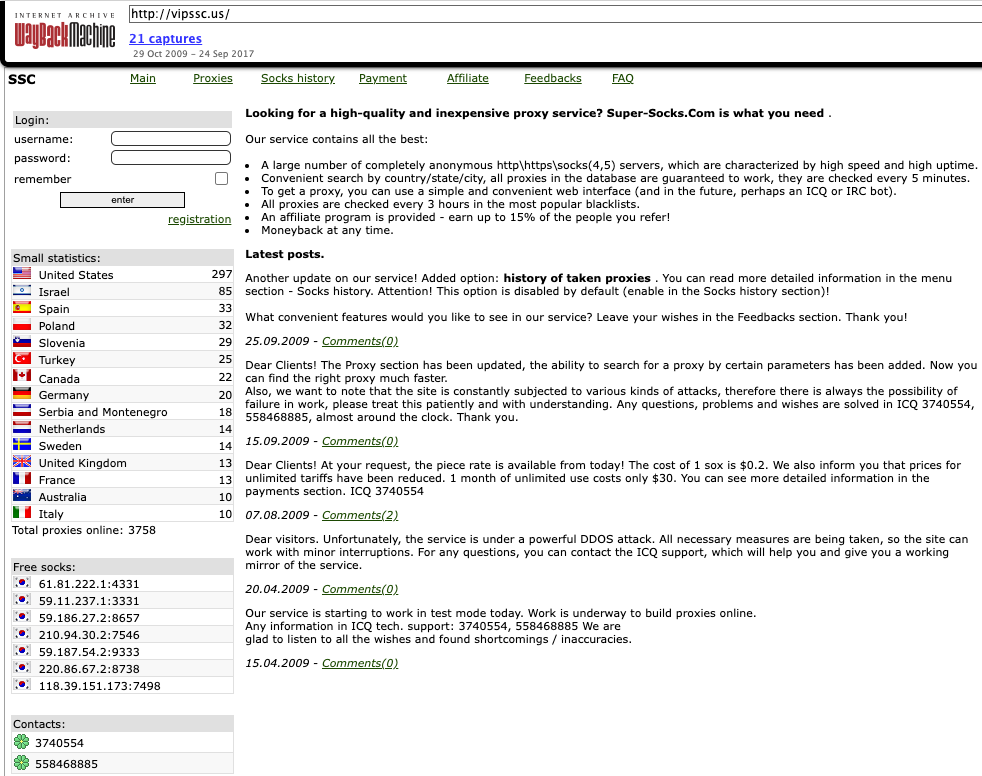
Image: Archive.org. Page translation from Russian via Google Translate.

According to cyber intelligence firm Intel 471, the very first “SSC” identity registered on the cybercrime forums happened in 2009 at the Russian language hacker community Antichat, where SSC registered using the email address adriman@gmail.com. SSC asked fellow forum members for help in testing the security of a website they claimed was theirs: myiptest[.]com, which promised to tell visitors whether their proxy address was included on any security or anti-spam block lists.

DomainTools says myiptest[.]com was registered in 2008 to an Adrian Crismaru from Chisinau, Moldova. Myiptest[.]com is no longer responding, but a cached copy of it from Archive.org shows that for about four years it included in its HTML source a Google Analytics code of US-2665744, which was also present on more than a dozen other websites.

Most of the sites that once bore that Google tracking code are no longer online, but nearly all of them centered around services that were similar to myiptest[.]com, such as abuseipdb[.]com, bestiptest[.]com, checkdnslbl[.]com, dnsbltools[.]com and dnsblmonitor[.]com.

Each of these services were designed to help visitors quickly determine whether the Internet address they were visiting the site from was listed by any security firms as spammy, malicious or phishous. In other words, these services were designed so that proxy service users could easily tell if their rented Internet address was still safe to use for online fraud.

Another domain with the Google Analytics code US-2665744 was sscompany[.]net. An archived copy of the site says SSC stands for “Server Support Company,” which advertised outsourced solutions for technical support and server administration. The company was located in Chisinau, Moldova and owned by Adrian Crismaru.

Leaked copies of the hacked Antichat forum indicate the SSC identity tied to adriman@gmail.com registered on the forum using the IP address 71.229.207.214. That same IP was used to register the nickname “Deem3n®,” a prolific poster on Antichat between 2005 and 2009 who served as a moderator on the forum.

There was a Deem3n® user on the webmaster forum Searchengines.guru whose signature in their posts says they run a popular community catering to programmers in Moldova called sysadmin[.]md, and that they were a systems administrator for sscompany[.]net.

That same Google Analytics code is also now present on the homepages of wiremo[.]co and a VPN provider called HideIPVPN[.]com.

Wiremo sells software and services to help website owners better manage their customer reviews. Wiremo’s Contact Us page lists a “Server Management LLC” in Wilmington, DE as the parent company. Records from the Delaware Secretary of State indicate Crismaru is CEO of this company.

Server Management LLC is currently listed in Apple’s App Store as the owner of a “free” VPN app called HideIPVPN. The contact information on Crismaru’s LinkedIn page says his company websites include myiptest[.]com, sscompany[.]net, and hideipvpn[.]com.

“The best way to secure the transmissions of your mobile device is VPN,” reads HideIPVPN’s description on the Apple Store. “Now, we provide you with an even easier way to connect to our VPN servers. We will hide your IP address, encrypt all your traffic, secure all your sensitive information (passwords, mail credit card details, etc.) form [sic] hackers on public networks.”

Mr. Crismaru did not respond to multiple requests for comment. When asked about the company’s apparent connection to SocksEscort, Wiremo responded, “We do not control this domain and no one from our team is connected to this domain.” Wiremo did not respond when presented with the findings in this report.

from Krebs on Security https://ift.tt/J076auA
via IFTTT

Home affairs cyber survey exposed personal data of participating firms

Minister admits leak of ‘sensitive’ information after research into the Optus and Medibank hacks was ‘deeply ironic’

The home affairs department exposed the personal information of more than 50 small business survey participants who were sought for their views on cybersecurity, Guardian Australia can reveal.

The names, business names, phone numbers and emails of the participants in the survey were published on the parliament website in response to a question on notice from May’s Budget estimates hearing.

Continue reading…

from Data and computer security | The Guardian https://ift.tt/PMajL7w
via IFTTT

Few Fortune 100 Firms List Security Pros in Their Executive Ranks

Many things have changed since 2018, such as the names of the companies in the Fortune 100 list. But one aspect of that vaunted list that hasn’t shifted much since is that very few of these companies list any security professionals within their top executive ranks.

The next time you receive a breach notification letter that invariably says a company you trusted places a top priority on customer security and privacy, consider this: Only four of the Fortune 100 companies currently list a security professional in the executive leadership pages of their websites. This is actually down from five of the Fortune 100 in 2018, the last time KrebsOnSecurity performed this analysis.

A review of the executives pages published by the 2022 list of Fortune 100 companies found only four — BestBuy, Cigna, Coca-Cola,  and Walmart — that listed a Chief Security Officer (CSO) or Chief Information Security Officer (CISO) in their highest corporate ranks.

One-third of last year’s Fortune 100 companies included a Chief Technology Officer (CTO) in their executive stables; 40 listed Chief Information Officer (CIO) roles, but just 21 included a Chief Risk Officer (CRO).

As I noted in 2018, this is not to say that 96 percent of the Fortune 100 companies don’t have a CISO or CSO in their employ: A review of LinkedIn suggests that most of them in fact do have people in those roles, and experts say some of the largest multinational companies will have multiple people in these positions.

But it is interesting to note which executive positions the top companies deem worth publishing in their executive leadership pages. For example, 88 percent listed a Director of Human Resources (or “Chief People Officer”), and 37 out of 100 included a Chief Marketing Officer.

Not that these roles are somehow more or less important than that of a CISO/CSO within the organization. Nor is the average pay hugely different among all three roles. Yet, considering how much marketing (think consumer/customer data) and human resources (think employee personal/financial data) are impacted by your average data breach, it’s somewhat remarkable that more companies don’t list their chief security personnel among their top ranks.

One likely explanation as to why a great many companies still don’t include their security leaders within their highest echelons is that these employees do not report directly to the company’s CEO, board of directors, or Chief Risk Officer.

The CSO or CISO position traditionally has reported to an executive in a technical role, such as the CTO or CIO. But workforce experts say placing the CISO/CSO on unequal footing with the organization’s top leaders makes it more likely that cybersecurity and risk concerns will take a backseat to initiatives designed to increase productivity and generally grow the business.

“Separation of duties is a fundamental concept of security, whether we’re talking about cyber threats, employee fraud, or physical theft,” said Tari Schreider, an analyst with Datos Insights. “But that critical separation is violated every day with the CISO or CSO reporting to the heads of technology.”

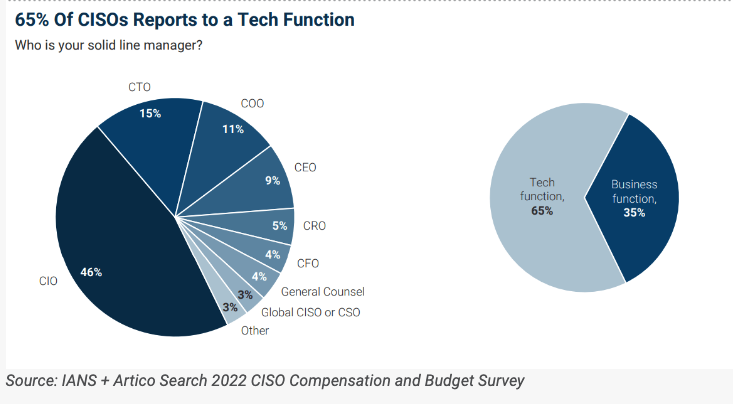
IANS, an organization geared toward CISOs/CSOs and their teams, surveyed more than 500 organizations last year and found roughly 65 percent of CISOs still report to a technical leader, such as the CTO or CIO: IANS found 46 percent of CISOs reported to a CIO, with 15 percent reporting directly to a CTO.

A survey last year by IANS found 65 percent of CISOs report to a tech function within organizations, such as the CTO or CIO. Image: IANS Research.

Schreider said one big reason many CISOs and CSOs aren’t listed in corporate executive biographies at major companies is that these positions often do not enjoy the same legal and insurance protections afforded to other officers within the company, Schreider said.

Typically, larger companies will purchase a “Directors and Officers” liability policy that covers legal expenses should one of the organization’s top executives find themselves dragged into court over some business failing on the part of their employer. But organizations that do not offer this coverage to their security leaders are unlikely to list those positions in their highest ranks, Schreider said.

“It’s frankly shocking,” Schreider said, upon hearing that only four of the Fortune 100 listed any security personnel in their top executive hierarchies. “If the company isn’t going to give them legal cover, then why give them the responsibility for security? Especially when CISOs and CSOs shouldn’t own the risk, yet the majority of them carry the mantle of responsibility and they tend to be scapegoats” when the organization eventually gets hacked, he said.

Schreider said while Datos Insights focuses mostly on the financial and insurance industries, a recent Datos survey echoes the IANS findings from last year. Datos surveyed 25 of the largest financial institutions by asset size (two of which are no longer in existence), and found just 22 percent of CSOs/CISOs reported to the CEO. A majority — 65 percent — had their CSOs/CISOs reporting to either a CTO or CIO.

“I’ve looked at these types of statistics for years and they’ve never really changed that much,” Schreider said. “The CISO or CSO is in the purview of the technical stack from a management perspective. Right, wrong or indifferent, that’s what’s happening.”

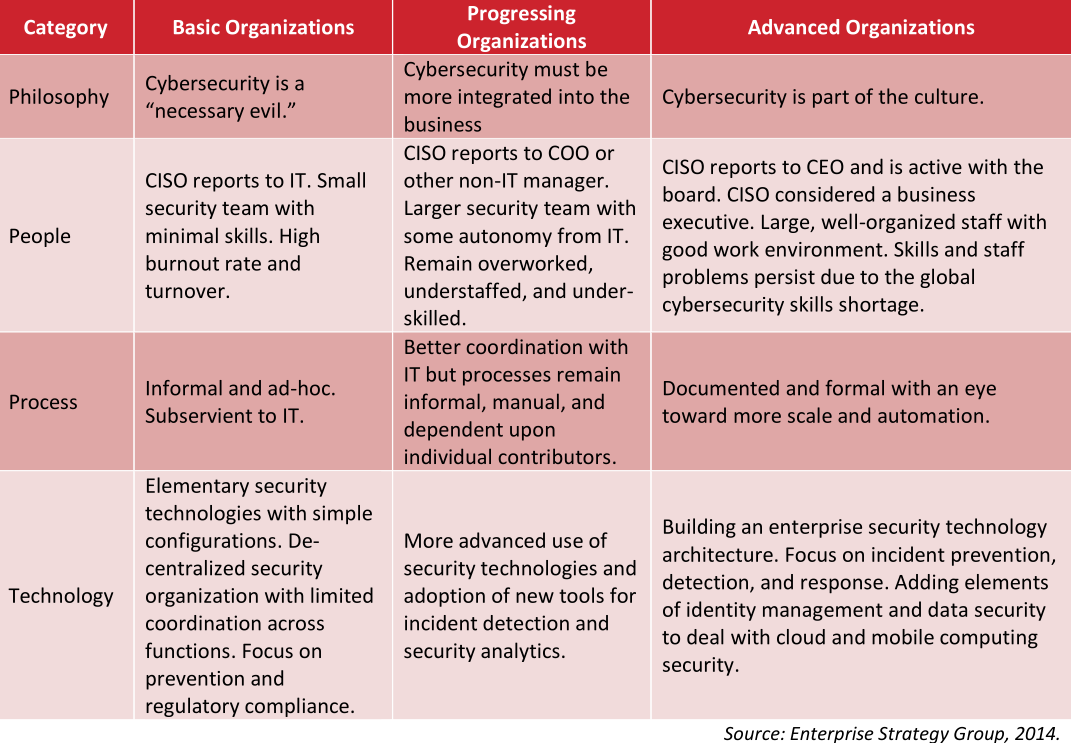
Earlier this year, IT consulting firm Accenture released results from surveying more than 3,000 respondents from 15 industries across 14 countries about their security maturity levels. Accenture found that only about one-third of the organizations they surveyed had enough security maturity under their belts to have integrated security into virtually every aspect of their businesses — and this includes having CISOs or CSOs report to someone in charge of overseeing risk for the business as a whole.

Not surprisingly, Accenture also found that only a third of respondents considered cybersecurity risk “to a great extent” when evaluating overall enterprise risk.

“This highlights there is still some way to go to make cybersecurity a proactive, strategic necessity within the business,” the report concluded.

One way of depicting the different stages of security maturity.

A spreadsheet tracking the prevalence of security leaders on the executive pages of the 2022 Fortune 100 firms is available here.

from Krebs on Security https://ift.tt/oiU4eRI
via IFTTT