Organizations that can break out of siloed data and apply context can transform intelligence into actionable, relevant security knowledge.
from Dark Reading https://ift.tt/1EeJgOI
via IFTTT

Organizations that can break out of siloed data and apply context can transform intelligence into actionable, relevant security knowledge.
from Dark Reading https://ift.tt/1EeJgOI
via IFTTT
Microsoft on Tuesday released software updates to fix 60 security vulnerabilities in its Windows operating systems and other software, including a zero-day flaw in all supported Microsoft Office versions on all flavors of Windows that’s seen active exploitation for at least two months now. On a lighter note, Microsoft is officially retiring its Internet Explorer (IE) web browser, which turns 27 years old this year.
Three of the bugs tackled this month earned Microsoft’s most dire “critical” label, meaning they can be exploited remotely by malware or miscreants to seize complete control over a vulnerable system. On top of the critical heap this month is CVE-2022-30190, a vulnerability in the Microsoft Support Diagnostics Tool (MSDT), a service built into Windows.
Dubbed “Follina,” the flaw became public knowledge on May 27, when a security researcher tweeted about a malicious Word document that had surprisingly low detection rates by antivirus products. Researchers soon learned that the malicious document was using a feature in Word to retrieve a HTML file from a remote server, and that HTML file in turn used MSDT to load code and execute PowerShell commands.
“What makes this new MS Word vulnerability unique is the fact that there are no macros exploited in this attack,” writes Mayuresh Dani, manager of threat research at Qualys. “Most malicious Word documents leverage the macro feature of the software to deliver their malicious payload. As a result, normal macro-based scanning methods will not work to detect Follina. All an attacker needs to do is lure a targeted user to download a Microsoft document or view an HTML file embedded with the malicious code.”
Kevin Beaumont, the researcher who gave Follina its name, penned a fairly damning account and timeline of Microsoft’s response to being alerted about the weakness. Beaumont says researchers in March 2021 told Microsoft they were able achieve the same exploit using Microsoft Teams as an example, and that Microsoft silently fixed the issue in Teams but did not patch MSDT in Windows or the attack vector in Microsoft Office.
Beaumont said other researchers on April 12, 2022 told Microsoft about active exploitation of the MSDT flaw, but Microsoft closed the ticket saying it wasn’t a security issue. Microsoft finally issued a CVE for the problem on May 30, the same day it released recommendations on how to mitigate the threat from the vulnerability.
Microsoft also is taking flak from security experts regarding a different set of flaws in its Azure cloud hosting platform. Orca Security said that back on January 4 it told Microsoft about a critical bug in Azure’s Synapse service that allowed attackers to obtain credentials to other workspaces, execute code, or leak customer credentials to data sources outside of Azure.
In an update to their research published Tuesday, Orca researchers said they were able to bypass Microsoft’s fix for the issue twice before the company put a working fix in place.
“In previous cases, vulnerabilities were fixed by the cloud providers within a few days of our disclosure to the affected vendor,” wrote Orca’s Avi Shua. “Based on our understanding of the architecture of the service, and our repeated bypasses of fixes, we think that the architecture contains underlying weaknesses that should be addressed with a more robust tenant separation mechanism. Until a better solution is implemented, we advise that all customers assess their usage of the service and refrain from storing sensitive data or keys in it.”
Amit Yoran, CEO of Tenable and a former U.S. cybersecurity czar, took Microsoft to task for silently patching an issue Tenable reported in the same Azure Synapse service.
“It was only after being told that we were going to go public, that their story changed…89 days after the initial vulnerability notification…when they privately acknowledged the severity of the security issue,” Yoran wrote in a post on LinkedIn. “To date, Microsoft customers have not been notified. Without timely and detailed disclosures, customers have no idea if they were, or are, vulnerable to attack…or if they fell victim to attack prior to a vulnerability being patched. And not notifying customers denies them the opportunity to look for evidence that they were or were not compromised, a grossly irresponsible policy.”
Also in the critical and notable stack this month is CVE-2022-30136, which is a remote code execution flaw in the Windows Network File System (NFS version 4.1) that earned a CVSS score of 9.8 (10 being the worst). Microsoft issued a very similar patch last month for vulnerabilities in NFS versions 2 and 3.
“This vulnerability could allow a remote attacker to execute privileged code on affected systems running NFS. On the surface, the only difference between the patches is that this month’s update fixes a bug in NFSV4.1, whereas last month’s bug only affected versions NSFV2.0 and NSFV3.0,” wrote Trend Micro’s Zero Day Initiative. “It’s not clear if this is a variant or a failed patch or a completely new issue. Regardless, enterprises running NFS should prioritize testing and deploying this fix.”
Beginning today, Microsoft will officially stop supporting most versions of its Internet Explorer Web browser, which was launched in August 1995. The IE desktop application will be disabled, and Windows users who wish to stick with a Microsoft browser are encouraged to move to Microsoft Edge with IE mode, which will be supported through at least 2029.
For a closer look at the patches released by Microsoft today and indexed by severity and other metrics, check out the always-useful Patch Tuesday roundup from the SANS Internet Storm Center. And it’s not a bad idea to hold off updating for a few days until Microsoft works out any kinks in the updates: AskWoody.com usually has the dirt on any patches that may be causing problems for Windows users.
As always, please consider backing up your system or at least your important documents and data before applying system updates. And if you run into any problems with these updates, please drop a note about it here in the comments.
from Krebs on Security https://ift.tt/r7vRkdM
via IFTTT
We tried it out to make sure, so you don’t have to.
from Naked Security https://ift.tt/Zkf7WXq
via IFTTT
Organizations do not have good visibility into all the software-as-a-service applications that connect to and access data stored in core business.
from Dark Reading https://ift.tt/RMFtSLa
via IFTTT
Here’s a rundown of Dark Reading’s reporting and commentary from and surrounding the first in-person RSA Conference since the pandemic began in 2020.
from Dark Reading https://ift.tt/JYbAsIN
via IFTTT
Here are which Microsoft patches to prioritize among the June Patch Tuesday batch.
from Dark Reading https://ift.tt/keJoXRx
via IFTTT
The ability to handle intense pressure is just one of the skills that veterans bring to corporate cybersecurity work.
from Dark Reading https://ift.tt/UNM0lm4
via IFTTT
The distributed denial-as-a-service websites were behind more than 200K attacks on targets including schools and hospitals.
from Dark Reading https://ift.tt/pBGZk4h
via IFTTT
“Aoqin Dragon” has been operating since at least 2013, with targets including government and telecommunications companies in multiple countries.
from Dark Reading https://ift.tt/lnSjbt2
via IFTTT
Cybercrime groups that specialize in stealing corporate data and demanding a ransom not to publish it have tried countless approaches to shaming their victims into paying. The latest innovation in ratcheting up the heat comes from the ALPHV/BlackCat ransomware group, which has traditionally published any stolen victim data on the Dark Web. Today, however, the group began publishing individual victim websites on the public Internet, with the leaked data made available in an easily searchable form.
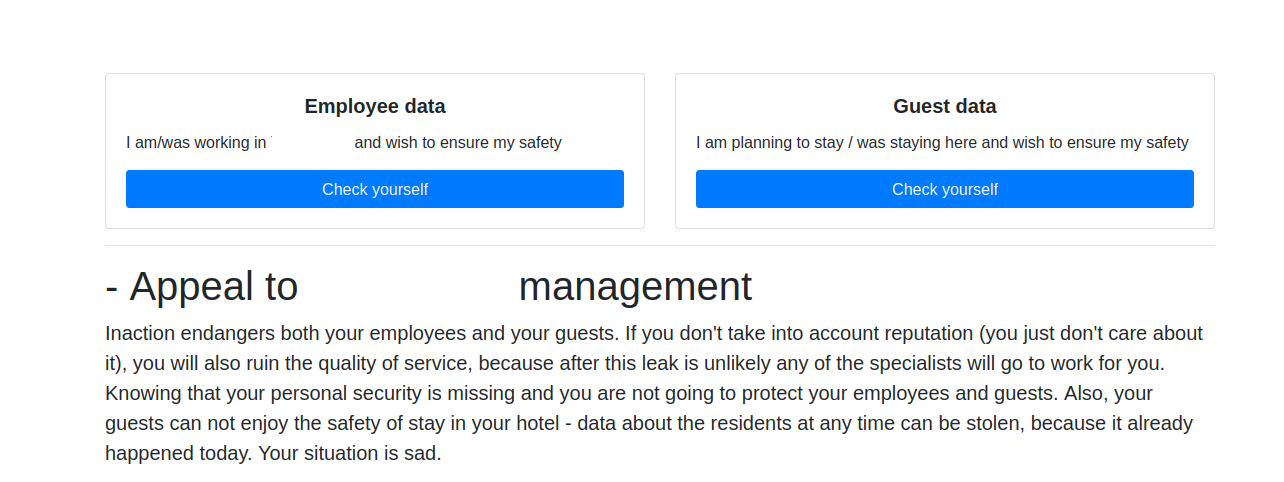
The ALPHV site claims to care about people’s privacy, but they let anyone view the sensitive stolen data.
ALPHV recently announced on its victim shaming and extortion website that it had hacked a luxury spa and resort in the western United States. Sometime in the last 24 hours, ALPHV published a website with the same victim’s name in the domain, and their logo on the homepage.
The website claims to list the personal information of 1,500 resort employees, and more than 2,500 residents at the facility. At the top of the page are two “Check Yourself” buttons, one for employees, and another for guests.
Brett Callow, a threat analyst with security firm Emsisoft, called the move by ALPHV “a cunning tactic” that will most certainly worry their other victims.
Callow said most of the victim shaming blogs maintained by the major ransomware and data ransom groups exist on obscure, slow-loading sites on the Darknet, reachable only through the use of third-party software like Tor. But the website erected by ALPHV as part of this new pressure tactic is available on the open Internet.
“Companies will likely be more concerned about the prospect of their data being shared in this way than of simply being posted to an obscure Tor site for which barely anyone knows the URL,” Callow said. “It’ll piss people off and make class actions more likely.”
It’s unclear if ALPHV plans to pursue this approach with every victim, but other recent victims of the crime group include a school district and a U.S. city. Most likely, this is a test run to see if it improves results.
“We are not going to stop, our leak distribution department will do their best to bury your business,” the victim website reads. “At this point, you still have a chance to keep your hotel’s security and reputation. We strongly advise you to be proactive in your negotiations; you do not have much time.”
Emerging in November 2021, ALPHV is perhaps most notable for its programming language (it is written in Rust). ALPHV has been actively recruiting operators from several ransomware organizations — including REvil, BlackMatter and DarkSide — offering affiliates up to 90 percent of any ransom paid by a victim organization.
Many security experts believe ALPHV/BlackCat is simply a rebrand of another ransomware group — “Darkside” a.k.a. “BlackMatter,” the same gang responsible for the 2021 attack on Colonial Pipeline that caused fuel shortages and price spikes for several days last summer.
Callow said there may be an upside to this ALPHV innovation, noting that his wife recently heard directly from a different ransomware group — Cl0p.
“On a positive note, stunts like this mean people may actually find out that their PI has been compromised,” he said. “Cl0p emailed my wife last year. The company that lost her data still hasn’t made any public disclosure or notified the people who were impacted (at least, she hasn’t heard from the company.)”
from Krebs on Security https://ift.tt/gfrNQKa
via IFTTT

