Cryptography isn’t just about secrecy. You need to take care of authenticity (no imposters!) and integrity (no tampering!) as well.
from Naked Security https://ift.tt/ZGy5lxu
via IFTTT

Cryptography isn’t just about secrecy. You need to take care of authenticity (no imposters!) and integrity (no tampering!) as well.
from Naked Security https://ift.tt/ZGy5lxu
via IFTTT
In large metropolitan areas, tourists are often easy to spot because they’re far more inclined than locals to gaze upward at the surrounding skyscrapers. Security experts say this same tourist dynamic is a dead giveaway in virtually all computer intrusions that lead to devastating attacks like data theft and ransomware, and that more organizations should set simple virtual tripwires that sound the alarm when authorized users and devices are spotted exhibiting this behavior.

In a blog post published last month, Cisco Talos said it was seeing a worrisome “increase in the rate of high-sophistication attacks on network infrastructure.” Cisco’s warning comes amid a flurry of successful data ransom and state-sponsored cyber espionage attacks targeting some of the most well-defended networks on the planet.
But despite their increasing complexity, a great many initial intrusions that lead to data theft could be nipped in the bud if more organizations started looking for the telltale signs of newly-arrived cybercriminals behaving like network tourists, Cisco says.
“One of the most important things to talk about here is that in each of the cases we’ve seen, the threat actors are taking the type of ‘first steps’ that someone who wants to understand (and control) your environment would take,” Cisco’s Hazel Burton wrote. “Examples we have observed include threat actors performing a ‘show config,’ ‘show interface,’ ‘show route,’ ‘show arp table’ and a ‘show CDP neighbor.’ All these actions give the attackers a picture of a router’s perspective of the network, and an understanding of what foothold they have.”
Cisco’s alert concerned espionage attacks from China and Russia that abused vulnerabilities in aging, end-of-life network routers. But at a very important level, it doesn’t matter how or why the attackers got that initial foothold on your network.
It might be zero-day vulnerabilities in your network firewall or file-transfer appliance. Your more immediate and primary concern has to be: How quickly can you detect and detach that initial foothold?
The same tourist behavior that Cisco described attackers exhibiting vis-a-vis older routers is also incredibly common early on in ransomware and data ransom attacks — which often unfurl in secret over days or weeks as attackers methodically identify and compromise a victim’s key network assets.
These virtual hostage situations usually begin with the intruders purchasing access to the target’s network from dark web brokers who resell access to stolen credentials and compromised computers. As a result, when those stolen resources first get used by would-be data thieves, almost invariably the attackers will run a series of basic commands asking the local system to confirm exactly who and where they are on the victim’s network.
This fundamental reality about modern cyberattacks — that cybercriminals almost always orient themselves by “looking up” who and where they are upon entering a foreign network for the first time — forms the business model of an innovative security company called Thinkst, which gives away easy-to-use tripwires or “canaries” that can fire off an alert whenever all sorts of suspicious activity is witnessed.
“Many people have pointed out that there are a handful of commands that are overwhelmingly run by attackers on compromised hosts (and seldom ever by regular users/usage),” the Thinkst website explains. “Reliably alerting when a user on your code-sign server runs whoami.exe can mean the difference between catching a compromise in week-1 (before the attackers dig in) and learning about the attack on CNN.”
These canaries — or “canary tokens” — are meant to be embedded inside regular files, acting much like a web beacon or web bug that tracks when someone opens an email.
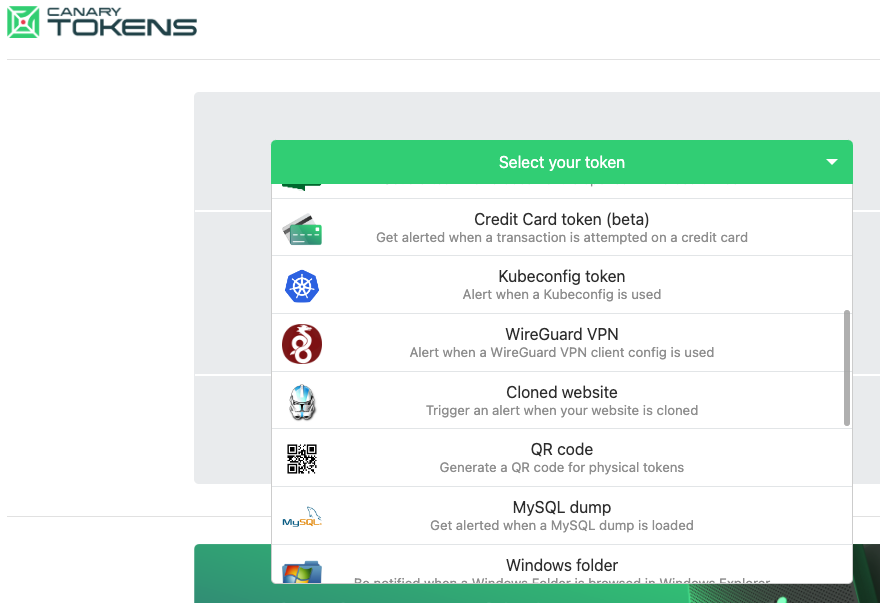
The Canary Tokens website from Thinkst Canary lists nearly two-dozen free customizable canaries.
“Imagine doing that, but for file reads, database queries, process executions or patterns in log files,” the Canary Tokens documentation explains. “Canarytokens does all this and more, letting you implant traps in your production systems rather than setting up separate honeypots.”
Thinkst operates alongside a burgeoning industry offering so-called “deception” or “honeypot” services — those designed to confuse, disrupt and entangle network intruders. But in an interview with KrebsOnSecurity, Thinkst founder and CEO Haroon Meer said most deception techniques involve some degree of hubris.
“Meaning, you’ll have deception teams in your network playing spy versus spy with people trying to break in, and it becomes this whole counterintelligence thing,” Meer said. “Nobody really has time for that. Instead, we are saying literally the opposite: That you’ve probably got all these [security improvement] projects that are going to take forever. But while you’re doing all that, just drop these 10 canaries, because everything else is going to take a long time to do.”
The idea here is to lay traps in sensitive areas of your network or web applications where few authorized users should ever trod. Importantly, the canary tokens themselves are useless to an attacker. For example, that AWS canary token sure looks like the digital keys to your cloud, but the token itself offers no access. It’s just a lure for the bad guys, and you get an alert when and if it is ever touched.
One nice thing about canary tokens is that Thinkst gives them away for free. Head over to canarytokens.org, and choose from a drop-down menu of available tokens, including:
-a web bug / URL token, designed to alert when a particular URL is visited;
-a DNS token, which alerts when a hostname is requested;
-an AWS token, which alerts when a specific Amazon Web Services key is used;
-a “custom exe” token, to alert when a specific Windows executable file or DLL is run;
-a “sensitive command” token, to alert when a suspicious Windows command is run.
-a Microsoft Excel/Word token, which alerts when a specific Excel or Word file is accessed.
Much like a “wet paint” sign often encourages people to touch a freshly painted surface anyway, attackers often can’t help themselves when they enter a foreign network and stumble upon what appear to be key digital assets, Meer says.
“If an attacker lands on your server and finds a key to your cloud environment, it’s really hard for them not to try it once,” Meer said. “Also, when these sorts of actors do land in a network, they have to orient themselves, and while doing that they are going to trip canaries.”
Meer says canary tokens are as likely to trip up attackers as they are “red teams,” security experts hired or employed by companies seeking to continuously probe their own computer systems and networks for security weaknesses.
“The concept and use of canary tokens has made me very hesitant to use credentials gained during an engagement, versus finding alternative means to an end goal,” wrote Shubham Shah, a penetration tester and co-founder of the security firm Assetnote. “If the aim is to increase the time taken for attackers, canary tokens work well.”
Thinkst makes money by selling Canary Tools, which is a paid version of Thinkst that is powered by a small hardware device designed to be installed on the local network as a canary token server.
“If you’ve got a sophisticated defense team, you can start putting these things in really interesting places,” Meer said. “Everyone says their stuff is simple, but we obsess over it. It’s really got to be so simple that people can’t mess it up. And if it works, it’s the best bang for your security buck you’re going to get.”
Further reading:
Dark Reading: Credential Canaries Create Minefield for Attackers
NCC Group: Extending a Thinkst Canary to Become an Interactive Honeypot
Cruise Automation’s experience deploying canary tokens
from Krebs on Security https://ift.tt/Ce9oZLK
via IFTTT
Almost one in three people aged 18-34 have been messaged by staff after giving personal details to a business
Almost one in three people aged 18-34 have received unwanted romantic contact after giving their personal information to a business, a UK poll has shown.
The Information Commissioner’s Office (ICO) has called for recipients of such texts to come forward to help the regulator gather evidence of the impact of this phenomenon.
The ICO has an online form for people who want to report an experience of unwanted contact.
from Data and computer security | The Guardian https://ift.tt/ki649P2
via IFTTT
WYSIWYG is short for “what you see is what you get”. Except when it isn’t…
from Naked Security https://ift.tt/L5KCTdh
via IFTTT
You’ve probably never heard of “16Shop,” but there’s a good chance someone using it has tried to phish you.
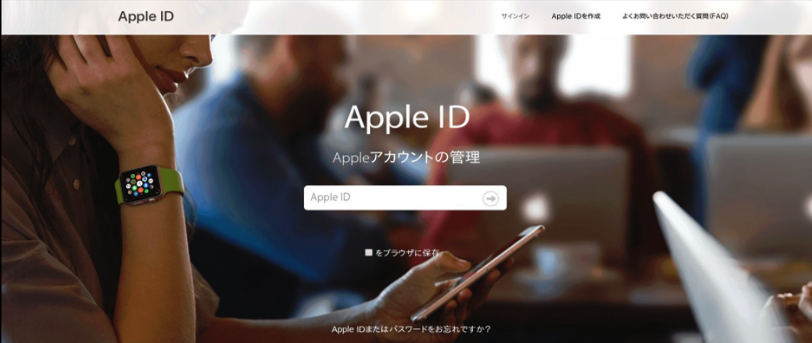
A 16Shop phishing page spoofing Apple and targeting Japanese users. Image: Akamai.com.
The international police organization INTERPOL said last week it had shuttered the notorious 16Shop, a popular phishing-as-a-service platform launched in 2017 that made it simple for even complete novices to conduct complex and convincing phishing scams. INTERPOL said authorities in Indonesia arrested the 21-year-old proprietor and one of his alleged facilitators, and that a third suspect was apprehended in Japan.
The INTERPOL statement says the platform sold hacking tools to compromise more than 70,000 users in 43 countries. Given how long 16Shop has been around and how many paying customers it enjoyed over the years, that number is almost certainly highly conservative.
Also, the sale of “hacking tools” doesn’t quite capture what 16Shop was all about: It was a fully automated phishing platform that gave its thousands of customers a series of brand-specific phishing kits to use, and provided the domain names needed to host the phishing pages and receive any stolen credentials.
Security experts investigating 16Shop found the service used an application programming interface (API) to manage its users, an innovation that allowed its proprietors to shut off access to customers who failed to pay a monthly fee, or for those attempting to copy or pirate the phishing kit.
16Shop also localized phishing pages in multiple languages, and the service would display relevant phishing content depending on the victim’s geolocation.
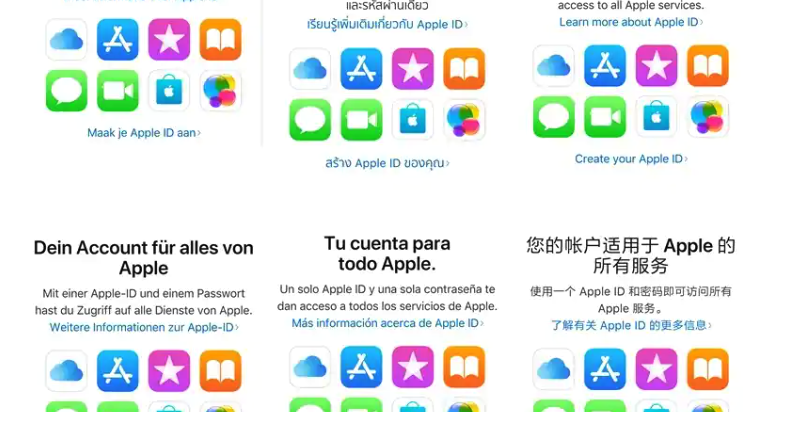
Various 16Shop lures for Apple users in different languages. Image: Akamai.
For example, in 2019 McAfee found that for targets in Japan, the 16Shop kit would also collect Web ID and Card Password, while US victims will be asked for their Social Security Number.
“Depending on location, 16Shop will also collect ID numbers (including Civil ID, National ID, and Citizen ID), passport numbers, social insurance numbers, sort codes, and credit limits,” McAfee wrote.
In addition, 16Shop employed various tricks to help its users’ phishing pages stay off the radar of security firms, including a local “blacklist” of Internet addresses tied to security companies, and a feature that allowed users to block entire Internet address ranges from accessing phishing pages.
The INTERPOL announcement does not name any of the suspects arrested in connection with the 16Shop investigation. However, a number of security firms — including Akamai, McAfee and ZeroFox, previously connected the service to a young Indonesian man named Riswanda Noor Saputra, who sold 16Shop under the hacker handle “Devilscream.”
According to the Indonesian security blog Cyberthreat.id, Saputra admitted being the administrator of 16Shop, but told the publication he handed the project off to others by early 2020.
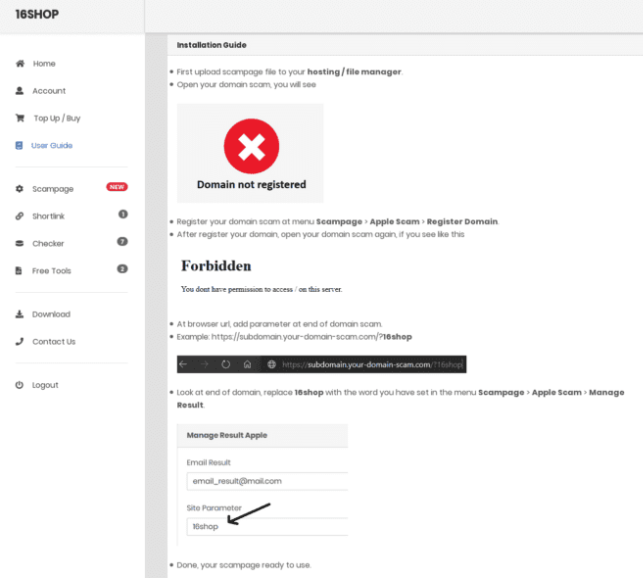
16Shop documentation instructing operators on how to deploy the kit. Image: ZeroFox.
Nevertheless, Cyberthreat reported that Devilscream was arrested by Indonesian police in late 2021 as part of a collaboration between INTERPOL and the U.S. Federal Bureau of Investigation (FBI). Still, researchers who tracked 16Shop since its inception say Devilscream was not the original proprietor of the phishing platform, and he may not be the last.
It is not uncommon for cybercriminals to accidentally infect their own machines with password-stealing malware, and that is exactly what seems to have happened with one of the more recent administrators of 16Shop.
Constella Intelligence, a data breach and threat actor research platform, now allows users to cross-reference popular cybercrime websites and denizens of these forums with inadvertent malware infections by information-stealing trojans. A search in Constella on 16Shop’s domain name shows that in mid-2022, a key administrator of the phishing service infected their Microsoft Windows desktop computer with the Redline information stealer trojan — apparently by downloading a cracked (and secretly backdoored) copy of Adobe Photoshop.
Redline infections steal gobs of data from the victim machine, including a list of recent downloads, stored passwords and authentication cookies, as well as browser bookmarks and auto-fill data. Those records indicate the 16Shop admin used the nicknames “Rudi” and “Rizki/Rizky,” and maintained several Facebook profiles under these monikers.
It appears this user’s full name (or at least part of it) is Rizky Mauluna Sidik, and they are from Bandung in West Java, Indonesia. One of this user’s Facebook pages says Rizky is the chief executive officer and founder of an entity called BandungXploiter, whose Facebook page indicates it is a group focused mainly on hacking and defacing websites.
A LinkedIn profile for Rizky says he is a backend Web developer in Bandung who earned a bachelor’s degree in information technology in 2020. Mr. Rizky did not respond to requests for comment.
from Krebs on Security https://ift.tt/zXasBvy
via IFTTT
Celebrating the true crypto bros. Listen now (full transcript available).
from Naked Security https://ift.tt/F5dZNlb
via IFTTT
The leak could undermine security in Northern Ireland – restoring power sharing is a political necessity at this moment
Half of the people who live in these islands have no adult memory at all of the Northern Ireland troubles. Too many of those who can remember them have allowed the bombings, shootings, riots and violence to slip from their minds in the 25 years that have passed since a peace treaty was signed in 1998. But last week’s data leak by the Police Service of Northern Ireland (PSNI) ought to be a wake-up call for the forgetful, and a lightbulb moment for the unaware.
Nine days ago, in response to a freedom of information request whose provenance remains unclear, someone in the PSNI mistakenly put the names, initials, ranks, place of work and departments of all of its 10,000 officers and staff online for about three hours before they were removed. Especially in a profession where police and their families were, and sometimes still are, regular targets, it was a spectacular security breach, even in these more peaceful times.
Martin Kettle is a Guardian columnist
from Data and computer security | The Guardian https://ift.tt/ptrhUgi
via IFTTT
Apps on your iPhone must come from the App Store. Except when they don’t… we explain what to look out for.
from Naked Security https://ift.tt/Yghxt5a
via IFTTT
Personal information of people including victims of crime was included in freedom of information responses, forces say
The personal data of more than 1,000 people, including victims of crime, was included in freedom of information (FoI) responses issued by Norfolk and Suffolk police, the forces have said.
In a statement, the two East Anglian constabularies said a “technical issue” meant raw crime report data was included in a “very small percentage” of FoI responses issued between April 2021 and March 2022.
from Data and computer security | The Guardian https://ift.tt/bPJiK38
via IFTTT
The rise of tap-to-pay and chip-and-PIN hasn’t rid the world of ATM card skimming criminals…
from Naked Security https://ift.tt/BDE7aUH
via IFTTT
 Pacosite's Blog