To consolidate all of our security intelligence and news in one location, we have migrated Naked Security to the Sophos News platform.
from Naked Security https://ift.tt/fv0YuGs
via IFTTT

To consolidate all of our security intelligence and news in one location, we have migrated Naked Security to the Sophos News platform.
from Naked Security https://ift.tt/fv0YuGs
via IFTTT
The password manager service LastPass is now forcing some of its users to pick longer master passwords. LastPass says the changes are needed to ensure all customers are protected by their latest security improvements. But critics say the move is little more than a public relations stunt that will do nothing to help countless early adopters whose password vaults were exposed in a 2022 breach at LastPass.
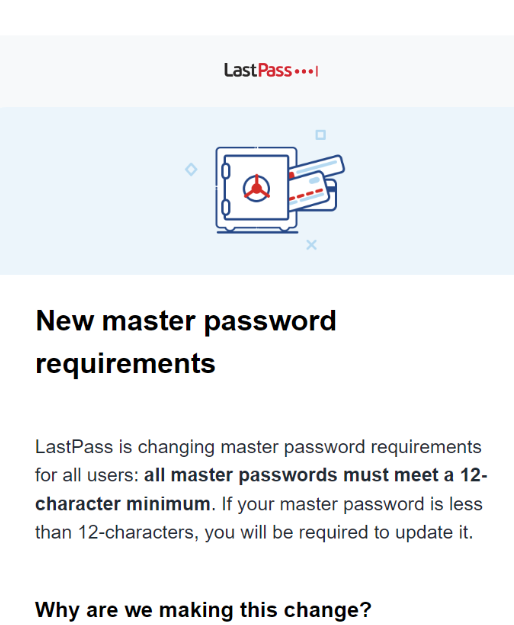
LastPass sent this notification to users earlier this week.
LastPass told customers this week they would be forced to update their master password if it was less than 12 characters. LastPass officially instituted this change back in 2018, but some undisclosed number of the company’s earlier customers were never required to increase the length of their master passwords.
This is significant because in November 2022, LastPass disclosed a breach in which hackers stole password vaults containing both encrypted and plaintext data for more than 25 million users.
Since then, a steady trickle of six-figure cryptocurrency heists targeting security-conscious people throughout the tech industry has led some security experts to conclude that crooks likely have succeeded at cracking open some of the stolen LastPass vaults.
KrebsOnSecurity last month interviewed a victim who recently saw more than three million dollars worth of cryptocurrency siphoned from his account. That user signed up with LastPass nearly a decade ago, stored their cryptocurrency seed phrase there, and yet never changed his master password — which was just eight characters. Nor was he ever forced to improve his master password.
That story cited research from Adblock Plus creator Wladimir Palant, who said LastPass failed to upgrade many older, original customers to more secure encryption protections that were offered to newer customers over the years.
For example, another important default setting in LastPass is the number of “iterations,” or how many times your master password is run through the company’s encryption routines. The more iterations, the longer it takes an offline attacker to crack your master password.
Palant said that for many older LastPass users, the initial default setting for iterations was anywhere from “1” to “500.” By 2013, new LastPass customers were given 5,000 iterations by default. In February 2018, LastPass changed the default to 100,100 iterations. And very recently, it upped that again to 600,000. Still, Palant and others impacted by the 2022 breach at LastPass say their account security settings were never forcibly upgraded.
Palant called this latest action by LastPass a PR stunt.
“They sent this message to everyone, whether they have a weak master password or not – this way they can again blame the users for not respecting their policies,” Palant said. “But I just logged in with my weak password, and I am not forced to change it. Sending emails is cheap, but they once again didn’t implement any technical measures to enforce this policy change.”
Either way, Palant said, the changes won’t help people affected by the 2022 breach.
“These people need to change all their passwords, something that LastPass still won’t recommend,” Palant said. “But it will somewhat help with the breaches to come.”
LastPass CEO Karim Toubba said changing master password length (or even the master password itself) is not designed to address already stolen vaults that are offline.
“This is meant to better protect customers’ online vaults and encourage them to bring their accounts up to the 2018 LastPass standard default setting of a 12-character minimum (but could opt out from),” Toubba said in an emailed statement. “We know that some customers may have chosen convenience over security and utilized less complex master passwords despite encouragement to use our (or others) password generator to do otherwise.”
A basic functionality of LastPass is that it will pick and remember lengthy, complex passwords for each of your websites or online services. To automatically populate the appropriate credentials at any website going forward, you simply authenticate to LastPass using your master password.
LastPass has always emphasized that if you lose this master password, that’s too bad because they don’t store it and their encryption is so strong that even they can’t help you recover it.
But experts say all bets are off when cybercrooks can get their hands on the encrypted vault data itself — as opposed to having to interact with LastPass via its website. These so-called “offline” attacks allow the bad guys to conduct unlimited and unfettered “brute force” password cracking attempts against the encrypted data using powerful computers that can each try millions of password guesses per second.
A chart on Palant’s blog post offers an idea of how increasing password iterations dramatically increases the costs and time needed by the attackers to crack someone’s master password. Palant said it would take a single high-powered graphics card about a year to crack a password of average complexity with 500 iterations, and about 10 years to crack the same password run through 5,000 iterations.
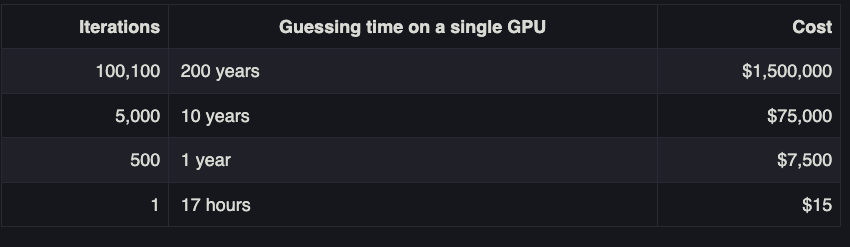
Image: palant.info
However, these numbers radically come down when a determined adversary also has other large-scale computational assets at their disposal, such as a bitcoin mining operation that can coordinate the password-cracking activity across multiple powerful systems simultaneously.
Meaning, LastPass users whose vaults were never upgraded to higher iterations and whose master passwords were weak (less than 12 characters) likely have been a primary target of distributed password-cracking attacks ever since the LastPass user vaults were stolen late last year.
Asked why some LastPass users were left behind on older security minimums, Toubba said a “small percentage” of customers had corrupted items in their password vaults that prevented those accounts from properly upgrading to the new requirements and settings.
“We have been able to determine that a small percentage of customers have items in their vaults that are corrupt and when we previously utilized automated scripts designed to re-encrypt vaults when the master password or iteration count is changed, they did not complete,” Toubba said. “These errors were not originally apparent as part of these efforts and, as we have discovered them, we have been working to be able to remedy this and finish the re-encryption.”
Nicholas Weaver, a researcher at University of California, Berkeley’s International Computer Science Institute (ICSI) and lecturer at UC Davis, said LastPass made a huge mistake years ago by not force-upgrading the iteration count for existing users.
“And now this is blaming the users — ‘you should have used a longer passphrase’ — not them for having weak defaults that were never upgraded for existing users,” Weaver said. “LastPass in my book is one step above snake-oil. I used to be, ‘Pick whichever password manager you want,’ but now I am very much, ‘Pick any password manager but LastPass.’”
Asked why LastPass isn’t recommending that users change all of the passwords secured by the encrypted master password that was stolen when the company got hacked last year, Toubba said it’s because “the data demonstrates that the majority of our customers follow our recommendations (or greater), and the probability of successfully brute forcing vault encryption is greatly reduced accordingly.”
“We’ve been telling customers since December of 2022 that they should be following recommended guidelines,” Toubba continued. “And if they haven’t followed the guidelines we recommended that they change their downstream passwords.”
from Krebs on Security https://ift.tt/1EFwI84
via IFTTT
Company says it believes about 193,000 customers are affected by the breach, which it spotted in early September
Follow our Australia news live blog for latest updates
Pizza Hut’s Australian operations have been hit by a cyber-attack, the company says, with customer data including delivery addresses and order details stolen in the hack.
In an email to customers on Wednesday, Pizza Hut Australia’s chief executive, Phil Reed, said the company became aware in early September that there had been “unauthorised third party” access to some of the company’s data.
from Data and computer security | The Guardian https://ift.tt/VgIZQMx
via IFTTT
The victim shaming website operated by the cybercriminals behind 8Base — currently one of the more active ransomware groups — was until earlier today leaking quite a bit of information that the crime group probably did not intend to be made public. The leaked data suggests that at least some of website’s code was written by a 36-year-old programmer residing in the capital city of Moldova.
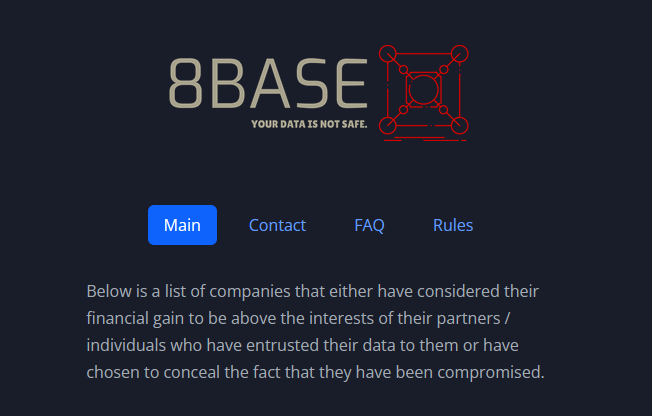
The 8Base ransomware group’s victim shaming website on the darknet.
8Base maintains a darknet website that is only reachable via Tor, a freely available global anonymity network. The site lists hundreds of victim organizations and companies — all allegedly hacking victims that refused to pay a ransom to keep their stolen data from being published.
The 8Base darknet site also has a built-in chat feature, presumably so that 8Base victims can communicate and negotiate with their extortionists. This chat feature, which runs on the Laravel web application framework, works fine as long as you are *sending* information to the site (i.e., by making a “POST” request).
However, if one were to try to fetch data from the same chat service (i.e., by making a “GET” request), the website until quite recently generated an extremely verbose error message:
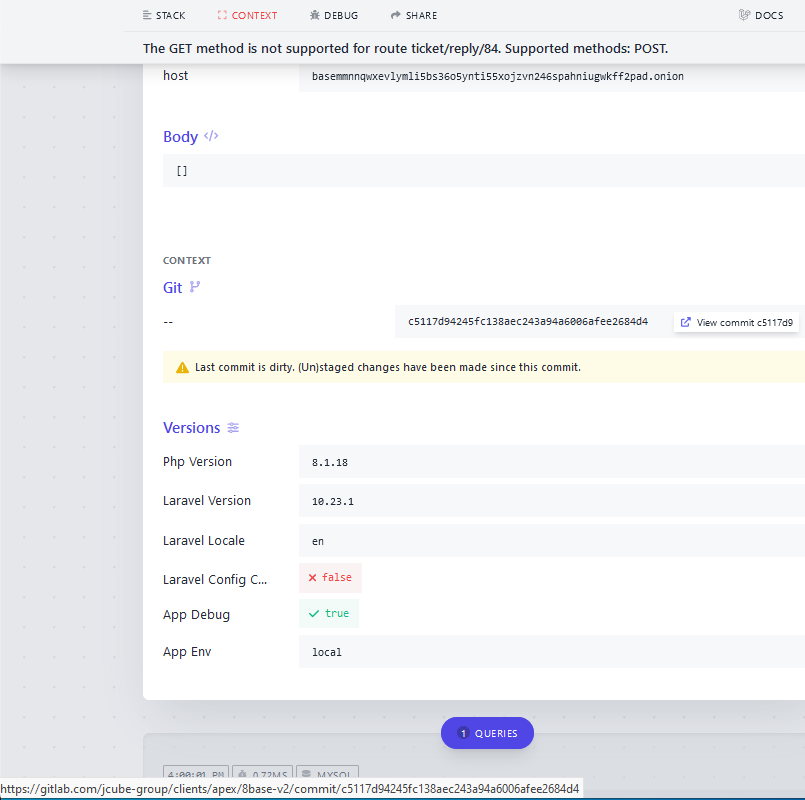
The verbose error message when one tries to pull data from 8Base’s darknet site. Notice the link at the bottom of this image, which is generated when one hovers over the “View commit” message under the “Git” heading.
That error page revealed the true Internet address of the Tor hidden service that houses the 8Base website: 95.216.51[.]74, which according to DomainTools.com is a server in Finland that is tied to the Germany-based hosting giant Hetzner.
But that’s not the interesting part: Scrolling down the lengthy error message, we can see a link to a private Gitlab server called Jcube-group: gitlab[.]com/jcube-group/clients/apex/8base-v2. Digging further into this Gitlab account, we can find some curious data points available in the JCube Group’s public code repository.
For example, this “status.php” page, which was committed to JCube Group’s Gitlab repository roughly one month ago, includes code that makes several mentions of the term “KYC” (e.g. KYC_UNVERIFIED, KYC_VERIFIED, and KYC_PENDING).
This is curious because a FAQ on the 8Base darknet site includes a section on “special offers for journalists and reporters,” which says the crime group is open to interviews but that journalists will need to prove their identity before any interview can take place. The 8base FAQ refers to this vetting process as “KYC,” which typically stands for “Know Your Customer.”
“We highly respect the work of journalists and consider information to be our priority,” the 8Base FAQ reads. “We have a special program for journalists which includes sharing information a few hours or even days before it is officially published on our news website and Telegram channel: you would need to go through a KYC procedure to apply. Journalists and reporters can contact us via our PR Telegram channel with any questions.”
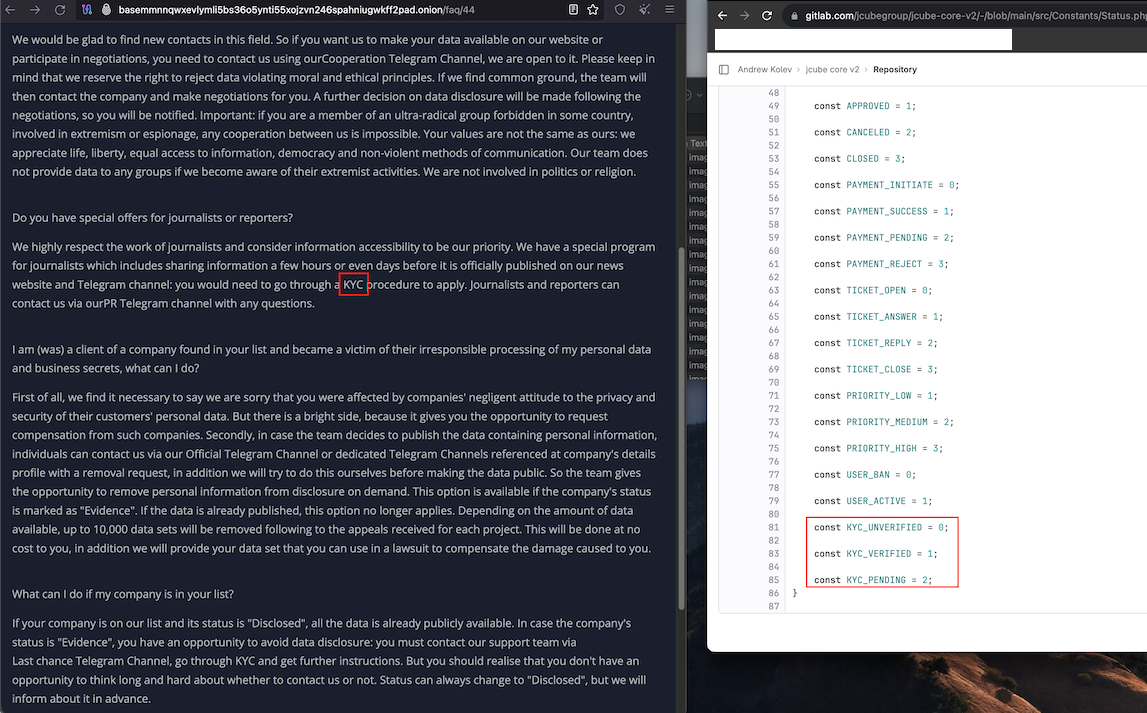
The 8Base FAQ (left) and the KYC code in Kolev’s Gitlab account (right)
The 8Base darknet site also has a publicly accessible “admin” login page, which features an image of a commercial passenger plane parked at what appears to be an airport. Next to the airplane photo is a message that reads, “Welcome to 8Base. Admin Login to 8Base dashboard.”
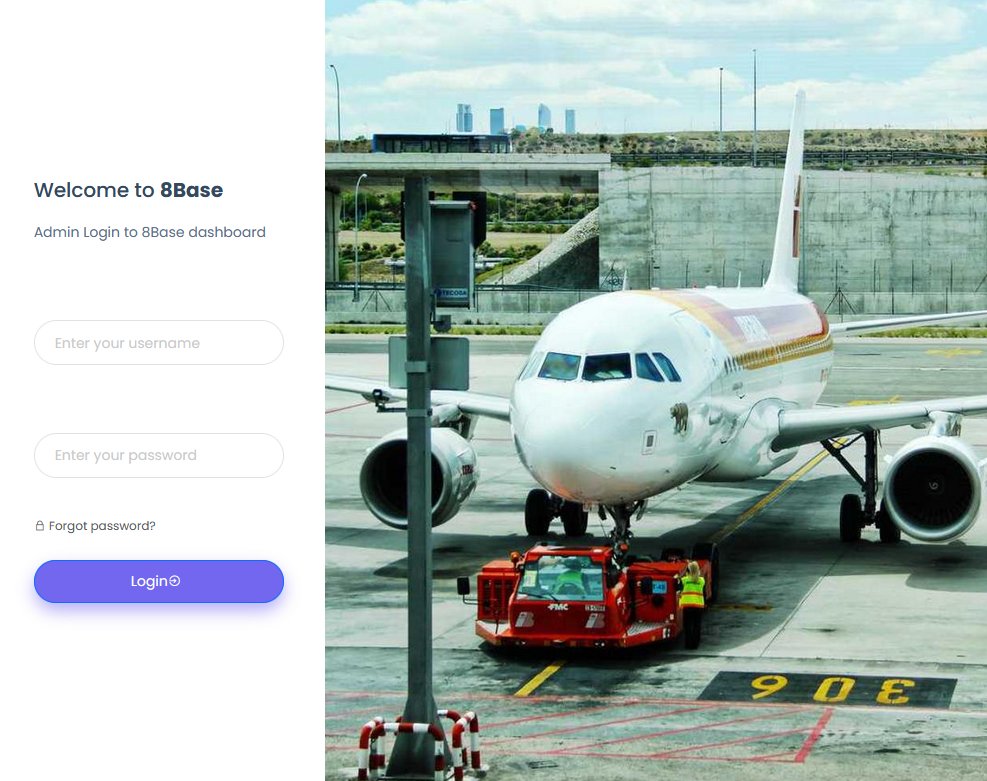
The login page on the 8Base ransomware group’s darknet website.
Right-clicking on the 8Base admin page and selecting “View Source” produces the page’s HTML code. That code is virtually identical to a “login.blade.php” page that was authored and committed to JCube Group’s Gitlab repository roughly three weeks ago.
It appears the person responsible for the JCube Group’s code is a 36-year-old developer from Chisinau, Moldova named Andrei Kolev. Mr. Kolev’s LinkedIn page says he’s a full-stack developer at JCube Group, and that he’s currently looking for work. The homepage for Jcubegroup[.]com lists an address and phone number that Moldovan business records confirm is tied to Mr. Kolev.
The posts on the Twitter account for Mr. Kolev (@andrewkolev) are all written in Russian, and reference several now-defunct online businesses, including pluginspro[.]ru.
Reached for comment via LinkedIn, Mr. Kolev said he had no idea why the 8Base darknet site was pulling code from the “clients” directory of his private JCube Group Gitlab repository, or how the 8Base name was even included.
“I [don’t have] a clue, I don’t have that project in my repo,” Kolev explained. “They [aren’t] my clients. Actually we currently have just our own projects.”
Mr. Kolev shared a screenshot of his current projects, but very quickly after that deleted the image he’d shared. However, KrebsOnSecurity captured a copy of it before it was removed:
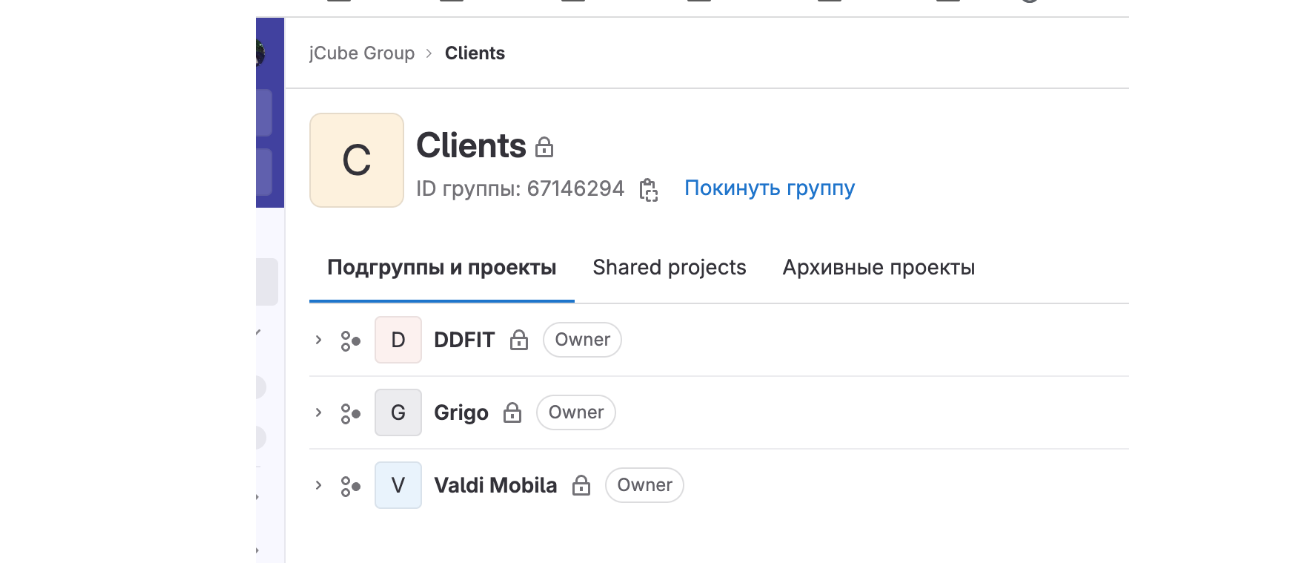
A screenshot of Mr. Kolev’s current projects that he quickly deleted.
Within minutes of explaining why I was reaching out to Mr. Kolev and walking him through the process of finding this connection, the 8Base website was changed, and the error message that linked to the JCube Group private Gitlab repository no longer appeared. Instead, trying the same “GET” method described above caused the 8Base website to return a “405 Method Not Allowed” error page:
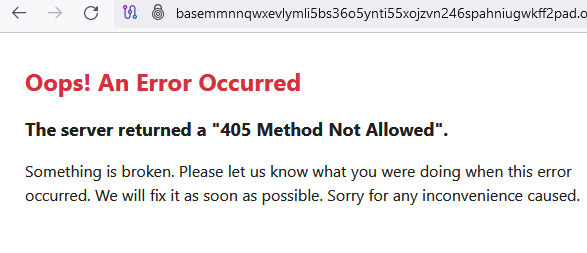
Mr. Kolev claimed he didn’t know anything about the now-removed error page on 8Base’s site that referenced his private Gitlab repo, and said he deleted the screenshot from our LinkedIn chat because it contained private information.
Ransomware groups are known to remotely hire developers for specific projects without disclosing exactly who they are or how the new hire’s code is intended to be used, and it is possible that one of Mr. Kolev’s clients is merely a front for 8Base. But despite 8Base’s statement that they are happy to correspond with journalists, KrebsOnSecurity is still waiting for a reply from the group via their Telegram channel.
The tip about the leaky 8Base website was provided by a reader who asked to remain anonymous. That reader, who we’ll call Steve (not his real name), said it is likely that whoever developed the 8Base website inadvertently left it in “development mode,” which is what caused the site to be so verbose with its error messages.
“If 8Base was running the app in production mode instead of development mode, this Tor de-anonymization would have never been possible,” Steve said.
A recent blog post from VMware called the 8Base ransomware group “a heavy hitter” that has remained relatively unknown despite the massive spike in activity in Summer of 2023.
“8Base is a Ransomware group that has been active since March 2022 with a significant spike in activity in June of 2023,” VMware researchers wrote. “Describing themselves as ‘simple pen testers,’ their leak site provided victim details through Frequently Asked Questions and Rules sections as well as multiple ways to contact them. ”
According to VMware, what’s particularly interesting about 8Base’s communication style is the use of verbiage that is strikingly familiar to another known cybercriminal group: RansomHouse.
“The group utilizes encryption paired with ‘name-and-shame’ techniques to compel their victims to pay their ransoms,” VMware researchers wrote. “8Base has an opportunistic pattern of compromise with recent victims spanning across varied industries. Despite the high amount of compromises, the information regarding identities, methodology, and underlying motivation behind these incidents still remains a mystery.”
from Krebs on Security https://ift.tt/EFkyidI
via IFTTT
Details of ‘thousands’ of officers may have been taken by hackers after breach of third-party supplier
The details of thousands of Greater Manchester police officers have been hacked as part of a cyber-attack.
The force said one of its third-party suppliers had been breached in a ransomware attack that was being taken “extremely seriously”.
from Data and computer security | The Guardian https://ift.tt/eQC4JZ3
via IFTTT
The government is about to award a £480m contract to build a vast new database of patient data. But if people don’t trust it, they’ll opt out – I know, because I felt I had to
Last December, I had an abortion. Most unwanted pregnancies set a panic-timer ticking, but I was almost counting down the seconds until I had to catch a flight from London, where I live, to Texas, where I grew up, and where the provision of abortion care was recently made a felony. You bleed for a while after most abortions, and I was still bleeding when I boarded the plane home for Christmas.
Going to Texas so soon after the procedure made me consider where the record of my abortion – my health data – would end up. When I phoned an abortion clinic in late November to book an appointment, one of the first questions staff asked was: “May we share a record of your treatment with your GP?”
from Data and computer security | The Guardian https://ift.tt/YgUqNZR
via IFTTT
In December 2022, KrebsOnSecurity broke the news that a cybercriminal using the handle “USDoD” had infiltrated the FBI‘s vetted information sharing network InfraGard, and was selling the contact information for all 80,000 members. The FBI responded by reverifying all InfraGard members and by seizing the cybercrime forum where the data was being sold. But on Sept. 11, 2023, USDoD resurfaced after a lengthy absence to leak sensitive employee data stolen from the aerospace giant Airbus, while promising to visit the same treatment on top U.S. defense contractors.

USDoD’s avatar used to be the seal of the U.S. Department of Defense. Now it’s a charming kitten.
In a post on the English language cybercrime forum BreachForums, USDoD leaked information on roughly 3,200 Airbus vendors, including names, addresses, phone numbers, and email addresses. USDoD claimed they grabbed the data by using passwords stolen from a Turkish airline employee who had third-party access to Airbus’ systems.
USDoD didn’t say why they decided to leak the data on the 22nd anniversary of the 9/11 attacks, but there was definitely an aircraft theme to the message that accompanied the leak, which concluded with the words, “Lockheed martin, Raytheon and the entire defense contractos [sic], I’m coming for you [expletive].”
Airbus has apparently confirmed the cybercriminal’s account to the cyber intelligence firm Hudson Rock, which determined that the Airbus credentials were stolen after a Turkish airline employee infected their computer with a prevalent and powerful info-stealing trojan called RedLine.
Info-stealers like RedLine typically are deployed via opportunistic email malware campaigns, and by secretly bundling the trojans with cracked versions of popular software titles made available online. Credentials stolen by info-stealers often end up for sale on cybercrime shops that peddle purloined passwords and authentication cookies (these logs also often show up in the malware scanning service VirusTotal).
Hudson Rock said it recovered the log files created by a RedLine infection on the Turkish airline employee’s system, and found the employee likely infected their machine after downloading pirated and secretly backdoored software for Microsoft Windows.
Hudson Rock says info-stealer infections from RedLine and a host of similar trojans have surged in recent years, and that they remain “a primary initial attack vector used by threat actors to infiltrate organizations and execute cyberattacks, including ransomware, data breaches, account overtakes, and corporate espionage.”
The prevalence of RedLine and other info-stealers means that a great many consequential security breaches begin with cybercriminals abusing stolen employee credentials. In this scenario, the attacker temporarily assumes the identity and online privileges assigned to a hacked employee, and the onus is on the employer to tell the difference.
In addition to snarfing any passwords stored on or transmitted through an infected system, info-stealers also siphon authentication cookies or tokens that allow one to remain signed-in to online services for long periods of time without having to resupply one’s password and multi-factor authentication code. By stealing these tokens, attackers can often reuse them in their own web browser, and bypass any authentication normally required for that account.
Microsoft Corp. this week acknowledged that a China-backed hacking group was able to steal one of the keys to its email kingdom that granted near-unfettered access to U.S. government inboxes. Microsoft’s detailed post-mortem cum mea culpa explained that a secret signing key was stolen from an employee in an unlucky series of unfortunate events, and thanks to TechCrunch we now know that the culprit once again was “token-stealing malware” on the employee’s system.
In April 2023, the FBI seized Genesis Market, a bustling, fully automated cybercrime store that was continuously restocked with freshly hacked passwords and authentication tokens stolen by a network of contractors who deployed RedLine and other info-stealer malware.
In March 2023, the FBI arrested and charged the alleged administrator of BreachForums (aka Breached), the same cybercrime community where USDoD leaked the Airbus data. In June 2023, the FBI seized the BreachForums domain name, but the forum has since migrated to a new domain.
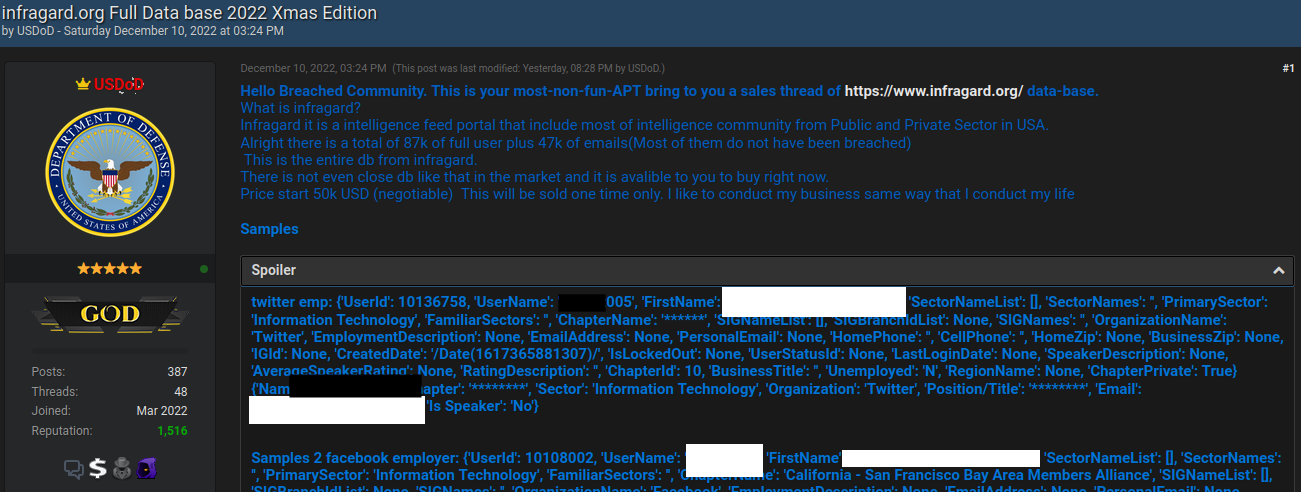
USDoD’s InfraGard sales thread on Breached.
Unsolicited email continues to be a huge vector for info-stealing malware, but lately the crooks behind these schemes have been gaming the search engines so that their malicious sites impersonating popular software vendors actually appear before the legitimate vendor’s website. So take special care when downloading software to ensure that you are in fact getting the program from the original, legitimate source whenever possible.
Also, unless you really know what you’re doing, please don’t download and install pirated software. Sure, the cracked program might do exactly what you expect it to do, but the chances are good that it is also laced with something nasty. And when all of your passwords are stolen and your important accounts have been hijacked or sold, you will wish you had simply paid for it.
from Krebs on Security https://ift.tt/gifvH3B
via IFTTT
US Department of Justice files case over compliance with FTC order on data security and privacy practices
Elon Musk’s takeover of Twitter created a “chaotic environment” at the social media platform that may have violated a government order requiring an overhaul of its data security and privacy practices, according to a court filing.
The US Department of Justice (DoJ) alleged in a legal filing on Tuesday that depositions from former employees at Twitter, now rebranded X, raised “serious questions” about whether the company was complying with an order imposed by the consumer and competition watchdog, the Federal Trade Commission (FTC).
from Data and computer security | The Guardian https://ift.tt/7HgEXMz
via IFTTT
Microsoft today issued software updates to fix at least five dozen security holes in Windows and supported software, including patches for two zero-day vulnerabilities that are already being exploited. Also, Adobe, Google Chrome and Apple iOS users may have their own zero-day patching to do.

On Sept. 7, researchers at Citizen Lab warned they were seeing active exploitation of a “zero-click,” zero-day flaw to install spyware on iOS devices without any interaction from the victim.
“The exploit chain was capable of compromising iPhones running the latest version of iOS (16.6) without any interaction from the victim,” the researchers wrote.
According to Citizen Lab, the exploit uses malicious images sent via iMessage, an embedded component of Apple’s iOS that has been the source of previous zero-click flaws in iPhones and iPads.
Apple says the iOS flaw (CVE-2023-41064) does not seem to work against devices that have its ultra-paranoid “Lockdown Mode” enabled. This feature restricts non-essential iOS features to reduce the device’s overall attack surface, and it was designed for users concerned that they may be subject to targeted attacks. Citizen Lab says the bug it discovered was being exploited to install spyware made by the Israeli cyber surveillance company NSO Group.
This vulnerability is fixed in iOS 16.6.1 and iPadOS 16.6.1. To turn on Lockdown Mode in iOS 16, go to Settings, then Privacy and Security, then Lockdown Mode.
Not to be left out of the zero-day fun, Google acknowledged on Sept. 11 that an exploit for a heap overflow bug in Chrome is being exploited in the wild. Google says it is releasing updates to fix the flaw, and that restarting Chrome is the way to apply any pending updates. Interestingly, Google says this bug was reported by Apple and Citizen Lab.
On the Microsoft front, a zero-day in Microsoft Word is among the more concerning bugs fixed today. Tracked as CVE-2023-36761, it is flagged as an “information disclosure” vulnerability. But that description hardly grasps at the sensitivity of the information potentially exposed here.
Tom Bowyer, manager of product security at Automox, said exploiting this vulnerability could lead to the disclosure of Net-NTLMv2 hashes, which are used for authentication in Windows environments.
“If a malicious actor gains access to these hashes, they can potentially impersonate the user, gaining unauthorized access to sensitive data and systems,” Bowyer said, noting that CVE-2023-36761 can be exploited just by viewing a malicious document in the Windows preview pane. “They could also conduct pass-the-hash attacks, where the attacker uses the hashed version of a password to authenticate themselves without needing to decrypt it.”
The other Windows zero-day fixed this month is CVE-2023-36802. This is an “elevation of privilege” flaw in the “Microsoft Streaming Service Proxy,” which is built into Windows 10, 11 and Windows Server versions. Microsoft says an attacker who successfully exploits the bug can gain SYSTEM level privileges on a Windows computer.
Five of the flaws Microsoft fixed this month earned its “critical” rating, which the software giant reserves for vulnerabilities that can be exploited by malware or malcontents with little or no interaction by Windows users.
According to the SANS Internet Storm Center, the most serious critical bug in September’s Patch Tuesday is CVE-2023-38148, which is a weakness in the Internet Connection Sharing service on Windows. Microsoft says an unauthenticated attacker could leverage the flaw to install malware just sending a specially crafted data packet to a vulnerable Windows system.
Finally, Adobe has released critical security updates for its Adobe Reader and Acrobat software that also fixes a zero-day vulnerability (CVE-2023-26369). More details are at Adobe’s advisory.
For a more granular breakdown of the Windows updates pushed out today, check out Microsoft Patch Tuesday by Morphus Labs. In the meantime, consider backing up your data before updating Windows, and keep an eye on AskWoody.com for reports of any widespread problems with any of the updates released as part of September’s Patch Tuesday.
from Krebs on Security https://ift.tt/jdeImx8
via IFTTT
Citizen Lab discovers alleged attack using ‘zero-click exploit’ on individual employed by DC organization
An individual employed by a Washington DC-based organization with international offices was targeted with powerful hacking software made by NSO Group, researchers have claimed, raising new concerns about the proliferation of spyware that can infect Apple devices.
The alleged attack was discovered by researchers at the Citizen Lab at the Munk School at the University of Toronto while they were checking the individual’s device.
from Data and computer security | The Guardian https://ift.tt/QR0Hr8m
via IFTTT
 Pacosite's Blog