Personal data stolen in British Library cyber-attack appears for sale online

Ransomware group Rhysida claims responsibility for hack and has posted images from library’s HR files

The British Library has confirmed that personal data stolen in a major cyber-attack has appeared online, apparently for sale to the highest bidder.

An attack was carried out in October by a “group known for such criminal activity”, said the UK’s national library, which holds about 14m books and millions of other items.

Continue reading…

from Data and computer security | The Guardian https://ift.tt/IZacgqk
via IFTTT

Alleged Extortioner of Psychotherapy Patients Faces Trial

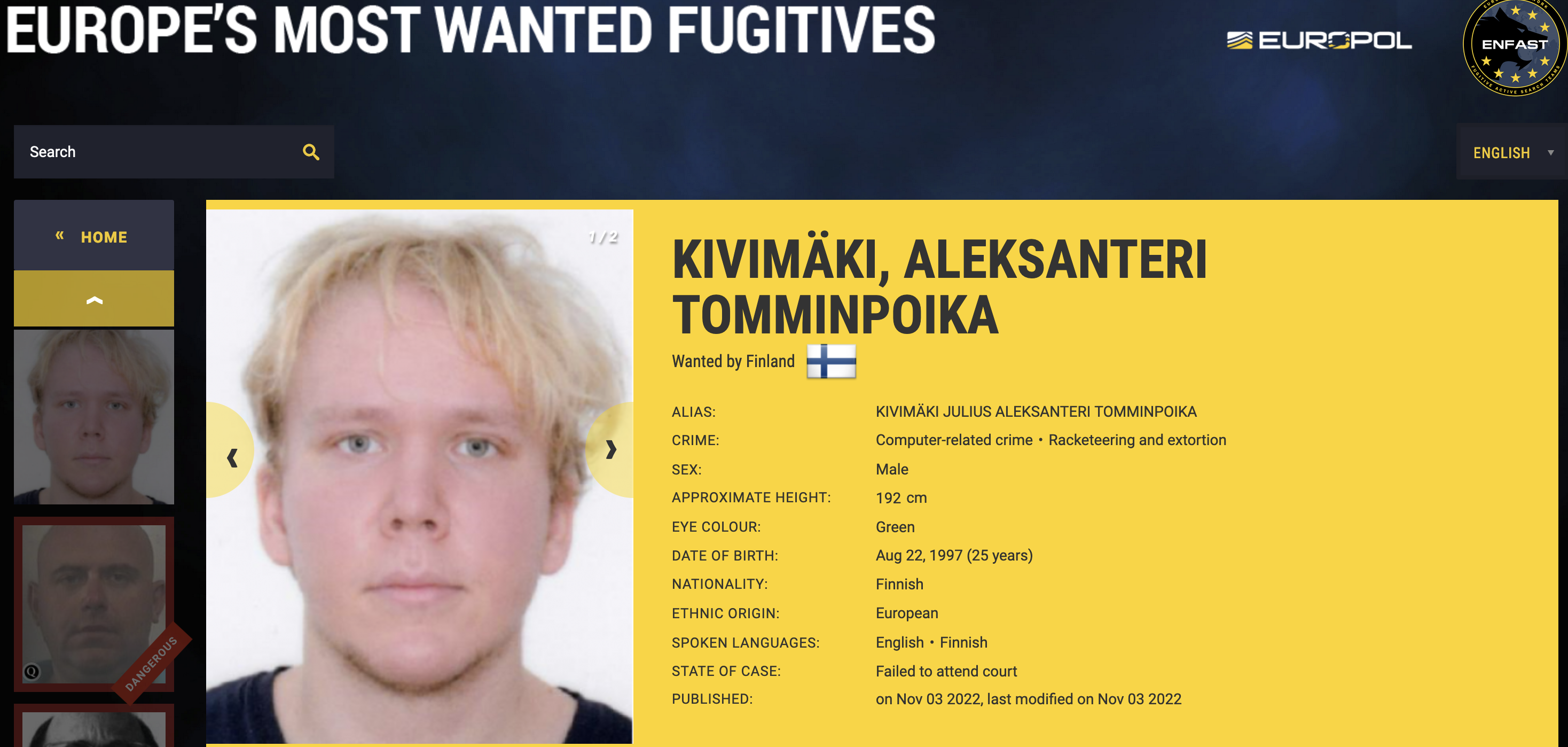
Prosecutors in Finland this week commenced their criminal trial against Julius Kivimäki, a 26-year-old Finnish man charged with extorting a once popular and now-bankrupt online psychotherapy practice and thousands of its patients. In a 2,200-page report, Finnish authorities laid out how they connected the extortion spree to Kivimäki, a notorious hacker who was convicted in 2015 of perpetrating tens of thousands of cybercrimes, including data breaches, payment fraud, operating a botnet and calling in bomb threats.

In late October 2022, Kivimäki was charged with attempting to extort money from the Vastaamo Psychotherapy Center. In that breach, which occurred in October 2020, a hacker using the handle “Ransom Man” threatened to publish patient psychotherapy notes if Vastaamo did not pay a six-figure ransom demand.

Vastaamo refused, so Ransom Man shifted to extorting individual patients — sending them targeted emails threatening to publish their therapy notes unless paid a 500-euro ransom. When Ransom Man found little success extorting patients directly, they uploaded to the dark web a large compressed file containing all of the stolen Vastaamo patient records.

Security experts soon discovered Ransom Man had mistakenly included an entire copy of their home folder, where investigators found many clues pointing to Kivimäki’s involvement. In November 2022, the Finnish government charged Kivimäki in absentia with the Vastaamo hack. The 2,200-page evidence document against Kivimäki suggests he enjoyed a lavish lifestyle while on the lam, frequenting luxury resorts and renting fabulously expensive cars and living quarters.

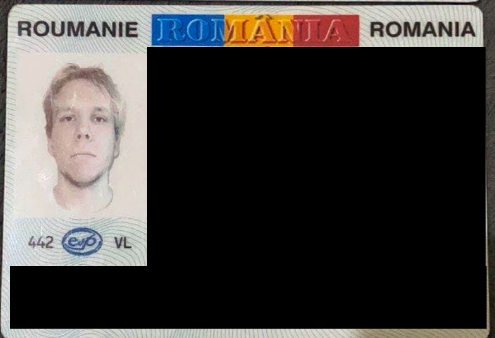
But in February 2023, Kivimäki was arrested in France after authorities there responded to a domestic disturbance call and found the defendant sleeping off a hangover on the couch of a woman he’d met the night before. The French police grew suspicious when the 6′ 3″ blonde, green-eyed man presented an ID that stated he was of Romanian nationality.

A redacted copy of an ID Kivimaki gave to French authorities claiming he was from Romania.

Finnish prosecutors showed that Kivimäki’s credit card had been used to pay for the virtual server that hosted the stolen Vastaamo patient notes. What’s more, the home folder included in the Vastaamo patient data archive also allowed investigators to peer into other cybercrime projects of the accused, including domains that Ransom Man had access to as well as a lengthy history of commands he’d executed on the rented virtual server.

Some of those domains allegedly administered by Kivimäki were set up to smear the reputations of different companies and individuals. One of those was a website that claimed to have been authored by a person who headed up IT infrastructure for a major bank in Norway which discussed the idea of legalizing child sexual abuse.

Another domain hosted a fake blog that besmirched the reputation of a Tulsa, Okla. man whose name was attached to blog posts about supporting the “white pride” movement and calling for a pardon of the Oklahoma City bomber Timothy McVeigh.

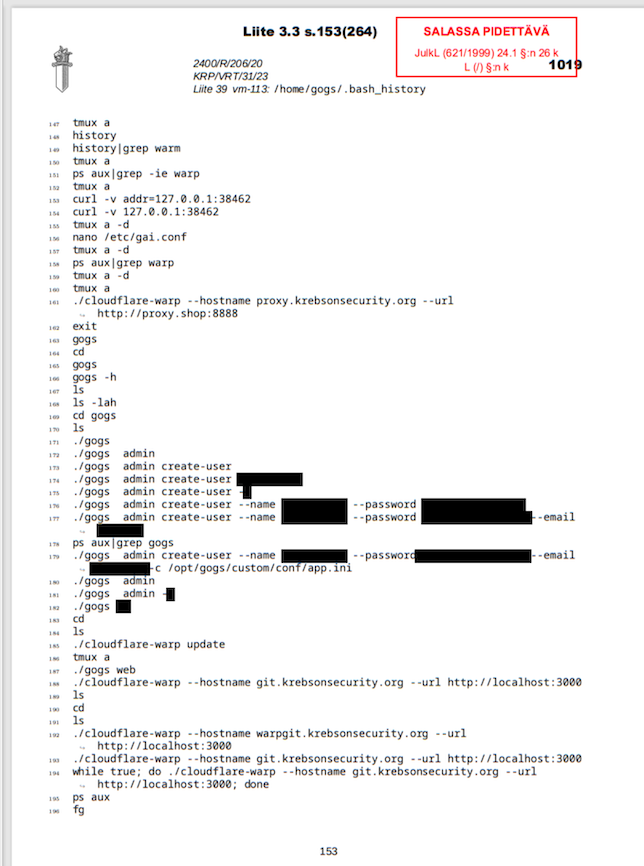
Kivimäki appears to have sought to sully the name of this reporter as well. The 2,200-page document shows that Kivimäki owned and operated the domain krebsonsecurity[.]org, which hosted various hacking tools that Kivimäki allegedly used, including programs for mass-scanning the Internet for systems vulnerable to known security flaws, as well as scripts for cracking database server usernames and passwords, and downloading databases.

Ransom Man inadvertently included a copy of his home directory in the leaked Vastaamo patient data. A lengthy history of the commands run by that user show they used krebsonsecurity-dot-org to host hacking and scanning tools.

Mikko Hyppönen, chief research officer at WithSecure (formerly F-Secure), said the Finnish authorities have done “amazing work,” and that “it’s rare to have this much evidence for a cybercrime case.”

Petteri Järvinen is a respected IT expert and author who has been following the trial, and he said the prosecution’s case so far has been strong.

“The National Bureau of Investigation has done a good job and Mr Kivimäki for his part some elementary mistakes,” Järvinen wrote on LinkedIn. “This sends an important message: online crime does not pay. Traces are left in the digital world too, even if it is very tedious for the police to collect them from servers all around the world.”

Antti Kurittu is an information security specialist and a former criminal investigator. In 2013, Kurittu worked on an investigation involving Kivimäki’s use of the Zbot botnet, among other activities Kivimäki engaged in as a member of the hacker group Hack the Planet (HTP). Kurittu said it remains to be seen if the prosecution can make their case, and if the defense has any answers to all of the evidence presented.

“Based on the public pretrial investigation report, it looks like the case has a lot of details that seem very improbable to be coincidental,” Kurittu told KrebsOnSecurity. “For example, a full copy of the Vastaamo patient database was found on a server that belonged to Scanifi, a company with no reasonable business that Kivimäki was affiliated with. The leaked home folder contents were also connected to Kivimäki and were found on servers that were under his control.”

The Finnish daily yle.fi reports that Kivimäki’s lawyers sought to have their client released from confinement for the remainder of his trial, noting that the defendant has already been detained for eight months.

The court denied that request, saying the defendant was still a flight risk. Kivimäki’s trial is expected to continue until February 2024, in part to accommodate testimony from a large number of victims. Prosecutors are seeking a seven-year sentence for Kivimäki.

from Krebs on Security https://ift.tt/EzbKZ8r
via IFTTT

Microsoft Patch Tuesday, November 2023 Edition

Microsoft today released updates to fix more than five dozen security holes in its Windows operating systems and related software, including three “zero day” vulnerabilities that Microsoft warns are already being exploited in active attacks.

The zero-day threats targeting Microsoft this month include CVE-2023-36025, a weakness that allows malicious content to bypass the Windows SmartScreen Security feature. SmartScreen is a built-in Windows component that tries to detect and block malicious websites and files. Microsoft’s security advisory for this flaw says attackers could exploit it by getting a Windows user to click on a booby-trapped link to a shortcut file.

Kevin Breen, senior director of threat research at Immersive Labs, said emails with .url attachments or logs with processes spawning from .url files “should be a high priority for threat hunters given the active exploitation of this vulnerability in the wild.”

The second zero day this month is CVE-2023-36033, which is a vulnerability in the “DWM Core Library” in Microsoft Windows that was exploited in the wild as a zero day and publicly disclosed prior to patches being available. It affects Microsoft Windows 10 and later, as well as Microsoft Windows Server 2019 and subsequent versions.

“This vulnerability can be exploited locally, with low complexity and without needing high-level privileges or user interaction,” said Mike Walters, president and co-founder of the security firm Action1. “Attackers exploiting this flaw could gain SYSTEM privileges, making it an efficient method for escalating privileges, especially after initial access through methods like phishing.”

The final zero day in this month’s Patch Tuesday is a problem in the “Windows Cloud Files Mini Filter Driver” tracked as CVE-2023-36036 that affects Windows 10 and later, as well as Windows Server 2008 at later. Microsoft says it is relatively straightforward for attackers to exploit CVE-2023-36036 as a way to elevate their privileges on a compromised PC.

Beyond the zero day flaws, Breen said organizations running Microsoft Exchange Server should prioritize several new Exchange patches, including CVE-2023-36439, which is a bug that would allow attackers to install malicious software on an Exchange server. This weakness technically requires the attacker to be authenticated to the target’s local network, but Breen notes that a pair of phished Exchange credentials will provide that access nicely.

“This is typically achieved through social engineering attacks with spear phishing to gain initial access to a host before searching for other vulnerable internal targets – just because your Exchange Server doesn’t have internet-facing authentication doesn’t mean it’s protected,” Breen said.

Breen said this vulnerability goes hand in hand with three other Exchange bugs that Microsoft designated as “exploitation more likely:” CVE-2023-36050, CVE-2023-36039 and CVE-2023-36035.

Finally, the SANS Internet Storm Center points to two additional bugs patched by Microsoft this month that aren’t yet showing signs of active exploitation but that were made public prior to today and thus deserve prioritization. Those include: CVE-2023-36038, a denial of service vulnerability in ASP.NET Core, with a CVSS score of 8.2; and CVE-2023-36413: A Microsoft Office security feature bypass. Exploiting this vulnerability will bypass the protected mode when opening a file received via the web.

Windows users, please consider backing up your data and/or imaging your system before applying any updates. And feel free to sound off in the comments if you experience any difficulties as a result of these patches.

from Krebs on Security https://ift.tt/bNKDML0
via IFTTT

Australia politics live: Scott Morrison defends handling of Aukus; data breaches double in a year

Former PM denies lying to French president when securing the nuclear sub deal; signals directorate records huge jump in attacks on networks. Follow the day’s news live

Good morning and welcome to our rolling news coverage. I’m Martin Farrer and I’ll be bringing you the best of our overnight and breaking news before Amy Remeikis takes the helm for a day of politics.

The rising cost of living is eating away at Australians’ treasured way of life, but it’s also costing the country in togetherness. According to our top story this morning, a running index of social cohesion is at its lowest ebb since it began to be tracked 16 years ago. At the same time, banks are making massive profits and our Full Story podcast asks how they’re doing it.

Continue reading…

from Data and computer security | The Guardian https://ift.tt/qvAQJTh
via IFTTT

Private UK health data donated for medical research shared with insurance companies

Observer investigation reveals UK Biobank opened its biomedical database to insurance firms despite pledge it would not do so

Sensitive health information donated for medical research by half a million UK citizens has been shared with insurance companies despite a pledge that it would not be.

An Observer investigation has found that UK Biobank opened up its vast biomedical database to insurance sector firms several times between 2020 and 2023. The data was provided to insurance consultancy and tech firms for projects to create digital tools that help insurers predict a person’s risk of getting a chronic disease. The findings have raised concerns among geneticists, data privacy experts and campaigners over vetting and ethical checks at Biobank.

Continue reading…

from Data and computer security | The Guardian https://ift.tt/wmiB5EL
via IFTTT

It’s Still Easy for Anyone to Become You at Experian

In the summer of 2022, KrebsOnSecurity documented the plight of several readers who had their accounts at big-three consumer credit reporting bureau Experian hijacked after identity thieves simply re-registered the accounts using a different email address. Sixteen months later, Experian clearly has not addressed this gaping lack of security. I know that because my account at Experian was recently hijacked, and the only way I could recover access was by recreating the account.

Entering my SSN and birthday at Experian showed my identity was tied to an email address I did not authorize.

I recently ordered a copy of my credit file from Experian via annualcreditreport.com, but as usual Experian declined to provide it, saying they couldn’t verify my identity. Attempts to log in to my account directly at Experian.com also failed; the site said it didn’t recognize my username and/or password.

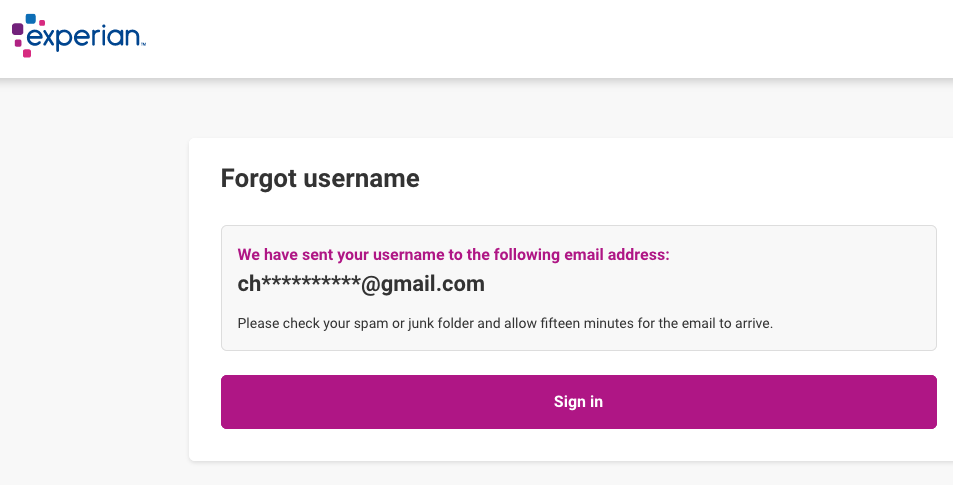
A request for my Experian account username required my full Social Security number and date of birth, after which the website displayed portions of an email address I never authorized and did not recognize (the full address was redacted by Experian).

I immediately suspected that Experian was still allowing anyone to recreate their credit file account using the same personal information but a different email address, a major authentication failure that was explored in last year’s story, Experian, You Have Some Explaining to Do. So once again I sought to re-register as myself at Experian.

The homepage said I needed to provide a Social Security number and mobile phone number, and that I’d soon receive a link that I should click to verify myself. The site claims that the phone number you provide will be used to help validate your identity. But it appears you could supply any phone number in the United States at this stage in the process, and Experian’s website would not balk. Regardless, users can simply skip this step by selecting the option to “Continue another way.”

Experian then asks for your full name, address, date of birth, Social Security number, email address and chosen password. After that, they require you to successfully answer between three to five multiple-choice security questions whose answers are very often based on public records. When I recreated my account this week, the only question that pertained to my real information concerned a previous street addresses we’ve lived at — information that is just a Google search away.

Assuming you sail through the multiple-choice questions, you’re prompted to create a 4-digit PIN and provide an answer to one of several pre-selected challenge questions. After that, your new account is created and you’re directed to the Experian dashboard, which allows you to view your full credit file, and freeze or unfreeze it.

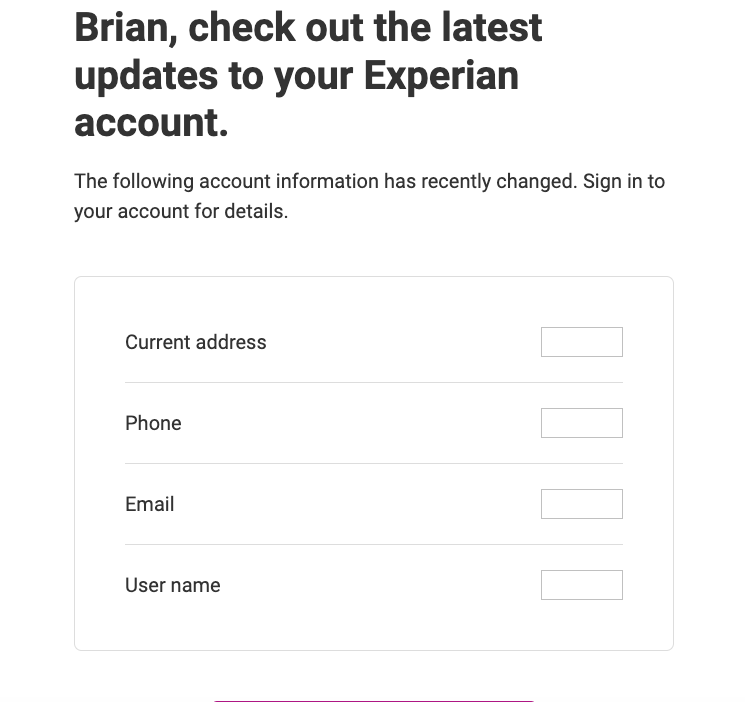
At this point, Experian will send a message to the old email address tied to the account, saying certain aspects of the user profile have changed. But this message isn’t a request seeking verification: It’s just a notification from Experian that the account’s user data has changed, and the original user is offered zero recourse here other than to a click a link to log in at Experian.com.

If you don’t have an Experian account, it’s a good idea to create one. Because at least then you will receive one of these  emails when someone hijacks your credit file at Experian.

And of course, a user who receives one of these notices will find that their credentials to their Experian account no longer work. Nor do their PIN or account recovery question, because those have been changed also. Your only option at this point is recreate your account at Experian and steal it back from the ID thieves!

In contrast, if you try to recreate an existing account at either of the other two major consumer credit reporting bureaus — Equifax or TransUnion — they will ask you to enter a code sent to the email address or phone number on file before any changes can be made.

Reached for comment, Experian declined to share the full email address that was added without authorization to my credit file.

“To ensure the protection of consumers’ identities and information, we have implemented a multi-layered security approach, which includes passive and active measures, and are constantly evolving,” Experian spokesperson Scott Anderson said in an emailed statement. “This includes knowledge-based questions and answers, and device possession and ownership verification processes.”

Anderson said all consumers have the option to activate a multi-factor authentication method that’s requested each time they log in to their account. But what good is multi-factor authentication if someone can simply recreate your account with a new phone number and email address?

Several readers who spotted my rant about Experian on Mastodon earlier this week responded to a request to validate my findings. The Mastodon user @Jackerbee is a reader from Michican who works in the biotechnology industry. @Jackerbee said when prompted by Experian to provide his phone number and the last four digits of his SSN, he chose the option to “manually enter my information.”

“I put my second phone number and the new email address,” he explained. “I received a single email in my original account inbox that said they’ve updated my information after I ‘signed up.’ No verification required from the original email address at any point. I also did not receive any text alerts at the original phone number. The especially interesting and egregious part is that when I sign in, it does 2FA with the new phone number.”

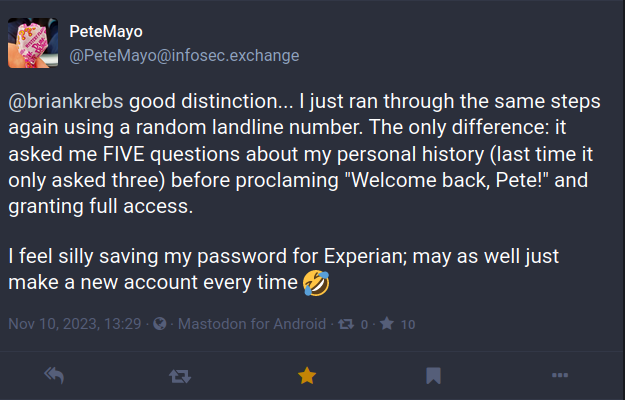
The Mastodon user PeteMayo said they recreated their Experian account twice this week, the second time by supplying a random landline number.

“The only difference: it asked me FIVE questions about my personal history (last time it only asked three) before proclaiming, ‘Welcome back, Pete!,’ and granting full access,” @PeteMayo wrote. “I feel silly saving my password for Experian; may as well just make a new account every time.”

I was fortunate in that whoever hijacked my account did not also thaw my credit freeze.  Or if they did, they politely froze it again when they were done. But I fully expect my Experian account will be hijacked yet again unless Experian makes some important changes to its authentication process.

It boggles the mind that these fundamental authentication weaknesses have been allowed to persist for so long at Experian, which already has a horrible track record in this regard.

In December 2022, KrebsOnSecurity alerted Experian that identity thieves had worked out a remarkably simple way to bypass its security and access any consumer’s full credit report — armed with nothing more than a person’s name, address, date of birth, and Social Security number. Experian fixed the glitch, and acknowledged that it persisted for nearly seven weeks, between Nov. 9, 2022 and Dec. 26, 2022.

In April 2021, KrebsOnSecurity revealed how identity thieves were exploiting lax authentication on Experian’s PIN retrieval page to unfreeze consumer credit files. In those cases, Experian failed to send any notice via email when a freeze PIN was retrieved, nor did it require the PIN to be sent to an email address already associated with the consumer’s account.

A few days after that April 2021 story, KrebsOnSecurity broke the news that an Experian API was exposing the credit scores of most Americans.

More greatest hits from Experian:

2022: Class Action Targets Experian Over Account Security
2017: Experian Site Can Give Anyone Your Credit Freeze PIN
2015: Experian Breach Affects 15 Million Customers
2015: Experian Breach Tied to NY-NJ ID Theft Ring
2015: At Experian, Security Attrition Amid Acquisitions
2015: Experian Hit With Class Action Over ID Theft Service
2014: Experian Lapse Allowed ID Theft Service Access to 200 Million Consumer Records
2013: Experian Sold Consumer Data to ID Theft Service

from Krebs on Security https://ift.tt/OmRy8Nu
via IFTTT

Who’s Behind the SWAT USA Reshipping Service?

Last week, KrebsOnSecurity broke the news that one of the largest cybercrime services for laundering stolen merchandise was hacked recently, exposing its internal operations, finances and organizational structure. In today’s Part II, we’ll examine clues about the real-life identity of “Fearless,” the nickname chosen by the proprietor of the SWAT USA Drops service.

Based in Russia, SWAT USA recruits people in the United States to reship packages containing pricey electronics that are purchased with stolen credit cards. As detailed in this Nov. 2 story, SWAT currently employs more than 1,200 U.S. residents, all of whom will be cut loose without a promised payday at the end of their first month reshipping stolen goods.

The current co-owner of SWAT, a cybercriminal who uses the nickname “Fearlless,” operates primarily on the cybercrime forum Verified. This Russian-language forum has tens of thousands of members, and it has suffered several hacks that exposed more than a decade’s worth of user data and direct messages.

January 2021 posts on Verified show that Fearlless and his partner Universalo purchased the SWAT reshipping business from a Verified member named SWAT, who’d been operating the service for years. SWAT agreed to transfer the business in exchange for 30 percent of the net profit over the ensuing six months.

Cyber intelligence firm Intel 471 says Fearlless first registered on Verified in February 2013. The email address Fearlless used on Verified leads nowhere, but a review of Fearlless’ direct messages on Verified indicates this user originally registered on Verified a year earlier as a reshipping vendor, under the alias “Apathyp.”

There are two clues supporting the conclusion that Apathyp and Fearlless are the same person. First, the Verified administrators warned Apathyp he had violated the forum’s rules barring the use of multiple accounts by the same person, and that Verified’s automated systems had detected that Apathyp and Fearlless were logging in from the same device.  Second, in his earliest private direct messages on Verified, Fearlless told others to contact him on an instant messenger address that Apathyp had claimed as his.

Intel 471 says Apathyp registered on Verified using the email address triploo@mail.ru. A search on that email address at the breach intelligence service Constella Intelligence found that a password commonly associated with it was “niceone.” But the triploo@mail.ru account isn’t connected to much else that’s interesting except a now-deleted account at Vkontakte, the Russian answer to Facebook.

However, in Sept. 2020, Apathyp sent a private message on Verified to the owner of a stolen credit card shop, saying his credentials no longer worked. Apathyp told the proprietor that his chosen password on the service was “12Apathy.”

A search on that password at Constella reveals it was used by just four different email addresses, two of which are particularly interesting: gezze@yandex.ru and gezze@mail.ru. Constella discovered that both of these addresses were previously associated with the same password as triploo@mail.ru — “niceone,” or some variation thereof.

Constella found that years ago gezze@mail.ru was used to create a Vkontakte account under the name Ivan Sherban (former password: “12niceone“) from Magnitogorsk, an industrial city in the southern region of Russia. That same email address is now tied to a Vkontakte account for an Ivan Sherban who lists his home as Saint Petersburg, Russia. Sherban’s profile photo shows a heavily tattooed, muscular and recently married individual with his beautiful new bride getting ready to drive off in a convertible sports car.

A pivotal clue for validating the research into Apathyp/Fearlless came from the identity intelligence firm myNetWatchman, which found that gezze@mail.ru at one time used the passwords “геззи1991” (gezze1991) and “gezze18081991.”

Care to place a wager on when Vkontakte says is Mr. Sherban’s birthday? Ten points if you answered August 18 (18081991).

Mr. Sherban did not respond to multiple requests for comment.

from Krebs on Security https://ift.tt/mYR2J5H
via IFTTT

I resist sharenting on social media. Does that mean my son and I are missing out, or is it just safer? | Rhiannon Lucy Cosslett

Posting can turn into a privacy risk – and in a changing online landscape, it’s become another parental identity marker

An old friend asked me recently why I never put my son’s face online. “Can you explain the not showing pics of babies thing to me?” she asked. “Everyone our age seems to obscure their baby’s face with emojis. I feel as if I’ve missed a key essay on the morality of baby pic social media publication.”

I don’t do the emoji thing – in fact I’ve even stopped showing the back of his head, or any aspect of his home life, really – but I know what she means. A few years ago, sharenting, as it’s been called, felt like the norm among my social circle. These days I see far fewer babies’ faces on social media. Concerns about online privacy and safeguarding, as well as facial recognition and the commercial use of personal data, are far more prevalent than they were in the early days of Facebook. In fact, you could say that whether or not you share photos has become another parental identity marker, up there with breastfeeding, cloth nappies and baby-led weaning as evidence that you’re doing things “the right way”, not like “those other parents”.

Continue reading…

from Data and computer security | The Guardian https://ift.tt/qTeQ6tu
via IFTTT

Russian Reshipping Service ‘SWAT USA Drop’ Exposed

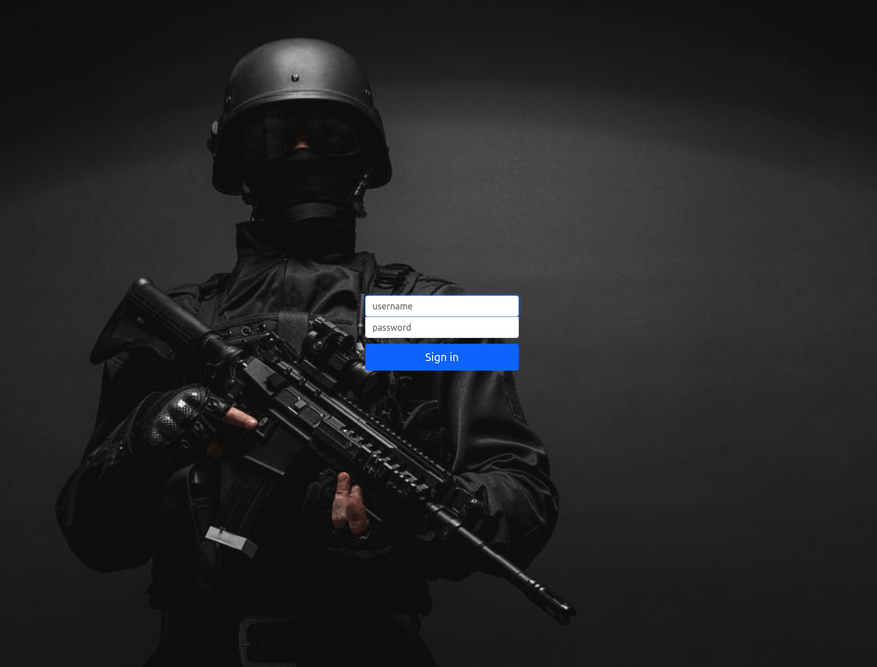
The login page for the criminal reshipping service SWAT USA Drop.

One of the largest cybercrime services for laundering stolen merchandise was hacked recently, exposing its internal operations, finances and organizational structure. Here’s a closer look at the Russia-based SWAT USA Drop Service, which currently employs more than 1,200 people across the United States who are knowingly or unwittingly involved in reshipping expensive consumer goods purchased with stolen credit cards.

Among the most common ways that thieves extract cash from stolen credit card accounts is through purchasing pricey consumer goods online and reselling them on the black market. Most online retailers grew wise to these scams years ago and stopped shipping to regions of the world most frequently associated with credit card fraud, including Eastern Europe, North Africa, and Russia.

But such restrictions have created a burgeoning underground market for reshipping scams, which rely on willing or unwitting residents in the United States and Europe to receive stolen goods and relay them to crooks living in the embargoed areas.

Services like SWAT are known as “Drops for stuff” on cybercrime forums. The “drops” are people who have responded to work-at-home package reshipping jobs advertised on craigslist.com and job search sites. Most reshipping scams promise employees a monthly salary and even cash bonuses. In reality, the crooks in charge almost always stop communicating with drops just before the first payday, usually about a month after the drop ships their first package.

The packages arrive with prepaid shipping labels that are paid for with stolen credit card numbers, or with hijacked online accounts at FedEx and the US Postal Service. Drops are responsible for inspecting and verifying the contents of shipments, attaching the correct shipping label to each package, and sending them off via the appropriate shipping company.

SWAT takes a percentage cut (up to 50 percent) where “stuffers” — thieves armed with stolen credit card numbers — pay a portion of each product’s retail value to SWAT as the reshipping fee. The stuffers use stolen cards to purchase high-value products from merchants and have the merchants ship the items to the drops’ address. Once the drops receive and successfully reship the stolen packages, the stuffers then sell the products on the local black market.

The SWAT drop service has been around in various names and under different ownership for almost a decade. But in early October 2023, SWAT’s current co-owner — a Russian-speaking individual who uses the handle “Fearlless” — took to his favorite cybercrime forum to lodge a formal complaint against the owner of a competing reshipping service, alleging his rival had hacked SWAT and was trying to poach his stuffers and reshippers by emailing them directly.

Milwaukee-based security firm Hold Security shared recent screenshots of a working SWAT stuffer’s user panel, and those images show that SWAT currently lists more than 1,200 drops in the United States that are available for stuffers to rent. The contact information for Kareem, a young man from Maryland, was listed as an active drop. Contacted by KrebsOnSecurity, Kareem agreed to speak on condition that his full name not be used in this story.
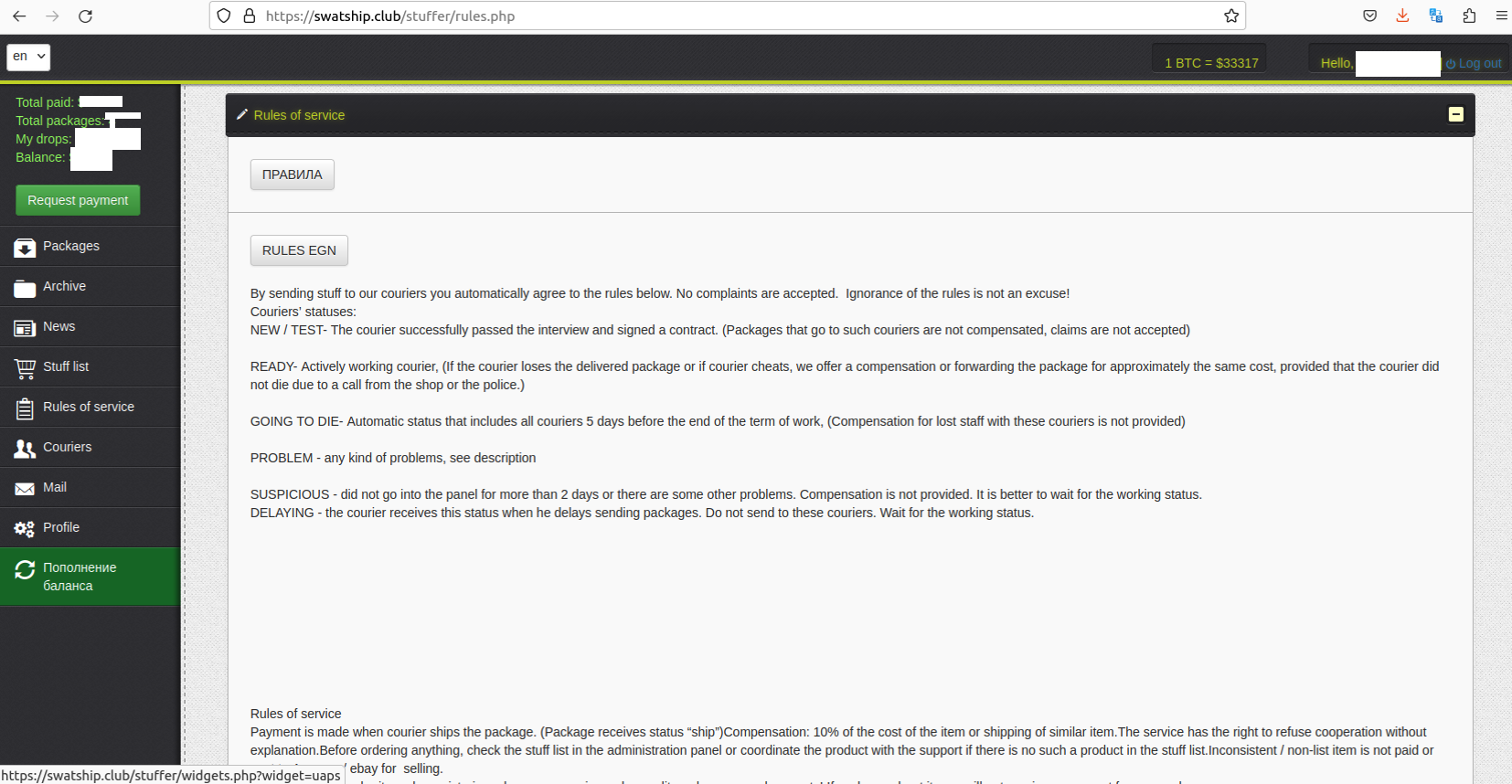
A SWAT panel for stuffers/customers. This page lists the rules of the service, which do not reimburse stuffers for “acts of god,” i.e. authorities seizing stolen goods or arresting the drop.

Kareem said he’d been hired via an online job board to reship packages on behalf of a company calling itself CTSI, and that he’s been receiving and reshipping iPads and Apple watches for several weeks now. Kareem was less than thrilled to learn he would probably not be getting his salary on the promised payday, which was coming up in a few days.

Kareem said he was instructed to create an account at a website called portal-ctsi[.]com, where each day he was expected to log in and check for new messages about pending shipments. Anyone can sign up at this website as a potential reshipping mule, although doing so requires applicants to share a great deal of personal and financial information, as well as copies of an ID or passport matching the supplied name.
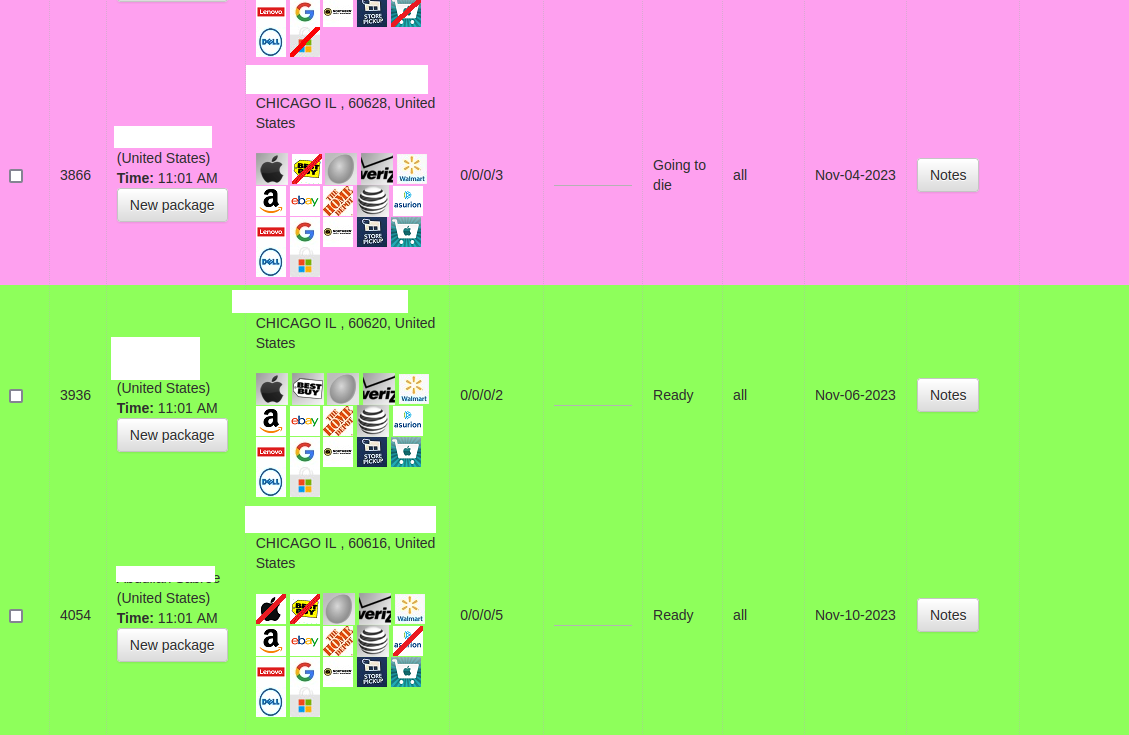
A SWAT panel for stuffers/customers, listing hundreds of drops in the United States by their status. “Going to die” are those who are about to be let go without promised payment, or who have quit on their own.

On a suspicion that the login page for portal-ctsi[.]com might be a custom coding job, KrebsOnSecurity selected “view source” from the homepage to expose the site’s HTML code. Grabbing a snippet of that code (e.g., “smarty/default/jui/js/jquery-ui-1.9.2.min.js”) and searching on it at publicwww.com reveals more than four dozen other websites running the same login panel. And all of those appear to be geared toward either stuffers or drops.

In fact, more than half of the domains that use this same login panel actually include the word “stuffer” in the login URL, according to publicwww. Each of the domains below that end in “/user/login.php” are sites for active and prospective drops, and each corresponds to a unique fake company that is responsible for managing its own stable of drops:

lvlup-store[.]com/stuffer/login.php
personalsp[.]com/user/login.php
destaf[.]com/stuffer/login.php
jaderaplus[.]com/stuffer/login.php
33cow[.]com/stuffer/login.php
panelka[.]net/stuffer/login.php
aaservice[.]net/stuffer/login.php
re-shipping[.]ru/stuffer/login.php
bashar[.]cc/stuffer/login.php
marketingyoursmall[.]biz/stuffer/login.php
hovard[.]xyz/stuffer/login.php
pullback[.]xyz/stuffer/login.php
telollevoexpress[.]com/stuffer/login.php
postme[.]today/stuffer/login.php
wint-job[.]com/stuffer/login.php
squadup[.]club/stuffer/login.php
mmmpack[.]pro/stuffer/login.php
yoursmartpanel[.]com/user/login.php
opt257[.]org/user/login.php
touchpad[.]online/stuffer/login.php
peresyloff[.]top/stuffer/login.php
ruzke[.]vodka/stuffer/login.php
staf-manager.net/stuffer/login.php
data-job[.]club/stuffer/login.php
logistics-services[.]org/user/login.php
swatship[.]club/stuffer/login.php
logistikmanager[.]online/user/login.php
endorphine[.]world/stuffer/login.php
burbon[.]club/stuffer/login.php
bigdropproject[.]com/stuffer/login.php
jobspaket[.]net/user/login.php
yourcontrolboard[.]com/stuffer/login.php
packmania[.]online/stuffer/login.php
shopping-bro[.]com/stuffer/login.php
dash-redtag[.]com/user/login.php
mnger[.]net/stuffer/login.php
begg[.]work/stuffer/login.php
dashboard-lime[.]com/user/login.php
control-logistic[.]xyz/user/login.php
povetru[.]biz/stuffer/login.php
dash-nitrologistics[.]com/user/login.php
cbpanel[.]top/stuffer/login.php
hrparidise[.]pro/stuffer/login.php
d-cctv[.]top/user/login.php
versandproject[.]com/user/login.php
packitdash[.]com/user/login.php
avissanti-dash[.]com/user/login.php
e-host[.]life/user/login.php
pacmania[.]club/stuffer/login.php

Why so many websites? In practice, all drops are cut loose within approximately 30 days of their first shipment — just before the promised paycheck is due. Because of this constant churn, each stuff shop operator must be constantly recruiting new drops. Also, with this distributed setup, even if one reshipping operation gets shut down (or exposed online), the rest can keep on pumping out dozens of packages a day.

A 2015 academic study (PDF) on criminal reshipping services found the average financial hit from a reshipping scheme per cardholder was $1,156.93. That study looked into the financial operations of several reshipping schemes, and estimated that approximately 1.6 million credit and debit cards are used to commit at least $1.8 billion in reshipping fraud each year.

It’s not hard to see how reshipping can be a profitable enterprise for card crooks. For example, a stuffer buys a stolen payment card off the black market for $10, and uses that card to purchase more than $1,100 worth of goods. After the reshipping service takes its cut (~$550), and the stuffer pays for his reshipping label (~$100), the stuffer receives the stolen goods and sells them on the black market in Russia for $1,400. He has just turned a $10 investment into more than $700. Rinse, wash, and repeat.

The breach at SWAT exposed not only the nicknames and contact information for all of its stuffers and drops, but also the group’s monthly earnings and payouts. SWAT apparently kept its books in a publicly accessible Google Sheets document, and that document reveals Fearlless and his business partner each routinely made more than $100,000 every month operating their various reshipping businesses.

The exposed SWAT financial records show this crime group has tens of thousands of dollars worth of expenses each month, including payments for the following recurring costs:

-advertising the service on crime forums and via spam;
-people hired to re-route packages, usually by voice over the phone;
-third-party services that sell hacked/stolen USPS/Fedex labels;
-“drops test” services, contractors who will test the honesty of drops by sending them fake jewelry;
-“documents,” e.g. sending drops to physically pick up legal documents for new phony front companies.

The spreadsheet also included the cryptocurrency account numbers that were to be credited each month with SWAT’s earnings. Unsurprisingly, a review of the blockchain activity tied to the bitcoin addresses listed in that document shows that many of them have a deep association with cybercrime, including ransomware activity and transactions at darknet sites that peddle stolen credit cards and residential proxy services.

The information leaked from SWAT also has exposed the real-life identity and financial dealings of its principal owner — Fearlless, a.k.a. “SwatVerified.” We’ll hear more about Fearlless in Part II of this story. Stay tuned.

from Krebs on Security https://ift.tt/bQCr9sR
via IFTTT

.US Harbors Prolific Malicious Link Shortening Service

The top-level domain for the United States — .US — is home to thousands of newly-registered domains tied to a malicious link shortening service that facilitates malware and phishing scams, new research suggests. The findings come close on the heels of a report that identified .US domains as among the most prevalent in phishing attacks over the past year.

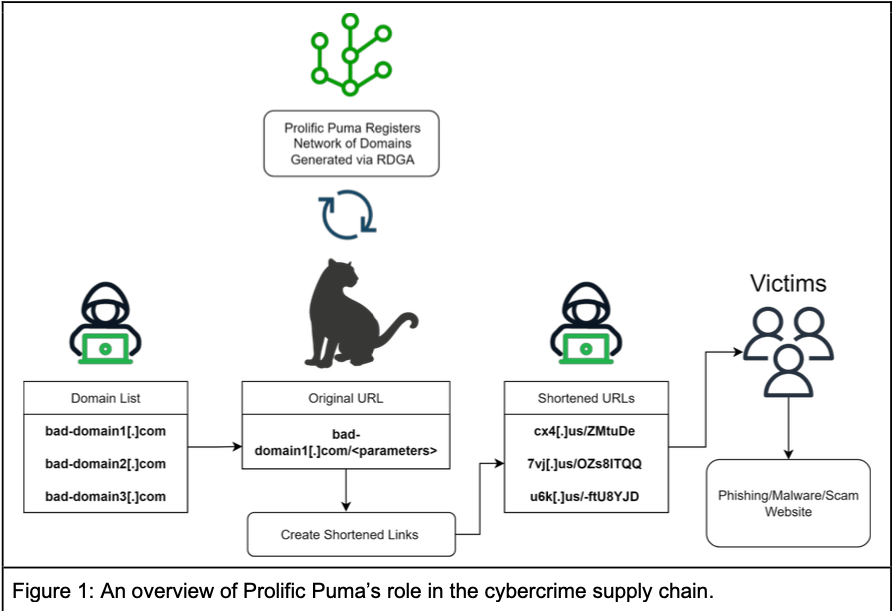
Researchers at Infoblox say they’ve been tracking what appears to be a three-year-old link shortening service that is catering to phishers and malware purveyors. Infoblox found the domains involved are typically three to seven characters long, and hosted on bulletproof hosting providers that charge a premium to ignore any abuse or legal complaints. The short domains don’t host any content themselves, but are used to obfuscate the real address of landing pages that try to phish users or install malware.

A graphic describing the operations of a malicious link shortening service that Infoblox has dubbed “Prolific Puma.”

Infoblox says it’s unclear how the phishing and malware landing pages tied to this service are being initially promoted, although they suspect it is mainly through scams targeting people on their phones via SMS. A new report says the company mapped the contours of this link shortening service thanks in part to pseudo-random patterns in the short domains, which all appear on the surface to be a meaningless jumble of letters and numbers.

“This came to our attention because we have systems that detect registrations that use domain name generation algorithms,” said Renee Burton, head of threat intelligence at Infoblox. “We have not found any legitimate content served through their shorteners.”

Infoblox determined that until May 2023, domains ending in .info accounted for the bulk of new registrations tied to the malicious link shortening service. Since then, they found that whoever is responsible for running the service has used .US for approximately 55 percent of the total domains created, with several dozen new malicious .US domains registered daily.

.US is overseen by the National Telecommunications and Information Administration (NTIA), an executive branch agency of the U.S. Department of Commerce. But Uncle Sam has long outsourced the management of .US to various private companies, which have gradually allowed the United States’s top-level domain to devolve into a cesspool of phishing activity.

Or so concludes The Interisle Consulting Group, which gathers phishing data from multiple industry sources and publishes an annual report on the latest trends. As far back as 2018, Interisle found .US domains were the worst in the world for spam, botnet (attack infrastructure for DDOS etc.) and illicit or harmful content.

Interisle’s newest study examined six million phishing reports between May 1, 2022 and April 30, 2023, and identified approximately 30,000 .US phishing domains. Interisle found significant numbers of .US domains were registered to attack some of the United States’ most prominent companies, including Bank of America, Amazon, Apple, AT&T, Citi, Comcast, Microsoft, Meta, and Target. Others were used to impersonate or attack U.S. government agencies.

Under NTIA regulations, domain registrars processing .US domain registrations must take certain steps (PDF) to verify that those customers actually reside in the United States, or else own organizations based in the U.S. However, if one registers a .US domain through GoDaddy — the largest domain registrar and the current administrator of the .US contract — the way one “proves” their U.S. nexus is simply by choosing from one of three pre-selected affirmative responses.

In an age when most domain registrars are automatically redacting customer information from publicly accessible registration records to avoid running afoul of European privacy laws, .US has remained something of an outlier because its charter specifies that all registration records be made public. However, Infoblox said it found more than 2,000 malicious link shortener domains ending in .US registered since October 2023 through NameSilo that have somehow subverted the transparency requirements for the usTLD and converted to private registrations.

“Through our own experience with NameSilo, it is not possible to select private registration for domains in the usTLD through their interface,” Infoblox wrote. “And yet, it was done. Of the total domains with private records, over 99% were registered with NameSilo. At this time, we are not able to explain this behavior.”

NameSilo has not yet responded to requests for comment.

Experts who track domains associated with malware and phishing say even phony information supplied at registration is useful in identifying potentially malicious or phishous domains before they can be used for abuse.

For example, when it was registered through NameSilo in July 2023, the domain 1ox[.]us — like thousands of others — listed its registrant as “Leila Puma” at a street address in Poland, and the email address blackpumaoct33@ukr.net. But according to DomainTools.com, on Oct. 1, 2023 those records were redacted and hidden by NameSilo.

This is why Infoblox refers to the people behind this malicious link shortening service as “Prolific Puma.” Infoblox notes that the username portion of the email address appears to be a reference to the song October 33 by the Black Pumas, an Austin, Texas based psychedelic soul band.

The Black Pumas aren’t exactly a household name, but they did recently have a popular Youtube video that featured a cover of the Kinks song “Strangers,” which included an emotional visual narrative about Ukrainians seeking refuge from the Russian invasion, titled “Ukraine Strangers.” Also, Leila Puma’s email address is at a Ukrainian email provider.

DomainTools shows that hundreds of other malicious domains tied to Prolific Puma previously were registered through NameCheap to a “Josef Bakhovsky” at a different street address in Poland. According to ancestry.com, the anglicized version of this surname — Bakovski — is the traditional name for someone from Bakowce, which is now known as Bakivtsi and is in Ukraine.

This possible Polish and/or Ukrainian connection may or may not tell us something about the “who” behind this link shortening service, but those details are useful for identifying and grouping these malicious short domains. However, even this meager visibility into .US registration data is now under threat.

The NTIA recently published a proposal that would allow registrars to redact all registrant data from WHOIS registration records for .US domains. A broad array of industry groups have filed comments opposing the proposed changes, saying they threaten to remove the last vestiges of accountability for a top-level domain that is already overrun with cybercrime activity.

Infoblox’s Burton says Prolific Puma is remarkable because they’ve been able to facilitate malicious activities for years while going largely unnoticed by the security industry.

“This exposes how persistent the criminal economy can be at a supply chain level,” Burton said. “We’re always looking at the end malware or phishing page, but what we’re finding here is that there’s this middle layer of DNS threat actors persisting for years without notice.”

Infoblox’s full report on Prolific Puma is here.

from Krebs on Security https://ift.tt/b4C1i6G
via IFTTT