Change the law on computer evidence with an amendment to data protection bill | Letter

A group of software experts and barristers who have been supporting the subpostmasters affected by the Post Office Horizon miscarriages of justice call for changes to the bill going through the House of Lords

It is now clear that the Post Office was advised by its lawyers to delay disclosing some evidence that would help subpostmasters (Post Office was urged by external lawyers to ‘suppress’ key document, inquiry hears, 18 April).

Failure to disclose vital evidence about the defects in the Horizon IT system led to appalling injustice. We suggest that the data protection and digital information bill that is currently before parliament should be amended to require that a person seeking to rely on computer evidence should have to declare on oath that, having made the necessary inquiries, they know of no reason why it should not be relied on.
Martyn Thomas Emeritus professor, Gresham College
Harold Thimbleby Emeritus professor, Gresham College
Bev Littlewood Emeritus professor, City, University of London
Martin Newby Emeritus professor, City, University of London
Paul Marshall Barrister
Stephen Mason Barrister
James Christie

Continue reading…

from Data and computer security | The Guardian https://ift.tt/Q9veLup
via IFTTT

Who Stole 3.6M Tax Records from South Carolina?

For nearly a dozen years, residents of South Carolina have been kept in the dark by state and federal investigators over who was responsible for hacking into the state’s revenue department in 2012 and stealing tax and bank account information for 3.6 million people. The answer may no longer be a mystery: KrebsOnSecurity found compelling clues suggesting the intrusion was carried out by the same Russian hacking crew that stole of millions of payment card records from big box retailers like Home Depot and Target in the years that followed.

Questions about who stole tax and financial data on roughly three quarters of all South Carolina residents came to the fore last week at the confirmation hearing of Mark Keel, who was appointed in 2011 by Gov. Nikki Haley to head the state’s law enforcement division. If approved, this would Keel’s third six-year term in that role.

The Associated Press reports that Keel was careful not to release many details about the breach at his hearing, telling lawmakers he knows who did it but that he wasn’t ready to name anyone.

“I think the fact that we didn’t come up with a whole lot of people’s information that got breached is a testament to the work that people have done on this case,” Keel asserted.

A ten-year retrospective published in 2022 by The Post and Courier in Columbia, S.C. said investigators determined the breach began on Aug. 13, 2012, after a state IT contractor clicked a malicious link in an email. State officials said they found out about the hack from federal law enforcement on October 10, 2012.

KrebsOnSecurity examined posts across dozens of cybercrime forums around that time, and found only one instance of someone selling large volumes of tax data in the year surrounding the breach date.

On Oct. 7, 2012 — three days before South Carolina officials say they first learned of the intrusion — a notorious cybercriminal who goes by the handle “Rescator” advertised the sale of “a database of the tax department of one of the states.”

“Bank account information, SSN and all other information,” Rescator’s sales thread on the Russian-language crime forum Embargo read. “If you purchase the entire database, I will give you access to it.”

A week later, Rescator posted a similar offer on the exclusive Russian forum Mazafaka, saying he was selling information from a U.S. state tax database, without naming the state. Rescator said the data exposed included employer, name, address, phone, taxable income, tax refund amount, and bank account number.

“There is a lot of information, I am ready to sell the entire database, with access to the database, and in parts,” Rescator told Mazafaka members. “There is also information on corporate taxpayers.”

On Oct. 26, 2012, the state announced the breach publicly. State officials said they were working with investigators from the U.S. Secret Service and digital forensics experts from Mandiant, which produced an incident report (PDF) that was later published by South Carolina Dept. of Revenue. KrebsOnSecurity sought comment from the Secret Service, South Carolina prosecutors, and Mr. Keel’s office. This story will be updated if any of them respond.

On Nov. 18, 2012, Rescator told fellow denizens of the forum Verified he was selling a database of 65,000 records with bank account information from several smaller, regional financial institutions. Rescator’s sales thread on Verified listed more than a dozen database fields, including account number, name, address, phone, tax ID, date of birth, employer and occupation.

Asked to provide more context about the database for sale, Rescator told forum members the database included financial records related to tax filings of a U.S. state. Rescator added that there was a second database of around 80,000 corporations that included social security numbers, names and addresses, but no financial information.

The AP says South Carolina paid $12 million to Experian for identity theft protection and credit monitoring for its residents after the breach.

“At the time, it was one of the largest breaches in U.S. history but has since been surpassed greatly by hacks to Equifax, Yahoo, Home Depot, Target and PlayStation,” the AP’s Jeffrey Collins wrote.

As it happens, Rescator’s criminal hacking crew was directly responsible for the 2013 breach at Target and the 2014 hack of Home Depot. The Target intrusion saw Rescator’s cybercrime shops selling roughly 40 million stolen payment cards, and 56 million cards from Home Depot customers.

Who is Rescator? On Dec. 14, 2023, KrebsOnSecurity published the results of a 10-year investigation into the identity of Rescator, a.k.a. Mikhail Borisovich Shefel, a 36-year-old who lives in Moscow and who recently changed his last name to Lenin.

Mr. Keel’s assertion that somehow the efforts of South Carolina officials following the breach may have lessened its impact on citizens seems unlikely. The stolen tax and financial data appears to have been sold openly on cybercrime forums by one of the Russian underground’s most aggressive and successful hacking crews.

While there are no indications from reviewing forum posts that Rescator ever sold the data, his sales threads came at a time when the incidence of tax refund fraud was skyrocketing.

Tax-related identity theft occurs when someone uses a stolen identity and Social Security number (SSN) to file a tax return in that person’s name claiming a fraudulent refund. Victims usually first learn of the crime after having their returns rejected because scammers beat them to it. Even those who are not required to file a return can be victims of refund fraud, as can those who are not actually owed a refund from the U.S. Internal Revenue Service (IRS).

According to a 2013 report from the Treasury Inspector General’s office, the IRS issued nearly $4 billion in bogus tax refunds in 2012, and more than $5.8 billion in 2013. The money largely was sent to people who stole SSNs and other information on U.S. citizens, and then filed fraudulent tax returns on those individuals claiming a large refund but at a different address.

It remains unclear why Shefel has never been officially implicated in the breaches at Target, Home Depot, or in South Carolina. It may be that Shefel has been indicted, and that those indictments remain sealed for some reason. Perhaps prosecutors were hoping Shefel would decide to leave Russia, at which point it would be easier to apprehend him if he believed no one was looking for him.

But all signs are that Shefel is deeply rooted in Russia, and has no plans to leave. In January 2024, authorities in Australia, the United States and the U.K. levied financial sanctions against 33-year-old Russian man Aleksandr Ermakov for allegedly stealing data on 10 million customers of the Australian health insurance giant Medibank.

A week after those sanctions were put in place, KrebsOnSecurity published a deep dive on Ermakov, which found that he co-ran a Moscow-based IT security consulting business along with Mikhail Shefel called Shtazi-IT.

A Google-translated version of Shtazi dot ru. Image: Archive.org.

from Krebs on Security https://ift.tt/1YKriF6
via IFTTT

Crickets from Chirp Systems in Smart Lock Key Leak

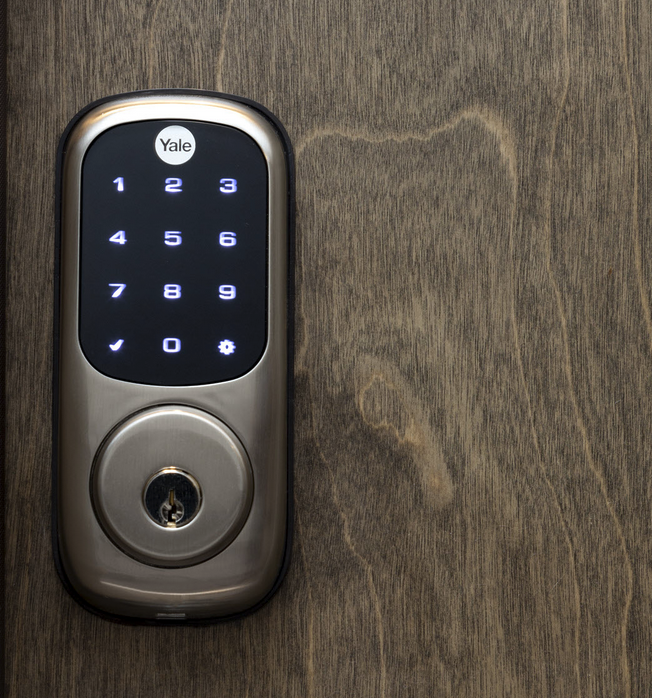
The U.S. government is warning that smart locks securing entry to an estimated 50,000 dwellings nationwide contain hard-coded credentials that can be used to remotely open any of the locks. The lock’s maker Chirp Systems remains unresponsive, even though it was first notified about the critical weakness in March 2021. Meanwhile, Chirp’s parent company, RealPage, Inc., is being sued by multiple U.S. states for allegedly colluding with landlords to illegally raise rents.

On March 7, 2024, the U.S. Cybersecurity & Infrastructure Security Agency (CISA) warned about a remotely exploitable vulnerability with “low attack complexity” in Chirp Systems smart locks.

“Chirp Access improperly stores credentials within its source code, potentially exposing sensitive information to unauthorized access,” CISA’s alert warned, assigning the bug a CVSS (badness) rating of 9.1 (out of a possible 10). “Chirp Systems has not responded to requests to work with CISA to mitigate this vulnerability.”

Matt Brown, the researcher CISA credits with reporting the flaw, is a senior systems development engineer at Amazon Web Services. Brown said he discovered the weakness and reported it to Chirp in March 2021, after the company that manages his apartment building started using Chirp smart locks and told everyone to install Chirp’s app to get in and out of their apartments.

“I use Android, which has a pretty simple workflow for downloading and decompiling the APK apps,” Brown told KrebsOnSecurity. “Given that I am pretty picky about what I trust on my devices, I downloaded Chirp and after decompiling, found that they were storing passwords and private key strings in a file.”

Using those hard-coded credentials, Brown found he could then connect to an application programming interface (API) that Chirp uses which is managed by smart lock vendor August.com, and use that enumerate and remotely lock or unlock any door in any building that uses the technology.

Brown said when he complained to his leasing office, they sold him a small $50 key fob that uses Near-Field Communications (NFC) to toggle the lock when he brings the fob close to his front door. But he said the fob doesn’t eliminate the ability for anyone to remotely unlock his front door using the exposed credentials and the Chirp mobile app.

A smart lock enabled with Chirp. Image: Camdenliving.com

Also, the fobs pass the credentials to his front door over the air in plain text, meaning someone could clone the fob just by bumping against him with a smartphone app made to read and write NFC tags.

Neither August nor Chirp Systems responded to requests for comment. It’s unclear exactly how many apartments and other residences are using the vulnerable Chirp locks, but multiple articles about the company from 2020 state that approximately 50,000 units use Chirp smart locks with August’s API.

Roughly a year before Brown reported the flaw to Chirp Systems, the company was bought by RealPage, a firm founded in 1998 as a developer of multifamily property management and data analytics software. In 2021, RealPage was acquired by the private equity giant Thoma Bravo.

Brown said the exposure he found in Chirp’s products is “an obvious flaw that is super easy to fix.”

“It’s just a matter of them being motivated to do it,” he said. “But they’re part of a private equity company now, so they’re not answerable to anybody. It’s too bad, because it’s not like residents of [the affected] properties have another choice. It’s either agree to use the app or move.”

In October 2022, an investigation by ProPublica examined RealPage’s dominance in the rent-setting software market, and that it found “uses a mysterious algorithm to help landlords push the highest possible rents on tenants.”

“For tenants, the system upends the practice of negotiating with apartment building staff,” ProPublic found. “RealPage discourages bargaining with renters and has even recommended that landlords in some cases accept a lower occupancy rate in order to raise rents and make more money. One of the algorithm’s developers told ProPublica that leasing agents had ‘too much empathy’ compared to computer generated pricing.”

Last year, the U.S. Department of Justice threw its weight behind a massive lawsuit filed by dozens of tenants who are accusing the $9 billion apartment software company of helping landlords collude to inflate rents.

In February 2024, attorneys general for Arizona and the District of Columbia sued RealPage, alleging RealPage’s software helped create a rental monopoly in their states.

from Krebs on Security https://ift.tt/t4b2C86
via IFTTT

Why CISA is Warning CISOs About a Breach at Sisense

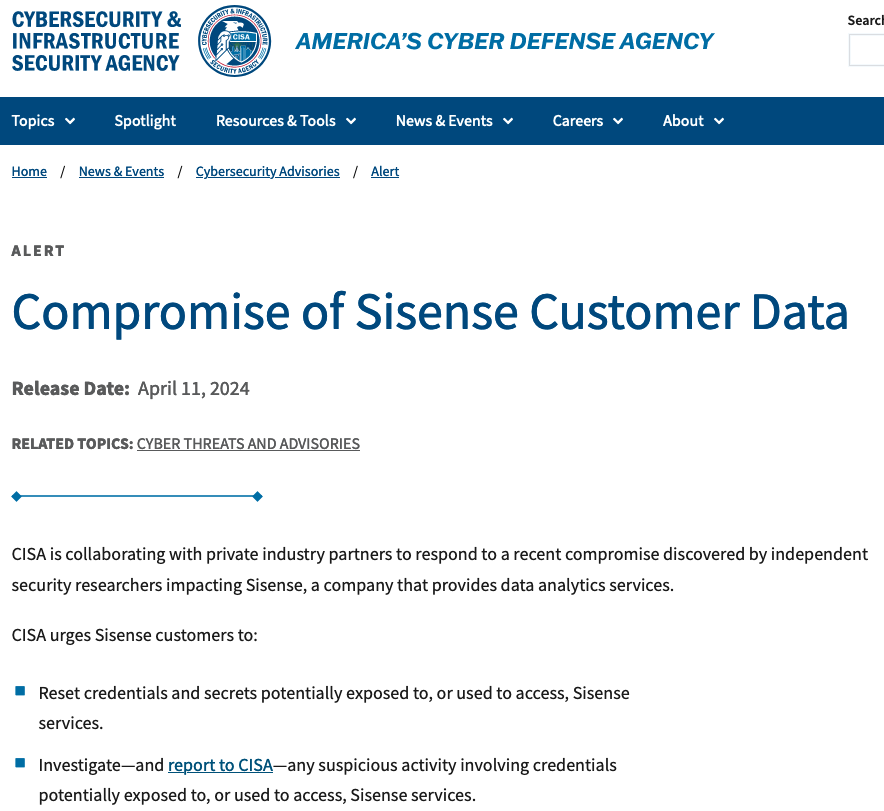
The U.S. Cybersecurity and Infrastructure Security Agency (CISA) said today it is investigating a breach at business intelligence company Sisense, whose products are designed to allow companies to view the status of multiple third-party online services in a single dashboard. CISA urged all Sisense customers to reset any credentials and secrets that may have been shared with the company, which is the same advice Sisense gave to its customers Wednesday evening.

New York City based Sisense has more than 1,000 customers across a range of industry verticals, including financial services, telecommunications, healthcare and higher education. On April 10, Sisense Chief Information Security Officer Sangram Dash told customers the company had been made aware of reports that “certain Sisense company information may have been made available on what we have been advised is a restricted access server (not generally available on the internet.)”

“We are taking this matter seriously and promptly commenced an investigation,” Dash continued. “We engaged industry-leading experts to assist us with the investigation. This matter has not resulted in an interruption to our business operations. Out of an abundance of caution, and while we continue to investigate, we urge you to promptly rotate any credentials that you use within your Sisense application.”

In its alert, CISA said it was working with private industry partners to respond to a recent compromise discovered by independent security researchers involving Sisense.

“CISA is taking an active role in collaborating with private industry partners to respond to this incident, especially as it relates to impacted critical infrastructure sector organizations,” the sparse alert reads. “We will provide updates as more information becomes available.”

Sisense declined to comment when asked about the veracity of information shared by two trusted sources with close knowledge of the breach investigation. Those sources said the breach appears to have started when the attackers somehow gained access to the company’s code repository at Gitlab, and that in that repository was a token or credential that gave the bad guys access to Sisense’s Amazon S3 buckets in the cloud.

Both sources said the attackers used the S3 access to copy and exfiltrate several terabytes worth of Sisent customer data, which apparently included millions of access tokens, email account passwords, and even SSL certificates.

The incident raises questions about whether Sisense was doing enough to protect sensitive data entrusted to it by customers, such as whether the massive volume of stolen customer data was ever encrypted while at rest in these Amazon cloud servers.

It is clear, however, that unknown attackers now have all of the credentials that Sisense customers used in their dashboards.

The breach also makes clear that Sisense is somewhat limited in the clean-up actions that it can take on behalf of customers, because access tokens are essentially text files on your computer that allow you to stay logged in for extended periods of time — sometimes indefinitely. And depending on which service we’re talking about, it may be possible for attackers to re-use those access tokens to authenticate as the victim without ever having to present valid credentials.

Beyond that, it is largely up to Sisense customers to decide if and when they change passwords to the various third-party services that they’ve previously entrusted to Sisense.

Earlier today, a public relations firm working with Sisense reached out to learn if KrebsOnSecurity planned to publish any further updates on their breach (KrebsOnSecurity posted a screenshot of the CISO’s customer email to both LinkedIn and Mastodon on Wednesday evening). The PR rep said Sisense wanted to make sure they had an opportunity to comment before the story ran.

But when confronted with the details shared by my sources, Sisense apparently changed its mind.

“After consulting with Sisense, they have told me that they don’t wish to respond,” the PR rep said in an emailed reply.

Nicholas Weaver, a researcher at University of California, Berkeley’s International Computer Science Institute (ICSI) and lecturer at UC Davis, said a company entrusted with so many sensitive logins should absolutely be encrypting that information.

“If they are hosting customer data on a third-party system like Amazon, it better damn well be encrypted,” Weaver said. “If they are telling people to rest credentials, that means it was not encrypted. So mistake number one is leaving Amazon credentials in your Git archive. Mistake number two is using S3 without using encryption on top of it. The former is bad but forgivable, but the latter given their business is unforgivable.”

from Krebs on Security https://ift.tt/rlivaAQ
via IFTTT

Met police failed to act on Commons ‘honeytrap’ sexting reports last year

The force has said there was nothing to suggest at the time that the messages were part of a wider pattern

The Metropolitan police first had reports of unsolicited messages targeting a number of MPs, staff and journalists in Westminster last year, but officers failed to notify politicians.

After the former Conservative MP William Wragg said he was manipulated into giving the personal phone numbers of colleagues to a man he met on a dating app, Scotland Yard said it was working with other police forces, alongside its own investigation, amid concerns many other MPs could have been targeted.

Continue reading…

from Data and computer security | The Guardian https://ift.tt/KGkvTgA
via IFTTT

Twitter’s Clumsy Pivot to X.com Is a Gift to Phishers

On April 9, Twitter/X began automatically modifying links that mention “twitter.com” to redirect to “x.com” instead. But over the past 48 hours, dozens of new domain names have been registered that demonstrate how this change could be used to craft convincing phishing links — such as fedetwitter[.]com, which is currently rendered as fedex.com in tweets.

The message currently displayed when one visits carfatwitter.com, which Twitter/X will now display as carfax.com in tweets and messages.

A search at DomainTools.com shows at least 60 domain names have been registered over the past two days for domains ending in “twitter.com,” although research so far shows the majority of these domains have been registered “defensively” by private individuals to prevent the domains from being purchased by scammers.

Those include carfatwitter.com, which Twitter/X will now truncate to carfax.com when the domain appears in user messages or tweets. Visiting this domain currently displays a message that begins, “Are you serious, X Corp?”

The same message is on other newly registered domains, including goodrtwitter.com (goodrx.com), neobutwitter.com (neobux.com), roblotwitter.com (roblox.com), square-enitwitter.com (square-enix.com) and yandetwitter.com (yandex.com). The message left on these domains indicates they were defensively registered by a user on Mastodon whose bio says they are a systems admin/engineer. That profile has not responded to requests for comment.

A number of these new domains including “twitter.com” appear to be registered defensively by Twitter/X users in Japan. The domain netflitwitter.com (netflix.com, to Twitter/X users) now displays a message saying it was “acquired to prevent its use for malicious purposes,” along with a Twitter/X username.

The domain mentioned at the beginning of this story — fedetwitter.com — redirects users to the blog of a Japanese technology enthusiast. A user with the handle “amplest0e” appears to have registered space-twitter.com, which Twitter/X users will now see as the CEO’s “space-x.com.” The domain “ametwitter.com” already redirects to the real americanexpress.com.

Some of the domains registered recently and ending in “twitter.com” currently do not resolve and contain no useful contact information in their registration records. Those include firefotwitter[.]com (firefox.com), ngintwitter[.]com (nginx.com), and webetwitter[.]com (webex.com).

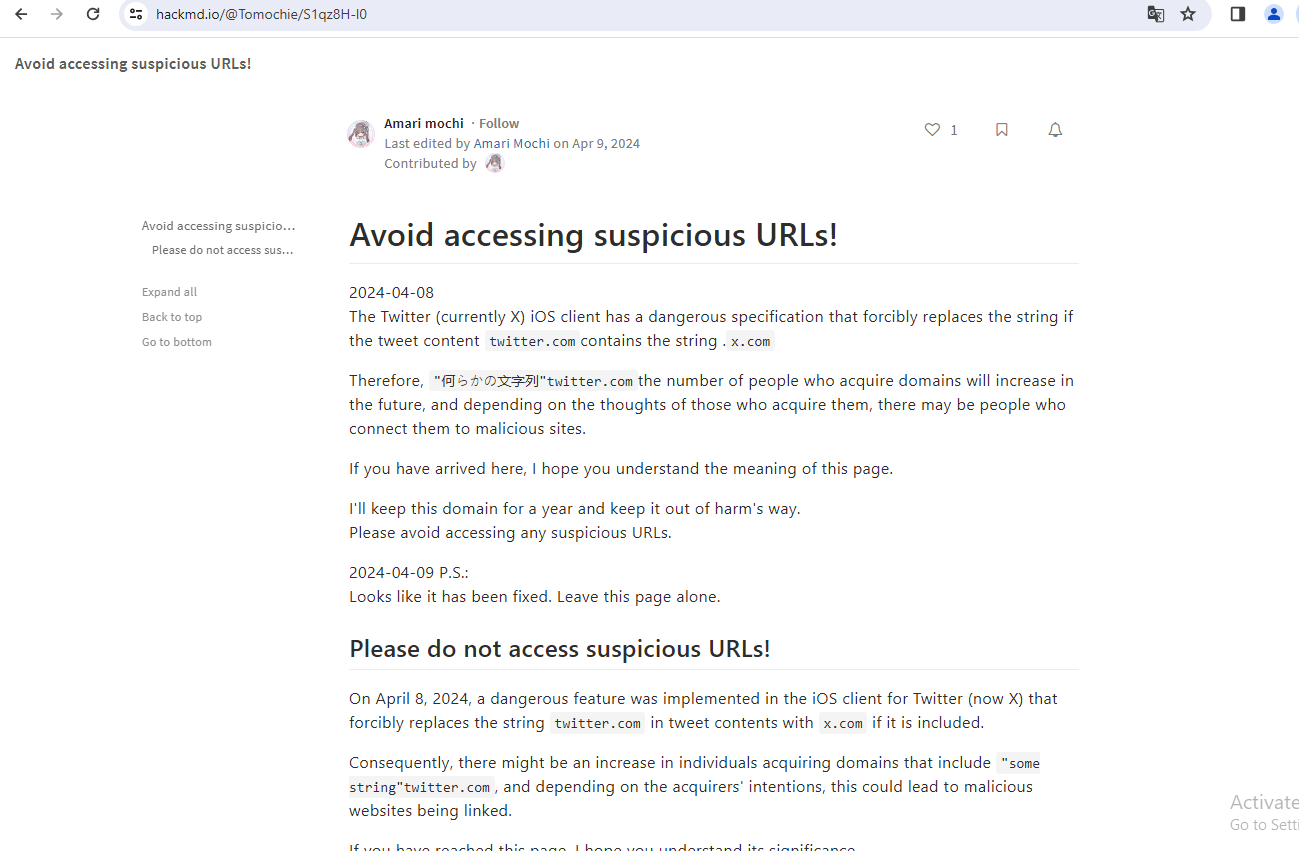
The domain setwitter.com, which Twitter/X will currently render as “sex.com,” redirects to this blog post warning about the recent changes and their potential use for phishing.

Sean McNee, vice president of research and data at DomainTools, told KrebsOnSecurity it appears Twitter/X did not properly limit its redirection efforts.

“Bad actors could register domains as a way to divert traffic from legitimate sites or brands given the opportunity — many such brands in the top million domains end in x, such as webex, hbomax, xerox, xbox, and more,” McNee said. “It is also notable that several other globally popular brands, such as Rolex and Linux, were also on the list of registered domains.”

The apparent oversight by Twitter/X was cause for amusement and amazement from many former users who have migrated to other social media platforms since the new CEO took over. Matthew Garrett, a lecturer at U.C. Berkeley’s School of Information, summed up the Schadenfreude thusly:

“Twitter just doing a “redirect links in tweets that go to x.com to twitter.com instead but accidentally do so for all domains that end x.com like eg spacex.com going to spacetwitter.com” is not absolutely the funniest thing I could imagine but it’s high up there.”

from Krebs on Security https://ift.tt/j1oBhc4
via IFTTT

April’s Patch Tuesday Brings Record Number of Fixes

If only Patch Tuesdays came around infrequently — like total solar eclipse rare — instead of just creeping up on us each month like The Man in the Moon. Although to be fair, it would be tough for Microsoft to eclipse the number of vulnerabilities fixed in this month’s patch batch — a record 147 flaws in Windows and related software.

Yes, you read that right. Microsoft today released updates to address 147 security holes in Windows, Office, Azure, .NET Framework, Visual Studio, SQL Server, DNS Server, Windows Defender, Bitlocker, and Windows Secure Boot.

“This is the largest release from Microsoft this year and the largest since at least 2017,” said Dustin Childs, from Trend Micro’s Zero Day Initiative (ZDI). “As far as I can tell, it’s the largest Patch Tuesday release from Microsoft of all time.”

Once again this month, there are no known zero-day vulnerabilities threatening Windows users. Tempering the sheer volume of this month’s patches is the middling severity of many of the bugs. Only three of April’s vulnerabilities earned Microsoft’s most-dire “critical” rating, meaning they can be abused by malware or malcontents to take remote control over unpatched systems with no help from users.

Most of the flaws that Microsoft deems “more likely to be exploited” this month are marked as “important,” which usually involve bugs that require a bit more user interaction (social engineering) but which nevertheless can result in system security bypass, compromise, and the theft of critical assets.

Ben McCarthy, lead cyber security engineer at Immersive Labs called attention to CVE-2024-20670, an Outlook for Windows spoofing vulnerability described as being easy to exploit. It involves convincing a user to click on a malicious link in an email, which can then steal the user’s password hash and authenticate as the user in another Microsoft service.

Another interesting bug McCarthy pointed to is CVE-2024-29063, which involves hard-coded credentials in Azure’s search backend infrastructure that could be gleaned by taking advantage of Azure AI search.

“This along with many other AI attacks in recent news shows a potential new attack surface that we are just learning how to mitigate against,” McCarthy said. “Microsoft has updated their backend and notified any customers who have been affected by the credential leakage.”

CVE-2024-29988 is a weakness that allows attackers to bypass Windows SmartScreen, a technology Microsoft designed to provide additional protections for end users against phishing and malware attacks. Childs said one ZDI’s researchers found this vulnerability being exploited in the wild, although Microsoft doesn’t currently list CVE-2024-29988 as being exploited.

“I would treat this as in the wild until Microsoft clarifies,” Childs said. “The bug itself acts much like CVE-2024-21412 – a [zero-day threat from February] that bypassed the Mark of the Web feature and allows malware to execute on a target system. Threat actors are sending exploits in a zipped file to evade EDR/NDR detection and then using this bug (and others) to bypass Mark of the Web.”

Satnam Narang at Tenable notes that this month’s release includes fixes for two dozen flaws in Windows Secure Boot, the majority of which are considered “Exploitation Less Likely” according to Microsoft.

“However, the last time Microsoft patched a flaw in Windows Secure Boot in May 2023 had a notable impact as it was exploited in the wild and linked to the BlackLotus UEFI bootkit, which was sold on dark web forums for $5,000,” Narang said. “BlackLotus can bypass functionality called secure boot, which is designed to block malware from being able to load when booting up. While none of these Secure Boot vulnerabilities addressed this month were exploited in the wild, they serve as a reminder that flaws in Secure Boot persist, and we could see more malicious activity related to Secure Boot in the future.”

For links to individual security advisories indexed by severity, check out ZDI’s blog and the Patch Tuesday post from the SANS Internet Storm Center. Please consider backing up your data or your drive before updating, and drop a note in the comments here if you experience any issues applying these fixes.

Adobe today released nine patches tackling at least two dozen vulnerabilities in a range of software products, including Adobe After Effects, Photoshop, Commerce, InDesign, Experience Manager, Media Encoder, Bridge, Illustrator, and Adobe Animate.

KrebsOnSecurity needs to correct the record on a point mentioned at the end of March’s “Fat Patch Tuesday” post, which looked at new AI capabilities built into Adobe Acrobat that are turned on by default. Adobe has since clarified that its apps won’t use AI to auto-scan your documents, as the original language in its FAQ suggested.

“In practice, no document scanning or analysis occurs unless a user actively engages with the AI features by agreeing to the terms, opening a document, and selecting the AI Assistant or generative summary buttons for that specific document,” Adobe said earlier this month.

from Krebs on Security https://ift.tt/Kuz9dxm
via IFTTT

William Wragg resigns from two Commons roles after divulging MPs’ phone numbers

Tory MP resigns committee roles after apology for role in parliamentary sexting scandal

The Conservative MP who divulged colleagues’ personal phone numbers to someone he met on a dating app as part of a parliamentary sexting scandal has stepped down from two Commons roles, it has been reported.

William Wragg has resigned as chair of the Commons’ public administration and constitutional affairs committee and also quit his post as the vice-chair of the 1922 Committee of Conservative backbenchers after admitting to giving the information to a man he met, according to reports.

Continue reading…

from Data and computer security | The Guardian https://ift.tt/CqAMSHZ
via IFTTT

No 10 tells MPs to be cautious about unsolicited messages after attempted ‘honeytrap’

Message comes as pressure builds on Tories to take disciplinary action against MP William Wragg

Downing Street has urged MPs to be cautious when responding to unsolicited messages, after the “spear-phishing” attack that targeted more than a dozen MPs, staff and journalists working in Westminster.

Number 10 issued the warning on Monday morning, days after two police forces launched an investigation into what is being described as an attempted “honeytrap”.

Continue reading…

from Data and computer security | The Guardian https://ift.tt/fZvxQp9
via IFTTT

An MP who gives out colleagues’ numbers to blackmailers. Isn’t William Wragg just right for this Tory party? | Marina Hyde

The ‘senior Tory’ has issued a self-flagellating apology, but he still has the whip – and Sunak’s low bar sinks lower

Where to start with Westminster’s latest scandal, which – without wishing to speculate on spoilers – I suggest you formally label as “developing”? Blowing his own cover in it is William Wragg, MP for Hazel Grove in Greater Manchester, and chair of the public administration and constitutional affairs committee. Aged 36, William is described as a “senior Tory” on the basis of something or other – possibly his predilection for calling for other politicians to resign on moral grounds. Mind you, these days being an MP since 2015 means you’ve seen five prime ministers. If anything, you’re a Tory grandee.

Anyway, here follow the bare bones of what Wragg seems to have got himself mixed up in. Having connected with someone on Grindr, he began an exchange that led, in his own words, to his correspondent getting “compromising things on me”. Instead of going immediately to the police, as far as we know Wragg instead opted to start obliging his tormentor with the numbers of other MPs, Westminster staff and political journalists. These new targets were duly sent photos fairly early on in their own exchanges with their mystery correspondent, and – incredibly and yet entirely credibly – at least two MPs then responded by sending explicit pictures themselves.

Marina Hyde is a Guardian columnist

Continue reading…

from Data and computer security | The Guardian https://ift.tt/nYpOPwe
via IFTTT