Do you make these security mistakes and put yourself at greater risk for successful attacks?
The post 10 common security mistakes and how to avoid them appeared first on WeLiveSecurity
from WeLiveSecurity https://ift.tt/ZkotnpH
via IFTTT

Do you make these security mistakes and put yourself at greater risk for successful attacks?
The post 10 common security mistakes and how to avoid them appeared first on WeLiveSecurity
from WeLiveSecurity https://ift.tt/ZkotnpH
via IFTTT
Not a zero-day, but important enough for a quick-fire patch to one system system library…
from Naked Security https://ift.tt/2elw8mW
via IFTTT
Post on blog linked to Russian ransomware group says it offered ‘discount’ ransom to health insurer of US$9.7m, or $1 for each customer’s data
The hacker behind the cyber-attack on Medibank set a US$10m price on not releasing the data, they claimed, alongside a new leak of apparently hacked records that purports to contain abortion health information.
In the early hours of Thursday on a dark web blog linked to the REvil Russian ransomware group, the attacker posted that they initially sought US$10m from Medibank, then reduced the price.
from Data and computer security | The Guardian https://ift.tt/ph8KBeN
via IFTTT
In all the excitement, we kind of lost count ourselves. Were there six 0-days, or only four?
from Naked Security https://ift.tt/Rc9LlmT
via IFTTT
Let’s face it: Having “2022 election” in the headline above is probably the only reason anyone might read this story today. Still, while most of us here in the United States are anxiously awaiting the results of how well we’ve patched our Democracy, it seems fitting that Microsoft Corp. today released gobs of security patches for its ubiquitous Windows operating systems. November’s patch batch includes fixes for a whopping six zero-day security vulnerabilities that miscreants and malware are already exploiting in the wild.
Probably the scariest of the zero-day flaws is CVE-2022-41128, a “critical” weakness in the Windows scripting languages that could be used to foist malicious software on vulnerable users who do nothing more than browse to a hacked or malicious site that exploits the weakness. Microsoft credits Google with reporting the vulnerability, which earned a CVSS score of 8.8.
CVE-2022-41073 is a zero-day flaw in the Windows Print Spooler, a Windows component that Microsoft has patched mightily over the past year. Kevin Breen, director of cyber threat research at Immersive Labs, noted that the print spooler has been a popular target for vulnerabilities in the last 12 months, with this marking the 9th patch.
The third zero-day Microsoft patched this month is CVE-2022-41125, which is an “elevation of privilege” vulnerability in the Windows Cryptography API: Next Generation (CNG) Key Isolation Service, a service for isolating private keys. Satnam Narang, senior staff research engineer at Tenable, said exploitation of this vulnerability could grant an attacker SYSTEM privileges.
The fourth zero-day, CVE-2022-41091, was previously disclosed and widely reported on in October. It is a Security Feature Bypass of “Windows Mark of the Web” – a mechanism meant to flag files that have come from an untrusted source.
The other two zero-day bugs Microsoft patched this month were for vulnerabilities being exploited in Exchange Server. News that these two Exchange flaws were being exploited in the wild surfaced in late September 2022, and many were surprised when Microsoft let October’s Patch Tuesday sail by without issuing official patches for them (the company instead issued mitigation instructions that it was forced to revise multiple times). Today’s patch batch addresses both issues.
Greg Wiseman, product manager at Rapid7, said the Exchange flaw CVE-2022-41040 is a “critical” elevation of privilege vulnerability, and CVE-2022-41082 is considered Important, allowing Remote Code Execution (RCE) when PowerShell is accessible to the attacker.
“Both vulnerabilities have been exploited in the wild,” Wiseman said. “Four other CVEs affecting Exchange Server have also been addressed this month. Three are rated as Important, and CVE-2022-41080 is another privilege escalation vulnerability considered Critical. Customers are advised to update their Exchange Server systems immediately, regardless of whether any previously recommended mitigation steps have been applied. The mitigation rules are no longer recommended once systems have been patched.”
Adobe usually issues security updates for its products on Patch Tuesday, but it did not this month. For a closer look at the patches released by Microsoft today and indexed by severity and other metrics, check out the always-useful Patch Tuesday roundup from the SANS Internet Storm Center. And it’s not a bad idea to hold off updating for a few days until Microsoft works out any kinks in the updates: AskWoody.com usually has the lowdown on any patches that may be causing problems for Windows users.
As always, please consider backing up your system or at least your important documents and data before applying system updates. And if you run into any problems with these updates, please drop a note about it here in the comments.
from Krebs on Security https://ift.tt/cXngjN1
via IFTTT
Jurisprudence isn’t like arithmetic… two negatives never make a positive!
from Naked Security https://ift.tt/AwRpWC1
via IFTTT
Make sure that the device that’s supposed to help you keep tabs on your little one isn’t itself a privacy and security risk
The post Hacking baby monitors can be child’s play: Here’s how to stay safe appeared first on WeLiveSecurity
from WeLiveSecurity https://ift.tt/E7zU6QD
via IFTTT
Never make your users cry/By how you use an API
from Naked Security https://ift.tt/fTLMDAZ
via IFTTT
This week’s news offered fresh reminders of the threat that ransomware poses for businesses and critical infrastructure worldwide
The post Ransomware rages on – Week in security with Tony Anscombe appeared first on WeLiveSecurity
from WeLiveSecurity https://ift.tt/rWBcxQj
via IFTTT
Responding to a recent surge in AI-generated bot accounts, LinkedIn is rolling out new features that it hopes will help users make more informed decisions about with whom they choose to connect. Many LinkedIn profiles now display a creation date, and the company is expanding its domain validation offering, which allows users to publicly confirm that they can reply to emails at the domain of their stated current employer.
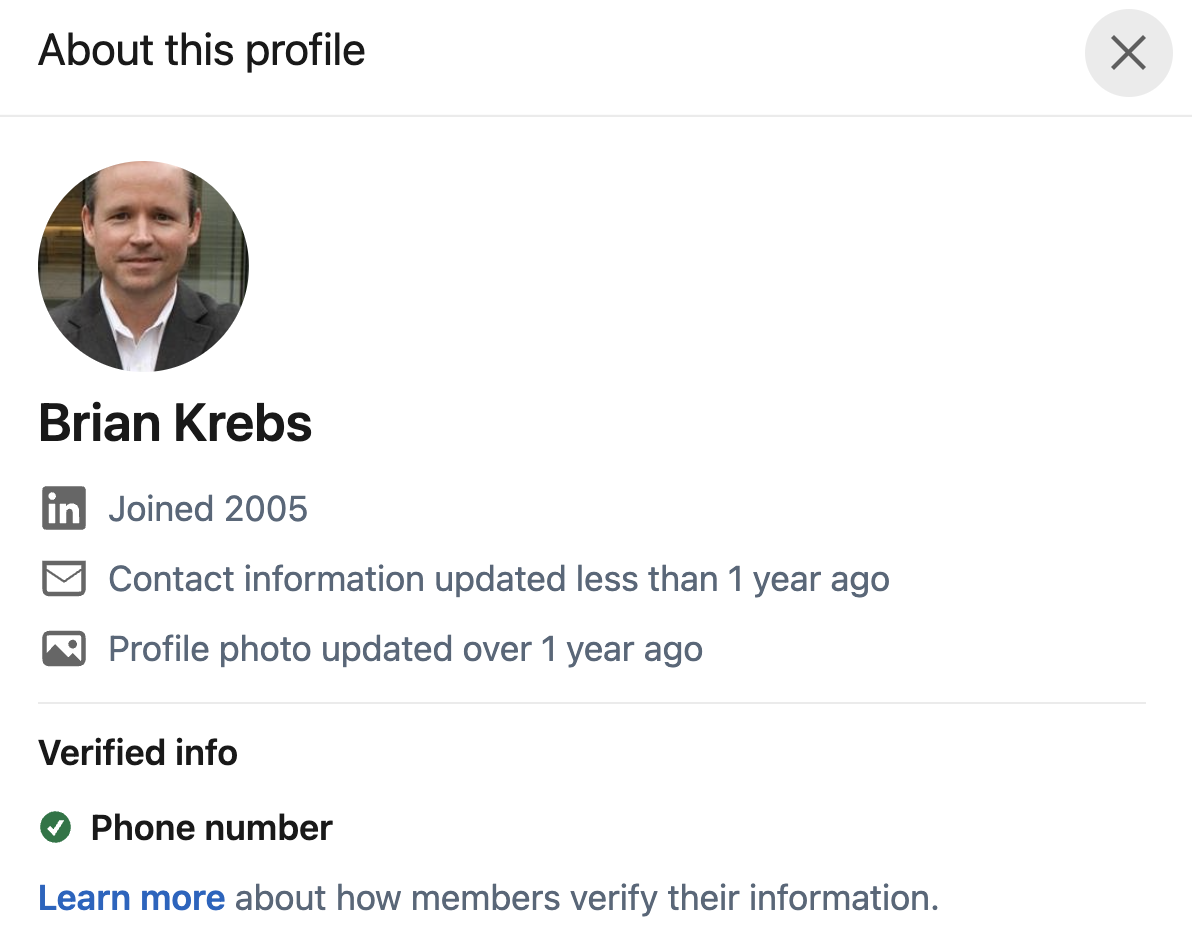
LinkedIn’s new “About This Profile” section — which is visible by clicking the “More” button at the top of a profile — includes the year the account was created, the last time the profile information was updated, and an indication of how and whether an account has been verified.
LinkedIn also said it is adding a warning to some LinkedIn messages that include high-risk content, or that try to entice the user into taking the conversation to another platform (like WeChat).
“We may warn you about messages that ask you to take the conversation to another platform because that can be a sign of a scam,” the company said in a blog post. “These warnings will also give you the choice to report the content without letting the sender know.”
In late September 2022, KrebsOnSecurity warned about the proliferation of fake LinkedIn profiles for Chief Information Security Officer (CISO) roles at some of the world’s largest corporations. A follow-up story on Oct. 5 showed how the phony profile problem has affected virtually all executive roles at corporations, and how these fake profiles are creating an identity crisis for the businesses networking site and the companies that rely on it to hire and screen prospective employees.
Reporting here last month also tracked a massive drop in profiles claiming to work at several major technology companies, as LinkedIn apparently took action against hundreds of thousands of inauthentic accounts that falsely claimed roles at these companies.
For example, on October 10, 2022, there were 576,562 LinkedIn accounts that listed their current employer as Apple Inc. The next day, half of those profiles no longer existed. At around the same time, the number of LinkedIn profiles claiming current roles at Amazon fell from roughly 1.25 million to 838,601 in just one day, a 33 percent drop.
For whatever reason, the majority of the phony LinkedIn profiles reviewed by this author were young women with profile photos that appear to have been generated by artificial intelligence (AI) tools.
“We’re seeing rapid advances in AI-based synthetic image generation technology and we’ve created a deep learning model to better catch profiles made with this technology,” LinkedIn’s Oscar Rodriguez wrote. “AI-based image generators can create an unlimited number of unique, high-quality profile photos that do not correspond to real people.”
It remains unclear who or what is behind the recent proliferation of fake executive profiles on LinkedIn, but likely they are from a combination of scams. Cybersecurity firm Mandiant (recently acquired by Google) told Bloomberg that hackers working for the North Korean government have been copying resumes and profiles from leading job listing platforms LinkedIn and Indeed, as part of an elaborate scheme to land jobs at cryptocurrency firms.
Identity thieves have been known to masquerade on LinkedIn as job recruiters, collecting personal and financial information from people who fall for employment scams.
Also, fake profiles also may be tied to so-called “pig butchering” scams, wherein people are lured by flirtatious strangers online into investing in cryptocurrency trading platforms that eventually seize any funds when victims try to cash out.
from Krebs on Security https://ift.tt/Sx4QNtX
via IFTTT
 Pacosite's Blog