Low-Drama ‘Dark Angels’ Reap Record Ransoms

A ransomware group called Dark Angels made headlines this past week when it was revealed the crime group recently received a record $75 million data ransom payment from a Fortune 50 company. Security experts say the Dark Angels have been around since 2021, but the group doesn’t get much press because they work alone and maintain a low profile, picking one target at a time and favoring mass data theft over disrupting the victim’s operations.

Image: Shutterstock.

Security firm Zscaler ThreatLabz this month ranked Dark Angels as the top ransomware threat for 2024, noting that in early 2024 a victim paid the ransomware group $75 million — higher than any previously recorded ransom payment. ThreatLabz found Dark Angels has conducted some of the largest ransomware attacks to date, and yet little is known about the group.

Brett Stone-Gross, senior director of threat intelligence at ThreatLabz, said Dark Angels operate using an entirely different playbook than most other ransomware groups. For starters, he said, Dark Angels does not employ the typical ransomware affiliate model, which relies on hackers-for-hire to install malicious software that locks up infected systems.

“They really don’t want to be in the headlines or cause business disruptions,” Stone-Gross said. “They’re about making money and attracting as little attention as possible.”

Most ransomware groups maintain flashy victim leak sites which threaten to publish the target’s stolen data unless a ransom demand is paid. But the Dark Angels didn’t even have a victim shaming site until April 2023. And the leak site isn’t particularly well branded; it’s called Dunghill Leak.
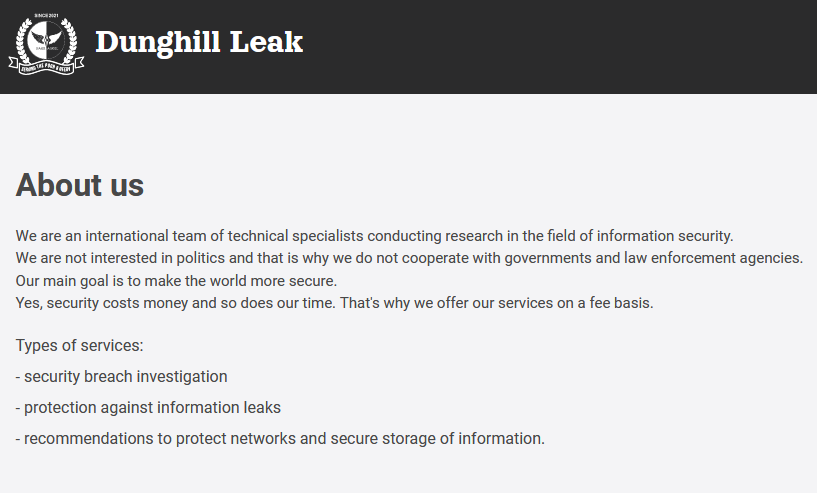
The Dark Angels victim shaming site, Dunghill Leak.

“Nothing about them is flashy,” Stone-Gross said. “For the longest time, they didn’t even want to cause a big headline, but they probably felt compelled to create that leaks site because they wanted to show they were serious and that they were going to post victim data and make it accessible.”

Dark Angels is thought to be a Russia-based cybercrime syndicate whose distinguishing characteristic is stealing truly staggering amounts of data from major companies across multiple sectors, including healthcare, finance, government and education. For large businesses, the group has exfiltrated between 10-100 terabytes of data, which can take days or weeks to transfer, ThreatLabz found.

Like most ransom gangs, Dark Angels will publish data stolen from victims who do not pay. Some of the more notable victims listed on Dunghill Leak include the global food distribution firm Sysco, which disclosed a ransomware attack in May 2023; and the travel booking giant Sabre, which was hit by the Dark Angels in September 2023.

Stone-Gross said Dark Angels is often reluctant to deploy ransomware malware because such attacks work by locking up the target’s IT infrastructure, which typically causes the victim’s business to grind to a halt for days, weeks or even months on end. And those types of breaches tend to make headlines quickly.

“They selectively choose whether they want to deploy ransomware or not,” he said. “If they deem they can encrypt some files that won’t cause major disruptions — but will give them a ton of data — that’s what they’ll do. But really, what separates them from the rest is the volume of data they’re stealing. It’s a whole order of magnitude greater with Dark Angels. Companies losing vast amounts of data will pay these high ransoms.”

So who paid the record $75 million ransom? Bleeping Computer posited on July 30 that the victim was the pharmaceutical giant Cencora (formerly AmeriSourceBergen Corporation), which reported a data security incident to the U.S. Securities and Exchange Commission (SEC) on February 21, 2024.

The SEC requires publicly-traded companies to disclose a potentially material cybersecurity event within four days of the incident. Cencora is currently #10 on the Fortune 500 list, generating more than $262 billion in revenue last year.

Cencora did not respond to questions about whether it had made a ransom payment in connection with the February cybersecurity incident, and referred KrebsOnSecurity to expenses listed under “Other” in the restructuring section of their latest quarterly financial report (PDF). That report shows the company incurred costs of more than $30 million associated with the breach.

Cencora’s quarterly statement said the incident affected a standalone legacy information technology platform in one country and the foreign business unit’s ability to operate in that country for approximately two weeks.
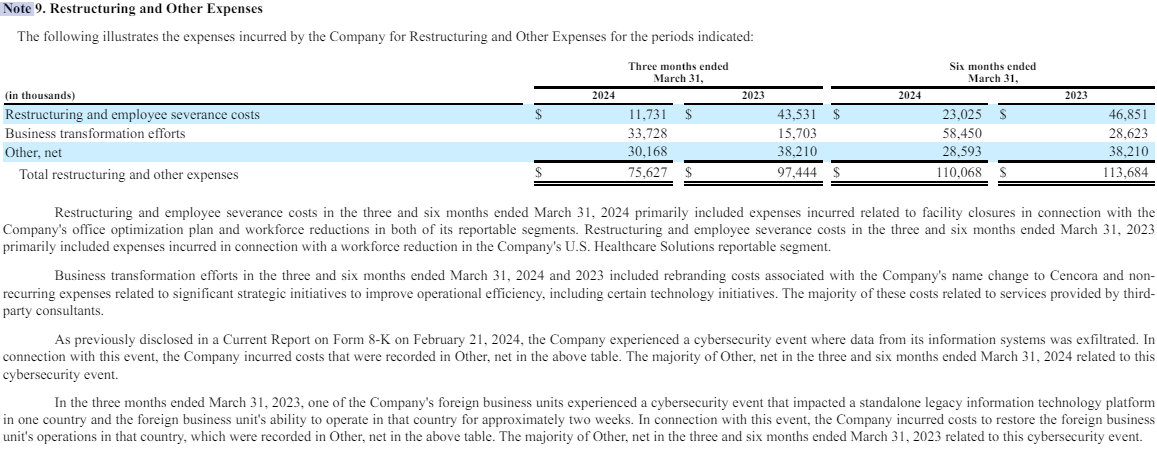
Cencora’s 2024 1st quarter report documents a $30 million cost associated with a data exfiltration event in mid-February 2024.

In its most recent State of Ransomware report (PDF), security firm Sophos found the average ransomware payment had increased fivefold in the past year, from $400,000 in 2023 to $2 million. Sophos says that in more than four-fifths (82%) of cases funding for the ransom came from multiple sources. Overall, 40% of total ransom funding came from the organizations themselves and 23% from insurance providers.

Further reading: ThreatLabz ransomware report (PDF).

from Krebs on Security https://ift.tt/N8Tsy4V
via IFTTT

Minister apologises for Northern Ireland special education needs data breach

Paul Givan says individuals concerned contacted after details of more than 400 people mistakenly sent out

The education minister in Northern Ireland has “unreservedly” apologised after the personal details of more than 400 people who had offered to contribute to a review of special education needs were breached.

The embarrassing data breach came to light on Thursday after the education department said it had mistakenly sent to 174 people a spreadsheet attachment that contained the names, email address and titles of 407 individuals who had expressed an interest in attending the end-to-end review of special education needs (SEN) events across Northern Ireland.

Continue reading…

from Data and computer security | The Guardian https://ift.tt/kyuWcGU
via IFTTT

U.S. Trades 5 Cybercriminals to Russia in Prisoner Swap

Twenty-four prisoners were freed today in an international prisoner swap between Russia and Western countries. Among the eight Russians repatriated were five convicted cybercriminals. In return, Russia has reportedly released 16 prisoners, including Wall Street Journal reporter Evan Gershkovich and ex-U.S. Marine Paul Whelan.

Among the more notable Russian hackers released in the prisoner swap is Roman Seleznev, 40, who was sentenced in 2017 to 27 years in prison for racketeering convictions tied to a lengthy career in stealing and selling payment card data. Seleznev earned this then-record sentence by operating some of the underground’s most bustling marketplaces for stolen card data.

Roman Seleznev, pictured with bundles of cash. Image: US DOJ.

Once known by the hacker handles “Track2,” “Bulba” and “nCux,” Seleznev is the son of Valery Seleznev, a prominent member of the Russian parliament who is considered an ally of Vladimir Putin. U.S. prosecutors showed that for years Vinnik stayed a step ahead of the law by tapping into contacts at the Russian FSB, the successor agency to the Soviet KGB, and by periodically changing hacker handles.

But in 2014 Seleznev was captured by U.S. Secret Service agents, who had zeroed in on Seleznev’s posh vacation spot in The Maldives. At the time, the South Asian island country was a popular destination for Eastern Europe-based cybercriminals, who viewed it as beyond the reach of U.S. law enforcement.

In addition to receiving a record prison sentence, Seleznev was ordered to pay more than $50 million in restitution to his victims. That loss amount equaled the total losses inflicted by Seleznev’s various carding stores, and other thefts attributed to members of the hacking forum carder[.]su, a bustling cybercrime community of which Seleznev was a leading organizer.

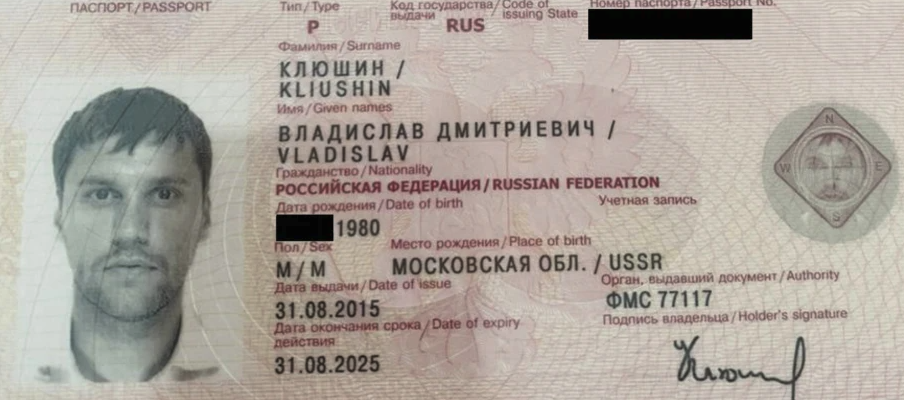
Also released in the prisoner swap was Vladislav Klyushin, a 42-year-old Muscovite sentenced in September 2023 to nine years in prison for what U.S. prosecutors called a “$93 million hack-to-trade conspiracy.” Klyushin and his crew hacked into companies and used information stolen in those intrusions to make illegal stock trades.

Klyushin likewise was arrested while vacationing abroad: The Associated Press reported that Klyushin was captured in Switzerland after arriving on a private jet, and just before he and his party were about to board a helicopter to whisk them to a nearby ski resort.

A passport photo of Klyushin. Image: USDOJ.

Klyushin is the owner of M-13, a Russian technology company that contracts with the Russian government. According to prosecutors, M-13 offered penetration testing and “advanced persistent threat (APT) emulation.” As part of his guilty plea, Klyushin was also ordered to forfeit $34 million, and to pay restitution in an amount that was to be determined.

The U.S. government says four of Klyushin’s alleged co-conspirators remain at large, including Ivan Ermakov, who was among 12 Russians charged in 2018 with hacking into key Democratic Party email accounts.

Russia also welcomed home one of its most accomplished money launderers. Alexander Vinnik, 44, was one of the operators of BTC-e, a large cryptocurrency exchange that helped launder crime proceeds tied to various ransomware groups.

In 2017, U.S. authorities seized BTC-e, charging Vinnik with operating an international money laundering scheme that included some 850,000 bitcoins stolen from cryptocurrency exchange Mt. Gox. In May 2024, Vinnik pleaded guilty to laundering more than $9 billion.

Vladimir Dunaev, 40, was one of the masterminds behind the Trickbot trojan, a crimeware-as-a-service platform that for many years was used by Russian cybercrime groups to install ransomware and siphon data from victims. Duanev was sentenced in January 2024 to five years and four months in prison.

The fifth convicted Russian sent back home this week is Maxim Marchenko, 52, who pleaded guilty in February 2024 to illicitly procuring large quantities of U.S.-made microelectronics on behalf of Russian clients in support of the war on Ukraine.

Marchenko admitted setting up a number of shell companies based in Hong Kong that were used to acquire the technology products that have military-grade applications, such as rifle scopes, night vision goggles and thermal optics.

Among the Americans freed by Russia were Wall Street Journal reporter Evan Gershkovich, 32, who has spent the last 16 months in a Russian prison on spying charges. Also released was Alsu Kurmasheva, 47, a Russian American editor for Radio Free Europe/Radio Liberty who was arrested last year; and Paul Whelan, 54, a former U.S. Marine arrested in 2018 and accused of spying.

The New York Times reports several others freed by Russia were German nationals, including German Moyzhes, a lawyer who was helping Russians obtain residence permits in Germany and other E.U. countries. The Times says Slovenia, Norway and Poland released four people accused of being Russian spies.

Reuters reports that Germany released Vadim Krasikov, an FSB colonel serving a life sentence there for murdering an exiled Chechen-Georgian dissident in a Berlin park.

from Krebs on Security https://ift.tt/M3NkpPs
via IFTTT

Don’t Let Your Domain Name Become a “Sitting Duck”

More than a million domain names — including many registered by Fortune 100 firms and brand protection companies — are vulnerable to takeover by cybercriminals thanks to authentication weaknesses at a number of large web hosting providers and domain registrars, new research finds.

Image: Shutterstock.

Your Web browser knows how to find a site like example.com thanks to the global Domain Name System (DNS), which serves as a kind of phone book for the Internet by translating human-friendly website names (example.com) into numeric Internet addresses.

When someone registers a domain name, the registrar will typically provide two sets of DNS records that the customer then needs to assign to their domain. Those records are crucial because they allow Web browsers to find the Internet address of the hosting provider that is serving that domain.

But potential problems can arise when a domain’s DNS records are “lame,” meaning the authoritative name server does not have enough information about the domain and can’t resolve queries to find it. A domain can become lame in a variety of ways, such as when it is not assigned an Internet address, or because the name servers in the domain’s authoritative record are misconfigured or missing.

The reason lame domains are problematic is that a number of Web hosting and DNS providers allow users to claim control over a domain without accessing the true owner’s account at their DNS provider or registrar.

If this threat sounds familiar, that’s because it is hardly new. Back in 2019, KrebsOnSecurity wrote about thieves employing this method to seize control over thousands of domains registered at GoDaddy, and using those to send bomb threats and sextortion emails (GoDaddy says they fixed that weakness in their systems not long after that 2019 story).

In the 2019 campaign, the spammers created accounts on GoDaddy and were able to take over vulnerable domains simply by registering a free account at GoDaddy and being assigned the same DNS servers as the hijacked domain.

Three years before that, the same pervasive weakness was described in a blog post by security researcher Matthew Bryant, who showed how one could commandeer at least 120,000 domains via DNS weaknesses at some of the world’s largest hosting providers.

Incredibly, new research jointly released today by security experts at Infoblox and Eclipsium finds this same authentication weakness is still present at a number of large hosting and DNS providers.

“It’s easy to exploit, very hard to detect, and it’s entirely preventable,” said Dave Mitchell, principal threat researcher at Infoblox. “Free services make it easier [to exploit] at scale. And the bulk of these are at a handful of DNS providers.”

SITTING DUCKS

Infoblox’s report found there are multiple cybercriminal groups abusing these stolen domains as a globally dispersed “traffic distribution system,” which can be used to mask the true source or destination of web traffic and to funnel Web users to malicious or phishous websites.

Commandeering domains this way also can allow thieves to impersonate trusted brands and abuse their positive or at least neutral reputation when sending email from those domains, as we saw in 2019 with the GoDaddy attacks.

“Hijacked domains have been used directly in phishing attacks and scams, as well as large spam systems,” reads the Infoblox report, which refers to lame domains as “Sitting Ducks.” “There is evidence that some domains were used for Cobalt Strike and other malware command and control (C2). Other attacks have used hijacked domains in targeted phishing attacks by creating lookalike subdomains. A few actors have stockpiled hijacked domains for an unknown purpose.”

Eclypsium researchers estimate there are currently about one million Sitting Duck domains, and that at least 30,000 of them have been hijacked for malicious use since 2019.

“As of the time of writing, numerous DNS providers enable this through weak or nonexistent verification of domain ownership for a given account,” Eclypsium wrote.

The security firms said they found a number of compromised Sitting Duck domains were originally registered by brand protection companies that specialize in defensive domain registrations (reserving look-alike domains for top brands before those names can be grabbed by scammers) and combating trademark infringement.

For example, Infoblox found cybercriminal groups using a Sitting Duck domain called clickermediacorp[.]com, which was initially registered on behalf of CBS Interactive Inc. by the brand protection firm MarkMonitor.

Another hijacked Sitting Duck domain — anti-phishing[.]org — was registered in 2003 by the Anti-Phishing Working Group (APWG), a cybersecurity not-for-profit organization that closely tracks phishing attacks.

In many cases, the researchers discovered Sitting Duck domains that appear to have been configured to auto-renew at the registrar, but the authoritative DNS or hosting services were not renewed.

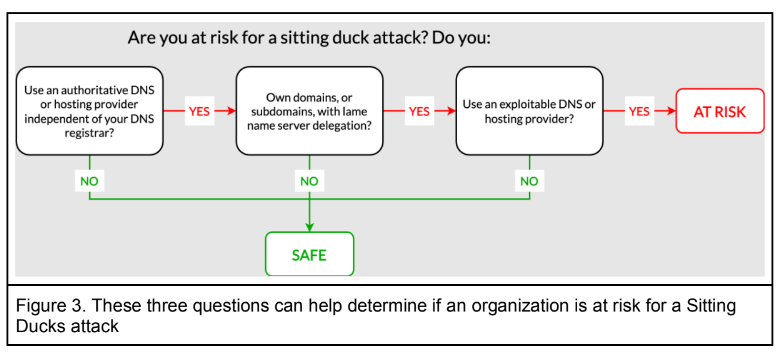
The researchers say Sitting Duck domains all possess three attributes that makes them vulnerable to takeover:

1) the domain uses or delegates authoritative DNS services to a different provider than the domain registrar;
2) the authoritative name server(s) for the domain does not have information about the Internet address the domain should point to;
3) the authoritative DNS provider is “exploitable,” i.e. an attacker can claim the domain at the provider and set up DNS records without access to the valid domain owner’s account at the domain registrar.

Image: Infoblox.

How does one know whether a DNS provider is exploitable? There is a frequently updated list published on GitHub called “Can I take over DNS,” which has been documenting exploitability by DNS provider over the past several years. The list includes examples for each of the named DNS providers.

In the case of the aforementioned Sitting Duck domain clickermediacorp[.]com, the domain was originally registered by MarkMonitor, but it appears to have been hijacked by scammers by claiming it at the web hosting firm DNSMadeEasy, which is owned by Digicert, one of the industry’s largest issuers of digital certificates (SSL/TLS certificates).

In an interview with KrebsOnSecurity, DNSMadeEasy founder and senior vice president Steve Job said the problem isn’t really his company’s to solve, noting that DNS providers who are also not domain registrars have no real way of validating whether a given customer legitimately owns the domain being claimed.

“We do shut down abusive accounts when we find them,” Job said. “But it’s my belief that the onus needs to be on the [domain registrants] themselves. If you’re going to buy something and point it somewhere you have no control over, we can’t prevent that.”

Infoblox, Eclypsium, and the DNS wiki listing at Github all say that web hosting giant Digital Ocean is among the vulnerable hosting firms. In response to questions, Digital Ocean said it was exploring options for mitigating such activity.

“The DigitalOcean DNS service is not authoritative, and we are not a domain registrar,” Digital Ocean wrote in an emailed response. “Where a domain owner has delegated authority to our DNS infrastructure with their registrar, and they have allowed their ownership of that DNS record in our infrastructure to lapse, that becomes a ‘lame delegation’ under this hijack model. We believe the root cause, ultimately, is poor management of domain name configuration by the owner, akin to leaving your keys in your unlocked car, but we acknowledge the opportunity to adjust our non-authoritative DNS service guardrails in an effort to help minimize the impact of a lapse in hygiene at the authoritative DNS level. We’re connected with the research teams to explore additional mitigation options.”

In a statement provided to KrebsOnSecurity, the hosting provider and registrar Hostinger said they were working to implement a solution to prevent lame duck attacks in the “upcoming weeks.”

“We are working on implementing an SOA-based domain verification system,” Hostinger wrote. “Custom nameservers with a Start of Authority (SOA) record will be used to verify whether the domain truly belongs to the customer. We aim to launch this user-friendly solution by the end of August. The final step is to deprecate preview domains, a functionality sometimes used by customers with malicious intents. Preview domains will be deprecated by the end of September. Legitimate users will be able to use randomly generated temporary subdomains instead.”

What did DNS providers that have struggled with this issue in the past do to address these authentication challenges? The security firms said that to claim a domain name, the best practice providers gave the account holder random name servers that required a change at the registrar before the domains could go live. They also found the best practice providers used various mechanisms to ensure that the newly assigned name server hosts did not match previous name server assignments.

[Side note: Infoblox observed that many of the hijacked domains were being hosted at Stark Industries Solutions, a sprawling hosting provider that appeared two weeks before Russia invaded Ukraine and has become the epicenter of countless cyberattacks against enemies of Russia].

Both Infoblox and Eclypsium said that without more cooperation and less finger-pointing by all stakeholders in the global DNS, attacks on sitting duck domains will continue to rise, with domain registrants and regular Internet users caught in the middle.

“Government organizations, regulators, and standards bodies should consider long-term solutions to vulnerabilities in the DNS management attack surface,” the Infoblox report concludes.

from Krebs on Security https://ift.tt/SKvunAs
via IFTTT

Crooks Bypassed Google’s Email Verification to Create Workspace Accounts, Access 3rd-Party Services

Google says it recently fixed an authentication weakness that allowed crooks to circumvent the email verification required to create a Google Workspace account, and leverage that to impersonate a domain holder to third-party services that allow logins through Google’s “Sign in with Google” feature.

Last week, KrebsOnSecurity heard from a reader who said they received a notice that their email address had been used to create a potentially malicious Workspace account that Google had blocked.

“In the last few weeks, we identified a small-scale abuse campaign whereby bad actors circumvented the email verification step in our account creation flow for Email Verified (EV) Google Workspace accounts using a specially constructed request,” the notice from Google read. “These EV users could then be used to gain access to third-party applications using ‘Sign In with Google’.”

In response to questions, Google said it fixed the problem within 72 hours of discovering it, and that the company has added additional detection to protect against these types of authentication bypasses going forward.

Anu Yamunan, director of abuse and safety protections at Google Workspace, told KrebsOnSecurity the malicious activity began in late June, and involved “a few thousand” Workspace accounts that were created without being domain-verified.

Google Workspace offers a free trial that people can use to access services like Google Docs, but other services such as Gmail are only available to Workspace users who can validate control over the domain name associated with their email address. The weakness Google fixed allowed attackers to bypass this validation process. Google emphasized that none of the affected domains had previously been associated with Workspace accounts or services.

“The tactic here was to create a specifically-constructed request by a bad actor to circumvent email verification during the signup process,” Yamunan said. “The vector here is they would use one email address to try to sign in, and a completely different email address to verify a token. Once they were email verified, in some cases we have seen them access third party services using Google single sign-on.”

Yamunan said none of the potentially malicious workspace accounts were used to abuse Google services, but rather the attackers sought to impersonate the domain holder to other services online.

In the case of the reader who shared the breach notice from Google, the imposters used the authentication bypass to associate his domain with a Workspace account. And that domain was tied to his login at several third-party services online. Indeed, the alert this reader received from Google said the unauthorized Workspace account appears to have been used to sign in to his account at Dropbox.

Google said the now-fixed authentication bypass is unrelated to a recent issue involving cryptocurrency-based domain names that were apparently compromised in their transition to Squarespace, which last year acquired more than 10 million domains that were registered via Google Domains.

On July 12, a number of domains tied to cryptocurrency businesses were hijacked from Squarespace users who hadn’t yet set up their Squarespace accounts. Squarespace has since published a statement blaming the domain hijacks on “a weakness related to OAuth logins”, which Squarespace said it fixed within hours.

from Krebs on Security https://ift.tt/2DCzePy
via IFTTT

Israel tried to frustrate US lawsuit over Pegasus spyware, leak suggests

Officials seized documents from NSO Group to try to stop handover of information about notorious hacking tool, files suggest

The Israeli government took extraordinary measures to frustrate a high-stakes US lawsuit that threatened to reveal closely guarded secrets about one of the world’s most notorious hacking tools, leaked files suggest.

Israeli officials seized documents about Pegasus spyware from its manufacturer, NSO Group, in an effort to prevent the company from being able to comply with demands made by WhatsApp in a US court to hand over information about the invasive technology.

Continue reading…

from Data and computer security | The Guardian https://ift.tt/BPOjzmC
via IFTTT

Phish-Friendly Domain Registry “.top” Put on Notice

The Chinese company in charge of handing out domain names ending in “.top” has been given until mid-August 2024 to show that it has put in place systems for managing phishing reports and suspending abusive domains, or else forfeit its license to sell domains. The warning comes amid the release of new findings that .top was the most common suffix in phishing websites over the past year, second only to domains ending in “.com.”

Image: Shutterstock.

On July 16, the Internet Corporation for Assigned Names and Numbers (ICANN) sent a letter to the owners of the .top domain registry. ICANN has filed hundreds of enforcement actions against domain registrars over the years, but this is thought to be the first in which ICANN has singled out a domain registry responsible for maintaining an entire top-level domain (TLD).

Among other reasons, the missive chided the registry for failing to respond to reports about phishing attacks involving .top domains.

“Based on the information and records gathered through several weeks, it was determined that .TOP Registry does not have a process in place to promptly, comprehensively, and reasonably investigate and act on reports of DNS Abuse,” the ICANN letter reads (PDF).

ICANN’s warning redacted the name of the recipient, but records show the .top registry is operated by a Chinese entity called Jiangsu Bangning Science & Technology Co. Ltd. Representatives for the company have not responded to requests for comment.

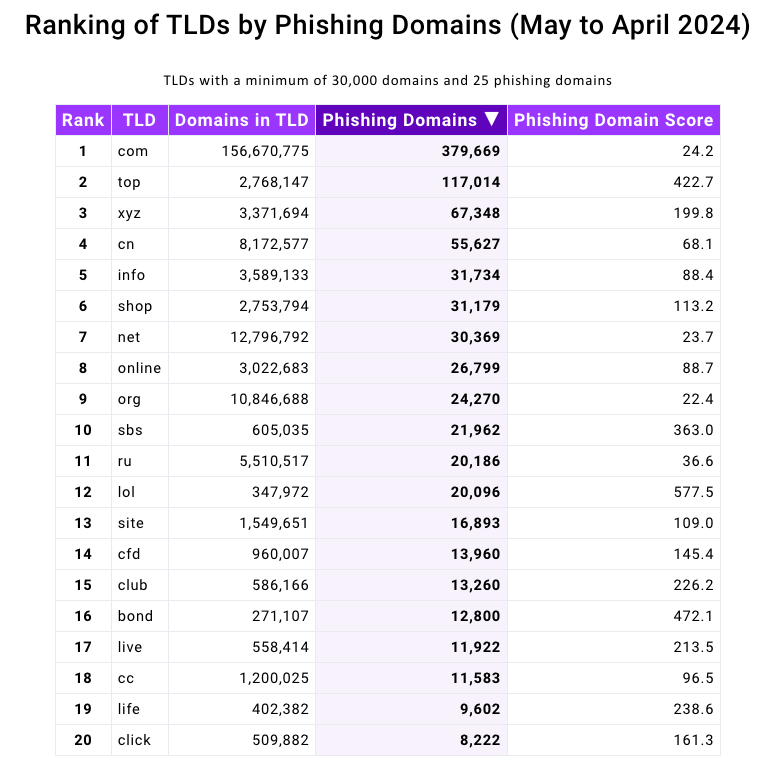
Domains ending in .top were represented prominently in a new phishing report released today by the Interisle Consulting Group, which sources phishing data from several places, including the Anti-Phishing Working Group (APWG), OpenPhish, PhishTank, and Spamhaus.

Interisle’s newest study examined nearly two million phishing attacks in the last year, and found that phishing sites accounted for more than four percent of all new .top domains between May 2023 and April 2024. Interisle said .top has roughly 2.76 million domains in its stable, and that more than 117,000 of those were phishing sites in the past year.

Source: Interisle Consulting Group.

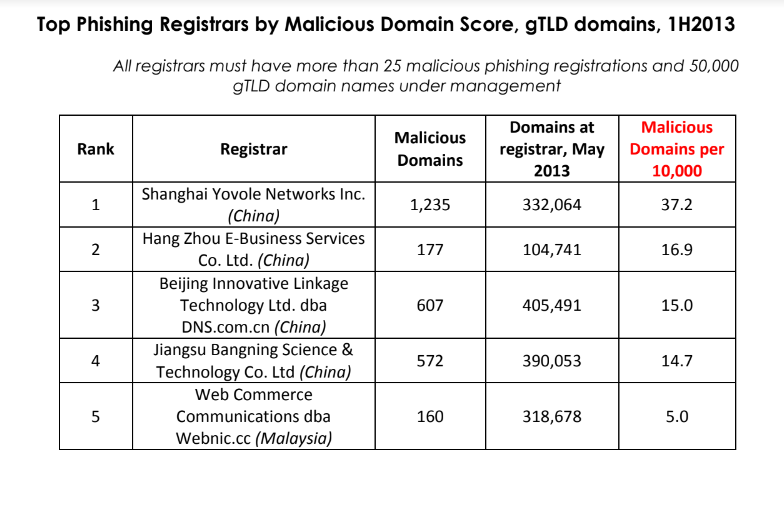
ICANN said its review was based on information collected and studied about .top domains over the past few weeks. But the fact that high volumes of phishing sites are being registered through Jiangsu Bangning Science & Technology Co Ltd. is hardly a new trend.

For example, more than 10 years ago the same Chinese registrar was the fourth most common source of phishing websites, as tracked by the APWG. Bear in mind that the APWG report excerpted below was published more than a year before Jiangsu Bangning received ICANN approval to introduce and administer the new .top registry.

Source: APWG phishing report from 2013, two years before .top came into being.

A fascinating new wrinkle in the phishing landscape is the growth in scam pages hosted via the InterPlanetary File System (IPFS), a decentralized data storage and delivery network that is based on peer-to-peer networking. According to Interisle, the use of IPFS to host and launch phishing attacks — which can make phishing sites more difficult to take down — increased a staggering 1,300 percent, to roughly 19,000 phishing sites reported in the last year.

Last year’s report from Interisle found that domain names ending in “.us” — the top-level domain for the United States — were among the most prevalent in phishing scams. While .us domains are not even on the Top 20 list of this year’s study, “.com” maintained its perennial #1 spot as the largest source of phishing domains overall.

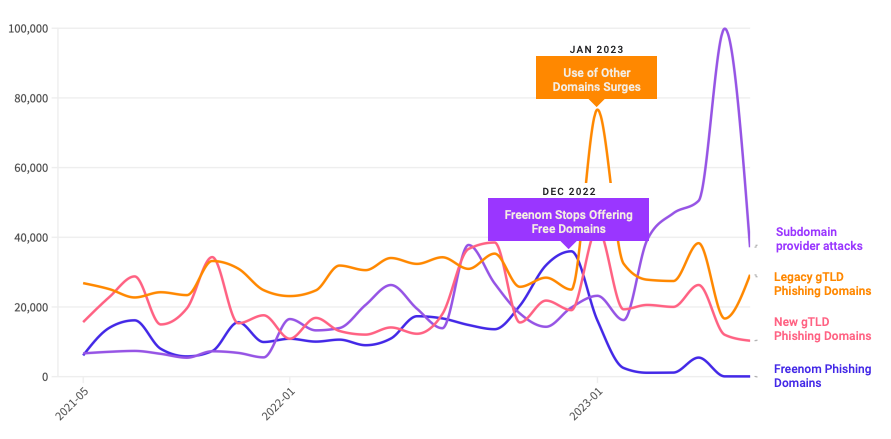
A year ago, the phishiest domain registrar by far was Freenom, a now-defunct registrar that handed out free domains in several country-code TLDs, including .tk, .ml, .ga and .cf. Freenom went out of business after being sued by Meta, which alleged Freenom ignored abuse complaints while monetizing traffic to abusive domains.

Following Freenom’s demise, phishers quickly migrated to other new low-cost TLDs and to services that allow anonymous, free domain registrations — particularly subdomain services. For example, Interisle found phishing attacks involving websites created on Google’s blogspot.com skyrocketed last year more than 230 percent. Other subdomain services that saw a substantial growth in domains registered by phishers include weebly.com, github.io, wix.com, and ChangeIP, the report notes.

Source: Interisle Consulting.

Interisle Consulting partner Dave Piscitello said ICANN could easily send similar warning letters to at least a half-dozen other top-level domain registries, noting that spammers and phishers tend to cycle through the same TLDs periodically — including .xyz, .info, .support and .lol, all of which saw considerably more business from phishers after Freenom’s implosion.

Piscitello said domain registrars and registries could significantly reduce the number of phishing sites registered through their services just by flagging customers who try to register huge volumes of domains at once. Their study found that at least 27% of the domains used for phishing were registered in bulk — i.e. the same registrant paid for hundreds or thousands of domains in quick succession.

The report includes a case study in which a phisher this year registered 17,562 domains over the course of an eight-hour period — roughly 38 domains per minute — using .lol domains that were all composed of random letters.

ICANN tries to resolve contract disputes privately with the registry and registrar community, and experts say the nonprofit organization usually only publishes enforcement letters when the recipient is ignoring its private notices. Indeed, ICANN’s letter notes Jiangsu Bangning didn’t even open its emailed notifications. It also cited the registry for falling behind in its ICANN membership fees.

With that in mind, a review of ICANN’s public enforcement activity suggests two trends: One is that there have been far fewer public compliance and enforcement actions in recent years — even as the number of new TLDs has expanded dramatically.

The second is that in a majority of cases, the failure of a registry or registrar to pay its annual ICANN membership fees was cited as a reason for a warning letter. A review of nearly two dozen enforcement letters ICANN has sent to domain registrars since 2022 shows that failure to pay dues was cited as a reason (or the reason) for the violation at least 75 percent of the time.

Piscitello, a former ICANN board member, said nearly all breach notices sent out while he was at ICANN were because the registrar owed money.

“I think the rest is just lipstick to suggest that ICANN’s on top of DNS Abuse,” Piscitello said.

KrebsOnSecurity has sought comment from ICANN and will update this story if they respond.

from Krebs on Security https://ift.tt/QwWRuxK
via IFTTT

Global Microsoft Meltdown Tied to Bad Crowstrike Update

A faulty software update from cybersecurity vendor Crowdstrike crippled countless Microsoft Windows computers across the globe today, disrupting everything from airline travel and financial institutions to hospitals and businesses online. Crowdstrike said a fix has been deployed, but experts say the recovery from this outage could take some time, as Crowdstrike’s solution needs to be applied manually on a per-machine basis.

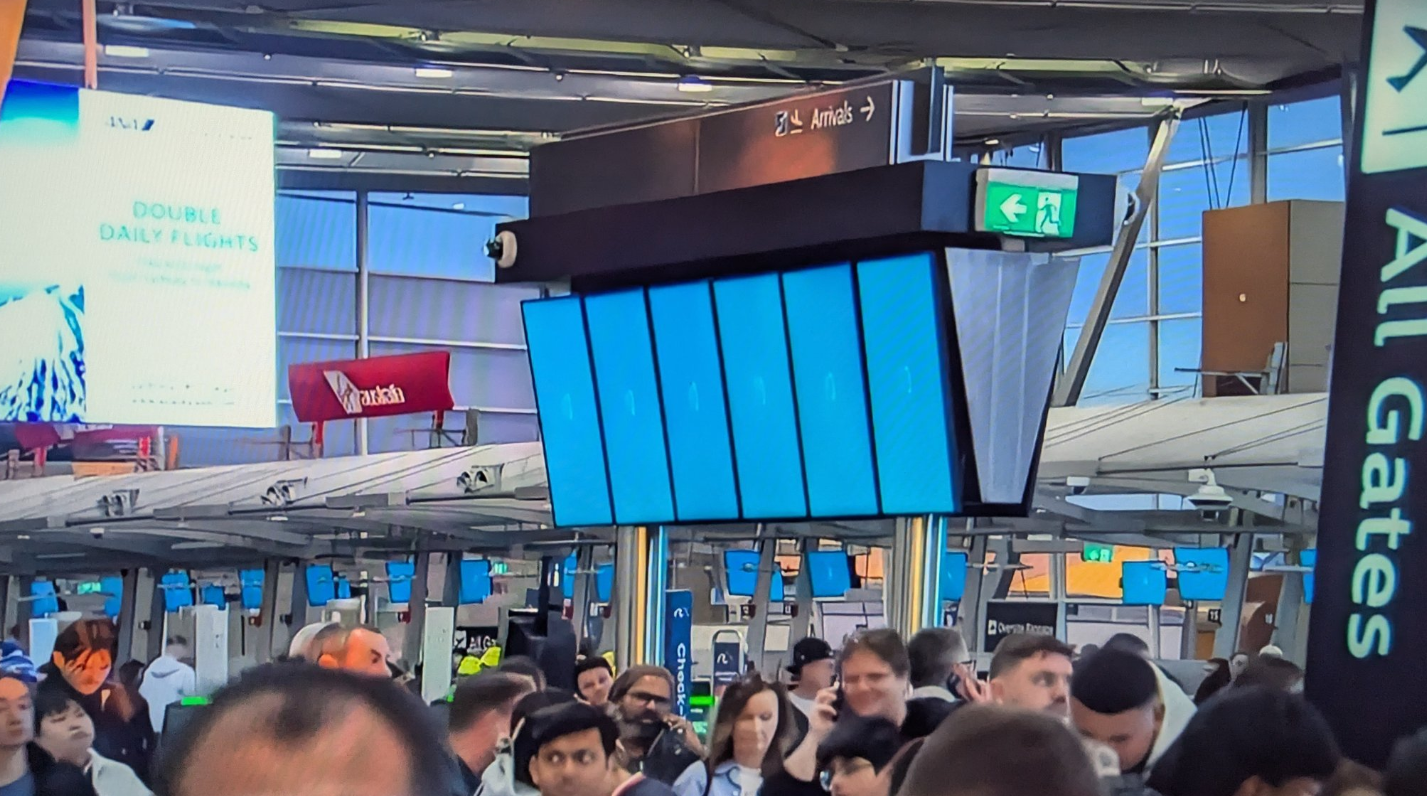
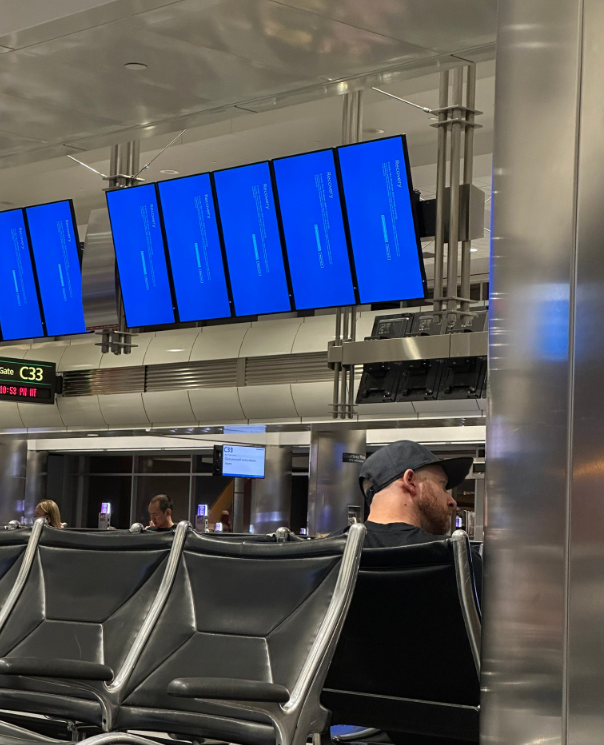
A photo taken at San Jose International Airport today shows the dreaded Microsoft “Blue Screen of Death” across the board. Credit: Twitter.com/adamdubya1990

Earlier today, an errant update shipped by Crowdstrike began causing Windows machines running the software to display the dreaded “Blue Screen of Death,” rendering those systems temporarily unusable. Like most security software, Crowdstrike requires deep hooks into the Windows operating system to fend off digital intruders, and in that environment a tiny coding error can quickly lead to catastrophic outcomes.

In a post on Twitter/X, Crowdstrike CEO George Kurtz said an update to correct the coding mistake has been shipped, and that Mac and Linux systems are not affected.

“This is not a security incident or cyberattack,” Kurtz said on Twitter, echoing a written statement by Crowdstrike. “The issue has been identified, isolated and a fix has been deployed.”

Posting to Twitter/X, the director of Crowdstrike’s threat hunting operations said the fix involves booting Windows into Safe Mode or the Windows Recovery Environment (Windows RE), deleting the file “C-00000291*.sys” and then restarting the machine.

The software snafu may have been compounded by a recent series of outages involving Microsoft’s Azure cloud services, The New York Times reports, although it remains unclear whether those Azure problems are at all related to the bad Crowdstrike update.

A reader shared this photo taken earlier today at Denver International Airport. Credit: Twitter.com/jterryy07

Reactions to today’s outage were swift and brutal on social media, which was flooded with images of people at airports surrounded by computer screens displaying the Microsoft blue screen error. Many Twitter/X users chided the Crowdstrike CEO for failing to apologize for the massively disruptive event, while others noted that doing so could expose the company to lawsuits.

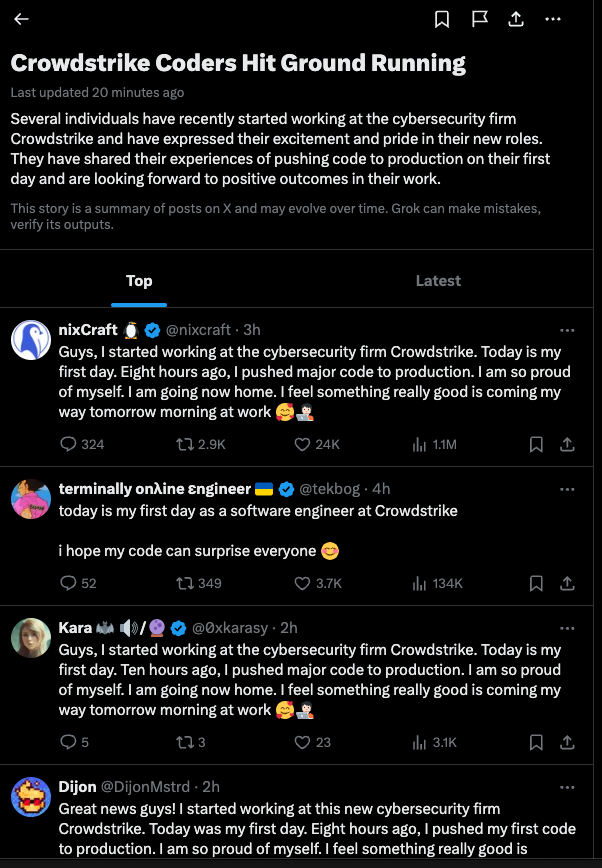
Meanwhile, the international Windows outage quickly became the most talked-about subject on Twitter/X, whose artificial intelligence bots collated a series of parody posts from cybersecurity professionals pretending to be on their first week of work at Crowdstrike. Incredibly,Twitter/X’s AI summarized these sarcastic posts into a sunny, can-do story about Crowdstrike that was promoted as the top discussion on Twitter this morning.

“Several individuals have recently started working at the cybersecurity firm Crowdstrike and have expressed their excitement and pride in their new roles,” the AI summary read. “They have shared their experiences of pushing code to production on their first day and are looking forward to positive outcomes in their work.”

The top story today on Twitter/X, as brilliantly summarized by X’s AI bots.

Wired.com’s Matt Burgess writes that within health care and emergency services, various medical providers around the world have reported issues with their Windows-linked systems, sharing news on social media or their own websites.

“The US Emergency Alert System, which issues hurricane warnings, said that there had been various 911 outages in a number of states,” Burgess wrote. “Germany’s University Hospital Schleswig-Holstein said it was canceling some nonurgent surgeries at two locations. In Israel, more than a dozen hospitals have been impacted, as well as pharmacies, with reports saying ambulances have been rerouted to nonimpacted medical organizations.”

In the United Kingdom, NHS England has confirmed that appointment and patient record systems have been impacted by the outages.

“One hospital has declared a ‘critical’ incident after a third-party IT system it used was impacted,” Wired reports. “Also in the country, train operators have said there are delays across the network, with multiple companies being impacted.”

This is an evolving story. Stay tuned for updates.

from Krebs on Security https://ift.tt/85Lx2kE
via IFTTT

Australians affected by MediSecure hack may never know their personal details have been compromised

Prime minister says ‘very significant cyber event’ still under investigation by federal police and he is ‘not aware’ if he is among the 12.9m victims

The 12.9 million Australians caught up in the hack on electronic prescriptions provider MediSecure may never be told their personal information has been compromised, with the prime minister saying on Friday he wasn’t aware if he was one of the victims.

On Thursday evening, the administrators for MediSecure – which went into administration after the hack – revealed 6.5TB of data had been compromised after a ransomware attack on a database server, which was discovered by the company in April.

Sign up for Guardian Australia’s free morning and afternoon email newsletters for your daily news roundup

Continue reading…

from Data and computer security | The Guardian https://ift.tt/oq8Wjm3
via IFTTT

Researchers: Weak Security Defaults Enabled Squarespace Domains Hijacks

At least a dozen organizations with domain names at domain registrar Squarespace saw their websites hijacked last week. Squarespace bought all assets of Google Domains a year ago, but many customers still haven’t set up their new accounts. Experts say malicious hackers learned they could commandeer any migrated Squarespace accounts that hadn’t yet been registered, merely by supplying an email address tied to an existing domain.

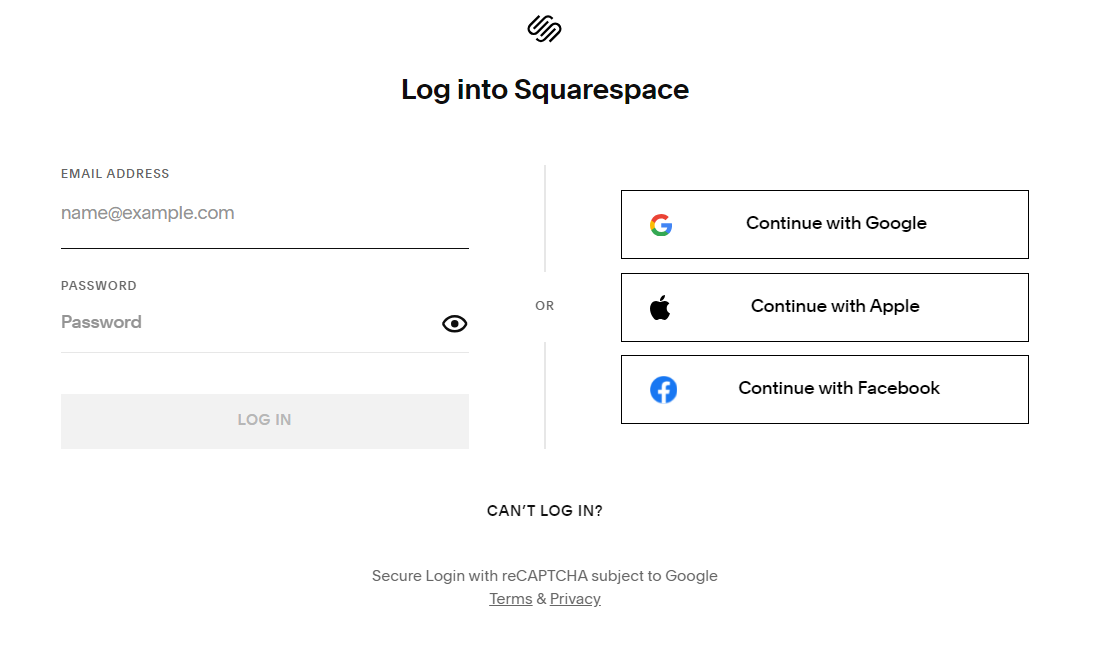
Until this past weekend, Squarespace’s website had an option to log in via email.

The Squarespace domain hijacks, which took place between July 9 and July 12, appear to have mostly targeted cryptocurrency businesses, including Celer Network, Compound Finance, Pendle Finance, and Unstoppable Domains. In some cases, the attackers were able to redirect the hijacked domains to phishing sites set up to steal visitors’ cryptocurrency funds.

New York City-based Squarespace purchased roughly 10 million domain names from Google Domains in June 2023, and it has been gradually migrating those domains to its service ever since. Squarespace has not responded to a request for comment, nor has it issued a statement about the attacks.

But an analysis released by security experts at Metamask and Paradigm finds the most likely explanation for what happened is that Squarespace assumed all users migrating from Google Domains would select the social login options — such “Continue with Google” or “Continue with Apple” — as opposed to the “Continue with email” choice.

Taylor Monahan, lead product manager at Metamask, said Squarespace never accounted for the possibility that a threat actor might sign up for an account using an email associated with a recently-migrated domain before the legitimate email holder created the account themselves.

“Thus nothing actually stops them from trying to login with an email,” Monahan told KrebsOnSecurity. “And since there’s no password on the account, it just shoots them to the ‘create password for your new account’ flow. And since the account is half-initialized on the backend, they now have access to the domain in question.”

Sometime in the last 24 hours, Squarespace removed the ability for people to create an account with just an email address. That option was available when KrebsOnSecurity created a test Squarespace account on Saturday (it’s unclear whether Squarespace ever sent a confirmation email from that signup, but I still haven’t received one).

What’s more, Monahan said, Squarespace did not require email verification for new accounts created with a password.

“The domains being migrated from Google to Squarespace are known,” Monahan said. “It’s either public or easily discernible info which email addresses have admin of a domain. And if that email never sets up their account on Squarespace — say because the billing admin left the company five years ago or folks just ignored the email — anyone who enters that email@domain in the squarespace form now has full access to control to the domain.”

The researchers say some Squarespace domains that were migrated over also could be hijacked if attackers discovered the email addresses for less privileged user accounts tied to the domain, such as “domain manager,” which likewise has the ability to transfer a domain or point it to a different Internet address.

Squarespace says domain owners and domain managers have many of the same privileges, including the ability to move a domain or manage the site’s domain name server (DNS) settings.

Monahan said the migration has left domain owners with fewer options to secure and monitor their accounts.

“Squarespace can’t support users who need any control or insight into the activity being performed in their account or domain,” Monahan said. “You basically have no control over the access different folks have. You don’t have any audit logs. You don’t get email notifications for some actions. The owner doesn’t get email notification for actions taken by a ‘domain manager.’ This is absolutely insane if you’re used to and expecting the controls Google provides.”

The researchers have published a comprehensive guide for locking down Squarespace user accounts, which urges Squarespace users to enable multi-factor authentication (disabled during the migration).

“Determining what emails have access to your new Squarespace account is step 1,” the help guide advises. “Most teams DO NOT REALIZE these accounts even exist, let alone theoretically have access.”

The guide also recommends removing unnecessary Squarespace user accounts, and disabling reseller access in Google Workspace.

“If you bought Google Workspace via Google Domains, Squarespace is now your authorized reseller,” the help document explains. “This means that anyone with access to your Squarespace account also has a backdoor into your Google Workspace unless you explicitly disable it by following the instructions here, which you should do. It’s easier to secure one account than two.”

from Krebs on Security https://ift.tt/7f8ARDO
via IFTTT