Who’s Behind the NetWire Remote Access Trojan?

A Croatian national has been arrested for allegedly operating NetWire, a Remote Access Trojan (RAT) marketed on cybercrime forums since 2012 as a stealthy way to spy on infected systems and siphon passwords. The arrest coincided with a seizure of the NetWire sales website by the U.S. Federal Bureau of Investigation (FBI). While the defendant in this case hasn’t yet been named publicly, the NetWire website has been leaking information about the likely true identity and location of its owner for the past 11 years.
Typically installed by booby-trapped Microsoft Office documents and distributed via email, NetWire is a multi-platform threat that is capable of targeting not only Microsoft Windows machines but also Android, Linux and Mac systems.

NetWire’s reliability and relatively low cost ($80-$140 depending on features) has made it an extremely popular RAT on the cybercrime forums for years, and NetWire infections consistently rank among the top 10 most active RATs in use.

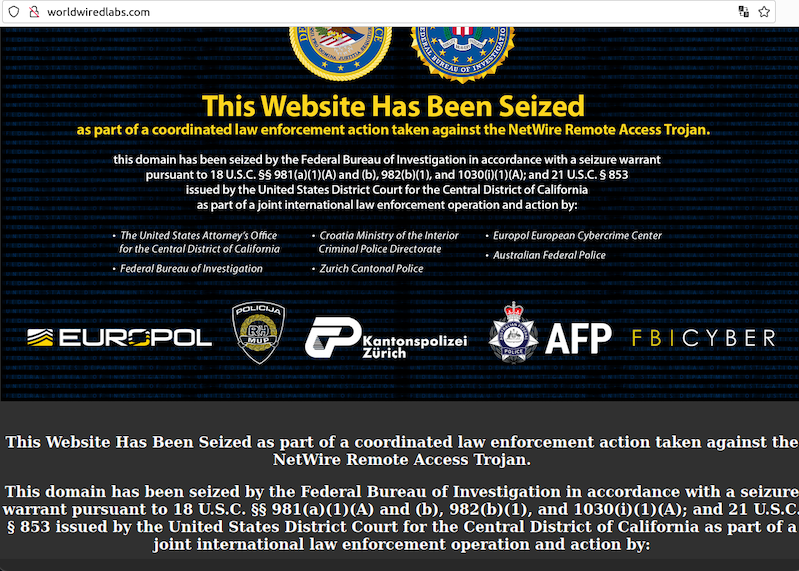
NetWire has been sold openly on the same website since 2012: worldwiredlabs[.]com. That website now features a seizure notice from the U.S. Department of Justice, which says the domain was taken as part of “a coordinated law enforcement action taken against the NetWire Remote Access Trojan.”

“As part of this week’s law enforcement action, authorities in Croatia on Tuesday arrested a Croatian national who allegedly was the administrator of the website,” reads a statement by the U.S. Department of Justice today. “This defendant will be prosecuted by Croatian authorities. Additionally, law enforcement in Switzerland on Tuesday seized the computer server hosting the NetWire RAT infrastructure.”

Neither the DOJ’s statement nor a press release on the operation published by Croatian authorities mentioned the name of the accused. But it’s fairly remarkable that it has taken so long for authorities in the United States and elsewhere to move against NetWire and its alleged proprietor, given that the RAT’s author apparently did very little to hide his real-life identity.

The WorldWiredLabs website first came online in February 2012 using a dedicated host with no other domains. The site’s true WHOIS registration records have always been hidden by privacy protection services, but there are plenty of clues in historical Domain Name System (DNS) records for WorldWiredLabs that point in the same direction.

In October 2012, the WorldWiredLabs domain moved to another dedicated server at the Internet address 198.91.90.7, which was home to just one other domain: printschoolmedia[.]org, also registered in 2012.

According to DomainTools.com, printschoolmedia[.]org was registered to a Mario Zanko in Zapresic, Croatia, and to the email address zankomario@gmail.com. DomainTools further shows this email address was used to register one other domain in 2012: wwlabshosting[.]com, also registered to Mario Zanko from Croatia.

A review of DNS records for both printschoolmedia[.]org and wwlabshosting[.]com shows that while these domains were online they both used the DNS name server ns1.worldwiredlabs[.]com. No other domains have been recorded using that same name server.
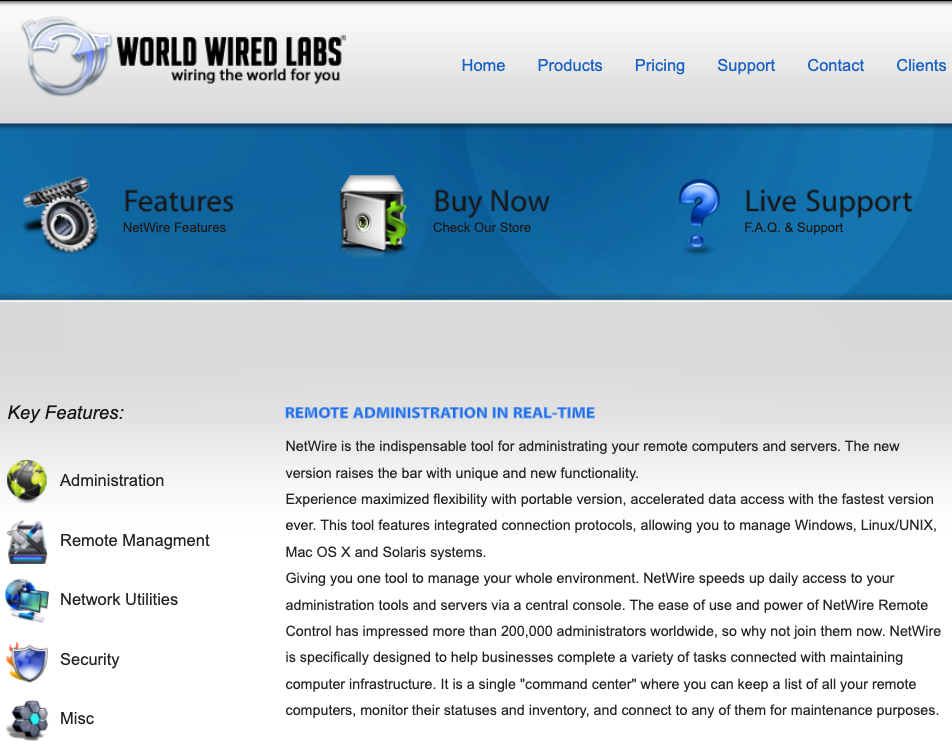
The WorldWiredLabs website, in 2013. Source: Archive.org.

DNS records for worldwiredlabs[.]com also show the site forwarded incoming email to the address tommaloney@ruggedinbox.com. Constella Intelligence, a service that indexes information exposed by public database leaks, shows this email address was used to register an account at the clothing retailer romwe.com, using the password “123456xx.”

Running a reverse search on this password in Constella Intelligence shows there are more than 450 email addresses known to have used this credential, and two of those are zankomario@gmail.com and zankomario@yahoo.com.

A search on zankomario@gmail.com in Skype returns three results, including the account name “Netwire” and the username “Dugidox,” and another for a Mario Zanko (username zanko.mario).
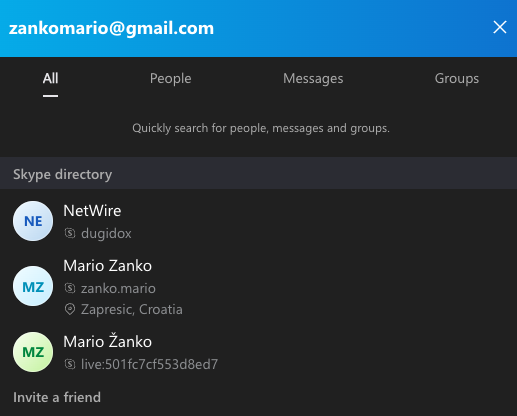
Dugidox corresponds to the hacker handle most frequently associated with NetWire sales and support discussion threads on multiple cybercrime forums over the years.

Constella ties dugidox@gmail.com to a number of website registrations, including the Dugidox handle on BlackHatWorld and HackForums, and to IP addresses in Croatia for both. Constella also shows the email address zankomario@gmail.com used the password “dugidox2407.”

In 2010, someone using the email address dugidox@gmail.com registered the domain dugidox[.]com. The WHOIS registration records for that domain list a “Senela Eanko” as the registrant, but the address used was the same street address in Zapresic that appears in the WHOIS records for printschoolmedia[.]org, which is registered in Mr. Zanco’s name.

Prior to the demise of Google+, the email address dugidox@gmail.com mapped to an account with the nickname “Netwire wwl.” The dugidox email also was tied to a Facebook account (mario.zanko3), which featured check-ins and photos from various places in Croatia.

That Facebook profile is no longer active, but back in January 2017, the administrator of WorldWiredLabs posted that he was considering adding certain Android mobile functionality to his service. Three days after that, the Mario.Zank3 profile posted a photo saying he was selected for an Android instruction course — with his dugidox email in the photo, naturally.

Incorporation records from the U.K.’s Companies House shows that in 2017 Mr. Zanko became an officer in a company called Godbex Solutions LTD. A Youtube video invoking this corporate name describes Godbex as a “next generation platform” for exchanging gold and cryptocurrencies.

The U.K. Companies House records show Godbex was dissolved in 2020. It also says Mr. Zanko was born in July 1983, and lists his occupation as “electrical engineer.”

Mr. Zanko did not respond to multiple requests for comment.

from Krebs on Security https://ift.tt/3yVfm5Y
via IFTTT

‘A woman from Mars’: Life in the pursuit of space exploration

An astrobiologist, analog astronaut, author and speaker, Dr. Michaela Musilova shares her experience as a woman at the forefront of space exploration and from her quest for scientific and personal excellence

The post ‘A woman from Mars’: Life in the pursuit of space exploration appeared first on WeLiveSecurity

from WeLiveSecurity https://ift.tt/b2SQgvi
via IFTTT

‘A woman from Mars’: Life in the pursuit of space exploration

An astrobiologist, analog astronaut, author and speaker, Dr. Michaela Musilova shares her experience as a woman at the forefront of space exploration and from her quest for scientific and personal excellence

The post ‘A woman from Mars’: Life in the pursuit of space exploration appeared first on WeLiveSecurity

from WeLiveSecurity https://ift.tt/b2SQgvi
via IFTTT

‘A woman from Mars’: Life in the pursuit of space exploration

An astrobiologist, analog astronaut, author and speaker, Dr. Michaela Musilova shares her experience as a woman at the forefront of space exploration and from her quest for scientific and personal excellence

The post ‘A woman from Mars’: Life in the pursuit of space exploration appeared first on WeLiveSecurity

from WeLiveSecurity https://ift.tt/b2SQgvi
via IFTTT

Love scam or espionage? Transparent Tribe lures Indian and Pakistani officials

ESET researchers analyze a cyberespionage campaign that distributes CapraRAT backdoors through trojanized and supposedly secure Android messaging apps – but also exfiltrates sensitive information

The post Love scam or espionage? Transparent Tribe lures Indian and Pakistani officials appeared first on WeLiveSecurity

from WeLiveSecurity https://ift.tt/Z3K8PC7
via IFTTT

Sued by Meta, Freenom Halts Domain Registrations

The domain name registrar Freenom, whose free domain names have long been a draw for spammers and phishers, has stopped allowing new domain name registrations. The move comes just days after the Dutch registrar was sued by Meta, which alleges the company ignores abuse complaints about phishing websites while monetizing traffic to those abusive domains.

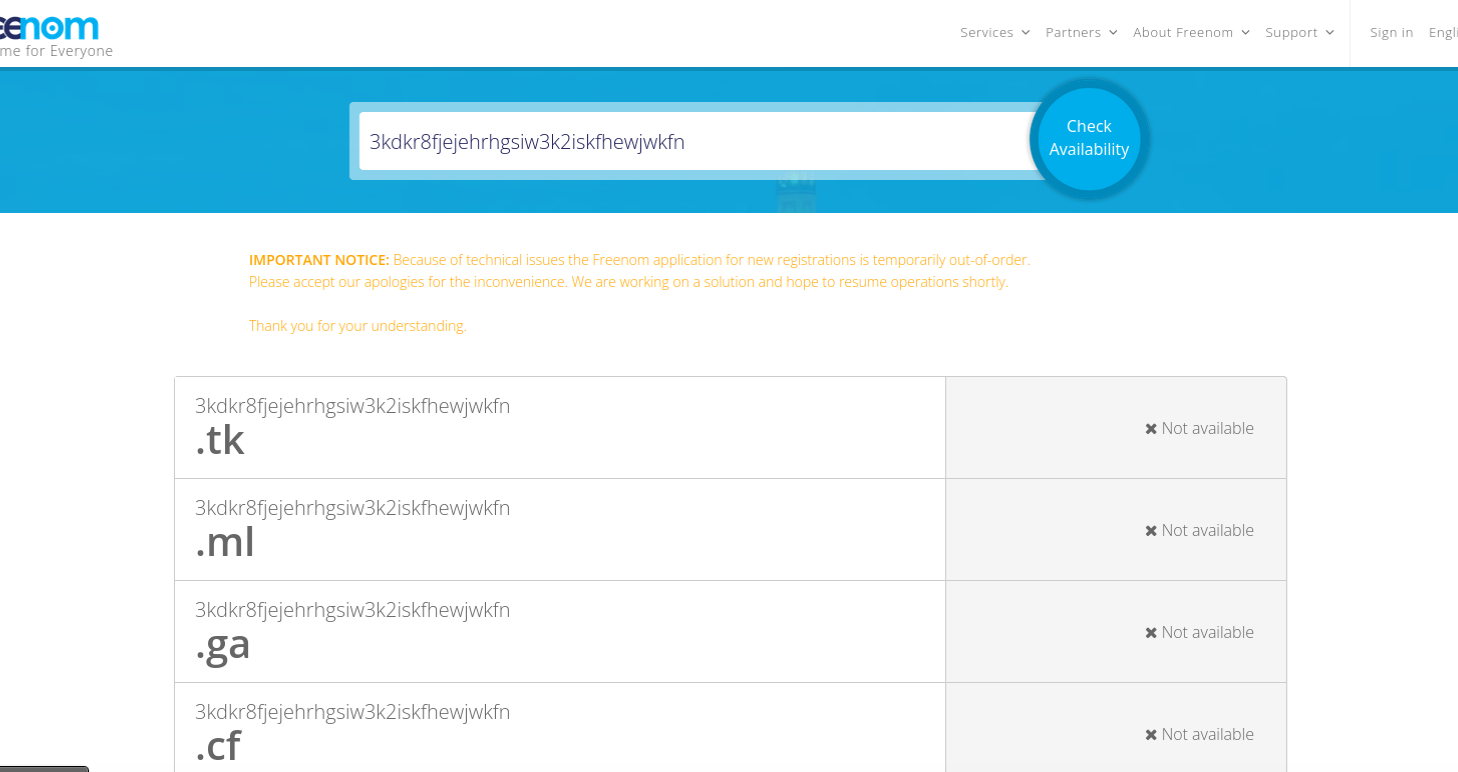
Freenom’s website features a message saying it is not currently allowing new registrations.

Freenom is the domain name registry service provider for five so-called “country code top level domains” (ccTLDs), including .cf for the Central African Republic; .ga for Gabon; .gq for Equatorial Guinea; .ml for Mali; and .tk for Tokelau.

Freenom has always waived the registration fees for domains in these country-code domains, presumably as a way to encourage users to pay for related services, such as registering a .com or .net domain, for which Freenom does charge a fee.

On March 3, 2023, social media giant Meta sued Freenom in a Northern California court, alleging cybersquatting violations and trademark infringement. The lawsuit also seeks information about the identities of 20 different “John Does” — Freenom customers that Meta says have been particularly active in phishing attacks against Facebook, Instagram, and WhatsApp users.

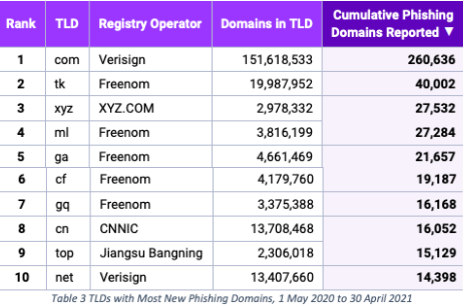
The lawsuit points to a 2021 study (PDF) on the abuse of domains conducted for the European Commission, which discovered that those ccTLDs operated by Freenom made up five of the Top Ten TLDs most abused by phishers.

“The five ccTLDs to which Freenom provides its services are the TLDs of choice for cybercriminals because Freenom provides free domain name registration services and shields its customers’ identity, even after being presented with evidence that the domain names are being used for illegal purposes,” the complaint charges. “Even after receiving notices of infringement or phishing by its customers, Freenom continues to license new infringing domain names to those same customers.”

Meta further alleges that “Freenom has repeatedly failed to take appropriate steps to investigate and respond appropriately to reports of abuse,” and that it monetizes the traffic from infringing domains by reselling them and by adding “parking pages” that redirect visitors to other commercial websites, websites with pornographic content, and websites used for malicious activity like phishing.

Freenom has not yet responded to requests for comment. But attempts to register a domain through the company’s website as of publication time generated an error message that reads:

“Because of technical issues the Freenom application for new registrations is temporarily out-of-order. Please accept our apologies for the inconvenience. We are working on a solution and hope to resume operations shortly. Thank you for your understanding.”

Image: Interisle Consulting Group, Phishing Landscape 2021, Sept. 2021.

Although Freenom is based in The Netherlands, some of its other sister companies named as defendants in the lawsuit names are incorporated in the United States.

Meta initially filed this lawsuit in December 2022, but it asked the court to seal the case, which would have restricted public access to court documents in the dispute. That request was denied, and Meta amended and re-filed the lawsuit last week.

According to Meta, this isn’t just a case of another domain name registrar ignoring abuse complaints because it’s bad for business. The lawsuit alleges that the owners of Freenom “are part of a web of companies created to facilitate cybersquatting, all for the benefit of Freenom.”

“On information and belief, one or more of the ccTLD Service Providers, ID Shield, Yoursafe, Freedom Registry, Fintag, Cervesia, VTL, Joost Zuurbier Management Services B.V., and Doe Defendants were created to hide assets, ensure unlawful activity including cybersquatting and phishing goes undetected, and to further the goals of Freenom,” Meta charged.

It remains unclear why Freenom has stopped allowing domain registration, but it could be that the company was recently the subject of some kind of disciplinary action by the Internet Corporation for Assigned Names and Numbers (ICANN), the nonprofit entity which oversees the domain registrars.

In June 2015, ICANN suspended Freenom’s ability to create new domain names or initiate inbound transfers of domain names for 90 days. According to Meta, the suspension was premised on ICANN’s determination that Freenom “has engaged in a pattern and practice of trafficking in or use of domain names identical or confusingly similar to a trademark or service mark of a third party in which the Registered Name Holder has no rights or legitimate interest.”

ICANN has not yet responded to requests for comment.

A copy of the amended complaint against Freenom, et. al, is available here (PDF).

from Krebs on Security https://ift.tt/kwJM5GN
via IFTTT