PhotoShow 3.0 – Remote Code Execution
from Exploit-DB.com RSS Feed https://ift.tt/rt2QWxs
via IFTTT

PhotoShow 3.0 – Remote Code Execution
from Exploit-DB.com RSS Feed https://ift.tt/rt2QWxs
via IFTTT
Operation led by FBI and Dutch police with involvement of UK National Crime Agency takes Genesis Market offline
A criminal online marketplace selling millions of stolen identities for as little as 56p has been taken down in an international crackdown.
The sting, led by the FBI and Dutch police with the involvement of law enforcement agencies across 18 countries, including the UK’s National Crime Agency (NCA), took Genesis Market offline on Tuesday evening.
from Data and computer security | The Guardian https://ift.tt/ZopvraG
via IFTTT
Several domain names tied to Genesis Market, a bustling cybercrime store that sold access to passwords and other data stolen from millions of computers infected with malicious software, were seized by the Federal Bureau of Investigation (FBI) today. Sources tell KrebsOnsecurity the domain seizures coincided with “dozens” of arrests in the United States and abroad targeting those who allegedly operated the service, as well as suppliers who continuously fed Genesis Market with freshly-stolen data.
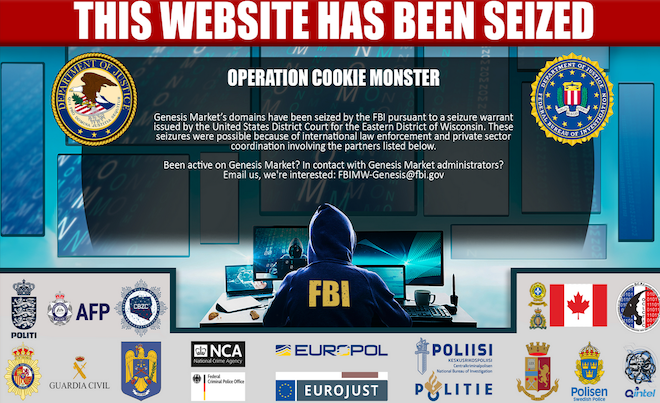
Several websites tied to the cybercrime store Genesis Market had their homepages changed today to this seizure notice.
Active since 2018, Genesis Market’s slogan has long been, “Our store sells bots with logs, cookies, and their real fingerprints.” Customers could search for infected systems with a variety of options, including by Internet address or by specific domain names associated with stolen credentials.
But earlier today, multiple domains associated with Genesis had their homepages replaced with a seizure notice from the FBI, which said the domains were seized pursuant to a warrant issued by the U.S. District Court for the Eastern District of Wisconsin.
The U.S. Attorney’s Office for the Eastern District of Wisconsin did not respond to requests for comment. The FBI declined to comment.
But sources close to the investigation tell KrebsOnSecurity that law enforcement agencies in the United States, Canada and across Europe are currently serving arrest warrants on dozens of individuals thought to support Genesis, either by maintaining the site or selling the service bot logs from infected systems.
The seizure notice includes the seals of law enforcement entities from several countries, including Australia, Canada, Denmark, Germany, the Netherlands, Spain, Sweden and the United Kingdom.
When Genesis customers purchase a bot, they’re purchasing the ability to have all of the victim’s authentication cookies loaded into their browser, so that online accounts belonging to that victim can be accessed without the need of a password, or in some cases even multi-factor authentication.
“You can buy a bot with a real fingerprint, access to e-mail, social networks, bank accounts, payment systems!,” a cybercrime forum ads for Genesis enthused. “You also get all previous digital life (history) of the bot – most services won’t even ask for login and password and identify you as their returning customer. Purchasing a bot kit with the fingerprint, cookies and accesses, you become the unique user of all his or her services and other web-sites. The other use of our kit of real fingerprints is to cover-up the traces of your real internet activity.”
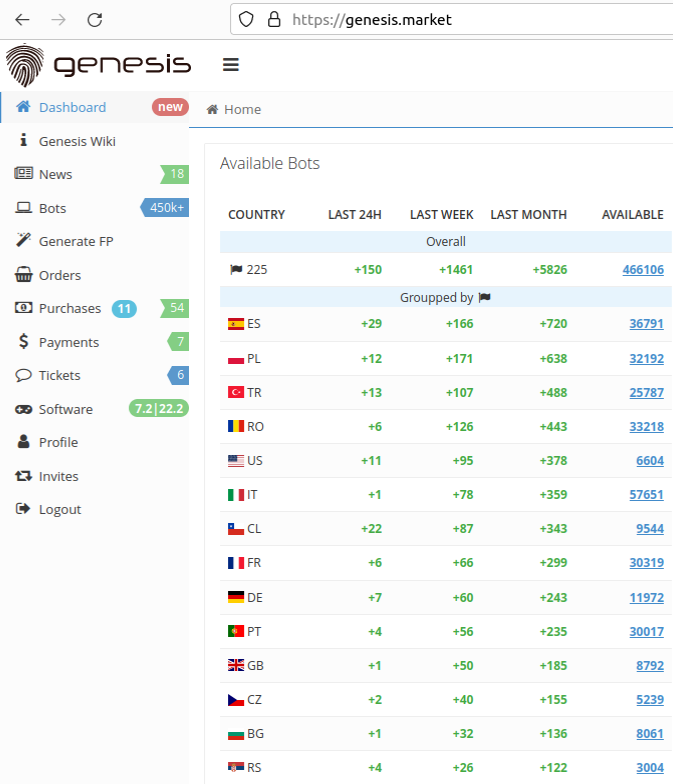
The Genesis Store had more than 450,000 bots for sale as of Mar. 21, 2023. Image: KrebsOnSecurity.
The pricing for Genesis bots ranged quite a bit, but in general bots with large amounts of passwords and authentication cookies — or those with access to specific financial websites such as PayPal and Coinbase — tended to fetch far higher prices.
New York based cyber intelligence firm Flashpoint says that in addition to containing a large number of resources, the most expensive bots overwhelmingly seem to have access to accounts that are easy to monetize.
“The high incidence of Google and Facebook is expected, as they are such widely used platforms,” Flashpoint noted in an analysis of Genesis Market, observing that all ten of the ten most expensive bots at the time included Coinbase credentials.
Genesis Market has introduced a number of cybercriminal innovations over its existence. Probably the best example is Genesis Security, which is a custom Web browser plugin which can load a Genesis bot profile so that the browser mimics virtually every important aspect of the victim’s device, from screen size and refresh rate to the unique user agent string tied to the victim’s web browser.
Flashpoint said the administrators of Genesis Market claim they are a team of specialists with “extensive experience in the field of systems metrics.” They say they developed the Genesis Security software by analyzing the top forty-seven browser fingerprinting and tracking systems, as well as those utilized by 283 different banking and payment systems.
Cybersecurity experts say Genesis and a handful of other bot shops are also popular among cybercriminals who work to identify and purchase bots inside corporate networks, and then turn around and resell that access to ransomware gangs.
Michael Debolt, chief intelligence officer for Intel 471, said so-called “network access brokers” will scour automated bot shops for high value targets, and then resell them for a bigger profit.
“From ‘used’ or ‘processed’ logs — it is actually quite common for the same log to be used by multiple different actors who are all using it for different purposes – for instance, some actors are only interested in crypto wallet or banking credentials so they bypass credentials that network access brokers are interested in,” Debolt said. “These network access brokers buy these ‘used’ logs for very cheap (or sometimes for free) and search for big fish targets from there.”
In June 2021, hackers who broke into and stole a wealth of source code and game data from the computer gaming giant EA told Motherboard they gained access by purchasing a $10 bot from Genesis Market that let them log into a company Slack account.
One feature of Genesis that sets it apart from other bot shops is that customers can retain access to infected systems in real-time, so that if the rightful owner of an infected system creates a new account online, those new credentials will get stolen and displayed in the web-based panel of the Genesis customer who purchased that bot.
“While some infostealers are designed to remove themselves after execution, others create persistent access,” reads a March 2023 report from cybersecurity firm SpyCloud. “That means bad actors have access to the current data for as long as the device remains infected, even if the user changes passwords.
SpyCloud says Genesis even advertises its commitment to keep the stolen data and the compromised systems’ fingerprints up to date.
“According to our research, Genesis Market had more than 430,000 stolen identities for sale as of early last year – and there are many other marketplaces like this one,” the SpyCloud report concludes.
This is a developing story. Any updates will be added with notice and timestamp here.
from Krebs on Security https://ift.tt/5VlRUri
via IFTTT
Imagine tiling a whole football field using a single shape… yet not being able to produce a repeating pattern, even if you wanted to!
from Naked Security https://ift.tt/NKBhIMv
via IFTTT
Spring is in the air and as the leaves start growing again, why not breathe some new life into the devices you depend on so badly?
The post Spring into action and tidy up your digital life like a pro appeared first on WeLiveSecurity
from WeLiveSecurity https://ift.tt/PSFbEk4
via IFTTT
They can’t read much of your data, but even a few stray network packets could tell them something they’re not supposed to know.
from Naked Security https://ift.tt/QKAoOIp
via IFTTT
John Clifton Davies, a 60-year-old con man from the United Kingdom who fled the country in 2015 before being sentenced to 12 years in prison for fraud, has enjoyed a successful life abroad swindling technology startups by pretending to be a billionaire investor. Davies’ newest invention appears to be “CodesToYou,” which purports to be a “full cycle software development company” based in the U.K.
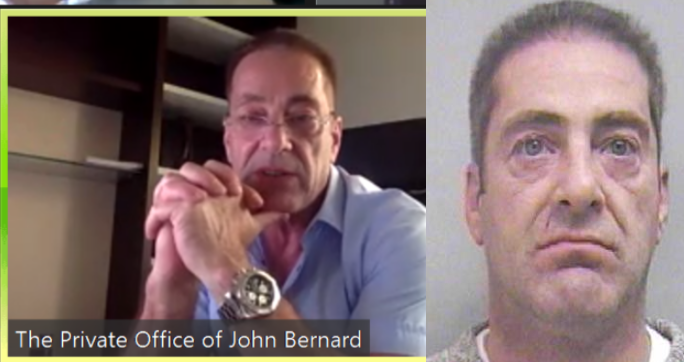
The scam artist John Bernard a.k.a. Alan John Mykailov (left) in a recent Zoom call, and a mugshot of John Clifton Davies from nearly a decade earlier.
Several articles here have delved into the history of John Bernard, the pseudonym used by a fake billionaire technology investor who tricked dozens of startups into giving him tens of millions of dollars.
John Bernard’s real name is John Clifton Davies, a convicted fraudster from the United Kingdom who is currently a fugitive from justice. For several years until reinventing himself again quite recently, Bernard pretended to be a billionaire Swiss investor who made his fortunes in the dot-com boom 20 years ago.
“The Private Office of John Bernard” let it be known to investment brokers that he had tens of millions of dollars to invest in tech startups, and he attracted a stream of new victims by offering extraordinarily generous finder’s fees to brokers who helped him secure new clients. But those brokers would eventually get stiffed because Bernard’s company would never consummate a deal.
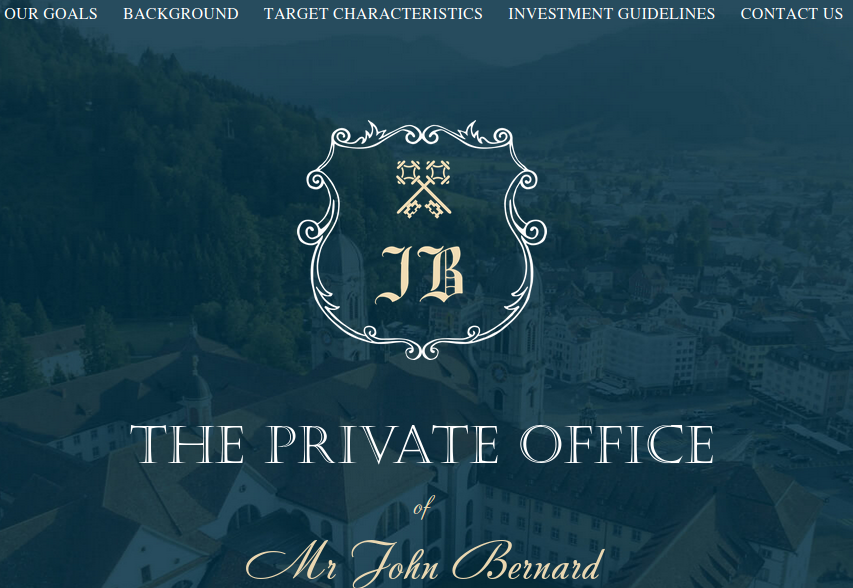
John Bernard’s former website, where he pretended to be a billionaire tech investor.
Bernard would promise to invest millions in tech startups, and then insist that companies pay tens of thousands of dollars worth of due diligence fees up front. However, the due diligence company he insisted on using — another Swiss firm called The Inside Knowledge GmbH — also was secretly owned by Bernard, who would invariably pull out of the deal after receiving the due diligence money.
A variety of clues suggest Davies has recently adopted at least one other identity — Alan John Mykhailov — who is listed as chairman of a British concern called CodesToYou LTD, incorporated in May 2022. The CodesToYou website says the company employs talented coders in several countries, and that its programmers offer “your ultimate balance between speed, cost and quality.”

The team from CodesToYou.
In response to questions from KrebsOnSecurity, CodesToYou’s marketing manager — who gave their name only as “Zhena” — said the company was not affiliated with any John Bernard or John Clifton Davies, and maintained that CodesToYou is a legitimate enterprise.
But publicly available information about this company and its leadership suggests otherwise. Official incorporation documents from the U.K.’s Companies House represent that CodesToYou is headed by an Alan John Mykhailov, a British citizen born in March 1958.
Companies House says Mykhailov is an officer in three other companies, including one called Blackstone Corporate Alliance Ltd. According to the Swiss business tracking service business-monitor.ch, Blackstone Corporate Alliance Ltd. is currently the entity holding a decision-making role in John Bernard’s fake due diligence company — The Inside Knowledge GmbH — which is now in liquidation.
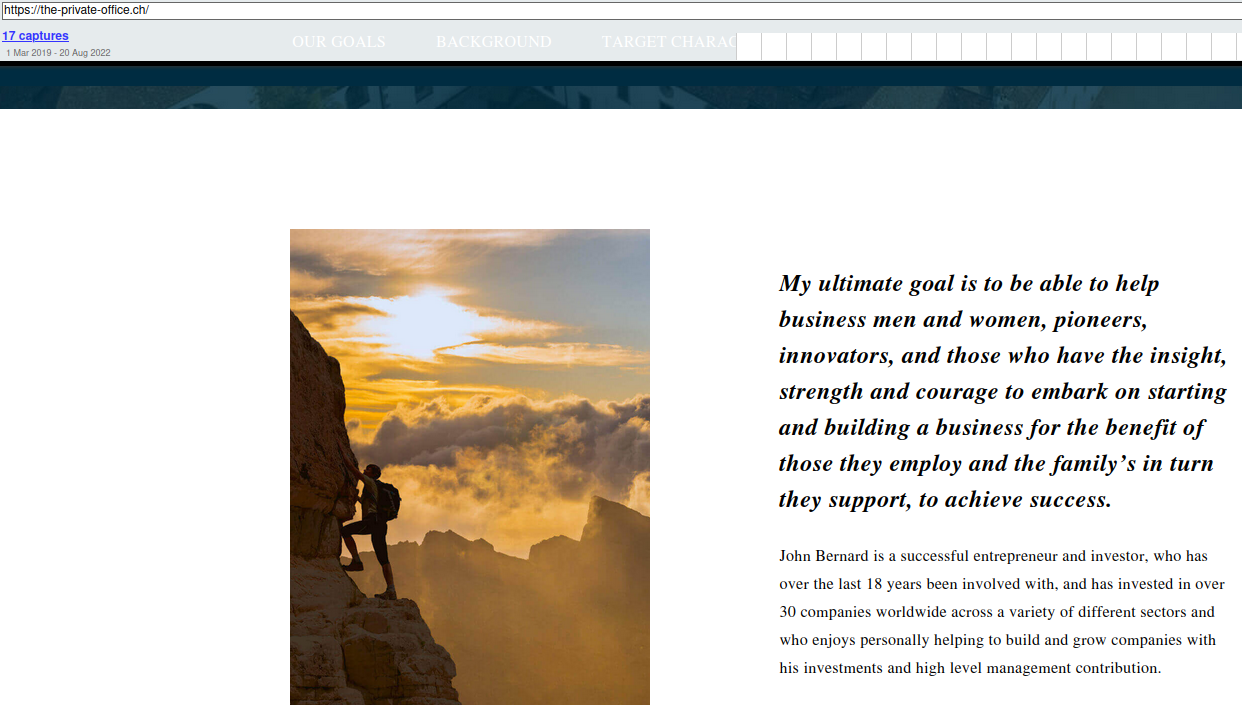
A screen shot of the stock photos and corporate-speak on John Bernard’s old website. Image: Archive.org
Also listed as a partner in Blackstone Corporate Alliance Limited is Igor Hubskyi (a.k.a. Igor Gubskyi), a Ukrainian man who was previously president of The Inside Knowledge GmbH.
The CodesToYou website says the company’s marketing team lead is Maria Yakovleva, and the photo of this employee matches the profile for the LinkedIn account name “Maria Y.” That same LinkedIn profile and photo previously listed Maria by a different first and last name — Mariya Kulikova; back then, Ms. Kulikova’s LinkedIn profile said she was an executive assistant in The Private Office of Mr. John Bernard.
Companies House lists Alan John Mykhailov as a current officer in two other companies, including Frisor Limited, and Ardelis Solutions Limited. A cached copy of the now-defunct Ardelis Solutions website says it was a private equity firm.
CodesToYou’s Maria also included Ardelis Solutions in the work history section of her LinkedIn resume. That is, until being contacted by this author on LinkedIn, after which Maria’s profile picture and any mention of Ardelis Solutions were deleted.
Listed as head of business development at CodesToYou is David Bruno, a Canadian man whose LinkedIn profile says he is founder of an organization called “World Privacy Resource.” As KrebsOnSecurity reported in 2020, Bruno was at the time promoting himself as the co-CEO of a company called SafeSwiss Secure Communication AG, and the founder of another tech startup called Secure Swiss Data.
Secure Swiss Data’s domain — secureswissdata.com — is a Swiss concern that sells encrypted email and data services. According to DomainTools.com, that website name was registered in 2015 by The Inside Knowledge GmbH. In February 2020, a press release announced that Secure Swiss Data was purchased in an “undisclosed multimillion buyout” by SafeSwiss Secure Communication AG.

A cached copy of the Ardelis Solutions website, which said it was a private equity firm and included similar stock images as John Bernard’s investment website.
When reached in 2020 and asked about his relationship to Mr. Bernard, Mr. Bruno said the two were business partners and that he couldn’t imagine that Mr. Bernard would be involved in anything improper. To this day Mr. Bruno is the only person I’ve spoken to who has had anything positive to say about Mr. Bernard.
Mr. Bruno did not respond to requests for comment this time around, but his LinkedIn profile no longer makes any mention of Secure Swiss Data or SafeSwiss — both companies he claimed to run for many years. Nor does it mention CodesToYou. However, Mr. Bruno’s former company SafeSwiss is listed as one of the six “portfolio” companies whose services are promoted on the CodesToYou website.
In mid-2021, Bruno announced he was running for public office in Ontario.
“The Kenora resident is no stranger to the government as he contributed to Canada’s new Digital Charter, Bill C-11, which is a new Cyber Security policy,” reported Drydennow.com, a news website that covers Northwestern Ontario. Drydennow says the next federal election is expected to be held on or before Oct. 16, 2023.
John Clifton Davies was convicted in 2015 of swindling businesses throughout the U.K. that were struggling financially and seeking to restructure their debt. For roughly six years, Davies ran a series of firms that pretended to offer insolvency services, but instead simply siphoned what little remaining money these companies had.
The very first entity mentioned in the technology portfolio advertised on the CodesToYou website is called “MySolve,” and it purports to offer a “multi-feature platform for insolvency practitioners.”
Mr. Davies’ fourth wife, Iryna Davies, is listed as a director of one of the insolvency consulting businesses in the U.K. that was part of John Davies’ 2015 fraud conviction. Prior to his trial for fraud, Davies served 16 months in jail before being cleared of murdering his third wife on their honeymoon in India: Colette Davies, 39, died after falling 80 feet from a viewing point at a steep gorge in the Himachal Pradesh region of India.
Mr. Davies was charged with murder and fraud after he attempted to collect GBP 132,000 in her life insurance payout, but British prosecutors ultimately conceded they did not have enough evidence to convict him.
The scams favored by Davies and his alter egos are smart because he never approaches investors directly; rather, investors are incentivized to put his portfolio in front of tech firms seeking financial backing. And all the best cons begin as an idea or possibility planted in the target’s mind.
It’s also a reliable scam because companies bilked by small-time investment schemes rarely pursue legal action, mainly because the legal fees involved can quickly surpass the losses. On top of that, many victims will likely be too ashamed to admit their duping. Victims who do press their case in court and win then face the daunting challenge of collecting damages from a slew of ephemeral shell corporations.
The latest Bernard victim to speak publicly — a Norwegian company hoping to build a fleet of environmentally friendly shipping vessels — is now embroiled in a lawsuit over a deal gone bad. As part of that scam, Bernard falsely claimed to have secured $100 million from six other wealthy investors, including the founder of Uber and the artist Abel Makkonen Tesfaye, better known as The Weeknd.
If you liked this story, check out my previous reporting on John Bernard/Davies:
Due Diligence That Money Can’t Buy
Who is Tech Investor John Bernard?
Promising Infusions of Cash, Fake Investor John Bernard Walked Away With $30 Million
Investment Scammer John Davies Reinvents Himself?
Fake Investor John Bernard Sinks Norwegian Green Shipping Dreams
from Krebs on Security https://ift.tt/HhXwqUu
via IFTTT
Paid Memberships Pro v2.9.8 (WordPress Plugin) – Unauthenticated SQL Injection
from Exploit-DB.com RSS Feed https://ift.tt/9DQRiNw
via IFTTT
GLPI Cartography Plugin v6.0.0 – Unauthenticated Remote Code Execution (RCE)
from Exploit-DB.com RSS Feed https://ift.tt/OkWntzZ
via IFTTT
GLPI v10.0.2 – SQL Injection (Authentication Depends on Configuration)
from Exploit-DB.com RSS Feed https://ift.tt/7Zh6VB8
via IFTTT
 Pacosite's Blog