Atlassian Jira Server/Data Center 8.16.0 – Reflected Cross-Site Scripting (XSS)
from Exploit-DB.com RSS Feed https://ift.tt/3vVuhDa
via IFTTT

Atlassian Jira Server/Data Center 8.16.0 – Reflected Cross-Site Scripting (XSS)
from Exploit-DB.com RSS Feed https://ift.tt/3vVuhDa
via IFTTT
Justice secretary Robert Buckland calls for regular sweeps for hidden cameras in government offices
The justice secretary, Robert Buckland, has signalled that ministerial security may have been compromised as he called for regular security sweeps for cameras in ministers’ offices after the Matt Hancock scandal.
Hancock resigned as health secretary on Saturday following the leak of CCTV images from his departmental office showing him kissing his senior aide Gina Coladangelo.
from Data and computer security | The Guardian https://ift.tt/3x0zpqQ
via IFTTT
SAS Environment Manager 2.5 – ‘name’ Stored Cross-Site Scripting (XSS)
from Exploit-DB.com RSS Feed https://ift.tt/3x3YMIe
via IFTTT
WordPress Plugin YOP Polls 6.2.7 – Stored Cross Site Scripting (XSS)
from Exploit-DB.com RSS Feed https://ift.tt/35YNPMu
via IFTTT
Controversial antivirus software pioneer who entered US politics and became a fugitive from justice
As the inventor of the antivirus software that bears his name, John McAfee, who has died aged 75 after apparently taking his own life in a Spanish prison, turned paranoia into a fortune. He was one of the first successful self-promoting celebrity millionaires whose power and media exposure provide untold influence in the US.
Moving from computer savant to spiritual guru, he then began an extended second act in Belize, where his outsized lifestyle fuelled his own personal paranoia, and led to his becoming the leading suspect in the murder of a beachfront neighbour.
from Data and computer security | The Guardian https://ift.tt/3w0pyQL
via IFTTT
Telling state-backed hackers apart from cybercriminals – How to check if a website is safe – Gaming firms plagued by cyberattacks amid the pandemic
The post Week in security with Tony Anscombe appeared first on WeLiveSecurity
from WeLiveSecurity https://ift.tt/2Sw50Sq
via IFTTT
Telling state-backed hackers apart from cybercriminals – How to check if a website is safe – Gaming firms plagued by cyberattacks amid the pandemic
The post Week in security with Tony Anscombe appeared first on WeLiveSecurity
from WeLiveSecurity https://ift.tt/2Sw50Sq
via IFTTT
Telling state-backed hackers apart from cybercriminals – How to check if a website is safe – Gaming firms plagued by cyberattacks amid the pandemic
The post Week in security with Tony Anscombe appeared first on WeLiveSecurity
from WeLiveSecurity https://ift.tt/2Sw50Sq
via IFTTT
Redmond’s latest OS will run only on systems with TPM 2.0 chips.
from Dark Reading: https://ift.tt/3wWIH7q
via IFTTT
Hard drive giant Western Digital is urging users of its MyBook Live brand of network storage drives to disconnect them from the Internet, warning that malicious hackers are remotely wiping the drives using a previously unknown critical flaw that can be triggered by anyone who knows the Internet address of an affected device.
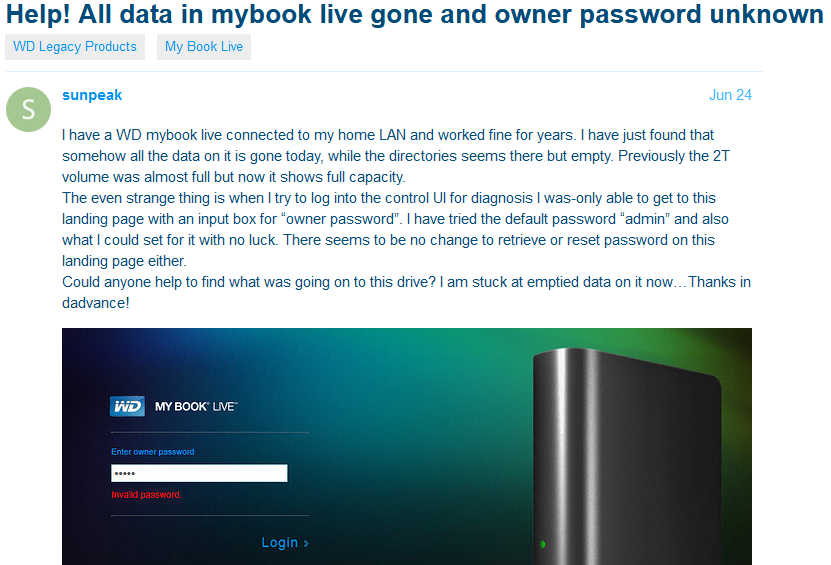
One of many similar complaints on Western Digital’s user forum.
Earlier this week, Bleeping Computer and Ars Technica pointed to a heated discussion thread on Western Digital’s user forum where many customers complained of finding their MyBook Live and MyBook Live Duo devices completely wiped of their data.
“Western Digital has determined that some My Book Live and My Book Live Duo devices are being compromised through exploitation of a remote command execution vulnerability,” the company said in a statement June 24. “In some cases, this compromise has led to a factory reset that appears to erase all data on the device. The My Book Live and My Book Live Duo devices received its final firmware update in 2015. We understand that our customers’ data is very important. We are actively investigating the issue and will provide an updated advisory when we have more information.”
Western Digital’s brief advisory includes a link to an entry in the National Vulnerability Database for CVE-2018-18472. The NVD writeup says Western Digital WD My Book Live and WD My Book Live Duo (all versions) have a root Remote Command Execution bug.
“It can be triggered by anyone who knows the IP address of the affected device, as exploited in the wild in June 2021 for factory reset commands,” NVD wrote.
Examine the CVE attached to this flaw and you’ll notice it was issued in 2018. The NVD’s advisory credits VPN reviewer Wizcase.com with reporting the bug to Western Digital three years ago, back in June 2018.
In some ways, it’s remarkable that it took this long for vulnerable MyBook devices to be attacked: The 2018 Wizcase writeup on the flaw includes proof-of-concept code that lets anyone run commands on the devices as the all-powerful “root” user.
Western Digital’s response at the time was that the affected devices were no longer supported and that customers should avoid connecting them to the Internet. That response also suggested this bug has been present in its devices for at least a decade.
“The vulnerability report CVE-2018-18472 affects My Book Live devices originally introduced to the market between 2010 and 2012,” reads a reply from Western Digital that Wizcase posted to its blog. “These products have been discontinued since 2014 and are no longer covered under our device software support lifecycle. We encourage users who wish to continue operating these legacy products to configure their firewall to prevent remote access to these devices, and to take measures to ensure that only trusted devices on the local network have access to the device.”
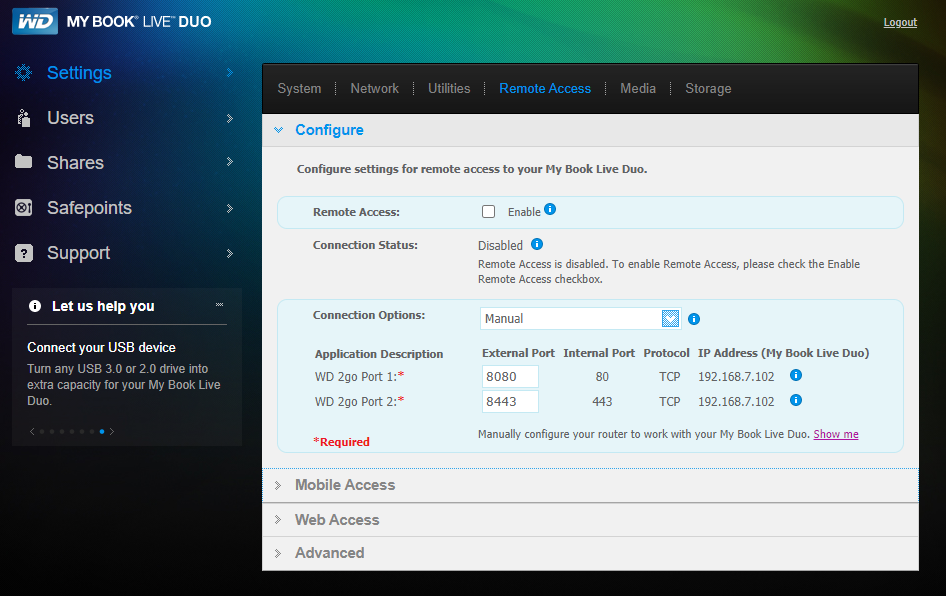
A local administration page for the MyBook Live Duo.
Wizcase said the flaw it found in MyBook devices also may be present in certain models of WD MyCloud network attached storage (NAS) devices, although Western Digital’s advisory makes no mention of its MyCloud line being affected.
The vulnerable MyBook devices are popular among home users and small businesses because they’re relatively feature-rich and inexpensive, and can be upgraded with additional storage quite easily. But these products also make it simple for users to access their files remotely over the Internet using a mobile app.
I’m guessing it is primarily users who’ve configured their MyBooks to be remotely accessible who are experiencing these unfortunate drive wipes. Regardless, it’s probably safest to observe Western Digital’s advice and disconnect any MyBooks you have from ethernet access.
If you’d still like to keep your MyBook connected to your local network (at least until you can find a suitable backup for your backups), please make double sure remote access is not enabled in your device settings (see screenshot above).
from Krebs on Security https://ift.tt/2SuQDha
via IFTTT
 Pacosite's Blog