Artificial intelligence is a maturing area in cybersecurity, but there are different concerns depending on whether you’re a defender or an attacker.
from Dark Reading: https://ift.tt/36wLkkM
via IFTTT

Artificial intelligence is a maturing area in cybersecurity, but there are different concerns depending on whether you’re a defender or an attacker.
from Dark Reading: https://ift.tt/36wLkkM
via IFTTT
Microsoft Active Directory, ubiquitous across enterprises, has long been a primary target for attackers seeking network access and sensitive data.
from Dark Reading: https://ift.tt/3k94fdt
via IFTTT
The Kaseya VST supply-chain attack impacts hundreds of companies – ESET discovers a new version of Bandook malware – How the ransomware business model works
The post Week in security with Tony Anscombe appeared first on WeLiveSecurity
from WeLiveSecurity https://ift.tt/3k2JNL2
via IFTTT
The Kaseya VST supply-chain attack impacts hundreds of companies – ESET discovers a new version of Bandook malware – How the ransomware business model works
The post Week in security with Tony Anscombe appeared first on WeLiveSecurity
from WeLiveSecurity https://ift.tt/3k2JNL2
via IFTTT
The Kaseya VST supply-chain attack impacts hundreds of companies – ESET discovers a new version of Bandook malware – How the ransomware business model works
The post Week in security with Tony Anscombe appeared first on WeLiveSecurity
from WeLiveSecurity https://ift.tt/3k2JNL2
via IFTTT
Determining which malware is most damaging, and worthy of immediate attention, has become difficult in environments filled with alerts and noise.
from Dark Reading: https://ift.tt/3AN3AnO
via IFTTT
Last summer, financial institutions throughout Texas started reporting a sudden increase in attacks involving well-orchestrated teams that would show up at night, use stolen trucks and heavy chains to rip Automated Teller Machines (ATMs) out of their foundations, and make off with the cash boxes inside. Now it appears the crime — known variously as “ATM smash-and-grab” or “chain gang” attacks — is rapidly increasing in other states.
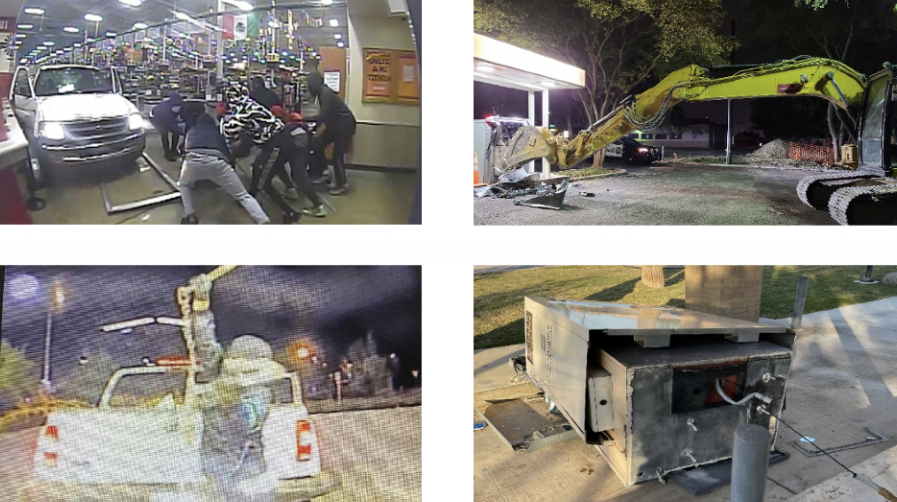
Four different ATM “chain gang” attacks in Texas recently. Image: Texas Bankers Association.
The Texas Bankers Association documented at least 139 chain gang attacks against Texas financial institutions in the year ending November 2020. The association says organized crime is the main source of the destructive activity, and that Houston-based FBI officials have made more than 50 arrests and are actively tracking about 250 individuals suspected of being part of these criminal rings.
From surveillance camera footage examined by fraud investigators, the perpetrators have followed the same playbook in each incident. The bad guys show up in the early morning hours with a truck or tractor that’s been stolen from a local construction site.
Then two or three masked men will pry the front covering from the ATM using crowbars, and attach heavy chains to the cash machine. The canisters of cash inside are exposed once the crooks pull the ATM’s safe door off using the stolen vehicle.
In nearly all cases, the perpetrators are done in less than five minutes.
Tracey Santor is the bond product manager for Travelers, which insures a large number of financial institutions against this type of crime. Santor said investigators questioning some of the suspects learned that the smash-and-grabs are used as a kind of initiation for would-be gang members.
“One of the things they found out during the arrest was the people wanting to be in the gang were told they had to bring them $250,000 within a week,” Santor said. “And they were given instructions on how to do it. I’ve also heard of cases where the perpetrators put construction cones around the ATM so it looks to anyone passing by that they’re legitimately doing construction at the site.”
Santor said the chain gang attacks have spread to other states, and that in the year ending June 2021 Travelers saw a 257 percent increase in the number of insurance claims related to ATM smash-and-grabs.
That 257 percent increase also includes claims involving incidents where attackers will crash a stolen car into a convenience store, and then in the ensuing commotion load the store’s ATM into the back of the vehicle and drive away.
In addition to any cash losses — which can often exceed $200,000 — replacing destroyed ATMs and any associated housing can take weeks, and newer model ATMs can cost $80,000 or more.
“It’s not stopping,” Santor said of the chain gang attacks. “In the last year we counted 32 separate states we’ve seen this type of attack in. Normally we are seeing single digits across the country. 2021 is going to be the same or worse for us than last year.”
Increased law enforcement scrutiny of the crime in Texas might explain why a number of neighboring states are seeing a recent uptick in the number of chain gang attacks, said Elaine Dodd, executive vice president of the fraud division for the Oklahoma Bankers Association.
“We have a lot of it going on here now and they’re getting good at it,” Dodd said. “The numbers are surging. I think since Texas has focused law enforcement attention on this it’s spreading like fingers out from there.”
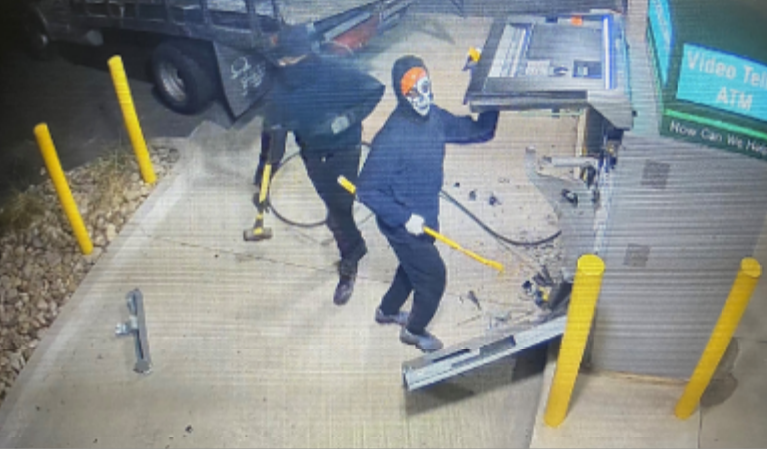
Chain gang members at work on a Texas bank ATM. Image: Texas Bankers Association.
It’s not hard to see why physical attacks against ATMs are on the rise. In 2019, the average amount stolen in a traditional bank robbery was just $1,797, according to the FBI.
In contrast, robbing ATMs is way less risky and potentially far more rewarding for the perpetrators. That’s because bank ATMs can typically hold hundreds of thousands of dollars in cash.
Dodd said she hopes to see more involvement from federal investigators in fighting chain gang attacks, and that it would help if more of these attacks were prosecuted as bank robberies, which can carry stiff federal penalties. As it is, she said, most incidents are treated as property crimes and left to local investigators.
“We had a rash of three attacks recently and contacted the FBI, and were told, ‘We don’t work these,’” Dodd said. “The FBI looks at these attacks not as bank robbery, but just the theft of cash.”
In January, Texas lawmakers are introduced legislation that would make destroying an ATM a third degree felony offense. Such a change would mean chain gang members could be prosecuted with the same zeal Texas applies to people who steal someone’s livestock, a crime which is punishable by 2-10 years in prison and a fine of up to $10,000 (or both).
“The bottom line is, right now bank robbery is a felony and robbing an unattended ATM is not,” Santor said.
KrebsOnSecurity checked in with the European ATM Security Team (EAST), which maintains statistics about fraud of all kinds targeting ATM operators in Europe. EAST Executive Director Lachlan Gunn said overall physical attacks on ATMs in Europe have been a lot quieter since the pandemic started.
“Attacks fell right away during the lockdowns and have started to pick up a little as the restrictions are eased,” Gunn said. “So no major spike here, although [the United States is] further ahead when it comes to the easing of restrictions.”
Gunn said the most common physical attacks on European ATMs continue to involve explosives — such as gas tanks and solid explosives that are typically stolen from mining and construction sites.
“The biggest physical attack issue in Europe remains solid explosive attacks, due to the extensive collateral damage and the risk to life,” Gunn said.
The Texas Bankers Association report, available here (PDF), includes a number of recommended steps financial institutions can take to reduce the likelihood of being targeted by chain gangs.
from Krebs on Security https://ift.tt/3k3ch7m
via IFTTT
The analysis shows potential attack paths and the most effective techniques for each tactic documented in CISA’s Risk and Vulnerability Assessments.
from Dark Reading: https://ift.tt/3hXUSun
via IFTTT
As attackers use more synthetic media in social engineering campaigns, a new framework is built to describe threats and provide countermeasures.
from Dark Reading: https://ift.tt/3AXi2d4
via IFTTT
Yes, the headline is a rhetorical question. But sometimes we get literal answers, and they’re well worth remembering.
from Naked Security https://ift.tt/3xxXd5H
via IFTTT
 Pacosite's Blog