The chip giant has developed new features and services to make it more difficult for malicious hackers and insiders to access sensitive data from applications in the cloud.
from Dark Reading https://ift.tt/d65CMxT
via IFTTT

The chip giant has developed new features and services to make it more difficult for malicious hackers and insiders to access sensitive data from applications in the cloud.
from Dark Reading https://ift.tt/d65CMxT
via IFTTT
.
from Dark Reading https://ift.tt/L6lt2gm
via IFTTT
KnowBe4’s Compliance Audit Readiness Assessment (CARA) now addresses select requirements from HIPAA Security Rule.
from Dark Reading https://ift.tt/nd3B1Hs
via IFTTT
Combination of two companies to help SAP customers streamline audit, compliance and control processes.
from Dark Reading https://ift.tt/bcgjled
via IFTTT
Survey of over 2,000 IT pros revealed that a quarter either don’t know or don’t think Microsoft 365 data can be affected by ransomware.
from Dark Reading https://ift.tt/3MG90WF
via IFTTT
Someone has recently created a large number of fake LinkedIn profiles for Chief Information Security Officer (CISO) roles at some of the world’s largest corporations. It’s not clear who’s behind this network of fake CISOs or what their intentions may be. But the fabricated LinkedIn identities are confusing search engine results for CISO roles at major companies, and they are being indexed as gospel by various downstream data-scraping sources.
If one searches LinkedIn for the CISO of the energy giant Chevron, one might find the profile for a Victor Sites, who says he’s from Westerville, Ohio and is a graduate of Texas A&M University.
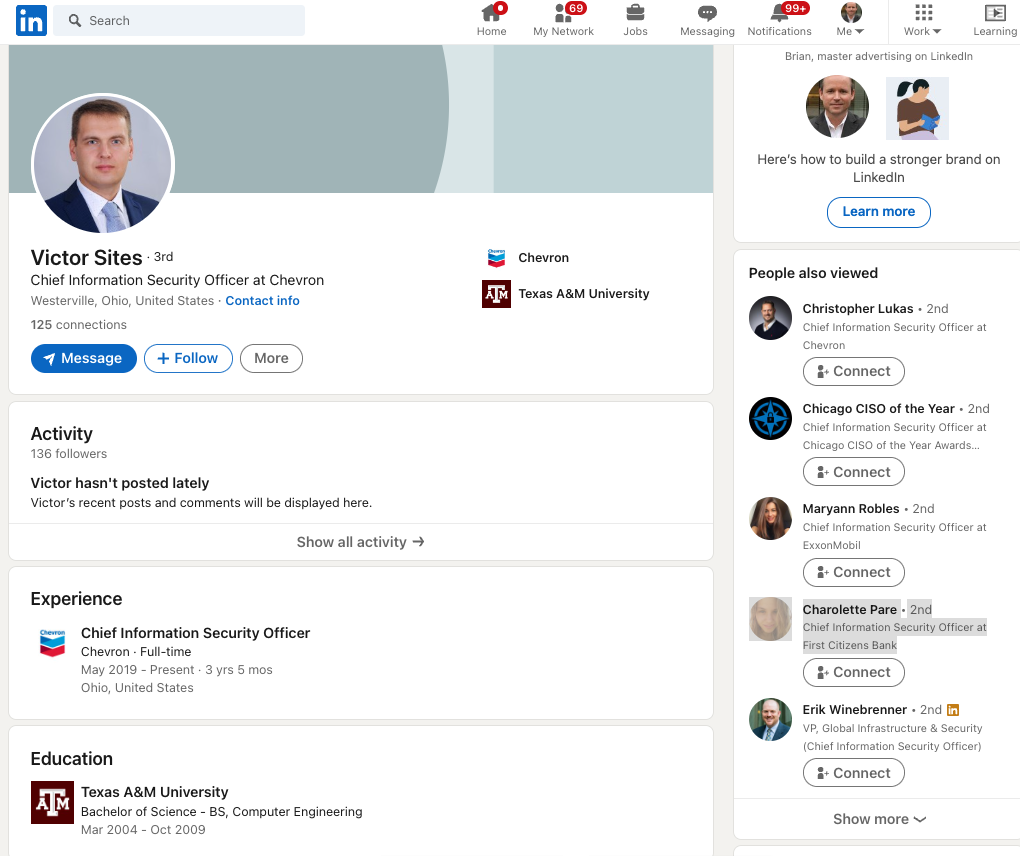
The LinkedIn profile for Victor Sites, who is most certainly NOT the CISO of Chevron.
Of course, Sites is not the real CISO of Chevron. That role is currently occupied by Christopher Lukas of Danville, Calif. If you were confused at this point, you might ask Google who it thinks is the current Chief Information Security Officer of Chevron. When KrebsOnSecurity did that earlier this morning, the fake CISO profile was the very first search result returned (followed by the LinkedIn profile for the real Chevron CISO).
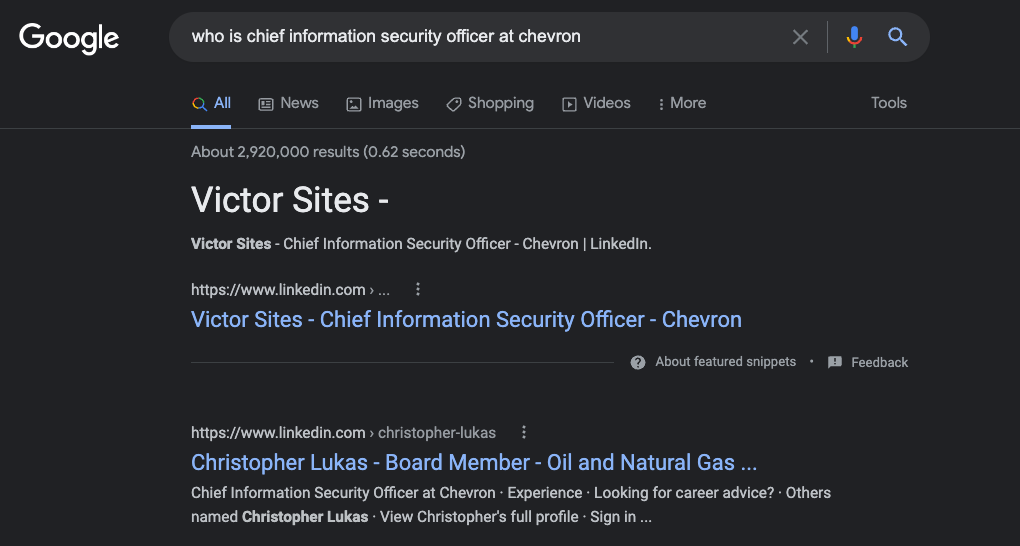
Helpfully, LinkedIn seems to be able to detect something in common about all these fake CISO profiles, because it suggested I view a number of them in the “People Also Viewed” column seen in the image above. There are two fake CISO profiles suggested there, including one for a Maryann Robles, who claims to be the CISO of another energy giant — ExxonMobil.
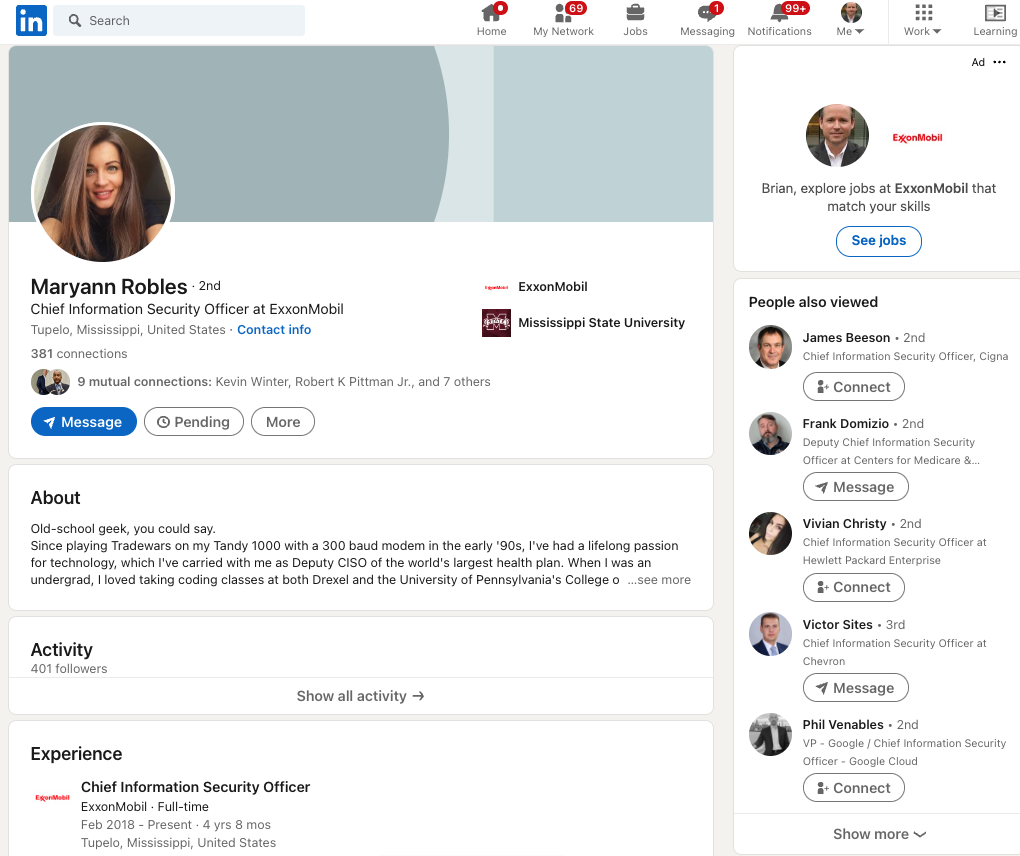
Maryann’s profile says she’s from Tupelo, Miss., and includes a quaint description of how she became a self-described “old-school geek.”
“Since playing Tradewars on my Tandy 1000 with a 300 baud modem in the early ’90s, I’ve had a lifelong passion for technology, which I’ve carried with me as Deputy CISO of the world’s largest health plan,” her profile reads.
However, this description appears to have been lifted from the profile for the real CISO at the Centers for Medicare & Medicaid Services in Baltimore, Md.
Interestingly, Maryann’s LinkedIn profile was accepted as truth by Cybercrime Magazine’s CISO 500 listing, which claims to maintain a list of the current CISOs at America’s largest companies:
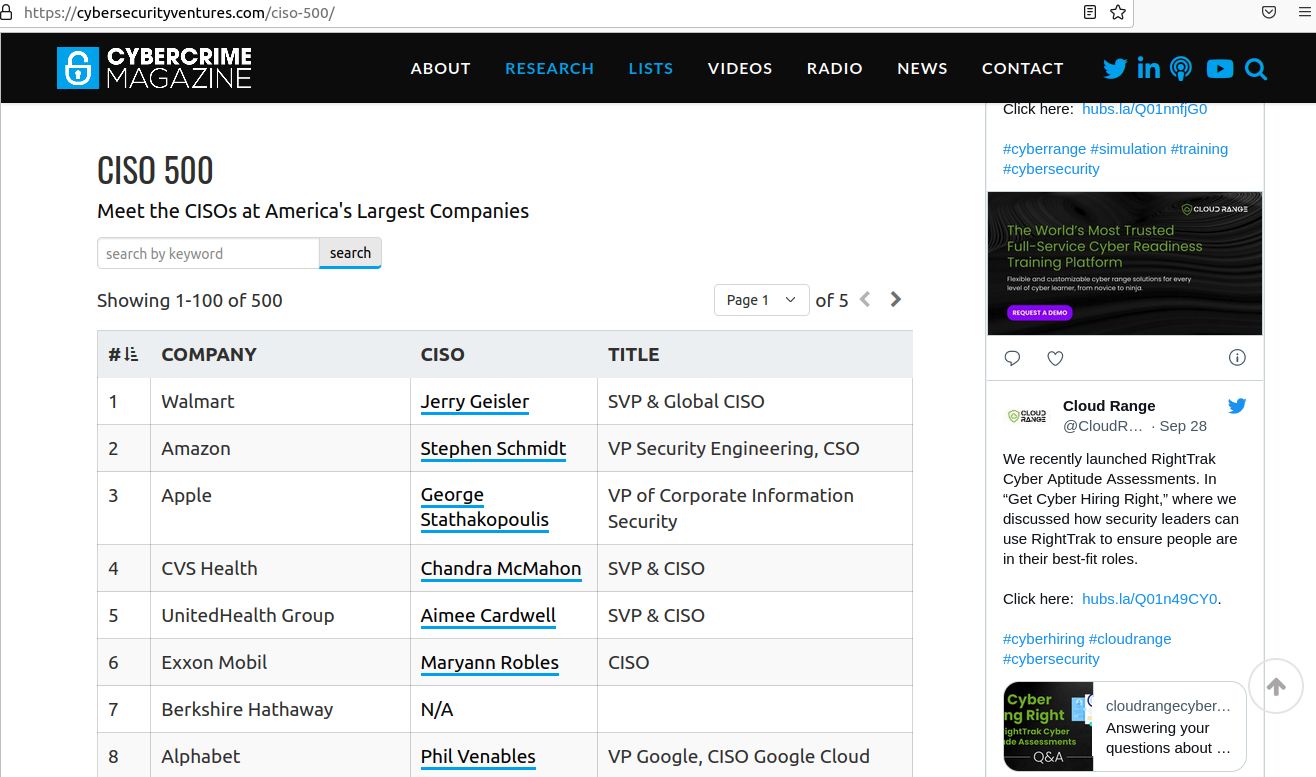
The fake CISO for ExxOnMobil was indexed in Cybercrime Magazine’s CISO 500.
Rich Mason, the former CISO at Fortune 500 firm Honeywell, began warning his colleagues on LinkedIn about the phony profiles earlier this week.
“It’s interesting the downstream sources that repeat LinkedIn bogus content as truth,” Mason said. “This is dangerous, Apollo.io, Signalhire, and Cybersecurity Ventures.”
Google wasn’t fooled by the phony LinkedIn profile for Jennie Biller, who claims to be CISO at biotechnology giant Biogen (the real Biogen CISO is Russell Koste). But Biller’s profile is worth mentioning because it shows how some of these phony profiles appear to be quite hastily assembled. Case in point: Biller’s name and profile photo suggest she is female, however the “About” description of her accomplishments uses male pronouns. Also, it might help that Jennie only has 18 connections on LinkedIn.
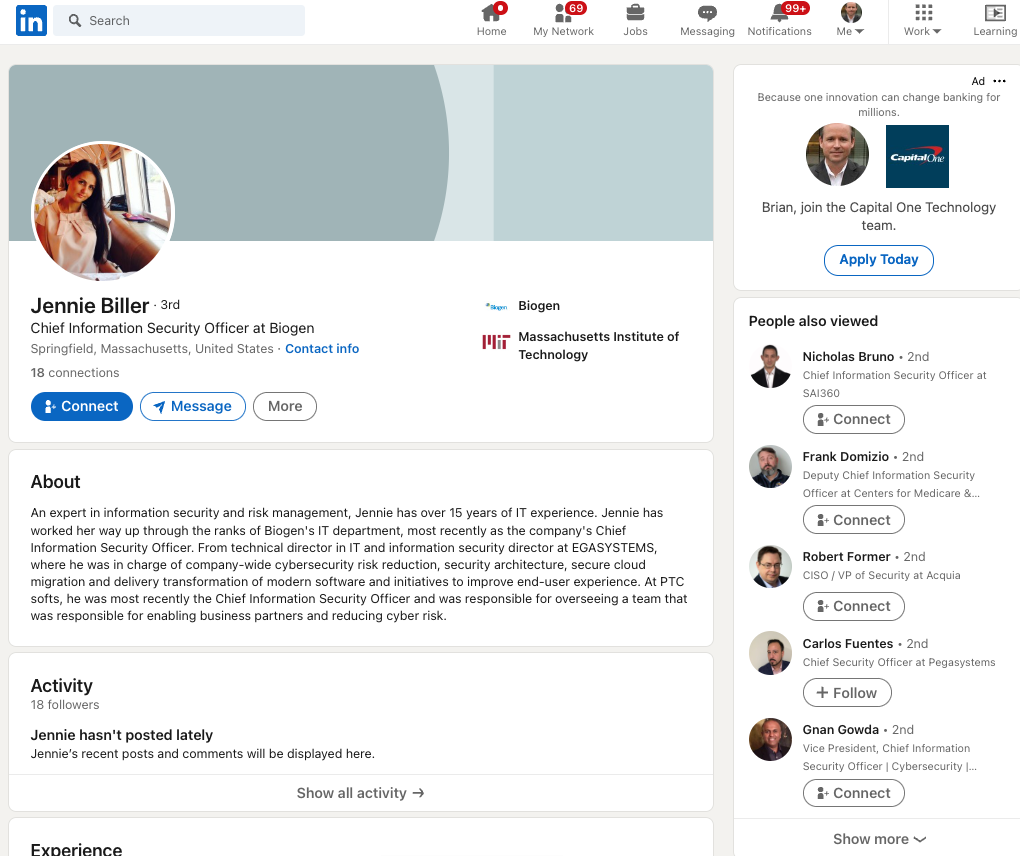
Again, we don’t know much about who or what is behind these profiles, but in August the security firm Mandiant (recently acquired by Google) told Bloomberg that hackers working for the North Korean government have been copying resumes and profiles from leading job listing platforms LinkedIn and Indeed, as part of an elaborate scheme to land jobs at cryptocurrency firms.
None of the profiles listed here responded to requests for comment (or to become a connection).
In a statement provided to KrebsOnSecurity, LinkedIn said its teams were actively working to take these fake accounts down.
“We do have strong human and automated systems in place, and we’re continually improving, as fake account activity becomes more sophisticated,” the statement reads. “In our transparency report we share how our teams plus automated systems are stopping the vast majority of fraudulent activity we detect in our community – around 96% of fake accounts and around 99.1% of spam and scam.”
LinkedIn could take one simple step that would make it far easier for people to make informed decisions about whether to trust a given profile: Add a “created on” date for every profile. Twitter does this, and it’s enormously helpful for filtering out a great deal of noise and unwanted communications.
The former CISO Mason said LinkedIn also could experiment with offering something akin to Twitter’s verified mark to users who chose to validate that they can respond to email at the domain associated with their stated current employer.
“If I saw that a LinkedIn profile had been domain-validated, then my confidence in that profile would go way up,” Mason said, noting that many of the fake profiles had hundreds of followers, including dozens of real CISOs. Maryann’s profile grew by a hundred connections in just the past few days, he said.
“If we have CISOs that are falling for this, what hopes do the masses have?” Mason said.
Mason said LinkedIn also needs a more streamlined process for allowing employers to remove phony employee accounts. He recently tried to get a phony profile removed from LinkedIn for someone who falsely claimed to have worked for his company.
“I shot a note to LinkedIn and said please remove this, and they said, well, we have to contact that person and arbitrate this,” he said. “They gave the guy two weeks and he didn’t respond, so they took it down. But that doesn’t scale, and there needs to be a mechanism where an employer can contact LinkedIn and have these fake profiles taken down in less than two weeks.”
from Krebs on Security https://ift.tt/ds8hzRt
via IFTTT
Literacy, levels of personal freedom, and other macro-social factors help determine how strong average passwords are in a given locale, researchers have found.
from Dark Reading https://ift.tt/vKNpGLc
via IFTTT
China-based threat actor used poisoned vSphere Installation Bundles to deliver multiple backdoors on systems, security vendor says.
from Dark Reading https://ift.tt/R3boFYi
via IFTTT
Identity verification could be the key to fighting back and building trust in an industry beset with high-stakes fraud.
from Dark Reading https://ift.tt/TQgyhzb
via IFTTT
2,700 cybersecurity career pursuers have already passed the (ISC)2 Certified in Cybersecurity℠ exam, with more than 53,000 more people registered for a free course and exam.
from Dark Reading https://ift.tt/GyRTY1K
via IFTTT
 Pacosite's Blog