
A nonprofit organization is suing the state of Massachusetts on behalf of thousands of low-income families who were collectively robbed of more than a $1 million in food assistance benefits by card skimming devices secretly installed at cash machines and grocery store checkout lanes across the state. Federal law bars states from replacing these benefits using federal funds, and a recent rash of skimming incidents nationwide has disproportionately affected those receiving food assistance via state-issued prepaid debit cards.
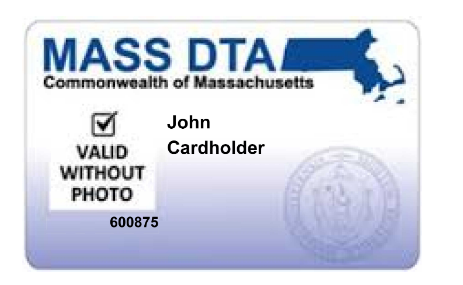
The Massachusetts SNAP benefits card looks more like a library card than a payment card.
On Nov. 4, The Massachusetts Law Reform Institute (MLRI) filed a class action lawsuit on behalf of low-income families whose Supplemental Nutrition and Assistance Program (SNAP) benefits were stolen from their accounts. The SNAP program serves over a million people in Massachusetts, and 41 million people nationally.
“Over the past few months, thieves have stolen over a million SNAP dollars from thousands of Massachusetts families – putting their nutrition and economic stability at risk,” the MLRI said in a statement on the lawsuit. “The criminals attach a skimming device on a POS (point of sale) terminal to capture the household’s account information and PIN. The criminals then use that information to make a fake card and steal the SNAP benefits.”
In announcing the lawsuit, the MRLI linked to a story KrebsOnSecurity published last month that examined how skimming thieves increasingly are targeting SNAP payment card holders nationwide. The story looked at how the vast majority of SNAP benefit cards issued by the states do not include the latest chip technology that makes it more difficult and expensive for thieves to clone them.
The story also highlighted how SNAP cardholders usually have little recourse to recover any stolen funds — even in unlikely cases where the victim has gathered mountains of proof to show state and federal officials that the fraudulent withdrawals were not theirs.
Deborah Harris is a staff attorney at the MLRI. Harris said the goal of the lawsuit is to force Massachusetts to reimburse SNAP skimming victims using state funds, and to convince The U.S. Department of Agriculture (USDA) — which funds the program that states draw from — to change its policies and allow states to replace stolen benefits with federal funds.
“Ultimately we think it’s the USDA that needs to step up and tell states they have a duty to restore the stolen benefits, and that USDA will cover the cost at least until there is better security in place, such as chip cards,” Harris told KrebsOnSecurity.
“The losses we’re talking about are relatively small in the scheme of total SNAP expenditures which are billions,” she said. “But if you are a family that can’t pay for food because you suddenly don’t have money in your account, it’s devastating for the family.”
The USDA has not said it will help states restore the stolen funds. But on Oct. 31, 2022, the agency released guidance (PDF) whose primary instructions were included in an appendix titled, Card Security Options Available to Households. Notably, the USDA did not mention the idea of shifting to chip-based SNAP benefits cards.
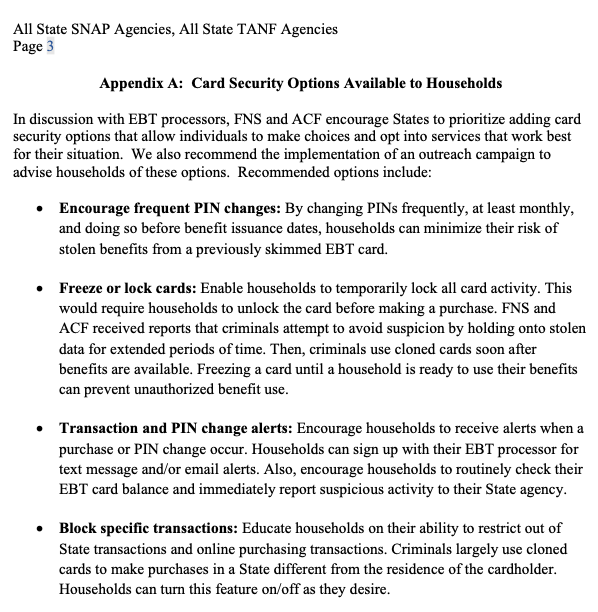
The recently issued USDA guidance.
“The guidance generally continues to make households responsible for preventing the theft of their benefits as well as for suffering the loss when benefits are stolen through no fault of the household,” Harris said. “Many of the recommendations are not practical for households who don’t have a smartphone to receive text messages and aren’t able to change their PIN after each transaction and keep track of the new PIN.”
Harris said three of the four recommendations are not currently available in Massachusetts, and they are very likely not currently available in other states. For example, she said, Massachusetts households do not have the option of freezing or locking their cards between transactions. Nor do they receive alerts about transactions. And they most certainly don’t have any way to block out-of-state transactions.
“Perhaps these are options that [card] processors and states could provide, but they are not available now as far as we know,” Harris said. “Most likely they would take time to implement.”
The Center for Law and Social Policy (CLASP) recently published Five Ways State Agencies Can Support EBT Users at Risk of Skimming. CLASP says while it is true states can’t use federal funds to replace benefits unless the loss was due to a “system error,” states could use their own funds.
“Doing so will ensure families don’t have to go without food, gas money, or their rent for the month,” CLASP wrote.
That would help address the symptoms of card skimming, but not a root cause. Hardly anyone is suggesting the obvious, which is to equip SNAP benefit cards with the same security technology afforded to practically everyone else participating in the U.S. banking system.
There are several reasons most state-issued SNAP benefit cards do not include chips. For starters, nobody says they have to. Also, it’s a fair bit more expensive to produce chip cards versus plain old magnetic stripe cards, and many state assistance programs are chronically under-funded. Finally, there is no vocal (or at least well-heeled) constituency advocating for change.
A copy of the class action complaint filed by the MLRI is available here.
from Krebs on Security https://ift.tt/ZV5N0wy
via IFTTT

 Pacosite's Blog