Don’t let a keen eye for bargains lead you into risky online behaviour…
from Naked Security https://ift.tt/6cIYutB
via IFTTT

Don’t let a keen eye for bargains lead you into risky online behaviour…
from Naked Security https://ift.tt/6cIYutB
via IFTTT
The convenience with which you manage all your financial wants and needs may come at a cost
The post Open banking: Tell me what you buy, and I’ll tell you who you are appeared first on WeLiveSecurity
from WeLiveSecurity https://ift.tt/0STBWXi
via IFTTT
What’s so bad about a web page going fullscreen without warning you first?
from Naked Security https://ift.tt/EZSx05n
via IFTTT
A financial cybercrime group calling itself the Disneyland Team has been making liberal use of visually confusing phishing domains that spoof popular bank brands using Punycode, an Internet standard that allows web browsers to render domain names with non-Latin alphabets like Cyrillic and Ukrainian.
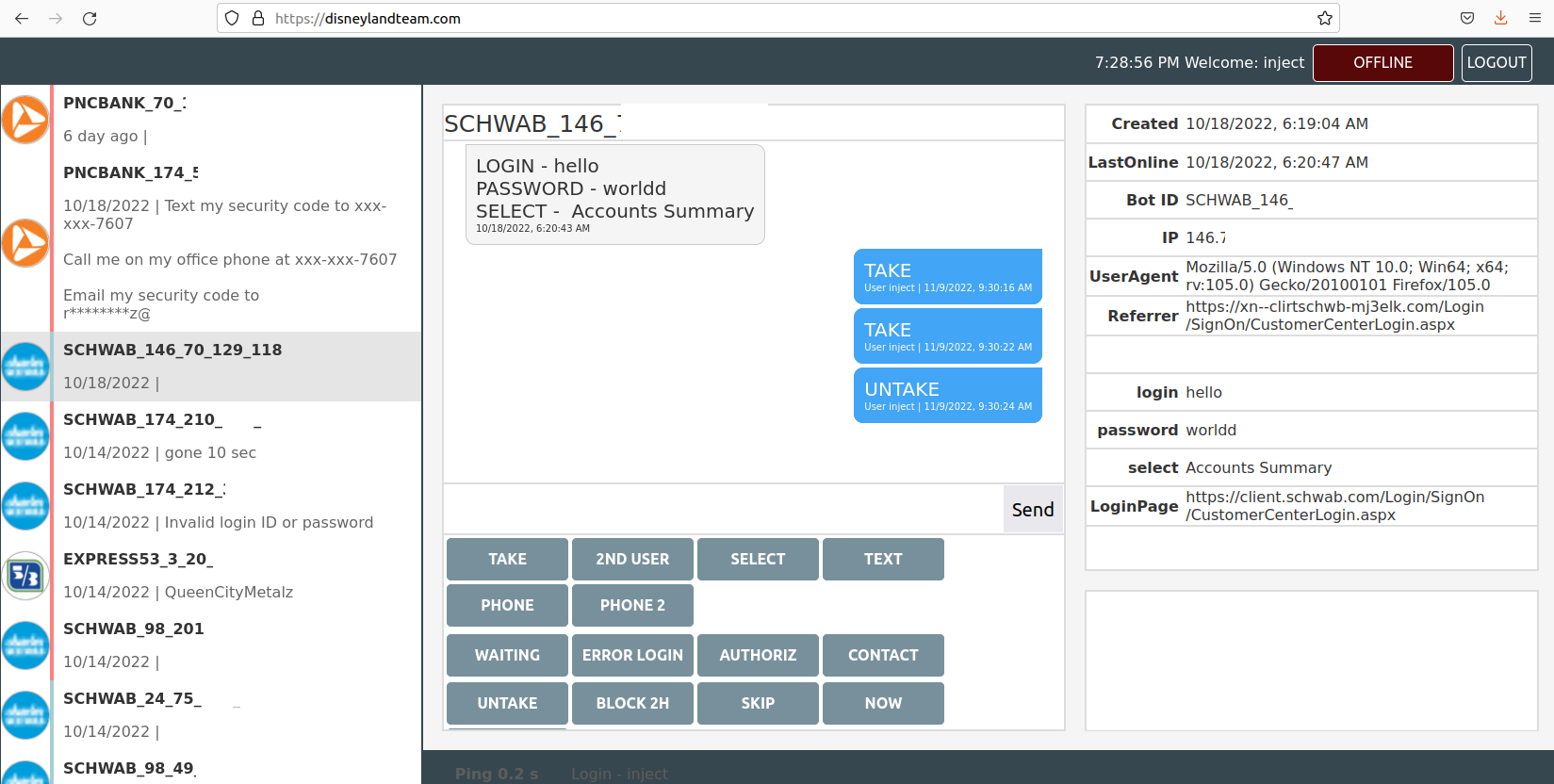
The Disneyland Team’s Web interface, which allows them to interact with malware victims in real time to phish their login credentials using phony bank websites.
The Disneyland Team uses common misspellings for top bank brands in its domains. For example, one domain the gang has used since March 2022 is ushank[.]com — which was created to phish U.S. Bank customers.
But this group also usually makes use of Punycode to make their phony bank domains look more legit. The U.S. financial services firm Ameriprise uses the domain ameriprise.com; the Disneyland Team’s domain for Ameriprise customers is https://www.xn--meripris-mx0doj%5B.%5Dcom [brackets added to defang the domain], which displays in the browser URL bar as ạmeriprisẹ.com.
Look carefully, and you’ll notice small dots beneath the “a” and the second “e”. You could be forgiven if you mistook one or both of those dots for a spec of dust on your computer screen or mobile device.
This candid view inside the Disneyland Team comes from Alex Holden, founder of the Milwaukee-based cybersecurity consulting firm Hold Security. Holden’s analysts gained access to a Web-based control panel the crime group has been using to keep track of victim credentials (see screenshot above). The panel reveals the gang has been operating dozens of Punycode-based phishing domains for the better part of 2022.
Have a look at the Punycode in this Disneyland Team phishing domain: https://login2.xn--mirtesnbd-276drj%5B.%5Dcom, which shows up in the browser URL bar as login2.ẹmirạtesnbd[.]com, a domain targeting users of Emirates NBD Bank in Dubai.
Here’s another domain registered this year by the Disneyland Team: https://xn--clientchwb-zxd5678f%5B.%5Dcom, which spoofs the login page of financial advisor Charles Schwab with the landing page of cliẹntșchwab[.]com. Again, notice the dots under the letters “e” and “s”. Another Punycode domain of theirs sends would-be victims to cliẹrtschwạb[.]com, which combines a brand misspelling with Punycode.
We see the same dynamic with the Disneyland Team Punycode domain https://singlepoint.xn--bamk-pxb5435b%5B.%5Dcom, which translates to singlepoint.ụșbamk[.]com — again phishing U.S. Bank customers.
What’s going on here? Holden says the Disneyland Team is Russian-speaking — if not also based in Russia — but it is not a phishing gang per se. Rather, this group uses the phony bank domains in conjunction with malicious software that is already secretly installed on a victim’s computer.
Holden said the Disneyland Team domains were made to help the group steal money from victims infected with a powerful strain of Microsoft Windows-based banking malware known as Gozi 2.0/Ursnif. Gozi specializes in collecting credentials, and is mainly used for attacks on client-side online banking to facilitate fraudulent bank transfers. Gozi also allows the attackers to connect to a bank’s website using the victim’s computer.
In years past, crooks like these would use custom-made “web injects” to manipulate what Gozi victims see in their Web browser when they visit their bank’s site. These web injects allowed malware to rewrite the bank’s HTML code on the fly, and copy and/or intercept any data users would enter into a web-based form, such as a username and password.
Most Web browser makers, however, have spent years adding security protections to block such nefarious activity. As a result, the Disneyland Team simply tries to make their domains look as much like the real thing as possible, and then funnel victims toward interacting with those imposter sites.
“The reason that it is infeasible for them to use in-browser injects include browser and OS protection measures, and difficulties manipulating dynamic pages for banks that require multi-factor authentication,” Holden said.
In reality, the fake bank website overlaid by the Disneyland Team’s malware relays the victim’s browser activity through to the real bank website, while allowing the attackers to forward any secondary login requests from the bank, such as secret questions or multi-factor authentication challenges.
The Disneyland Team included instructions for its users, noting that when the victim enters their login credentials, he sees a 10-second spinning wheel, and then the message, “Awaiting back office approval for your request. Please don’t close this window.”
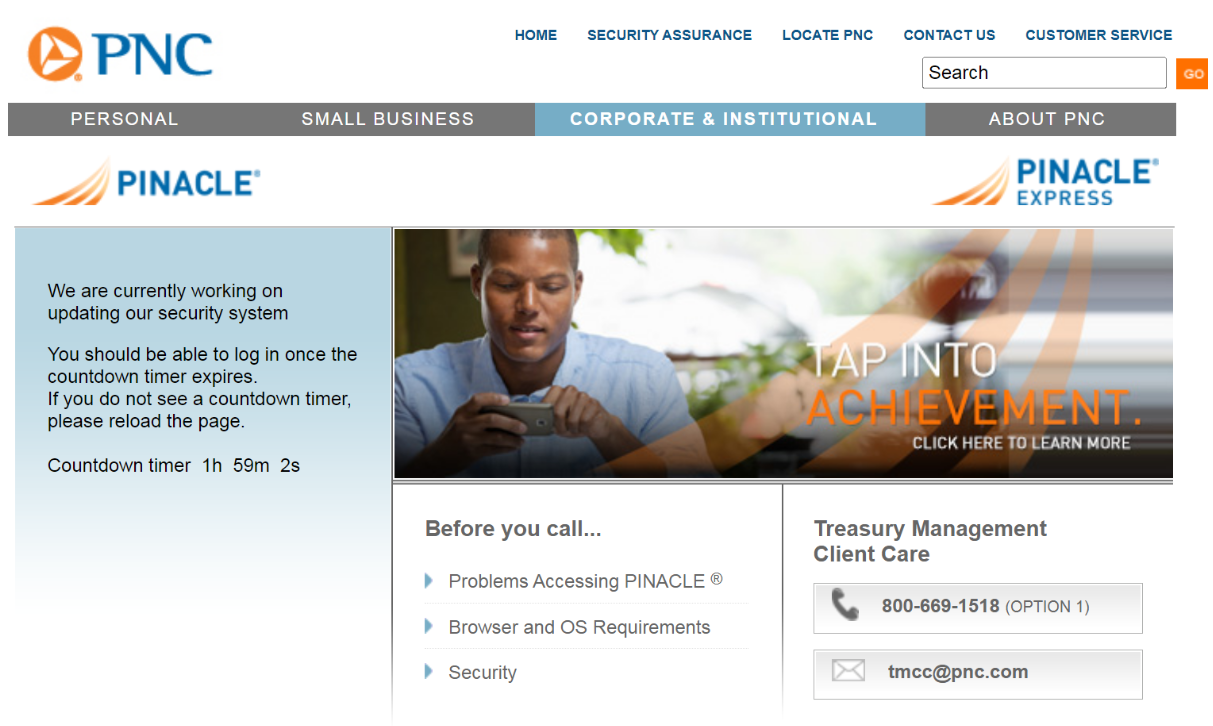
A fake PNC website overlay or “web inject” displaying a message intended to temporarily prevent the user from accessing their account.
The “SKIP” button in the screenshot above sends the user to the real bank login page, “in case the account is not interesting to us,” the manual explains. “Also, this redirect works if none of our operators are working at the time.”
The “TAKE” button in the Disneyland Team control panel allows users or affiliates to claim ownership over a specific infected machine or bot, which then excludes other users from interacting with that victim.
In the event that it somehow takes a long time to get the victim (bot) connected to the Disneyland Team control panel, or if it is necessary to delay a transaction, users can push a button that prompts the following message to appear on the victim’s screen:
“Your case ID number is 875472. An online banking support representative will get in touch shortly. Please provide your case ID number, and DO NOT close this page.”
The Disneyland user manual explains that the panel can be used to force the victim to log in again if they transmit invalid credentials. It also has other options for stalling victims whilst their accounts are drained. Another fake prompt the panel can produce shows the victim a message saying, “We are currently working on updating our security system. You should be able to log in once the countdown timer expires.”
The user manual says this option blocks the user from accessing their account for two hours. “It is possible to block for an hour with this button, in this case they get less frustrated, within the hours ddos will kill their network.”
Cybercrime groups will sometimes launch distributed denial-of-service (DDoS) attacks on the servers of the companies they’re trying to rob — which is usually intended to distract victims from their fleecing, although Holden said it’s unclear if the Disneyland Team employs this tactic as well.
For many years, KrebsOnSecurity tracked the day-to-day activities of a similar malware crew that used web injects and bots to steal tens of millions of dollars from small- to mid-sized businesses across the United States.
At the end of each story, I would close with a recommendation that anyone concerned about malware snarfing their banking information should strongly consider doing their online banking from a dedicated, security-hardened system which is only used for that purpose. Of course, the dedicated system approach works only if you always use that dedicated system for managing your account online.
Those stories also observed that since the vast majority of the malicious software used in cyberheists is designed to run only on Microsoft Windows computers, it made sense to pick a non-Windows computer for that dedicated banking system, such as a Mac or even a version of Linux. I still stand by this advice.
In case anyone is interested, here (PDF) is a list of all phishing domains currently and previously used by the Disneyland Team.
from Krebs on Security https://ift.tt/vq9OSNU
via IFTTT
Researchers at cloud coding security company Oxeye have written up a critical bug that they recently discovered in the popular cloud development toolkit Backstage. Their report includes an explanation of how the bug works, plus proof-of-concept (PoC) code showing how to exploit it. Backstage is what’s known as a cloud developer portal – a sort […]
from Naked Security https://ift.tt/sadK0zj
via IFTTT
Vyacheslav “Tank” Penchukov, the accused 40-year-old Ukrainian leader of a prolific cybercriminal group that stole tens of millions of dollars from small to mid-sized businesses in the United States and Europe, has been arrested in Switzerland, according to multiple sources.
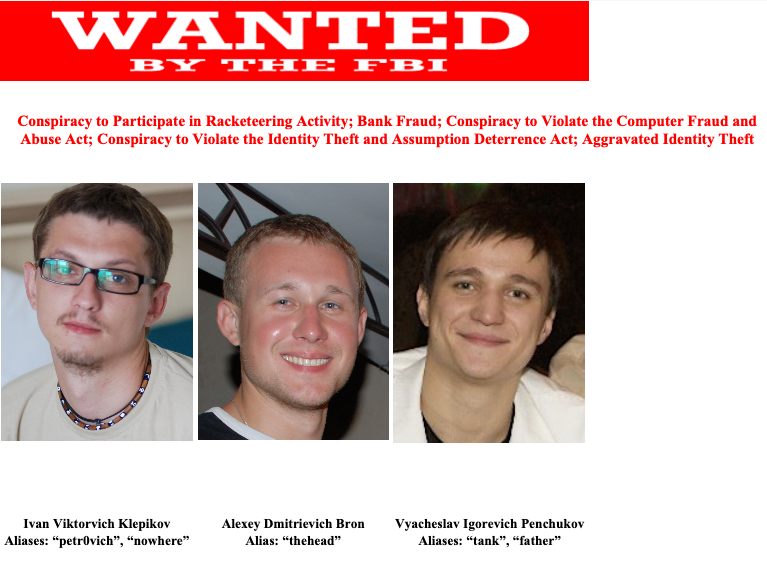
Wanted Ukrainian cybercrime suspect Vyacheslav “Tank” Penchukov (right) was arrested in Geneva, Switzerland. Tank was the day-to-day manager of a cybercriminal group that stole tens of millions of dollars from small to mid-sized businesses.
Penchukov was named in a 2014 indictment by the U.S. Department of Justice as a top figure in the JabberZeus Crew, a small but potent cybercriminal collective from Ukraine and Russia that attacked victim companies with a powerful, custom-made version of the Zeus banking trojan.
The U.S. Federal Bureau of Investigation (FBI) declined to comment for this story. But according to multiple sources, Penchukov was arrested in Geneva, Switzerland roughly three weeks ago as he was traveling to meet up with his wife there.
Penchukov is from Donetsk, a traditionally Russia-leaning region in Eastern Ukraine that was recently annexed by Russia. In his hometown, Penchukov was a well-known deejay (“DJ Slava Rich“) who enjoyed being seen riding around in his high-end BMWs and Porsches. More recently, Penchukov has been investing quite a bit in local businesses.
The JabberZeus crew’s name is derived from the malware they used, which was configured to send them a Jabber instant message each time a new victim entered a one-time password code into a phishing page mimicking their bank. The JabberZeus gang targeted mostly small to mid-sized businesses, and they were an early pioneer of so-called “man-in-the-browser” attacks, malware that can silently siphon any data that victims submit via a web-based form.
Once inside a victim company’s bank accounts, the crooks would modify the firm’s payroll to add dozens of “money mules,” people recruited through work-at-home schemes to handle bank transfers. The mules in turn would forward any stolen payroll deposits — minus their commissions — via wire transfer overseas.

Tank, a.k.a. “DJ Slava Rich,” seen here performing as a DJ in Ukraine in an undated photo from social media.
The JabberZeus malware was custom-made for the crime group by the alleged author of the Zeus trojan — Evgeniy Mikhailovich Bogachev, a top Russian cybercriminal with a $3 million bounty on his head from the FBI. Bogachev is accused of running the Gameover Zeus botnet, a massive crime machine of 500,000 to 1 million infected PCs that was used for large DDoS attacks and for spreading Cryptolocker — a peer-to-peer ransomware threat that was years ahead of its time.
Investigators knew Bogachev and JabberZeus were linked because for many years they were reading the private Jabber chats between and among members of the JabberZeus crew, and Bogachev’s monitored aliases were in semi-regular contact with the group about updates to the malware.
Gary Warner, director of research in computer forensics at the University of Alabama at Birmingham, noted in his blog from 2014 that Tank told co-conspirators in a JabberZeus chat on July 22, 2009 that his daughter, Miloslava, had been born and gave her birth weight.
“A search of Ukrainian birth records only showed one girl named Miloslava with that birth weight born on that day,” Warner wrote. This was enough to positively identify Tank as Penchukov, Warner said.
Ultimately, Penchukov’s political connections helped him evade prosecution by Ukrainian cybercrime investigators for many years. The late son of former Ukrainian President Victor Yanukovych (Victor Yanukovych Jr.) would serve as godfather to Tank’s daughter Miloslava. Through his connections to the Yanukovych family, Tank was able to establish contact with key insiders in top tiers of the Ukrainian government, including law enforcement.
Sources briefed on the investigation into Penchukov said that in 2010 — at a time when the Security Service of Ukraine (SBU) was preparing to serve search warrants on Tank and his crew — Tank received a tip that the SBU was coming to raid his home. That warning gave Tank ample time to destroy important evidence against the group, and to avoid being home when the raids happened. Those sources also said Tank used his contacts to have the investigation into his crew moved to a different unit that was headed by his corrupt SBU contact.
Writing for Technology Review, Patrick Howell O’Neil recounted how SBU agents in 2010 were trailing Tank around the city, watching closely as he moved between nightclubs and his apartment.
“In early October, the Ukrainian surveillance team said they’d lost him,” he wrote. “The Americans were unhappy, and a little surprised. But they were also resigned to what they saw as the realities of working in Ukraine. The country had a notorious corruption problem. The running joke was that it was easy to find the SBU’s anticorruption unit—just look for the parking lot full of BMWs.”
I first encountered Tank and the JabberZeus crew roughly 14 years ago as a reporter for The Washington Post, after a trusted source confided that he’d secretly gained access to the group’s private Jabber conversations.
From reading those discussions each day, it became clear Tank was nominally in charge of the Ukrainian crew, and that he spent much of his time overseeing the activities of the money mule recruiters — which were an integral part of their victim cashout scheme.
It was soon discovered that the phony corporate websites the money mule recruiters used to manage new hires had a security weakness that allowed anyone who signed up at the portal to view messages for every other user. A scraping tool was built to harvest these money mule recruitment messages, and at the height of the JabberZeus gang’s activity in 2010 that scraper was monitoring messages on close to a dozen different money mule recruitment sites, each managing hundreds of “employees.”
Each mule was given busy work or menial tasks for a few days or weeks prior to being asked to handle money transfers. I believe this was an effort to weed out unreliable money mules. After all, those who showed up late for work tended to cost the crooks a lot of money, as the victim’s bank would usually try to reverse any transfers that hadn’t already been withdrawn by the mules.
When it came time to transfer stolen funds, the recruiters would send a message through the fake company website saying something like: “Good morning [mule name here]. Our client — XYZ Corp. — is sending you some money today. Please visit your bank now and withdraw this payment in cash, and then wire the funds in equal payments — minus your commission — to these three individuals in Eastern Europe.”
Only, in every case the company mentioned as the “client” was in fact a small business whose payroll accounts they’d already hacked into.
So, each day for several years my morning routine went as follows: Make a pot of coffee; shuffle over to the computer and view the messages Tank and his co-conspirators had sent to their money mules over the previous 12-24 hours; look up the victim company names in Google; pick up the phone to warn each that they were in the process of being robbed by the Russian Cyber Mob.
My spiel on all of these calls was more or less the same: “You probably have no idea who I am, but here’s all my contact info and what I do. Your payroll accounts have been hacked, and you’re about to lose a great deal of money. You should contact your bank immediately and have them put a hold on any pending transfers before it’s too late. Feel free to call me back afterwards if you want more information about how I know all this, but for now please just call or visit your bank.”
In many instances, my call would come in just minutes or hours before an unauthorized payroll batch was processed by the victim company’s bank, and some of those notifications prevented what otherwise would have been enormous losses — often several times the amount of the organization’s normal weekly payroll. At some point I stopped counting how many tens of thousands of dollars those calls saved victims, but over several years it was probably in the millions.
Just as often, the victim company would suspect that I was somehow involved in the robbery, and soon after alerting them I would receive a call from an FBI agent or from a police officer in the victim’s hometown. Those were always interesting conversations.
Collectively, these notifications to victims led to dozens of stories over several years about small businesses battling their financial institutions to recover their losses. I never wrote about a single victim that wasn’t okay with my calling attention to their plight and to the sophistication of the threat facing other companies.
This incessant meddling on my part very much aggravated Tank, who on more than one occasion expressed mystification about how I knew so much about their operations and victims. Here’s a snippet from one of their Jabber chats in 2009, after I’d written a story for The Washington Post about their efforts to steal $415,000 from the coffers of Bullitt County, Kentucky. In the chat below, “lucky12345” is the Zeus author Bogachev:
tank: Are you there?
tank: This is what they damn wrote about me.
tank: https://ift.tt/bwShze9
tank: I’ll take a quick look at history
tank: Originator: BULLITT COUNTY FISCAL Company: Bullitt County Fiscal Court
tank: Well, you got [it] from that cash-in.
lucky12345: From 200K?
tank: Well, they are not the right amounts and the cash out from that account was shitty.
tank: Levak was written there.
tank: Because now the entire USA knows about Zeus.
tank:
lucky12345: It’s fucked.
On Dec. 13, 2009, one of Tank’s top money mule recruiters — a crook who used the pseudonym “Jim Rogers” — told his boss something I hadn’t shared beyond a few trusted confidants at that point: That The Washington Post had eliminated my job in the process of merging the newspaper’s Web site (where I worked at the time) with the dead tree edition.
jim_rogers: There is a rumor that our favorite (Brian) didn’t get his contract extension at Washington Post. We are giddily awaiting confirmation
Good news expected exactly by the New Year! Besides us no one reads his column
tank: Mr. Fucking Brian Fucking Kerbs!
Another member of the JabberZeus crew — Ukrainian-born Maksim “Aqua” Yakubets — also is currently wanted by the FBI, which is offering a $5 million reward for information leading to his arrest and conviction.
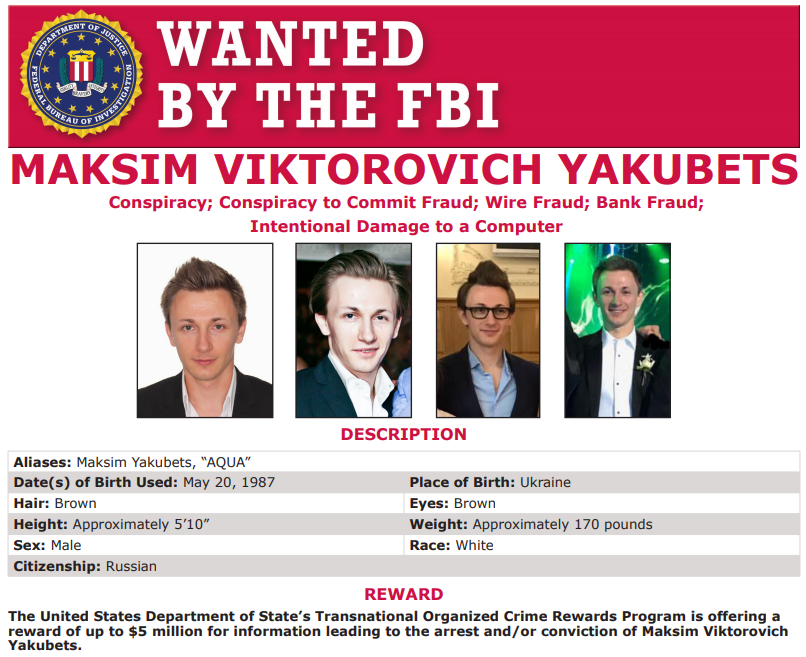
Alleged “Evil Corp” bigwig Maksim “Aqua” Yakubets. Image: FBI
from Krebs on Security https://ift.tt/qnvkBHu
via IFTTT
He was sentenced under his real-life name of Ramon, but in back in his boastful days of pretending to be a seriously successful real estate agent based in Dubai, you may have seen and heard of him as Ray, or, to give him his full nickname, Ray Hushpuppi. To be clear, Ramon Olorunwa Abbas wasn’t […]
from Naked Security https://ift.tt/Zt5cBGW
via IFTTT
An overview of the activities of selected APT groups investigated and analyzed by ESET Research in T2 2022
The post ESET APT Activity Report T2 2022 appeared first on WeLiveSecurity
from WeLiveSecurity https://ift.tt/Qcshjua
via IFTTT
New ESET report shows how ever-growing threats impact SMB sentiment and why many SMBs are underprepared to defend against attacks
The post Security challenges facing SMBs – Week in security with Tony Anscombe appeared first on WeLiveSecurity
from WeLiveSecurity https://ift.tt/JF3ncYQ
via IFTTT
When in doubt, kick it out, plus other tips for hardening your cyber-defenses against World Cup-themed phishing and other scams
The post FIFA World Cup 2022 scams: Beware of fake lotteries, ticket fraud and other cons appeared first on WeLiveSecurity
from WeLiveSecurity https://ift.tt/6k2uibG
via IFTTT

 Pacosite's Blog