The crooks now know who you are, where you live, which computers are yours… and they got those password vaults, too.
from Naked Security https://ift.tt/Z1jBlIt
via IFTTT

The crooks now know who you are, where you live, which computers are yours… and they got those password vaults, too.
from Naked Security https://ift.tt/Z1jBlIt
via IFTTT
Join world-renowned expert Fraser Howard, Director of Research at SophosLabs, for this fascinating episode on how to fight cybercrime.
from Naked Security https://ift.tt/WjgtyS7
via IFTTT
It’s all fun and games over the holidays, but is your young gamer safe from the darker side of the action?
The post ‘Tis the season for gaming: Keeping children safe (and parents sane) appeared first on WeLiveSecurity
from WeLiveSecurity https://ift.tt/0KRmxWH
via IFTTT
It’s all fun and games over the holidays, but is your young gamer safe from the darker side of the action?
The post ‘Tis the season for gaming: Keeping children safe (and parents sane) appeared first on WeLiveSecurity
from WeLiveSecurity https://ift.tt/0KRmxWH
via IFTTT
It’s all fun and games over the holidays, but is your young gamer safe from the darker side of the action?
The post ‘Tis the season for gaming: Keeping children safe (and parents sane) appeared first on WeLiveSecurity
from WeLiveSecurity https://ift.tt/0KRmxWH
via IFTTT
A picture is worth 1024 words – we clicked through so you don’t have to.
from Naked Security https://ift.tt/ucQvFHB
via IFTTT
Millions of people likely just received an email or snail mail notice saying they’re eligible to claim a class action payment in connection with the 2017 megabreach at consumer credit bureau Equifax. Given the high volume of reader inquiries about this, it seemed worth pointing out that while this particular offer is legit (if paltry), scammers are likely to soon capitalize on public attention to the settlement money.
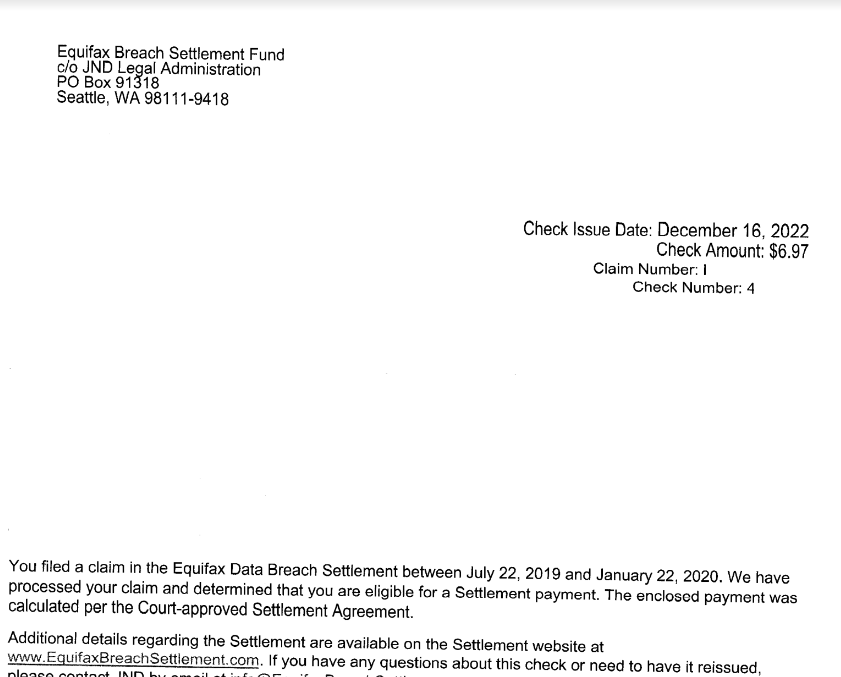
One reader’s copy of their Equifax Breach Settlement letter.
In 2017, Equifax disclosed a massive, extended data breach that led to the theft of Social Security Numbers, dates of birth, addresses and other personal information on nearly 150 million people. Following a public breach response perhaps best described as a giant dumpster fire, the big-three consumer credit reporting bureau was quickly hit with nearly two dozen class-action lawsuits.
In exchange for resolving all outstanding class action claims against it, Equifax in 2019 agreed to a settlement that includes up to $425 million to help people affected by the breach.
Affected consumers were eligible to apply for at least three years of credit monitoring via all three major bureaus simultaneously, including Equifax, Experian and Trans Union. Or, if you didn’t want to take advantage of the credit monitoring offers, you could opt for a cash payment of up to $125.
The settlement also offered reimbursement for the time you may have spent remedying identity theft or misuse of your personal information caused by the breach, or purchasing credit monitoring or credit reports. This was capped at 20 total hours at $25 per hour ($500), with total cash reimbursement payments not to exceed $20,000 per consumer.
Those who did file a claim probably started receiving emails or other communications earlier this year from the Equifax Breach Settlement Fund, which has been messaging class participants about methods of collecting their payments.
How much each recipient receives appears to vary quite a bit, but probably most people will have earned a payment on the smaller end of that $125 scale — like less than $10. Those who received higher amounts likely spent more time documenting actual losses and/or explaining how the breach affected them personally.
So far this week, KrebsOnSecurity has received at least 20 messages from readers seeking more information about these notices. Some readers shared copies of letters they got in the mail along with a paper check from the Equifax Breach Settlement Fund (see screenshot above).
Others said they got emails from the Equifax Breach Settlement domain that looked like an animated greeting card offering instructions on how to redeem a virtual prepaid card.
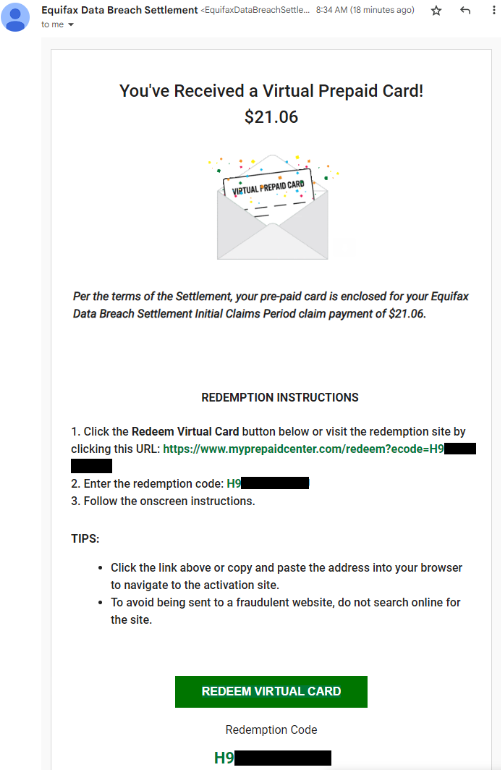
If you received one of these settlement emails and are wary about clicking the included links (good for you, by the way), copy the redemption code and paste it into the search box at myprepaidcenter.com/redeem. Successfully completing the card application requires accepting a prepaid MasterCard agreement (PDF).
The website for the settlement — equifaxbreachsettlement.com — also includes a lookup tool that lets visitors check whether they were affected by the breach; it requires your last name and the last six digits of your Social Security Number.
In February 2020, the U.S. Justice Department indicted four Chinese officers of the People’s Liberation Army (PLA) for perpetrating the 2017 Equifax hack. DOJ officials said the four men were responsible for carrying out the largest theft of sensitive personal information by state-sponsored hackers ever recorded.
Equifax surpassed Wall Street’s expectations in its most recently quarterly earnings: The company reported revenues of $1.24 billion for the quarter ending September 2022.
Of course, most of those earnings come from Equifax’s continued legal ability to buy and sell eye-popping amounts of financial and personal data on U.S. consumers. As one of the three major credit bureaus, Equifax collects and packages information about your credit, salary, and employment history. It tracks how many credit cards you have, how much money you owe, and how you pay your bills. Each company creates a credit report about you, and then sells this report to businesses who are deciding whether to give you credit.
Americans currently have no legal right to opt out of this data collection and trade. But you can and also should and freeze your credit, which by the way can make your credit profile less profitable for companies like Equifax — because they make money every time some potential creditor wants a peek inside your financial life. Also, it’s probably a good idea to freeze the credit of your children and/or dependents as well. It’s free on both counts.
from Krebs on Security https://ift.tt/Xsj1lLS
via IFTTT
It happens to the best of us: Microsoft highlights a security bypass bug on Macs that is curiously similar to a recent Windows 0-day.
from Naked Security https://ift.tt/Q4fMlbW
via IFTTT

Photo: BrandonKleinPhoto / Shutterstock.com
Two U.S. men have been charged with hacking into the Ring home security cameras of a dozen random people and then “swatting” them — falsely reporting a violent incident at the target’s address to trick local police into responding with force. Prosecutors say the duo used the compromised Ring devices to stream live video footage on social media of police raiding their targets’ homes, and to taunt authorities when they arrived.
Prosecutors in Los Angeles allege 20-year-old James Thomas Andrew McCarty, a.k.a. “Aspertaine,” of Charlotte, N.C., and Kya Christian Nelson, a.k.a. “ChumLul,” 22, of Racine, Wisc., conspired to hack into Yahoo email accounts belonging to victims in the United States. From there, the two allegedly would check how many of those Yahoo accounts were associated with Ring accounts, and then target people who used the same password for both accounts.
An indictment unsealed this week says that in the span of just one week in November 2020, McCarty and Nelson identified and swatted at least a dozen different victims across the country.
“The defendants then allegedly accessed without authorization the victims’ Ring devices and transmitted the audio and video from those devices on social media during the police response,” reads a statement from Martin Estrada, the U.S. Attorney for the Central District of California. “They also allegedly verbally taunted responding police officers and victims through the Ring devices during several of the incidents.”

James Thomas Andrew McCarty.
The indictment charges that McCarty continued his swatting spree in 2021 from his hometown in Kayenta, Ariz., where he called in bomb threats or phony hostage situations on more than two dozen occasions.
The Telegram and Discord aliases allegedly used by McCarty — “Aspertaine” and “Couch,” among others — correspond to an identity that was active in certain channels dedicated to SIM-swapping, a crime that involves stealing wireless phone numbers and hijacking the online financial and social media accounts tied to those numbers.
Aspertaine bragged on Discord that he’d amassed more than $330,000 in virtual currency. On Telegram, the Aspertaine/Couch alias frequented several popular SIM-swapping channels, where they initially were active as a “holder” — a low-level but key SIM-swapping group member who agrees to hold stolen cryptocurrency after an account takeover is completed. Aspertaine later claimed more direct involvement in individual SIM-swapping attacks.
In September, KrebsOnSecurity broke the news about a wide-ranging federal investigation into “violence-as-a-service” offerings on Telegram and other social media networks, wherein people can settle scores by hiring total strangers to carry out physical attacks such as brickings, shootings, and firebombings at a target’s address.
The story observed that SIM swappers were especially enamored of these “IRL” or “In Real Life” violence services, which they frequently used to target one another in response to disagreements over how stolen money should be divided amongst themselves. And a number of Aspertaine’s peers on these SIM-swapping channels claimed they’d been ripped off after Aspertaine took more than a fair share from co-conspirators.
On April 30, 2022, a member of a popular SIM-swapping group on Telegram who was slighted by Aspertaine put out the word that he was looking for some physical violence to be visited on McCarty’s address in North Carolina. “Anyone live near here and wants to [do] a job for me,” the job ad with McCarty’s home address read. “Jobs range from $1k-$50k. Payment in BTC [bitcoin].” It’s unclear if anyone responded to that job offer.
In May 2021, KrebsOnSecurity published The Wages of Password ReUse: Your Money or Your Life, which observed that when normal computer users fall into the nasty habit of recycling passwords, the result is most often some type of financial loss. Whereas, when cybercriminals reuse passwords, it often costs them their freedom.
But perhaps that story should be updated, because it’s now clear that password reuse can also put you in mortal danger. Swatting attacks are dangerous, expensive hoaxes that sometimes end in tragedy.
In June 2021, an 18-year-old serial swatter from Tennessee was sentenced to five years in prison for his role in a fraudulent swatting attack that led to the death of a 60-year-old man.
In 2019, prosecutors handed down a 20-year sentence to Tyler Barriss, a then 26-year-old serial swatter from California who admitted making a phony emergency call to police in late 2017 that led to the shooting death of an innocent Kansas man.
McCarty was arrested last week in Arizona, and charged with conspiracy to intentionally access computers without authorization. Prosecutors said Nelson is currently incarcerated in Kentucky in connection with unrelated investigation.
If convicted on the conspiracy charge, both defendants would face a statutory maximum penalty of five years in federal prison. The charge of intentionally accessing without authorization a computer carries a maximum possible sentence of five years. A conviction on the additional charge against Nelson — aggravated identity theft — carries a mandatory two-year consecutive sentence.
from Krebs on Security https://ift.tt/4CyumHc
via IFTTT
Give yourself peace of mind and help create a safe online space for your child using Android or iOS parental controls
The post How to set up parental controls on your child’s new smartphone appeared first on WeLiveSecurity
from WeLiveSecurity https://ift.tt/w0xHIzT
via IFTTT
 Pacosite's Blog