
Authorities in the United States and United Kingdom today levied financial sanctions against seven men accused of operating “Trickbot,” a cybercrime-as-a-service platform based in Russia that has enabled countless ransomware attacks and bank account takeovers since its debut in 2016. The U.S. Department of the Treasury says the Trickbot group is associated with Russian intelligence services, and that this alliance led to the targeting of many U.S. companies and government entities.
Initially a stealthy trojan horse program delivered via email and used to steal passwords, Trickbot evolved into “a highly modular malware suite that provides the Trickbot Group with the ability to conduct a variety of illegal cyber activities, including ransomware attacks,” the Treasury Department said.
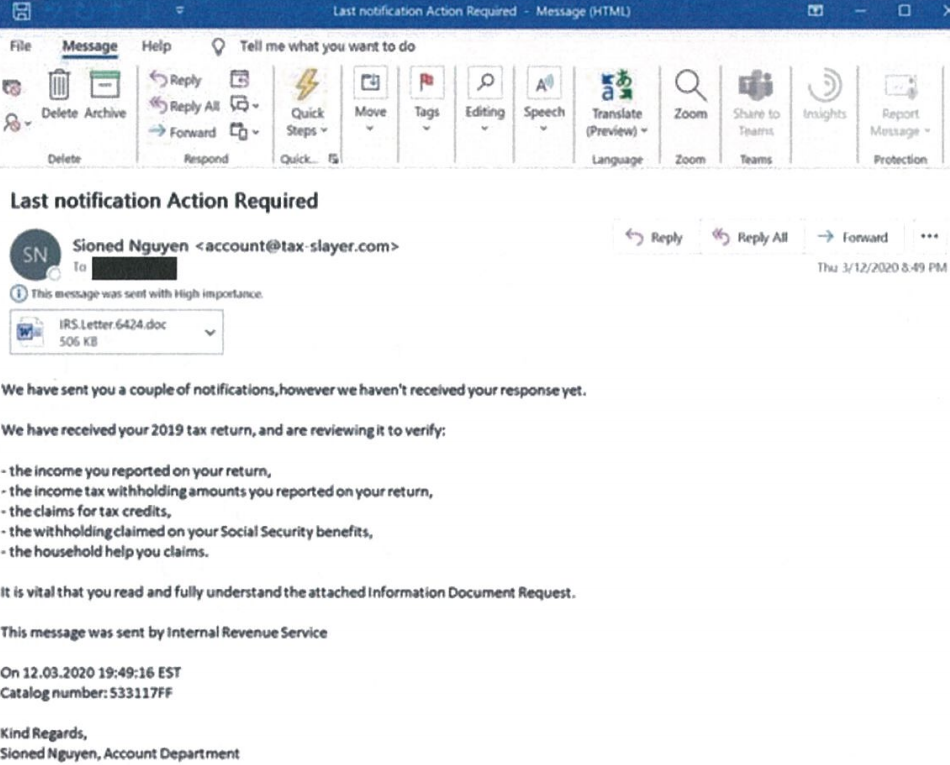
A spam email from 2020 containing a Trickbot-infected attachment. Image: Microsoft.
“During the height of the COVID-19 pandemic in 2020, Trickbot targeted hospitals and healthcare centers, launching a wave of ransomware attacks against hospitals across the United States,” the sanctions notice continued. “In one of these attacks, the Trickbot Group deployed ransomware against three Minnesota medical facilities, disrupting their computer networks and telephones, and causing a diversion of ambulances. Members of the Trickbot Group publicly gloated over the ease of targeting the medical facilities and the speed with which the ransoms were paid to the group.”
Only one of the men sanctioned today is known to have been criminally charged in connection with hacking activity. According to the Treasury Department, the alleged senior leader of the Trickbot group is 34-year-old Russian national Vitaly “Bentley” Kovalev.
A New Jersey grand jury indicted Kovalev in 2012 after an investigation by the U.S. Secret Service determined that he ran a massive “money mule” scheme, which used phony job offers to trick people into laundering money stolen from hacked small to mid-sized businesses in the United States. The 2012 indictment against Kovalev relates to cybercrimes he allegedly perpetrated prior to the creation of Trickbot.
BOTNET, THE MOVIE
In 2015, Kovalev reportedly began filming a movie in Russia about cybercrime called “Botnet.” According to a 2016 story from Forbes.ru, Botnet’s opening scene was to depict the plight of Christina Svechinskaya, a Russian student arrested by FBI agents in September 2010.

Christina Svechinskaya, a money mule hired by Bentley who was arrested by the FBI in 2010.
Svechinskaya was one of Bentley’s money mules, most of whom were young Russian students on summer travel visas in the United States. She was among 37 alleged mules charged with aiding an international cybercrime operation — basically, setting up phony corporate bank accounts for the sole purpose of laundering stolen funds.
Although she possessed no real hacking skills, Svechinskaya’s mugshot and social media photos went viral online and she was quickly dubbed “the world’s sexiest computer hacker” by the tabloids.
Kovalev’s Botnet film project was disrupted after Russian authorities raided the film production company’s offices as part of a cybercrime investigation. In February 2016, Reuters reported that the raid was connected to a crackdown on “Dyre,” a sophisticated trojan that U.S. federal investigators say was the precursor to the Trickbot malware. The Forbes.ru article cited sources close to the investigation who said the film studio was operating as a money-laundering front for the cybercrooks behind Dyre.
TREASON
But shifting political winds in Russia would soon bring high treason charges against three of the Russian cybercrime investigators tied to the investigation into the film studio. In a major shakeup in 2017, the Kremlin levied treason charges against Sergey Mikhaylov, then deputy chief of Russia’s top anti-cybercrime unit.
Also charged with treason was Ruslan Stoyanov, then a senior employee at Russian security firm Kaspersky Lab [the Forbes.ru report from 2016 said investigators from Mikhaylov’s unit and Kaspersky Lab were present at the film company raid].
Russian media outlets have speculated that the men were accused of treason for helping American cybercrime investigators pursue top Russian hackers. However, the charges against both men were classified and have never been officially revealed. After their brief, closed trial, both men were convicted of treason. Mikhaylov was given a 22 year prison sentence; Stoyanov was sentenced to 14 years in prison.
In September 2021, the Kremlin issued treason charges against Ilya Sachkov, formerly head of the cybersecurity firm Group-IB. According to Reuters, Sachkov and his company were hired by the film studio “to advise the Botnet director and writers on the finer points of cybercrime.” Sachkov remains imprisoned in Russia pending his treason trial.
A WELL-OILED CYBERCRIME MACHINE
Trickbot was heavily used by Conti and Ryuk, two of Russia’s most ruthless and successful ransomware groups. Blockchain analysis firm Chainalysis estimates that in 2021 alone, Conti extorted more than USD $100 million from its hacking victims; Chainalysis estimates Ryuk extorted more than USD $150 million from its ransomware victims.
The U.S. cybersecurity firm CrowdStrike has long tracked the activities of Trickbot, Ryuk and Conti under the same moniker — “Wizard Spider” — which CrowdStrike describes as “a Russia-nexus cybercriminal group behind the core development and distribution of a sophisticated arsenal of criminal tools, that allow them to run multiple different types of operations.”
“CrowdStrike Intelligence has observed WIZARD SPIDER targeting multiple countries and industries such as academia, energy, financial services, government, and more,” said Adam Meyers, head of intelligence at CrowdStrike.
This is not the U.S. government’s first swipe at the Trickbot group. In early October 2020, KrebsOnSecurity broke the news that someone had launched a series of coordinated attacks designed to disrupt the Trickbot botnet. A week later, The Washington Post ran a story saying the attack on Trickbot was the work of U.S. Cyber Command, a branch of the Department of Defense headed by the director of the U.S. National Security Agency (NSA).
Days after Russia invaded Ukraine in February 2022, a Ukrainian researcher leaked several years of internal chat logs from the Conti ransomware gang. Those candid conversations offer a fascinating view into the challenges of running a sprawling criminal enterprise with more than 100 salaried employees. They also showed that Conti enjoyed protection from prosecution by Russian authorities, as long as the hacker group took care not to target Russian organizations.
In addition, the leaked Conti chats confirmed there was considerable overlap in the operation and leadership of Conti, Trickbot and Ryuk.
CrowdStrike’s Meyers said while Wizard Spider operations have significantly reduced following the demise of Conti in June 2022, today’s sanctions will likely cause temporary disruptions for the cybercriminal group while they look for ways to circumvent the financial restrictions — which make it illegal to transact with or hold the assets of sanctioned persons or entities.
“Often, when cybercriminal groups are disrupted, they will go dark for a time only to rebrand under a new name,” Meyers said.
The prosecution of Kovalev and six other men named in today’s sanctions is being handled by the U.S. Attorney’s Office in New Jersey. A copy of the now-unsealed 2012 indictment of Kovalev is here (PDF).
from Krebs on Security https://ift.tt/T9Eptfc
via IFTTT

 Pacosite's Blog