Rogue software packages. Rogue “sysadmins”. Rogue keyloggers. Rogue authenticators. Rogue ROGUES!
from Naked Security https://ift.tt/ZDihKc8
via IFTTT

Rogue software packages. Rogue “sysadmins”. Rogue keyloggers. Rogue authenticators. Rogue ROGUES!
from Naked Security https://ift.tt/ZDihKc8
via IFTTT
And that’s just the tip of the iceberg when it comes to the trends that defined the cyberthreat landscape in the final four months of 2022.
The post ESET Research Podcast: Ransomware trashed data, Android threats soared in T3 2022 appeared first on WeLiveSecurity
from WeLiveSecurity https://ift.tt/Ex8d7hA
via IFTTT
Image: Shutterstock.com
Three different cybercriminal groups claimed access to internal networks at communications giant T-Mobile in more than 100 separate incidents throughout 2022, new data suggests. In each case, the goal of the attackers was the same: Phish T-Mobile employees for access to internal company tools, and then convert that access into a cybercrime service that could be hired to divert any T-Mobile user’s text messages and phone calls to another device.
The conclusions above are based on an extensive analysis of Telegram chat logs from three distinct cybercrime groups or actors that have been identified by security researchers as particularly active in and effective at “SIM-swapping,” which involves temporarily seizing control over a target’s mobile phone number.
Countless websites and online services use SMS text messages for both password resets and multi-factor authentication. This means that stealing someone’s phone number often can let cybercriminals hijack the target’s entire digital life in short order — including access to any financial, email and social media accounts tied to that phone number.
All three SIM-swapping entities that were tracked for this story remain active in 2023, and they all conduct business in open channels on the instant messaging platform Telegram. KrebsOnSecurity is not naming those channels or groups here because they will simply migrate to more private servers if exposed publicly, and for now those servers remain a useful source of intelligence about their activities.
Each advertises their claimed access to T-Mobile systems in a similar way. At a minimum, every SIM-swapping opportunity is announced with a brief “Tmobile up!” or “Tmo up!” message to channel participants. Other information in the announcements includes the price for a single SIM-swap request, and the handle of the person who takes the payment and information about the targeted subscriber.
The information required from the customer of the SIM-swapping service includes the target’s phone number, and the serial number tied to the new SIM card that will be used to receive text messages and phone calls from the hijacked phone number.
Initially, the goal of this project was to count how many times each entity claimed access to T-Mobile throughout 2022, by cataloging the various “Tmo up!” posts from each day and working backwards from Dec. 31, 2022.
But by the time we got to claims made in the middle of May 2022, completing the rest of the year’s timeline seemed unnecessary. The tally shows that in the last seven-and-a-half months of 2022, these groups collectively made SIM-swapping claims against T-Mobile on 104 separate days — often with multiple groups claiming access on the same days.

The 104 days in the latter half of 2022 in which different known SIM-swapping groups claimed access to T-Mobile employee tools.
KrebsOnSecurity shared a large amount of data gathered for this story with T-Mobile. The company declined to confirm or deny any of these claimed intrusions. But in a written statement, T-Mobile said this type of activity affects the entire wireless industry.
“And we are constantly working to fight against it,” the statement reads. “We have continued to drive enhancements that further protect against unauthorized access, including enhancing multi-factor authentication controls, hardening environments, limiting access to data, apps or services, and more. We are also focused on gathering threat intelligence data, like what you have shared, to help further strengthen these ongoing efforts.”
While it is true that each of these cybercriminal actors periodically offer SIM-swapping services for other mobile phone providers — including AT&T, Verizon and smaller carriers — those solicitations appear far less frequently in these group chats than T-Mobile swap offers. And when those offers do materialize, they are considerably more expensive.
The prices advertised for a SIM-swap against T-Mobile customers in the latter half of 2022 ranged between USD $1,000 and $1,500, while SIM-swaps offered against AT&T and Verizon customers often cost well more than twice that amount.

To be clear, KrebsOnSecurity is not aware of specific SIM-swapping incidents tied to any of these breach claims. However, the vast majority of advertisements for SIM-swapping claims against T-Mobile tracked in this story had two things in common that set them apart from random SIM-swapping ads on Telegram.
First, they included an offer to use a mutually trusted “middleman” or escrow provider for the transaction (to protect either party from getting scammed). More importantly, the cybercriminal handles that were posting ads for SIM-swapping opportunities from these groups generally did so on a daily or near-daily basis — often teasing their upcoming swap events in the hours before posting a “Tmo up!” message announcement.
In other words, if the crooks offering these SIM-swapping services were ripping off their customers or claiming to have access that they didn’t, this would be almost immediately obvious from the responses of the more seasoned and serious cybercriminals in the same chat channel.
There are plenty of people on Telegram claiming to have SIM-swap access at major telecommunications firms, but a great many such offers are simply four-figure scams, and any pretenders on this front are soon identified and banned (if not worse).
One of the groups that reliably posted “Tmo up!” messages to announce SIM-swap availability against T-Mobile customers also reliably posted “Tmo down!” follow-up messages announcing exactly when their claimed access to T-Mobile employee tools was discovered and revoked by the mobile giant.
A review of the timestamps associated with this group’s incessant “Tmo up” and “Tmo down” posts indicates that while their claimed access to employee tools usually lasted less than an hour, in some cases that access apparently went undiscovered for several hours or even days.
How could these SIM-swapping groups be gaining access to T-Mobile’s network as frequently as they claim? Peppered throughout the daily chit-chat on their Telegram channels are solicitations for people urgently needed to serve as “callers,” or those who can be hired to social engineer employees over the phone into navigating to a phishing website and entering their employee credentials.
Allison Nixon is chief research officer for the New York City-based cybersecurity firm Unit 221B. Nixon said these SIM-swapping groups will typically call employees on their mobile devices, pretend to be someone from the company’s IT department, and then try to get the person on the other end of the line to visit a phishing website that mimics the company’s employee login page.
Nixon argues that many people in the security community tend to discount the threat from voice phishing attacks as somehow “low tech” and “low probability” threats.
“I see it as not low-tech at all, because there are a lot of moving parts to phishing these days,” Nixon said. “You have the caller who has the employee on the line, and the person operating the phish kit who needs to spin it up and down fast enough so that it doesn’t get flagged by security companies. Then they have to get the employee on that phishing site and steal their credentials.”
In addition, she said, often there will be yet another co-conspirator whose job it is to use the stolen credentials and log into employee tools. That person may also need to figure out how to make their device pass “posture checks,” a form of device authentication that some companies use to verify that each login is coming only from employee-issued phones or laptops.
For aspiring criminals with little experience in scam calling, there are plenty of sample call transcripts available on these Telegram chat channels that walk one through how to impersonate an IT technician at the targeted company — and how to respond to pushback or skepticism from the employee. Here’s a snippet from one such tutorial that appeared recently in one of the SIM-swapping channels:
“Hello this is James calling from Metro IT department, how’s your day today?”
(yea im doing good, how r u)
i’m doing great, thank you for asking
i’m calling in regards to a ticket we got last week from you guys, saying you guys were having issues with the network connectivity which also interfered with [Microsoft] Edge, not letting you sign in or disconnecting you randomly. We haven’t received any updates to this ticket ever since it was created so that’s why I’m calling in just to see if there’s still an issue or not….”
The TMO UP data referenced above, combined with comments from the SIM-swappers themselves, indicate that while many of their claimed accesses to T-Mobile tools in the middle of 2022 lasted hours on end, both the frequency and duration of these events began to steadily decrease as the year wore on.

T-Mobile declined to discuss what it may have done to combat these apparent intrusions last year. However, one of the groups began to complain loudly in late October 2022 that T-Mobile must have been doing something that was causing their phished access to employee tools to die very soon after they obtained it.
One group even remarked that they suspected T-Mobile’s security team had begun monitoring their chats.
Indeed, the timestamps associated with one group’s TMO UP/TMO DOWN notices show that their claimed access was often limited to less than 15 minutes throughout November and December of 2022.
Whatever the reason, the calendar graphic above clearly shows that the frequency of claimed access to T-Mobile decreased significantly across all three SIM-swapping groups in the waning weeks of 2022.
T-Mobile US reported revenues of nearly $80 billion last year. It currently employs more than 71,000 people in the United States, any one of whom can be a target for these phishers.
T-Mobile declined to answer questions about what it may be doing to beef up employee authentication. But Nicholas Weaver, a researcher and lecturer at University of California, Berkeley’s International Computer Science Institute, said T-Mobile and all the major wireless providers should be requiring employees to use physical security keys for that second factor when logging into company resources.
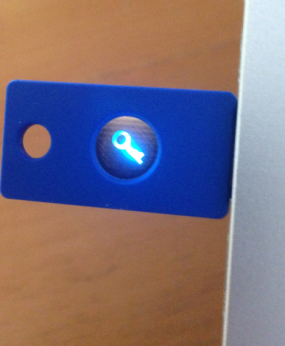
A U2F device made by Yubikey.
“These breaches should not happen,” Weaver said. “Because T-Mobile should have long ago issued all employees security keys and switched to security keys for the second factor. And because security keys provably block this style of attack.”
The most commonly used security keys are inexpensive USB-based devices. A security key implements a form of multi-factor authentication known as Universal 2nd Factor (U2F), which allows the user to complete the login process simply by inserting the USB key and pressing a button on the device. The key works without the need for any special software drivers.
The allure of U2F devices for multi-factor authentication is that even if an employee who has enrolled a security key for authentication tries to log in at an impostor site, the company’s systems simply refuse to request the security key if the user isn’t on their employer’s legitimate website, and the login attempt fails. Thus, the second factor cannot be phished, either over the phone or Internet.
Nixon said one confounding aspect of SIM-swapping is that these criminal groups tend to recruit teenagers to do their dirty work.
“A huge reason this problem has been allowed to spiral out of control is because children play such a prominent role in this form of breach,” Nixon said.
Nixon said SIM-swapping groups often advertise low-level jobs on places like Roblox and Minecraft, online games that are extremely popular with young adolescent males.
“Statistically speaking, that kind of recruiting is going to produce a lot of people who are underage,” she said. “They recruit children because they’re naive, you can get more out of them, and they have legal protections that other people over 18 don’t have.”
For example, she said, even when underage SIM-swappers are arrested, the offenders tend to go right back to committing the same crimes as soon as they’re released.
In January 2023, T-Mobile disclosed that a “bad actor” stole records on roughly 37 million current customers, including their name, billing address, email, phone number, date of birth, and T-Mobile account number.
In August 2021, T-Mobile acknowledged that hackers made off with the names, dates of birth, Social Security numbers and driver’s license/ID information on more than 40 million current, former or prospective customers who applied for credit with the company. That breach came to light after a hacker began selling the records on a cybercrime forum.
In the shadow of such mega-breaches, any damage from the continuous attacks by these SIM-swapping groups can seem insignificant by comparison. But Nixon says it’s a mistake to dismiss SIM-swapping as a low volume problem.
“Logistically, you may only be able to get a few dozen or a hundred SIM-swaps in a day, but you can pick any customer you want across their entire customer base,” she said. “Just because a targeted account takeover is low volume doesn’t mean it’s low risk. These guys have crews that go and identify people who are high net worth individuals and who have a lot to lose.”
Nixon said another aspect of SIM-swapping that causes cybersecurity defenders to dismiss the threat from these groups is the perception that they are full of low-skilled “script kiddies,” a derisive term used to describe novice hackers who rely mainly on point-and-click hacking tools.
“They underestimate these actors and say this person isn’t technically sophisticated,” she said. “But if you’re rolling around in millions worth of stolen crypto currency, you can buy that sophistication. I know for a fact some of these compromises were at the hands of these ‘script kiddies,’ but they’re not ripping off other people’s scripts so much as hiring people to make scripts for them. And they don’t care what gets the job done, as long as they get to steal the money.”
from Krebs on Security https://ift.tt/Zgly0Hh
via IFTTT
Seems the crooks implanted a keylogger via a vulnerable media app (LastPass politely didn’t say which one!) on a developer’s home computer.
from Naked Security https://ift.tt/tdJkwHX
via IFTTT
A paper expanding on greater ability to intervene during hacks – especially on private companies – causes alarm among Coalition and Greens
Labor could face Senate difficulties if it tries to dramatically expand the government’s powers to directly intervene in companies’ IT systems during cyber-attacks.
Under existing laws – which were controversial when introduced by the former Coalition government – the Australian Signals Directorate has the ability to “step in” as a “last resort” in some emergency situations, but only for critical infrastructure assets.
from Data and computer security | The Guardian https://ift.tt/rWM5ECf
via IFTTT
Ever paid hush money to crooks who broke into your network? Wondered how much you can trust them?
from Naked Security https://ift.tt/e2t71CG
via IFTTT
Web hosting giant GoDaddy made headlines this month when it disclosed that a multi-year breach allowed intruders to steal company source code, siphon customer and employee login credentials, and foist malware on customer websites. Media coverage understandably focused on GoDaddy’s admission that it suffered three different cyberattacks over as many years at the hands of the same hacking group. But it’s worth revisiting how this group typically got in to targeted companies: By calling employees and tricking them into navigating to a phishing website.

In a filing with the U.S. Securities and Exchange Commission (SEC), GoDaddy said it determined that the same “sophisticated threat actor group” was responsible for three separate intrusions, including:
-March 2020: A spear-phishing attack on a GoDaddy employee compromised the hosting login credentials of approximately 28,000 GoDaddy customers, as well as login credentials for a small number employees;
-November 2021: A compromised GoDaddy password let attackers steal source code and information tied to 1.2 million customers, including website administrator passwords, sFTP credentials, and private SSL keys;
-December 2022: Hackers gained access to and installed malware on GoDaddy’s cPanel hosting servers that “intermittently redirected random customer websites to malicious sites.”
“Based on our investigation, we believe these incidents are part of a multi-year campaign by a sophisticated threat actor group that, among other things, installed malware on our systems and obtained pieces of code related to some services within GoDaddy,” the company stated in its SEC filing.
What else do we know about the cause of these incidents? We don’t know much about the source of the November 2021 incident, other than GoDaddy’s statement that it involved a compromised password, and that it took about two months for the company to detect the intrusion. GoDaddy has not disclosed the source of the breach in December 2022 that led to malware on some customer websites.
But we do know the March 2020 attack was precipitated by a spear-phishing attack against a GoDaddy employee. GoDaddy described the incident at the time in general terms as a social engineering attack, but one of its customers affected by that March 2020 breach actually spoke to one of the hackers involved.
The hackers were able to change the Domain Name System (DNS) records for the transaction brokering site escrow.com so that it pointed to an address in Malaysia that was host to just a few other domains, including the then brand-new phishing domain servicenow-godaddy[.]com.
The general manager of Escrow.com found himself on the phone with one of the GoDaddy hackers, after someone who claimed they worked at GoDaddy called and said they needed him to authorize some changes to the account.
In reality, the caller had just tricked a GoDaddy employee into giving away their credentials, and he could see from the employee’s account that Escrow.com required a specific security procedure to complete a domain transfer.
The general manager of Escrow.com said he suspected the call was a scam, but decided to play along for about an hour — all the while recording the call and coaxing information out of the scammer.
“This guy had access to the notes, and knew the number to call,” to make changes to the account, the CEO of Escrow.com told KrebsOnSecurity. “He was literally reading off the tickets to the notes of the admin panel inside GoDaddy.”
About halfway through this conversation — after being called out by the general manager as an imposter — the hacker admitted that he was not a GoDaddy employee, and that he was in fact part of a group that enjoyed repeated success with social engineering employees at targeted companies over the phone.
Absent from GoDaddy’s SEC statement is another spate of attacks in November 2020, in which unknown intruders redirected email and web traffic for multiple cryptocurrency services that used GoDaddy in some capacity.
It is possible this incident was not mentioned because it was the work of yet another group of intruders. But in response to questions from KrebsOnSecurity at the time, GoDaddy said that incident also stemmed from a “limited” number of GoDaddy employees falling for a sophisticated social engineering scam.
“As threat actors become increasingly sophisticated and aggressive in their attacks, we are constantly educating employees about new tactics that might be used against them and adopting new security measures to prevent future attacks,” GoDaddy said in a written statement back in 2020.
Voice phishing or “vishing” attacks typically target employees who work remotely. The phishers will usually claim that they’re calling from the employer’s IT department, supposedly to help troubleshoot some issue. The goal is to convince the target to enter their credentials at a website set up by the attackers that mimics the organization’s corporate email or VPN portal.
Experts interviewed for an August 2020 story on a steep rise in successful voice phishing attacks said there are generally at least two people involved in each vishing scam: One who is social engineering the target over the phone, and another co-conspirator who takes any credentials entered at the phishing page — including multi-factor authentication codes shared by the victim — and quickly uses them to log in to the company’s website.
The attackers are usually careful to do nothing with the phishing domain until they are ready to initiate a vishing call to a potential victim. And when the attack or call is complete, they disable the website tied to the domain.
This is key because many domain registrars will only respond to external requests to take down a phishing website if the site is live at the time of the abuse complaint. This tactic also can stymie efforts by companies that focus on identifying newly-registered phishing domains before they can be used for fraud.
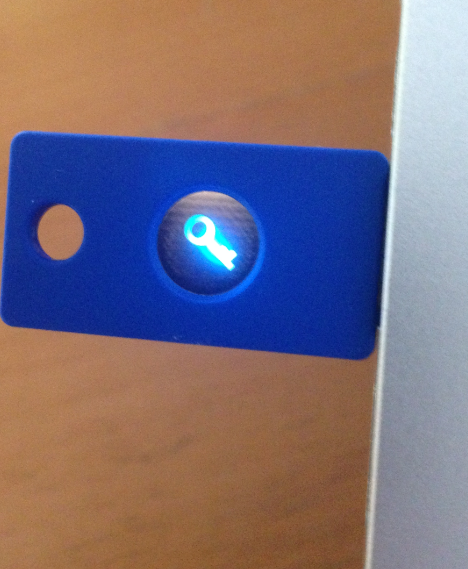
A U2F device made by Yubikey.
GoDaddy’s latest SEC filing indicates the company had nearly 7,000 employees as of December 2022. In addition, GoDaddy contracts with another 3,000 people who work full-time for the company via business process outsourcing companies based primarily in India, the Philippines and Colombia.
Many companies now require employees to supply a one-time password — such as one sent via SMS or produced by a mobile authenticator app — in addition to their username and password when logging in to company assets online. But both SMS and app-based codes can be undermined by phishing attacks that simply request this information in addition to the user’s password.
One multifactor option — physical security keys — appears to be immune to these advanced scams. The most commonly used security keys are inexpensive USB-based devices. A security key implements a form of multi-factor authentication known as Universal 2nd Factor (U2F), which allows the user to complete the login process simply by inserting the USB device and pressing a button on the device. The key works without the need for any special software drivers.
The allure of U2F devices for multi-factor authentication is that even if an employee who has enrolled a security key for authentication tries to log in at an impostor site, the company’s systems simply refuse to request the security key if the user isn’t on their employer’s legitimate website, and the login attempt fails. Thus, the second factor cannot be phished, either over the phone or Internet.
In July 2018, Google disclosed that it had not had any of its 85,000+ employees successfully phished on their work-related accounts since early 2017, when it began requiring all employees to use physical security keys in place of one-time codes.
from Krebs on Security https://ift.tt/5mT3nRb
via IFTTT
Even in Apple’s and Google’s “walled gardens”, there are plenty of 2FA apps that are either dangerously incompetent, or unrepentantly malicious. (Or perhaps both.)
from Naked Security https://ift.tt/CJuvGfh
via IFTTT
A security firm has discovered that a six-year-old crafty botnet known as Mylobot appears to be powering a residential proxy service called BHProxies, which offers paying customers the ability to route their web traffic anonymously through compromised computers. Here’s a closer look at Mylobot, and a deep dive into who may be responsible for operating the BHProxies service.

The BHProxies website.
First identified in 2017 by the security firm Deep Instinct, Mylobot employs a number of fairly sophisticated methods to remain undetected on infected hosts, such as running exclusively in the computer’s temporary memory, and waiting 14 days before attempting to contact the botnet’s command and control servers.
Last year, researchers at Minerva Labs spotted the botnet being used to blast out sextortion scams. But according to a new report from BitSight, the Mylobot botnet’s main functionality has always been about transforming the infected system into a proxy.
The Mylobot malware includes more than 1,000 hard-coded and encrypted domain names, any one of which can be registered and used as control networks for the infected hosts. BitSight researchers found significant overlap in the Internet addresses used by those domains and a domain called BHproxies[.]com.
BHProxies sells access to “residential proxy” networks, which allow someone to rent a residential IP address to use as a relay for their Internet communications, providing anonymity and the advantage of being perceived as a residential user surfing the web. The service is currently advertising access to more than 150,000 devices globally.
“At this point, we cannot prove that BHProxies is linked to Mylobot, but we have a strong suspicion,” wrote BitSight’s Stanislas Arnoud.
To test their hypothesis, BitSight obtained 50 proxies from BHProxies. The researchers were able to use 48 of those 50 proxies to browse to a website they controlled — allowing them to record the true IP addresses of each proxy device.
“Among these 48 recovered residential proxies IP addresses, 28 (58.3%) of those were already present in our sinkhole systems, associated with the Mylobot malware family,” Arnoud continued. “This number is probably higher, but we don’t have a full visibility of the botnet. This gave us clear evidence that Mylobot infected computers are used by the BHProxies service.”
BitSight said it is currently seeing more than 50,000 unique Mylobot infected systems every day, and that India appears to be the most targeted country, followed by the United States, Indonesia and Iran.
“We believe we are only seeing part of the full botnet, which may lead to more than 150,000 infected computers as advertised by BHProxies’ operators,” Arnoud wrote.
The website BHProxies[.]com has been advertised for nearly a decade on the forum Black Hat World by the user BHProxies. BHProxies has authored 129 posts on Black Hat World since 2012, and their last post on the forum was in December 2022.
BHProxies initially was fairly active on Black Hat World between May and November 2012, after which it suddenly ceased all activity. The account didn’t resume posting on the forum until April 2014.
According to cyber intelligence firm Intel 471, the user BHProxies also used the handle “hassan_isabad_subar” and marketed various software tools, including “Subar’s free email creator” and “Subar’s free proxy scraper.”
Intel 471’s data shows that hassan_isabad_subar registered on the forum using the email address jesus.fn.christ@gmail.com. In a June 2012 private message exchange with a website developer on Black Hat World, hassan_isabad_subar confided that they were working at the time to develop two websites, including the now-defunct customscrabblejewelry.com.
DomainTools.com reports that customscrabblejewelry.com was registered in 2012 to a Teresa Shotliff in Chesterland, Ohio. A search on jesus.fn.christ@gmail.com at Constella Intelligence, a company that tracks compromised databases, shows this email address is tied to an account at the fundraising platform omaze.com, for a Brian Shotliff from Chesterland, Ohio.
Reached via LinkedIn, Mr. Shotliff said he sold his BHProxies account to another Black Hat World forum user from Egypt back in 2014. Shotliff shared an April 2014 password reset email from Black Hat World, which shows he forwarded the plaintext password to the email address legendboy2050@yahoo.com. He also shared a PayPal receipt and snippets of Facebook Messenger logs showing conversations in March 2014 with legendboy2050@yahoo.com.
Constella Intelligence confirmed that legendboy2050@yahoo.com was indeed another email address tied to the hassan_isabad_subar/BHProxies identity on Black Hat World. Constella also connects legendboy2050 to Facebook and Instagram accounts for one Abdala Tawfik from Cairo. This user’s Facebook page says Tawfik also uses the name Abdalla Khafagy.
Tawfik’s Instagram account says he is a former operations manager at the social media network TikTok, as well as a former director at Crypto.com.
Abdalla Khafagy’s LinkedIn profile says he was “global director of community” at Crypto.com for about a year ending in January 2022. Before that, the resume says he was operations manager of TikTok’s Middle East and North Africa region for approximately seven months ending in April 2020.
Khafagy’s LinkedIn profile says he is currently founder of LewkLabs, a Dubai-based “blockchain-powered, SocialFi content monetization platform” that last year reported funding of $3.26 million from private investors.
The only experience listed for Khafagy prior to the TikTok job is labeled “Marketing” at “Confidential,” from February 2014 to October 2019.
Reached via LinkedIn, Mr. Khafagy told KrebsOnSecurity that he had a Black Hat World account at some point, but that he didn’t recall ever having used an account by the name BHProxies or hassan_isabad_subar. Khafagy said he couldn’t remember the name of the account he had on the forum.
“I had an account that was simply hacked from me shortly after and I never bothered about it because it wasn’t mine in the first place,” he explained.
Khafagy declined to elaborate on the five-year stint in his resume marked “Confidential.” When asked directly whether he had ever been associated with the BHProxies service, Mr. Khafagy said no.
That Confidential job listing is interesting because its start date lines up with the creation of BHproxies[.]com. Archive.org indexed its first copy of BHProxies[.]com on Mar. 5, 2014, but historic DNS records show BHproxies[.]com first came online Feb. 25, 2014.
Shortly after that conversation with Mr. Khafagy, Mr. Shotliff shared a Facebook/Meta message he received that indicated Mr. Khafagy wanted him to support the claim that the BHProxies account had somehow gone missing.
“Hey mate, it’s been a long time. Hope you are doing well. Someone from Krebs on Security reached out to me about the account I got from you on BHW,” Khafagy’s Meta account wrote. “Didn’t we try to retrieve this account? I remember mentioning to you that it got stolen and I was never able to retrieve it.”
Mr. Shotliff said Khafagy’s sudden message this week was the first time he’d heard that claim.
“He bought the account,” Shotliff said. “He might have lost the account or had it stolen, but it’s not something I remember.”
If you liked this story, you may also enjoy these other investigations into botnet-based proxy services:
A Deep Dive Into the Residential Proxy Service ‘911’
911 Proxy Service Implodes After Disclosing Breach
Meet the Administrators of the RSOCKS Proxy Botnet
The Link Between AWM Proxy & the Glupteba Botnet
15-Year-Old Malware Proxy Network VIP72 Goes Dark
Who’s Behind the TDSS Botnet?
from Krebs on Security https://ift.tt/zFvqQ74
via IFTTT
With the conflict in Ukraine passing the one-year mark, have its cyber-war elements turned out as expected?
The post One year on, how is the war playing out in cyberspace? – Week in security with Tony Anscombe appeared first on WeLiveSecurity
from WeLiveSecurity https://ift.tt/rCb6EuR
via IFTTT
 Pacosite's Blog