If you’re pondering a move to the decentralized social network, here’s how to find the people you know and want to talk to.
from Gear Latest https://ift.tt/SKDV2Ce
via IFTTT

If you’re pondering a move to the decentralized social network, here’s how to find the people you know and want to talk to.
from Gear Latest https://ift.tt/SKDV2Ce
via IFTTT
Black Friday has taken over the month of November. You can stock up on gifts for your family now (or gadgets for yourself).
from Gear Latest https://ift.tt/SsAtTZm
via IFTTT

By BY NICO GRANT
The video platform said it had limited the spread of misinformation ahead of Election Day, but new research showed that false narratives continued to slip through.
Published: November 5, 2022 at 03:00AM
from NYT Technology https://ift.tt/3K4hqNW
via IFTTT
By BY NATASHA SINGER
In this polarized climate, hundreds of Americans told us they agree on one thing: Campaigns must stop spamming voters’ phones with unwanted political texts.
Published: November 5, 2022 at 03:00AM
from NYT Technology https://ift.tt/aI3b7fS
via IFTTT

By Kate Conger, Ryan Mac and Mike Isaac
The layoffs hit across many divisions, including the engineering and machine learning units, the teams that manage content moderation, and the sales and advertising departments.
Published: November 3, 2022 at 06:00PM
from NYT Technology https://ift.tt/uIHB8ac
via IFTTT
This week’s news offered fresh reminders of the threat that ransomware poses for businesses and critical infrastructure worldwide
The post Ransomware rages on – Week in security with Tony Anscombe appeared first on WeLiveSecurity
from WeLiveSecurity https://ift.tt/rWBcxQj
via IFTTT
Responding to a recent surge in AI-generated bot accounts, LinkedIn is rolling out new features that it hopes will help users make more informed decisions about with whom they choose to connect. Many LinkedIn profiles now display a creation date, and the company is expanding its domain validation offering, which allows users to publicly confirm that they can reply to emails at the domain of their stated current employer.
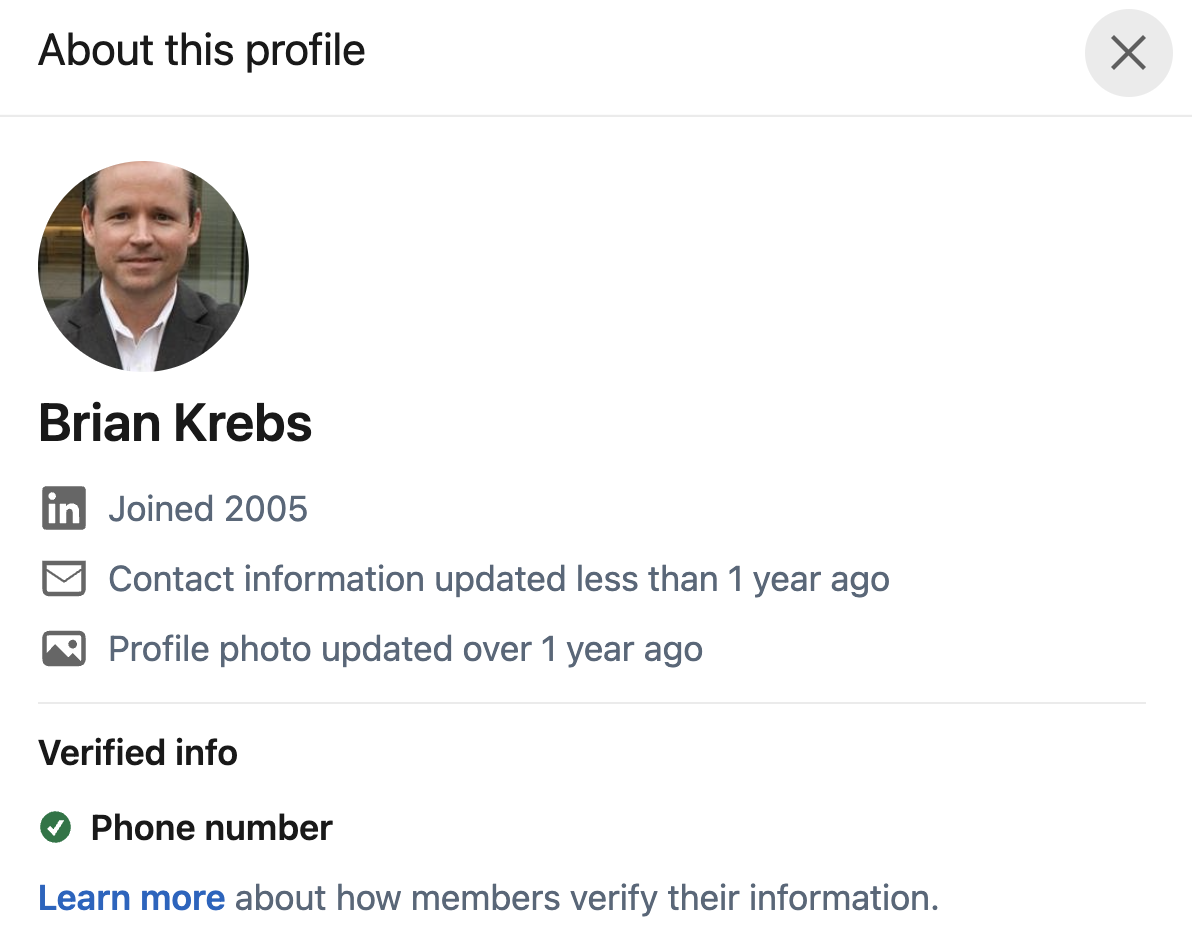
LinkedIn’s new “About This Profile” section — which is visible by clicking the “More” button at the top of a profile — includes the year the account was created, the last time the profile information was updated, and an indication of how and whether an account has been verified.
LinkedIn also said it is adding a warning to some LinkedIn messages that include high-risk content, or that try to entice the user into taking the conversation to another platform (like WeChat).
“We may warn you about messages that ask you to take the conversation to another platform because that can be a sign of a scam,” the company said in a blog post. “These warnings will also give you the choice to report the content without letting the sender know.”
In late September 2022, KrebsOnSecurity warned about the proliferation of fake LinkedIn profiles for Chief Information Security Officer (CISO) roles at some of the world’s largest corporations. A follow-up story on Oct. 5 showed how the phony profile problem has affected virtually all executive roles at corporations, and how these fake profiles are creating an identity crisis for the businesses networking site and the companies that rely on it to hire and screen prospective employees.
Reporting here last month also tracked a massive drop in profiles claiming to work at several major technology companies, as LinkedIn apparently took action against hundreds of thousands of inauthentic accounts that falsely claimed roles at these companies.
For example, on October 10, 2022, there were 576,562 LinkedIn accounts that listed their current employer as Apple Inc. The next day, half of those profiles no longer existed. At around the same time, the number of LinkedIn profiles claiming current roles at Amazon fell from roughly 1.25 million to 838,601 in just one day, a 33 percent drop.
For whatever reason, the majority of the phony LinkedIn profiles reviewed by this author were young women with profile photos that appear to have been generated by artificial intelligence (AI) tools.
“We’re seeing rapid advances in AI-based synthetic image generation technology and we’ve created a deep learning model to better catch profiles made with this technology,” LinkedIn’s Oscar Rodriguez wrote. “AI-based image generators can create an unlimited number of unique, high-quality profile photos that do not correspond to real people.”
It remains unclear who or what is behind the recent proliferation of fake executive profiles on LinkedIn, but likely they are from a combination of scams. Cybersecurity firm Mandiant (recently acquired by Google) told Bloomberg that hackers working for the North Korean government have been copying resumes and profiles from leading job listing platforms LinkedIn and Indeed, as part of an elaborate scheme to land jobs at cryptocurrency firms.
Identity thieves have been known to masquerade on LinkedIn as job recruiters, collecting personal and financial information from people who fall for employment scams.
Also, fake profiles also may be tied to so-called “pig butchering” scams, wherein people are lured by flirtatious strangers online into investing in cryptocurrency trading platforms that eventually seize any funds when victims try to cash out.
from Krebs on Security https://ift.tt/Sx4QNtX
via IFTTT
By BY KATE CONGER, RYAN MAC AND MIKE ISAAC
The layoffs hit across many divisions, including the engineering and machine learning units, the teams that manage content moderation, and the sales and advertising departments.
Published: November 4, 2022 at 01:56PM
from NYT Technology https://ift.tt/uIHB8ac
via IFTTT

By BY TIFFANY HSU
Elon Musk, Twitter’s new owner, acknowledged that ad spending on the platform had slumped. He blamed the drop on pressure from activists.
Published: November 4, 2022 at 12:43PM
from NYT Technology https://ift.tt/aDYf3hn
via IFTTT
Local interventions crucial to getting back on track to achieve malaria elimination targets
Oscar Reyes
4 Nov 2022
from PAHO/WHO | Pan American Health Organization https://ift.tt/R3ujB1x
via IFTTT
 Pacosite's Blog