El meteorito Erg Chech 002 es más viejo que la Tierra y viene de un protoplaneta
from Tendencias – Digital Trends Español https://ift.tt/3l2RxeD
via IFTTT

El meteorito Erg Chech 002 es más viejo que la Tierra y viene de un protoplaneta
from Tendencias – Digital Trends Español https://ift.tt/3l2RxeD
via IFTTT
On the off chance you were looking for more security to-dos from Microsoft today…the company released software updates to plug more than 82 security flaws in Windows and other supported software. Ten of these earned Microsoft’s “critical” rating, meaning they can be exploited by malware or miscreants with little or no help from users.
Top of the heap this month (apart from the ongoing, global Exchange Server mass-compromise) is a patch for an Internet Explorer bug that is seeing active exploitation. The IE weakness — CVE-2021-26411 — affects both IE11 and newer EdgeHTML-based versions, and it allows attackers to run a file of their choice by getting you to view a hacked or malicious website in IE.
The IE flaw is tied to a vulnerability that was publicly disclosed in early February by researchers at ENKI who claim it was one of those used in a recent campaign by nation-state actors to target security researchers. In the ENKI blog post, the researchers said they will publish proof-of-concept (PoC) details after the bug has been patched.
“As we’ve seen in the past, once PoC details become publicly available, attackers quickly incorporate those PoCs into their attack toolkits,” said Satnam Narang, staff research engineer at Tenable. “We strongly encourage all organizations that rely on Internet Explorer and Microsoft Edge (EdgeHTML-Based) to apply these patches as soon as possible.”
This is probably a good place to quote Ghacks.net’s Martin Brinkman: This is the last patch hurrah for the legacy Microsoft Edge web browser, which is being retired by Microsoft.
For the second month in a row, Microsoft has patched scary flaws in the DNS servers on Windows Server 2008 through 2019 versions that could be used to remotely install software of the attacker’s choice. All five of the DNS bugs quashed in today’s patch batch earned a CVSS Score (danger metric) of 9.8 — almost as bad as it gets.
“There is the outside chance this could be wormable between DNS servers,” warned Trend Micro’s Dustin Childs.
As mentioned above, hundreds of thousands of organizations are in the midst dealing with a security nightmare after having their Exchange Server and Outlook Web Access (OWA) hacked and retrofitted with a backdoor. If an organization you know has been affected by this attack, please have them check with the new victim notification website mentioned in today’s story.
Susan Bradley over at Askwoody.com says “nothing in the March security updates (besides the Exchange ones released last week) is causing me to want to urge you to go running to your machines and patch at this time.” I’d concur, unless of course you cruise the web with older Microsoft browsers.
It’s a good idea for Windows users to get in the habit of updating at least once a month, but for regular users (read: not enterprises) it’s usually safe to wait a few days until after the patches are released, so that Microsoft has time to iron out any kinks in the new armor.
But before you update, please make sure you have backed up your system and/or important files. It’s not uncommon for a Windows update package to hose one’s system or prevent it from booting properly, and some updates have been known to erase or corrupt files.
So do yourself a favor and backup before installing any patches. Windows 10 even has some built-in tools to help you do that, either on a per-file/folder basis or by making a complete and bootable copy of your hard drive all at once.
And if you wish to ensure Windows has been set to pause updating so you can back up your files and/or system before the operating system decides to reboot and install patches on its own schedule, see this guide.
As always, if you experience glitches or problems installing any of these patches this month, please consider leaving a comment about it below; there’s a better-than-even chance other readers have experienced the same and may chime in here with some helpful tips.
Additional reading:
Martin Brinkman’s always comprehensive take.
The SANS Internet Storm Center no-frills breakdown of the fixes.
from Krebs on Security https://ift.tt/3v5auSF
via IFTTT
Now adays most of us have numerous devices in our homes connect to the Internet. From thermostats and gaming consoles to baby monitors, door locks or even your car. Ensure you change the default passwords on these devices and enable automatic updating.
from SANS Institute Security Awareness Tip of the Day https://ift.tt/314imav
via IFTTT
Octagonal warning labels perform best in helping consumers choose healthier food, major study in Jamaica shows
mitchelc
9 Mar 2021
from PAHO/WHO | Pan American Health Organization https://ift.tt/38r4pGd
via IFTTT

Google celebra el décimo aniversario de sus Chromebooks justo en su mejor momento. En pasado año, Chrome OS se convirtió en el segundo sistema operativo más usado y la demanda de estos equipos creció un 109%.
Para impulsar todavía más las ventas de los Chromebooks, Google anuncia por todo lo alto las novedades de Chrome OS M89, una actualización muy importante que mejora la integración con nuestro móvil Android.
Podría ayudar a explicar el fuerte campo magnético de los interiores planetarios gigantes
from Tendencias – Digital Trends Español https://ift.tt/3bsugzv
via IFTTT
The monthly rollout follows last week’s emergency Microsoft Exchange Server patch covering seven CVEs, four of which are under attack.
from Dark Reading: https://ift.tt/3t0TYBd
via IFTTT
If you’ve been looking for a better TV setup, our favorite streaming devices are discounted.
from Gear Latest https://ift.tt/3v81dJt
via IFTTT
Investigadores han logrado determinar de qué forma influye el mar de Tasmania en este fenómeno
from Tendencias – Digital Trends Español https://ift.tt/3quuLNW
via IFTTT
Globally, hundreds of thousand of organizations running Exchange email servers from Microsoft just got mass-hacked, including at least 30,000 victims in the United States. Each hacked server has been retrofitted with a “web shell” backdoor that gives the bad guys total, remote control, the ability to read all email, and easy access to the victim’s other computers. Researchers are now racing to identify, alert and help victims, and hopefully prevent further mayhem.

On Mar. 5, KrebsOnSecurity broke the news that at least 30,000 organizations and hundreds of thousands globally had been hacked. The same sources who shared those figures say the victim list has grown considerably since then, with many victims compromised by multiple cybercrime groups.
Security experts are now trying to alert and assist these victims before malicious hackers launch what many refer to with a mix of dread and anticipation as “Stage 2,” when the bad guys revisit all these hacked servers and seed them with ransomware or else additional hacking tools for crawling even deeper into victim networks.
But that rescue effort has been stymied by the sheer volume of attacks on these Exchange vulnerabilities, and by the number of apparently distinct hacking groups that are vying for control over vulnerable systems.
A security expert who has briefed federal and military advisors on the threat says many victims appear to have more than one type of backdoor installed. Some victims had three of these web shells installed. One was pelted with eight distinct backdoors. This initially caused a major overcount of potential victims, and required a great deal of de-duping various victim lists.
The source, who spoke on condition of anonymity, said many in the cybersecurity community recently saw a large spike in attacks on thousands of Exchange servers that was later linked to a profit-motivated cybercriminal group.
“What we thought was Stage 2 actually was one criminal group hijacking like 10,000 exchange servers,” said one source who’s briefed U.S. national security advisors on the outbreak.
On Mar. 2, when Microsoft released updates to plug the four Exchange flaws being attacked, it attributed the hacking activity to a previously unidentified Chinese cyber espionage group it called “Hafnium.” Microsoft said Hafnium had been using the Exchange flaws to conduct a series of low-and-slow attacks against specific strategic targets, such as non-governmental organization (NGOs) and think tanks.
But by Feb. 26, that relatively stealthy activity was morphing into the indiscriminate mass-exploitation of all vulnerable Exchange servers. That means even Exchange users that patched the same day Microsoft released security updates may have had servers seeded with backdoors.
Many experts who spoke to KrebsOnSecurity said they believe different cybercriminal groups somehow learned of Microsoft’s plans to ship fixes for the Exchange flaws a week earlier than they’d hoped (Microsoft originally targeted today, Patch Tuesday, as the release date).
The vulnerability scanning activity also ramped up markedly after Microsoft released its updates on Mar. 2. Security researchers love to tear apart patches for clues about the underlying security holes, and one major concern is that various cybercriminal groups may have already worked out how to exploit the flaws independently.
Security experts now are desperately trying to reach tens of thousands of victim organizations with a single message: Whether you have patched yet or have been hacked, backup any data stored on those servers immediately.
Every source I’ve spoken with about this incident says they fully expect profit-motivated cybercriminals to pounce on victims by mass-deploying ransomware. Given that so many groups now have backdoor web shells installed, it would be trivial to unleash ransomware on the lot of them in one go. Also, compromised Exchange servers can be a virtual doorway into the rest of the victim’s network.
“With the number of different threat actors dropping [web] shells on servers increasing, ransomware is inevitable,” said Allison Nixon, chief research officer at Unit221B, a New York City-based cyber investigations firm.
So far there are no signs of victims of this mass-hack being ransomed. But that may well change if the exploit code used to break into these vulnerable Exchange servers goes public. And nobody I’ve interviewed seems to think working exploit code is going to stay unpublished for much longer.
When that happens, the exploits will get folded into publicly available exploit testing kits, effectively making it simple for any attacker to find and compromise a decent number of victims who haven’t already patched.
Nixon is part of a group of security industry leaders who are contributing data and time to a new victim notification platform online called Check My OWA (Outlook Web Access, the Internet-facing Web component of Exchange Server machines).
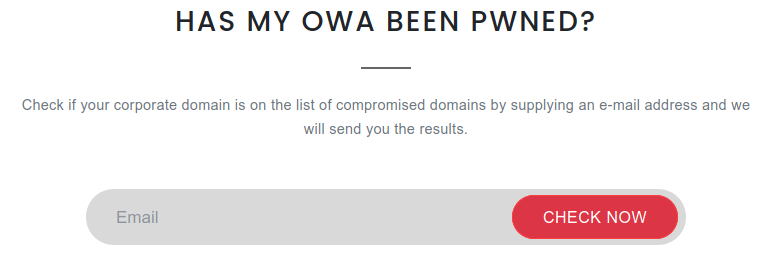
Checkmyown.unit221b.com checks if your Exchange Server domain showed up in attack logs or lists of known-compromised domains.
Perhaps it’s better to call it a self-notification service that is operated from Unit221B’s own web site. It draws on tens of thousands of data points that various ISPs and hosting firms have tied to victims around the world who are likely compromised by the backdoor shells. The data comes from large networks watching the sources and targets of mass-scans for vulnerable Exchange servers.
“Our goal is to motivate people who we might otherwise have never been able to contact,” Nixon said. “My hope is if this site can get out there, then there’s a chance some victim companies are notified and take action or can get attention.”
Enter an email address at Check My OWA, and if that address matches a domain name for a victim organization, that email address will get a notice.
If the email’s domain name (anything to the right of the @ sign) is detected in their database, the site will send that user an email stating that is has observed the email domain in a list of targeted domains.
“Malicious actors were able to successfully compromise, and some of this information suggested they may have been able to install a webshell on an Exchange server associated with this domain,” reads one of the messages to victims. “We strongly recommend saving an offline backup of your Exchange server’s emails immediately, and refer back to the site for additional information on patching and remediation.”
Other Exchange users may see this message:
“We have observed your e-mail domain appears in our list of domains the malicious actors were able to successfully compromise, and some of this information suggested they may have been able to install a webshell on an Exchange server associated with this domain,” is another message the site may return. We strongly recommend saving an offline backup of your Exchange server’s emails immediately, and refer back to the site for additional information on patching and remediation.”
Nixon said Exchange users can save themselves a potentially nightmarish scenario if they just back up any affected systems now. And given the number of adversaries currently attacking still-unpatched Exchange systems, there is almost no way this won’t end in disaster for at least some victims.
“There are researchers running honeypots to [attract] attacks from different groups, and those honeypots are getting shelled left and right,” she said. “The sooner they can run a backup, the better. This can help save a lot of heartache.”
Oh, and one more important thing: You’ll want to keep any backups disconnected from everything. Ransomware has a tendency to infect everything it can, so make sure at least one backup is stored completely offline.
“Just disconnect them from a computer, put them in a safe place and pray you don’t need them,” Nixon said.
from Krebs on Security https://ift.tt/38rcGtP
via IFTTT
 Pacosite's Blog