April means game sales, and who couldn’t use a little escapism right now?
from Gear Latest https://ift.tt/2y16dGF
via IFTTT

April means game sales, and who couldn’t use a little escapism right now?
from Gear Latest https://ift.tt/2y16dGF
via IFTTT
The U.S. federal government is now in the process of sending Economic Impact Payments by direct deposit to millions of Americans. Most who are eligible for payments can expect to have funds direct-deposited into the same bank accounts listed on previous years’ tax filings sometime next week. Today, the Internal Revenue Service (IRS) stood up a site to collect bank account information from the many Americans who don’t usually file a tax return. The question is, will those non-filers have a chance to claim their payments before fraudsters do?

The IRS says the Economic Impact Payment will be $1,200 for individual or head of household filers, and $2,400 for married filing jointly if they are not a dependent of another taxpayer and have a work eligible Social Security number with adjusted gross income up to:
Taxpayers with higher incomes will receive more modest payments (reduced by $5 for each $100 above the $75,000/$112,500/$150,000 thresholds). Most people who who filed a tax return in 2018 and/or 2019 and provided their bank account information for a debit or credit should soon see an Economic Impact Payment direct-deposited into their bank accounts. Likewise, people drawing Social Security payments from the government will receive stimulus payments the same way.
But there are millions of U.S. residents — including low-income workers and certain veterans and individuals with disabilities — who aren’t required to file a tax return but who are still eligible to receive at least a $1,200 stimulus payment. And earlier today, the IRS unveiled a Web site where it is asking those non-filers to provide their bank account information for direct deposits.
However, the possibility that fraudsters may intercept payments to these individuals seems very real, given the relatively lax identification requirements of this non-filer portal and the high incidence of tax refund fraud in years past. Each year, scam artists file phony tax refund requests on millions of Americans, regardless of whether or not the impersonated taxpayer is actually due a refund. In most cases, the victim only finds out when he or she goes to file their taxes and has the return rejected because it has already been filed by scammers.
In this case, fraudsters would simply need to identify the personal information for a pool of Americans who don’t normally file tax returns, which may well include a large number of people who are disabled, poor or simply do not have easy access to a computer or the Internet. Armed with this information, the scammers need only provide the target’s name, address, date of birth and Social Security number, and then supply their own bank account information to claim at least $1,200 in electronic payments.
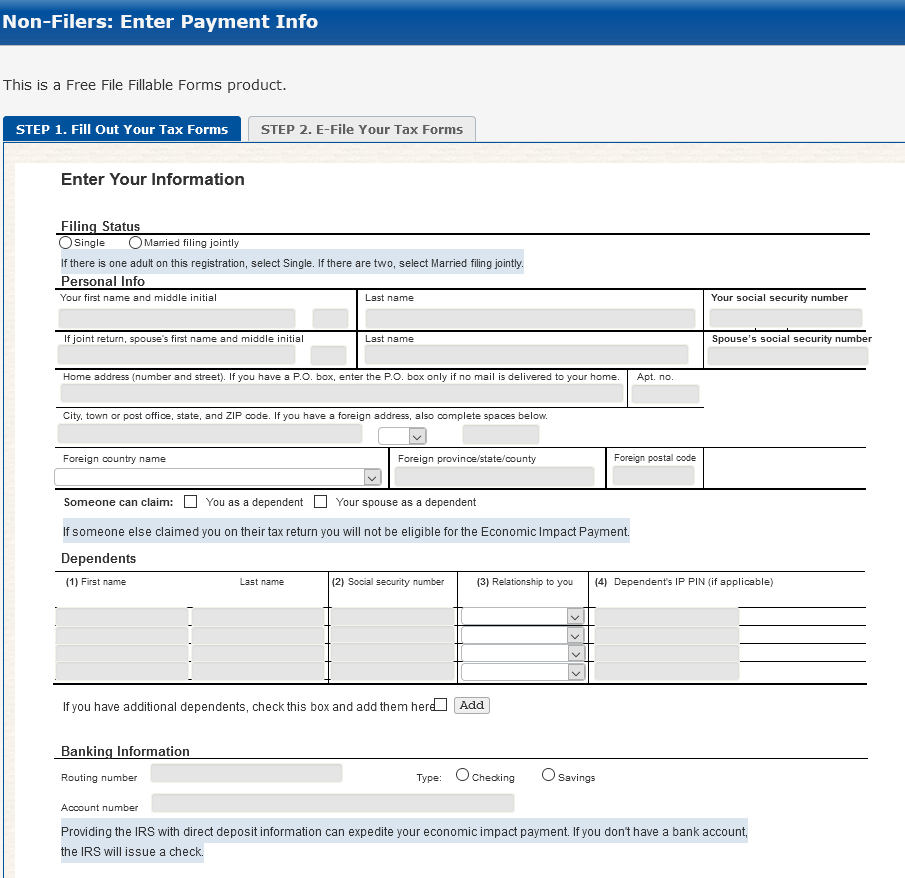
Page 1 of 2 in the IRS stimulus payment application page for non-filers.
Unfortunately, SSN and DOB data is not secret, nor is it hard to come by. As noted in countless stories here, there are multiple shops in the cybercrime underground that sell SSN and DOB data on tens of millions of Americans for a few dollars per record.
A review of the Web site set up to accept bank account information for the stimulus payments reveals few other mandatory identity checks to complete the filing process. It appears that all applicants need to provide a mobile phone number and verify they can receive text messages at that number, but beyond that the rest of the identity checks seem to be optional.
For example, Step 2 in the application process requests a number of data points under the “personal verification” heading,” and for verification purposes demands either the amount of the applicant’s Adjusted Gross Income (AGI) or last year’s “self-selected signature PIN.” The instructions say if you do not have or do not remember your PIN, skip this step and follow the instructions in step A above.
More importantly, it appears one doesn’t really need to supply one’s AGI in 2018. “If you didn’t file a return last year, enter 0,” the site explains.
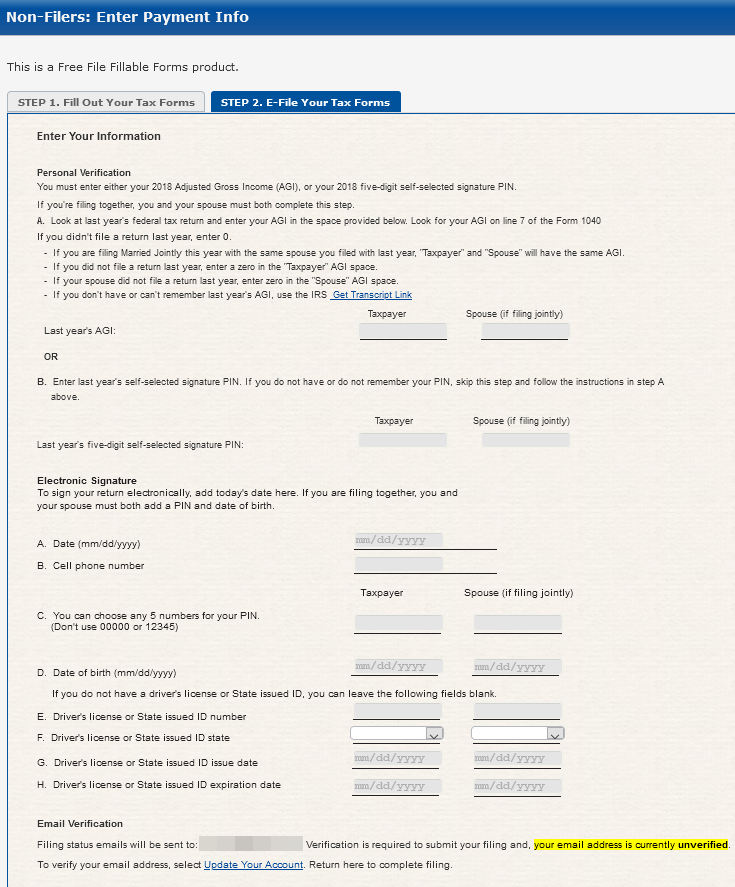
Step 2 in the application for non-filers.
In the “electronic signature,” section at the end of the filing, applicants are asked to provide a cell phone number, to choose a PIN, and provide their date of birth. To check the filer’s identity, the site asks for a state-issued driver’s license ID number, and the ID’s issuance and expiration dates. However, the instructions say “if you don’t have a driver’s license or state issued ID, you can leave the following fields blank.”
Alas, much may depend on how good the IRS is at spotting phony applications, and whether the IRS has access to and bothers to check state driver’s license records. But given the enormous pressure the agency is under to disburse these payments as rapidly as possible, it seems likely that at least some Americans will get scammed out of their stimulus payments.
The site built to collect payment data from non-filers is a slight variation on the “Free File Fillable Forms” product, which is a free tax filing service maintained by Intuit — a private company that also processes a huge percentage of tax returns each year through its paid TurboTax platform. According to a recent report from the Treasury Inspector General for Tax Administration, more than 14 million Americans paid for tax preparation services in 2019 when they could have filed them for free using the free-file site.
In any case, perhaps Intuit can help the IRS identify fraudulent applications sent through the non-filers site (such as by flagging users who attempt to file multiple applications from the same Internet address, browser or computer).
There is another potential fraud storm brewing with these stimulus payments. An app is set to be released sometime next week called “Get My Payment,” which is designed to be a tool for people who filed tax returns in 2018 and 2019 but who need to update their bank account information, or for those who did not provide direct deposit information in previous years’ returns.
It’s yet not clear how that app will handle verifying the identity of applicants, but KrebsOnSecurity will be taking a look at the Get My Payment app when it launches later this month (the IRS says it should be available in “mid-April”).
from Krebs on Security https://ift.tt/2UZWAkI
via IFTTT
There is no video and the whole thing is a scam to prey on your fears.
from Naked Security https://ift.tt/2xk0tI5
via IFTTT
Web app credentials were stolen in attacks on two airport websites.
from Dark Reading: https://ift.tt/2RsLbYd
via IFTTT
COVID-19 o también llamado coronavirus. Confinamiento en casa. No podemos salir de nuestros hogares salvo para causas muy justificadas. El resto del tiempo nos lo pasamos teletrabajando, viendo series y películas o jugando a videojuegos. De vez en cuando nos vemos con el resto de nuestros familiares y amigos **mediante alguna de las muchas apps de videoconferencia que tenemos a nuestra disposición*. Los usuarios de Apple lo tienen –tenemos– fácil.
Entra en Andro4all para leer el artículo completo
Puedes unirte a nosotros en Twitter, Facebook o en Google+
¡Suscríbete a nuestro canal de YouTube!
Publicado recientemente en Andro4all
La entrada Hoy, más que nunca, necesitamos un FaceTime universal se publicó primero en Andro4all.
from Andro4all https://ift.tt/2yR0ILa
via IFTTT
Cuando parecía que 2020 no podía llegar a ser un año más extraño, llegan Apple y Google para anunciar una de las colaboraciones que menos esperábamos, pero a su vez una de las más necesarias de los últimos tiempos. Ambas compañías han anunciado en sus correspondientes blogs oficiales —el de Google, y el de Apple— una alianza con el objetivo de desarrollar un sistema de monitorización integrado en los dispositivos
Entra en Andro4all para leer el artículo completo
Puedes unirte a nosotros en Twitter, Facebook o en Google+
¡Suscríbete a nuestro canal de YouTube!
Publicado recientemente en Andro4all
La entrada Google y Apple se alían para luchar contra el coronavirus creando una herramienta integrada en Android y iOS se publicó primero en Andro4all.
from Andro4all https://ift.tt/3c0KPA6
via IFTTT
¿Cada cuánto cambiáis de teléfono móvil? Mucha gente aguanta con sus teléfonos móviles durante varios años pero somos conscientes de que existen otros muchos usuarios que no pueden estar con un mismo smartphone durante mucho tiempo, hasta el punto de cambiar de terminal cada año e incluso varias veces en el mismo año. Cuando compramos un teléfono móvil lo hacemos porque o bien cubre nuestras necesidades básicas o porque simplemente
Entra en Andro4all para leer el artículo completo
Puedes unirte a nosotros en Twitter, Facebook o en Google+
¡Suscríbete a nuestro canal de YouTube!
Publicado recientemente en Andro4all
La entrada Qué es el efecto WOW y por qué deberías tener cuidado con él a la hora de comprar un móvil se publicó primero en Andro4all.
from Andro4all https://ift.tt/3e5ohQq
via IFTTT
Small business owners are concerned about cyberattacks targeting remote workers but lack the resources to invest in security.
from Dark Reading: https://ift.tt/2V0g2NW
via IFTTT
No poder ir a tu clase de yoga no es excusa para no seguir practicando tu técnica, sobre todo ahora que con tu móvil tienes acceso a un sinfín de clases online, cursos o incluso aplicaciones que te permiten practicar a tu ritmo, independientemente de cuál sea tu nivel. Y aunque existen decenas de apps para el móvil con las que practicar yoga, lo cierto es que no todas ellas
Entra en Andro4all para leer el artículo completo
Puedes unirte a nosotros en Twitter, Facebook o en Google+
¡Suscríbete a nuestro canal de YouTube!
Publicado recientemente en Andro4all
La entrada Las 6 mejores apps para practicar Yoga en casa se publicó primero en Andro4all.
from Andro4all https://ift.tt/2wvaphr
via IFTTT
La cuarentena ha cambiado nuestra forma de vida al obligarnos a pasar en casa más tiempo del que querríamos. Llegó la hora de teletrabajar (si es posible), de hacer ejercicio en unos pocos metros cuadrados y de aprovechar para hacer todas esas actividades de ocio para las que antes no teníamos tiempo. Videojuegos, series, libros, películas, música… Hay muchos títulos en los que invertir el tiempo libre que ahora tenemos.
Entra en Andro4all para leer el artículo completo
Puedes unirte a nosotros en Twitter, Facebook o en Google+
¡Suscríbete a nuestro canal de YouTube!
Publicado recientemente en Andro4all
La entrada Videojuegos, series, libros y más: las recomendaciones de los editores de Andro4all para la cuarentena se publicó primero en Andro4all.
from Andro4all https://ift.tt/3b2WOgg
via IFTTT
 Pacosite's Blog