Roughly one year ago, KrebsOnSecurity published a lengthy investigation into the individuals behind Coinhive[.]com, a cryptocurrency mining service that has been heavily abused to force hacked Web sites to mine virtual currency. On Tuesday, Coinhive announced plans to pull the plug on the project early next month.
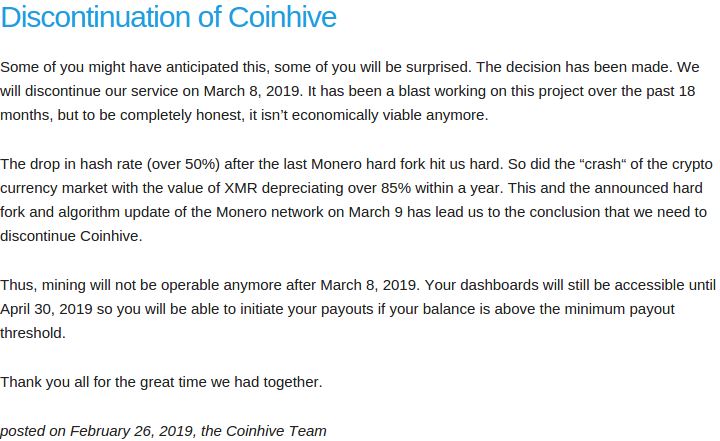
A message posted to the Coinhive blog on Tuesday, Feb. 26, 2019.
In March 2018, Coinhive was listed by many security firms as the top malicious threat to Internet users, thanks to the tendency for Coinhive’s computer code to be surreptitiously deployed on hacked Web sites to steal the computer processing power of its visitors’ devices.
Coinhive took a whopping 30 percent of the cut of all Monero currency mined by its code, and this presented something of a conflict of interest when it came to stopping the rampant abuse of its platform. At the time, Coinhive was only responding to abuse reports when contacted by a hacked site’s owner. Moreover, when it would respond, it did so by invalidating the cryptographic key tied to the abuse.
Trouble was, killing the key did nothing to stop Coinhive’s code from continuing to mine Monero on a hacked site. Once a key was invalidated, Coinhive would simply cut out the middleman and proceed to keep 100 percent of the cryptocurrency mined by sites tied to that account from then on.
In response to that investigation, Coinhive made structural changes to its platform to ensure it was no longer profiting from this shady practice.
Troy Mursch is chief research officer at Bad Packets LLC, a company that has closely chronicled a number of high-profile Web sites that were hacked and seeded with Coinhive mining code over the years. Mursch said that after those changes by Coinhive, the mining service became far less attractive to cybercriminals.
“After that, it was not exactly enticing for miscreants to use their platform,” Mursch said. “Most of those guys just took their business elsewhere to other mining pools that don’t charge anywhere near such high fees.”
As Coinhive noted in the statement about its closure, a severe and widespread drop in the value of most major crytpocurrencies weighed heavily on its decision. At the time of my March 2018 piece on Coinhive, Monero was trading at an all-time high of USD $342 per coin, according to charts maintained by coinmarketcap.com. Today, a single Monero is worth less than $50.
In the announcement about its pending closure, Coinhive said the mining service would cease to operate on March 8, 2019, but that users would still be able to access their earnings dashboards until the end of April. However, Coinhive noted that only those users who had earned above the company’s minimum payout threshold would be able to cash out their earnings.
Mursch said it is likely that a great many people using Coinhive — legitimately on their own sites or otherwise — are going to lose some money as a result. That’s because Coinhive’s minimum payout is .05 Monero, which equals roughly USD $2.35.
“That means Coinhive is going to keep all the virtually currency from user accounts that have mined something below that threshold,” he said. “Maybe that’s just a few dollars or a few pennies here or there, but that’s kind of been their business model all along. They have made a lot of money through their platform.”
KrebsOnSecurity’s March 2018 Coinhive story traced the origins of the mining service back to Dominic Szablewski, a programmer who founded the German-language image board pr0gramm[.]com (not safe for work). The story noted that Coinhive began as a money-making experiment that was first debuted on the pr0gramm Web site.
The Coinhive story prompted an unusual fundraising campaign from the pr0gramm[.]com user community, which expressed alarm over the publication of details related to the service’s founders (even though all of the details included in that piece were drawn from publicly-searchable records). In an expression of solidarity to protest that publication, the pr0gramm board members collectively donated hundreds of thousands of euros to various charities that support curing cancer (Krebs is translated in German to “cancer” or “crab.”)
After that piece ran, Coinhive added to its Web site the contact information for Badges2Go UG, a limited liability company established in 2017 and headed by a Slyvia Klein from Frankfurt who is also head of an entity called Blockchain Future. Klein did not respond to requests for comment.
from Krebs on Security https://ift.tt/2BSlN6w
via IFTTT


 Pacosite's Blog