This documentary investigates the surge in vaping culture and whether e-cigarettes can really help smokers kick the habit.
from New On Netflix USA http://bit.ly/2GglWDQ
via IFTTT

This documentary investigates the surge in vaping culture and whether e-cigarettes can really help smokers kick the habit.
from New On Netflix USA http://bit.ly/2GglWDQ
via IFTTT
Two history buffs with an eye for valuables traverse through forgotten mines and abandoned landmarks in the wild, wild West to score collectibles.
from New On Netflix USA http://bit.ly/2S1Xa1w
via IFTTT
More than 250 customers of a popular and powerful online attack-for-hire service that was dismantled by authorities in 2018 are expected to face legal action for the damage they caused, according to Europol, the European Union’s law enforcement agency.
In April 2018, investigators in the U.S., U.K. and the Netherlands took down attack-for-hire service WebStresser[.]org and arrested its alleged administrators. Prior to the takedown, the service had more than 151,000 registered users and was responsible for launching some four million attacks over three years. Now, those same authorities are targeting people who paid the service to conduct attacks.
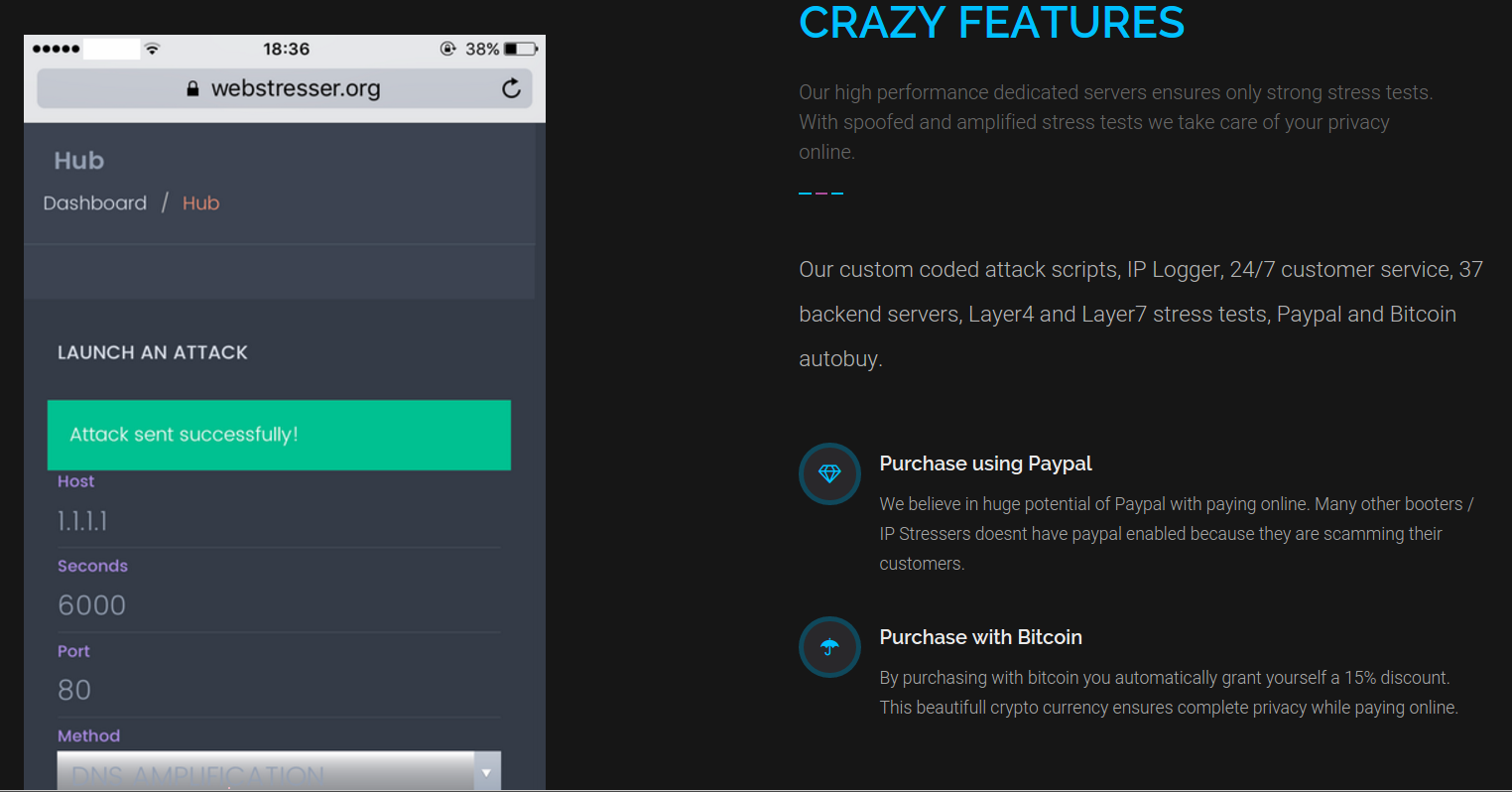
Webstresser.org (formerly Webstresser.co), as it appeared in 2017.
In the United Kingdom, police have seized more than 60 personal electronic devices from a number of Webstresser users, and some 250 customers of the service will soon face legal action, Europol said in a statement released this week.
“Size does not matter – all levels of users are under the radar of law enforcement, be it a gamer booting out the competition out of a game, or a high-level hacker carrying out DDoS attacks against commercial targets for financial gain,” Europol officials warned.
The focus on Webstresser’s customers is the latest phase of “Operation Power Off,” which targeted one of the most active services for launching point-and-click distributed denial-of-service (DDoS) attacks. WebStresser was one of many so-called “booter” or “stresser” services — virtual hired muscle that even completely unskilled users can rent to knock nearly any website or Internet user offline.
Operation Power Off is part of a broader law enforcement effort to disrupt the burgeoning booter service industry and to weaken demand for such services. In December, authorities in the United States filed criminal charges against three men accused of running booter services, and orchestrated a coordinated takedown of 15 different booter sites.
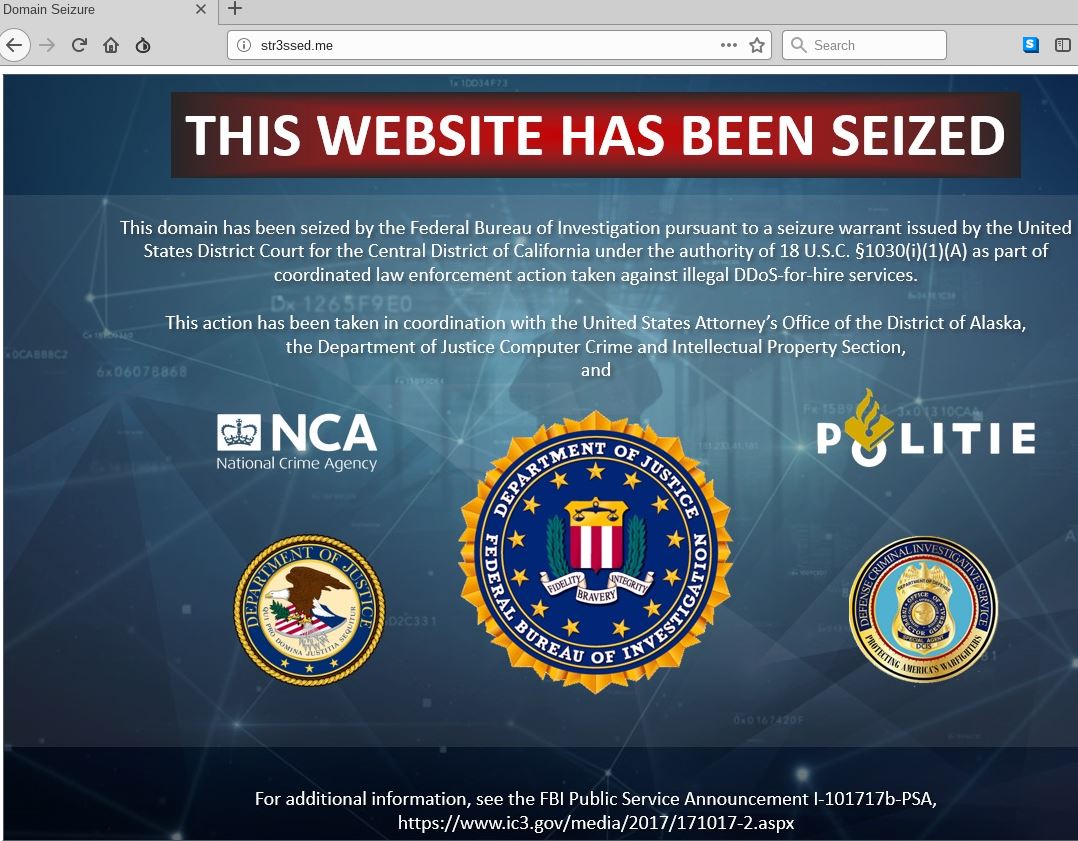
This seizure notice appeared on the homepage of more than a dozen popular “booter” or “stresser” DDoS-for-hire Web sites in December 2018.
The takedowns come as courts in the United States and Europe are beginning to hand down serious punishment for booter service operators, their customers, and for those convicted of launching large-scale DDoS attacks. Last month, a 34-year-old Connecticut man received a 10-year prison sentence for carrying out DDoS attacks a number of hospitals in 2014. Also last month, a 30-year-old in the United Kingdom was sentenced to 32 months in jail for using an army of hacked devices to crash large portions of Liberia’s Internet access in 2016.
In December 2018, the ringleader of an online crime group that launched DDoS attacks against Web sites — including several against KrebsOnSecurity — was sentenced to three years in a U.K. prison. And in 2017, a 20-year-old from Britain was sentenced to two years in jail for renting out Titanium Stresser, a booter service that earned him $300,000 over several years it was in operation.
Many in the hacker community have criticized authorities for targeting booter service administrators and users and for not pursuing what they perceive as more serious cybercriminals, noting that the vast majority of both groups are young men under the age of 21 and are using booter services to settle petty disputes over online games.
But not all countries involved in Operation Power Off are taking such a punitive approach. In the Netherlands, the police and the prosecutor’s office have deployed new legal intervention called “Hack_Right,” a diversion program intended for first-time cyber offenders. Europol says at least one user of Webstresser has already received this alternative sanction.
“Skills in coding, gaming, computer programming, cyber security or anything IT-related are in high demand and there are many careers and opportunities available to use these wisely,” Europol said.
According to U.S. federal prosecutors, the use of booter and stresser services to conduct attacks is punishable under both wire fraud laws and the Computer Fraud and Abuse Act (18 U.S.C. § 1030), and may result in arrest and prosecution, the seizure of computers or other electronics, as well as prison sentences and a penalty or fine.
from Krebs on Security http://bit.ly/2Da6ZjJ
via IFTTT
Huawei prepara el lanzamiento de su primer smartphone plegable con 5G, un dispositivo que se presentará de forma oficial este mes en el Mobile World Congress 2019, que se celebrará a finales de febrero en la ciudad de Barcelona. La firma china ha publicado una invitación a su evento de la feria en la que se revela la primera imagen de su móvil plegable. A través de su cuenta oficial
Entra en Andro4all para leer el artículo completo
Puedes unirte a nosotros en Twitter, Facebook o en Google+
¡Suscríbete a nuestro canal de YouTube!
Publicado recientemente en Andro4all
from Andro4all http://bit.ly/2GcLsdf
via IFTTT

By KAREN WEISE
The company is compensating for slowing growth in e-commerce by expanding its fast-moving, highly profitable cloud and advertising businesses.
Published: January 30, 2019 at 06:00PM
from NYT Technology https://nyti.ms/2MIgo6m
via IFTTT

MIT Researchers Have Taught A Robot To Play Jenga
Well, it sort of taught itself, actually….
February 1, 2019 at 08:45AM
via Digg http://bit.ly/2DM3DEM

Automated Background Checks Are Deciding Who’s Fit For A Home
But advocates say algorithms can’t capture the complexity of criminal records.
February 1, 2019 at 08:45AM
via Digg http://bit.ly/2BdzMU0
En el día de ayer hablamos sobre las cuentas de Samsung, que, a pesar de haber visto cómo sus ingresos descendían durante el último cuarto de 2018 en lo que a venta de smartphones se refiere, volvió a marcar un nuevo récord de ingresos totales a final de año. Hoy es el turno de Sony, que, como leemos en Ithome, también ha publicado las cuentas obtenidas durante los últimos meses
Entra en Andro4all para leer el artículo completo
Puedes unirte a nosotros en Twitter, Facebook o en Google+
¡Suscríbete a nuestro canal de YouTube!
Publicado recientemente en Andro4all
from Andro4all http://bit.ly/2RyyIPY
via IFTTT
The recently discovered tranches of stolen login credentials freely floating around the internet total 2.2 billion records
The post Four new caches of stolen logins put Collection #1 in the shade appeared first on WeLiveSecurity
from WeLiveSecurity http://bit.ly/2G4dgRz
via IFTTT
We look at what to expect when 5G is rolled out in 2020 and how it could both help and hinder our lives
Last month in Las Vegas, the Consumer Electronics Show showcased some of what we can expect from the tech world in 2019. This year’s CES was memorable for several reasons, from an intelligent toilet to banned sex toys. But one term kept popping up throughout the four days of the exhibition: 5G.
Most of us will have to wait until 2020 to see what 5G can do, but after 10 years in a 4G world, we’re still not totally prepared for the potential consequences of this next generation of wireless communication.
from Data and computer security | The Guardian http://bit.ly/2UvyevT
via IFTTT
 Pacosite's Blog