
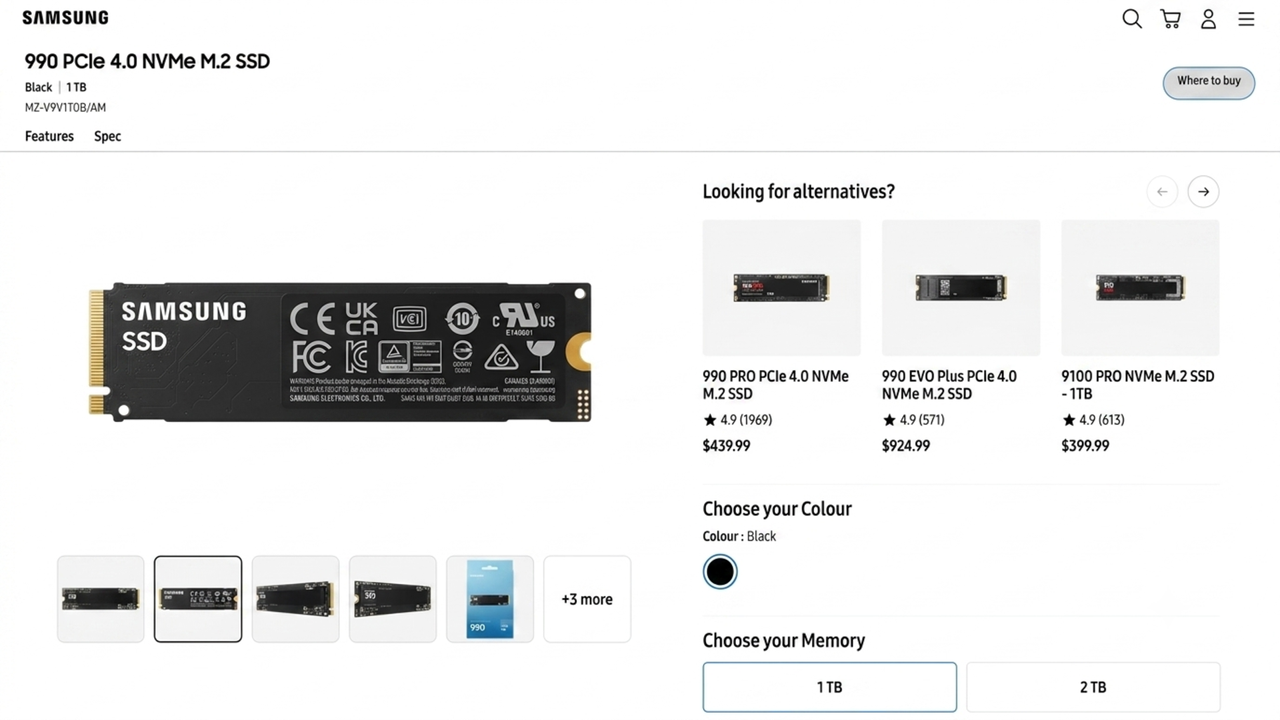
Samsung appears to be advancing a budget PCIe 4.0 NVMe SSD concept that omits onboard DRAM caches, relying instead on a Host Memory Buffer (HMB) to offset the absence of dedicated memory. Recent, though unconfirmed, listings suggest a 1TB drive delivering sequential read speeds around 7,150 MB/s and write speeds near 6,450 MB/s, placing it among flagship-level read performances within the mainstream PCIe 4.0 segment. The shift away from traditional DRAM caching reflects broader industry pressures as NAND and DRAM prices rise, prompting manufacturers to explore streamlined designs that maintain competitiveness without sacrificing too much in responsiveness or endurance.
How the architecture works
Traditional SSDs depend on dedicated DRAM to house the flash translation layer (FTL) and mapping data, enabling rapid translation of logical to physical addresses. The emerging DRAMless approach leverages NVMe’s Host Memory Buffer feature, which borrows a portion of system memory over PCIe. This borrowed space holds mapping metadata rather than user data, connecting logical addresses directly to their NAND locations. While HMB can boost performance relative to completely cache-less designs, it generally cannot match the immediacy and consistency of a local DRAM cache, especially under sustained workloads or heavy multitasking.
Endurance and NAND considerations
The reported endurance rating of 400 TBW for a 1TB model hints at Quad-Level Cell (QLC) NAND, which increases storage density and lowers costs but typically trades off endurance and long-term write performance. Samsung has not publicly disclosed the exact NAND technology for this specific model, leaving room for interpretation about its balance of cost and durability. As NAND pricing has climbed, the appeal of DRAMless designs grows among mainstream offerings seeking to maintain price competitiveness.
Implications for pricing and design strategy
Rising component costs are reshaping SSD design choices. By removing the DRAM package, manufacturers can reduce bill-of-materials costs, simplify PCB layouts, and preserve attractive price points within the non-premium segment. QLC technology further lowers manufacturing costs, though it remains less robust than MLC or SLC alternatives and can show weaker performance under sustained writes. Nevertheless, the disclosed performance figures position this DRAMless design as a viable option for users who prioritize cost efficiency while still expecting solid, day-to-day NVMe speeds.
What to watch for next
Key details still unresolved include the official product name, pricing, availability, and the exact NAND type used. Until Samsung confirms specifications, the leaked data should be interpreted as indicative rather than definitive. If the product arrives, it could represent a meaningful shift in how consumer-grade PCIe 4.0 SSDs are designed, signaling a broader industry trend toward DRAMless architectures supported by HMB, with potential implications for price-to-performance dynamics across the market.
from Latest from TechRadar https://ift.tt/WPRlXcB
via IFTTT IA

